| Home | Audio mag. | Stereo Review mag. | High Fidelity mag. | AE/AA mag.
|
CREEKING DIGITS -- C.G. goes up the Creek CD-60 CD player without a paddle
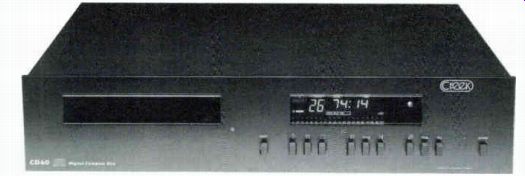
Creek CD-60 CD player
Creek CD-60 single-box CD player. Frequency response: 2Hz-20kHz. Channel matching: 0.06dB at 'kHz. SIN Ratio (A weighted): -1I2dB. Size: 16.5" (420mm) W by 11.4" (290mm) D by 3.5" (90mm) H. Weight: 12.65 lbs (5.75kg). Coaxial digital output: yes. Absolute polarity switchable: yes. Is it green: yes. Price: $1295. Approximate number of dealers: 40. Manufacturer Creek Audio Systems, Coatbridge, Scotland. Distributor Music Hall, 108 Station Road, Great Neck, NY L1023. Tel: (516) 487-3663. Fax: (516) 773-3891.
When CD first hit, its biggest mojo was that the new format would banish once and for all the infinite permutations of arms, turn tables, and cartridges that made putting together a decent analog rig such a gargantuan hassle. As the medium itself was "perfect," the cheapest player was supposed to sound identical to the most expensive model, the only real difference being the amount of trick convenience features the consumer was willing to shell out for.
Well, it's a decade later and even Consumer Reports admits that there are very real and audible differences between CD players. And ca 1993, the task of putting together a dig ital rig is just about as fraught with endless permutations as the Analog Nightmare CD was supposed to replace! Let's say you want a separate transport and processor: do you want to shell out big bucks for the best there is for the time being, or scale back a bit and get something a bit more af fordable? Maybe you want to purchase a single-box player that works well as a transport (not all of them do), like JVC's $800 XL Z1050, and wait to buy a separate processor down the road.
Yeah, a good single-box player sounds about right; now, just how good are we talking here? The $450 Rotel RCD-955AX? The $800 JVC? Or do you want something a little more serious? For audiophiles caught somewhere be tween Fantasy Island rigs like the Thetas, Meitners, and Levinsons and the budget kings like the Rotel and JVC, the road is fraught with peril. There's good stuff to be had, for sure, but none of it really does the do for me. I had the Audio Alchemy DDE in my rig for awhile, but / thought it had more cons than pros: detail and imaging were better than a run o' the mill CD player, but the highs were ragged and fatiguing. California Audio Labs' $695 Sigma processor is nice'n'smooth overall, but the bass just isn't up to the level of even the leanish JVC. No, I haven't found anything in the middle range to significantly better the $800 JVC XL Z1050 at anything near its price, and that's why I strongly recommend this budget-king player if you're looking for higher fi than the Rotels and NADs but can't quite swing the scratch for the crazy stuff on Mount Class A. Still, the JVC's not perfect. It's smooth and musical, with great low-level detail, but its bass just doesn't lock into the groove enough for me. It's fine for a Real World system that doesn't go very strong and low in the bass anyway, but hitch the JVC up to a He-Man rig and the rhythm is just not there.
Roy "Music" Hall promised me real rhythm would come out of his new $1295 Creek CD-60 player.
"S'wonderful!" Roy told me at this past S’CES. "S'marvelous!" "What, the Creek CD player?" "No, ya git, the S'cotch! S'more for ya, laddie?" S'o I got him to ship me the Creek. Does the CD-60 fill the gap between the best gear and the cheap'n'cheerful? Does the Creek got rhythm? S'ufferin' s'uccatash, read the review for yourself, laddie!
CREEK CD-60
The first thing you need to know about the Creek CD-60 CD player is that it's green.
The markings on the heavy black steel box, the fluorescent display, all is colored Creek Green, just like everything else in this off kilter company's line. Me, I love this look; Creek gear looks like something the Green Hornet would be digging Ahmad Jamal on deep in the Hornet's Nest with Jayne Mans field in a tight green dress holding two absinthe nightcaps.
On the surface, the Creek CD-60 appears to be yet another in a long-ass line of modified Philips/Magnavox CD players. It's got the same Philips CDM-4 transport mechanism as the lower and mid-priced Philips/ Magnavoxes, as well as the Rotel players. And it's based on the same classic Philips/Signetics 16-bit TDA-1541A DAC and SAA-7220P/B digital filter chipset used in players in every price range, from the cheapest Philips/Magnavox players (before they all went Bitstream) to the $450 Rotel RCD-955AX to the $7395 Naim CDS. The TDA-1541A DAC chip comes in several grades of performance, the hand-selected "Si Crown" version being the highest-grade version with the best low-level linearity; the Naim CDS uses this "Si Crown" grade DAC, and so does the Creek CD-60. But while players like the Rotels basically duplicate the stock Philips analog and digital circuits but substitute better-quality passive parts and circuit layout, the CD-60's resemblance to a stock Philips machine ends with the 16-bit chipset. In keeping with Creek's longstanding tradition of beefy power sup plies, the CD-60 sports an expensive, over sized Holden & Fisher toroidal transformer in place of the typical small, overworked unit found in most affordable players. This over kill transformer, said by Creek to be 75% overdesigned for the calculated load, is rated for up to 275V without saturating, to allow for both switchable 240V/110V operation via the internal switch and to ensure low mechanical vibration. This low-noise toroidal transformer is also damped by a foam pad between it and the green printed circuit board, another nice touch.
Creek also makes use of extensive power supply regulation; I counted 15 separate 337/317-type three-pin regulators in all. After the initial regulation stage, each area of the circuit-the focusing servos, disc motor, laser, digital and analog stages, etc.-is separately regulated to reduce current modulation be tween the different parts of the circuit. Separate ground planes for the analog and digital circuits, coupled with star-grounding, are other "hidden" features usually found in much more expensive equipment, and have a lot more to do with better sound than 1/41_ thick gold front panels and digital-domain volume controls.
Popping the Creek's hood revealed a top notch layout and build quality. Premium parts like metal-film resistors and polypropylene caps are used exclusively, while all pcb traces are nice and wide. The Creek's analog stage utilizes a Burr-Brown OPA-2604 high speed op-amp for the I/V converter, with a Signetics NE5534 for analog filtering and output drive. Interestingly, while the CD 60's analog outputs are AC-coupled with Philips 150µF/40V electrolytic capacitors, there appears to have been space originally given to film-type coupling caps; the pcb shows an outline and connection points that were undoubtedly meant for larger, higher quality film caps. Whether Creek decided the Philips electrolytics were as good sonically as the film caps originally meant for the cir cuit remains to be seen, but it does mean that mod-kateers who buy the Creek player can easily fit their fave film caps to the circuit and void the warranty to their hearts' content.
Feature-wise, the Creek player has all the usual tricks plus a few neato ones. Front panel switches are available for absolute polarity switching, turning the digital coaxial output signal off (indicated on the front panel display), and even extinguishing the green fluorescent display; Creek claims an audible improvement if the coax signal and the display are both switched off during listening, presumably because both the dig out circuit and the display radiate noise into the analog stage. I tried listening to the CD- 60 plugged into the Melos SHA-1 head phone amplifier, using the Grado head phones to listen to music while I tried turning both the dig-out and the display on and off, but I couldn't hear any difference at all whether both features were on or off. Still, as Creek obviously thinks enough of these thangs to include the switches, I turned both off during all my listening sessions with the CD-60. Overall, I was real impressed with the engineering and technical execution that went into the Creek player. $1295 sounds like a lot of money for a single-box player that doesn't appear to offer any more trick circuit mojo than the $450 Rotel, but the CD-60's price becomes more justifiable once you learn what's inside it. Don't assume from the low key styling and Creek's reputation as a cheerful budget-Brit line that the CD-60 is just another simply modded Philips machine; inside it lurks quite a bit of impressive engineering.
-------
1. As the Theta sounded substantially better from its balanced outputs, I built up an outboard balanced-in/unbalanced-out converter to mate the Theta's balanced outputs with either the Melos SHA-1 or my own buffered passive preamp, both of which lack balanced inputs. The outboard converter initially features a new Analog Devices differential receiver chip, the SSM-2017, powered by a power supply similar to that of my buffered passive preamp. The SSM-2017 audio-grade instrumentation amp preserves the distortion and noise canceling virtues of the Theta's balanced operation while let ting me use these two unbalanced preamps. Builders of my preamp who want to add true-balanced XLR input jacks can easily add a pair of these excellent chips to their own buffered preamps, powering them off of the existing supply. Those interested may call Analog Devices at (800) 262-5643 for the telephone number of their local AD sales rep.
-------------
S'YSTEM
The Creek CD player occupies such an interesting niche in the digital hierarchy that I decided to compare its sound to several different digital rigs at various price levels.
As it uses the same classic 4x-oversampling 16-bit Philips chipset as the budget-king Rotel '955AX I reviewed in Vol.15 No3, I put the CD-60 up against it. And because I still have JVC's excellent XL-Z1050 on hand serving in my Real World rig, I thought it might be interesting to see how the li'l-bit more-expensive Creek player fared against it, too. Of course, the Creek was held up against my main digital vein, the Theta Data II/Basic II combo I reviewed in Vol.16 And because the Creek shares its Philips chipset with the heralded Naim CDS two box player, and because I've heard dealers report that customers are snapping up CD 60s as "budget Naim players," i hauled the Creek over to Exposure's Casey McKee's house here in Austin, where we compared the Creek to Casey's CDS in his Expo sure/Linn system.
For the listening in my crib, the system was as follows: Melos SHA-1 and my own buffered passive preamp; Aragon 4004 Mk.II and VTL Deluxe 225 amps; Creek's own budget-classic $595 4140 S2 integrated amp;2 ProAc Response Two, Spica Angelus, and Creek's own $325/pair CLS-10 speakers (fa review to come); Muse Model 18 active subwoofer; and Kimber's KCAG interconnect, 4AG speaker cable, and PowerKord AC cables-everything plugged into the cool man Power Wedge AC line conditioners.
S'OUND
The British have a love thang for "rhythmic bass." Best exemplified by the Linn LP12 turntable, this kind of bass quality is a big, mysterious ? for American audiophiles who've never experienced it for themselves.
We Americans think of bass in terms of throbbing testicular power; we love the cars that go BOOM!3 I remember when I was first getting sucked into this quagmire called high-end audio as a teenager, I'd see all these expensive teensie-weensie British mini-monitors with no real bass, all these British turn tables that promised better bass (sh'yeah! As if!), all these late-'70s stoner Linn-otomized hi-fi salesmen who kept chanting "tap your toes, tap your toes, rama lama ding dong"-- what the hail did all this crap MEAN? Then, finally, I heard a demonstration of the Linn LP-12. Suddenly, I understood what they were babbling about; the Linn didn't put out that woolly, one-note throb that shouted "U-S-A! U-S-A!" Instead, it presented the bottom end as tight and well-defined, endowing basslines with clarity and articulation, all locked into a natural, flowing groove that could be summed up in only one word: RHYTHM. Aside from the big-ass TDLs and Linn's own Isobarik speakers, the Brits don't seem to care about ultimate Stygian bass extension; they prefer to trade off flat response to DC with a musically acceptable low end that's tight, tuneful, and rhythmic. I relate this bit of hi-fi history because, while the Brits no longer have an exclusive lock on rhythm-the American Thetas, VPIs, and Well-Tempereds are all champs in this area, too-their best speakers, turntables, and electronics always seem to have this quality in spades.
---
2 Reviewed by New Guy (Digital Lad's original identity) way back in Vol.12 No.9.
----
3 Except for Pintos.
----
You can now add the Creek CD-60 to that list. The Creek may lack the ultimate power and attack in the bass of the best digital gear, but it never failed to deliver the musical goods, whether I listened to the rhythmic intensity of Los Lobos' Kiko, the electric pel vic grind of Hendrix, or the sweet gospel harmonizing of February's Recording of the Month, the Fairfield Four's Standing in the Safety Zone.
' S 'GOT BASS
Starting at the bottom, the Creek player has a warm, full, bouncy low end that gives it a great sense of rhythmic excitement. This is where most affordable digital gear falls down, in my experience: either the bass is poorly defined and flabby, or it's overly lean, robbing groove-heavy music of its natural pulse and urgency.
The Creek is neither. Its bottom end is definitely to the warm side of strictly neutral, but, man and boy, I likes it that way! When the likes of Theta and Levinson are out of the question and price most definitely is an object, what do you want: the typical lean, anemic, anal-ytical Audiophile-Approved low end where you sit back with your Briar noting the crisp delineation of Ray Brown's fingering? Or a nice and fat-but-tight butt bumping groove thang that carries you off on the Soul Train's caboose? I know, I know, both are equally cool; I lived with Spica TC 50s for several happy years. But the CD-60's somewhat emphasized but always tuneful bottom end is the way I like my low end these days, especially from affordable gear. The Creek is no match in the bass for the mighty Theta rig, but it wipes most of the affordable digital I've heard-like the Rotel and JVC players and the Cal Sigma and Audio Alchemy DDE processors.
While the CD-60's bass is terrifically rhythmic and full, I did notice a slight lack of oomph in the deep bass when the music called for it. Louie Perez's kick drum on "Kiko and the Lavender Moon" from Los Lobos' masterpiece Kiko (Slash 26786-2) carne off with less sheer power than with the Theta rig; although the kick drum was re produced well enough, it lacked the Theta's effortless, lightning-fast low-end strength.
But again, compared to the less expensive players (especially the JVC, which has a relatively restrained bottom end), the Creek had by far the most impressive bass.
' S'HORTCOMINGS
In terms of space, the Creek occupies a place somewhere between the Thetas and Rotels of the world, although much closer to the Rotel side of the family. The Creek throws up a credible soundstage, but it just doesn't have the fully fleshed-out, front2back realism of the Theta Data II/Basic II combo. Whereas Kiko filled the room with Los Lobos all the way beyond the side and back walls with the Theta, the CD-60 presented a much smaller soundscape, the sound confined to the boundaries of my listening room.
The Creek turned the tables on the JVC and Rotel players, though, presenting a larger, better-defined sense of space. And this is basically what I experienced throughout my comparisons; while the Creek player gave ground to the Theta and Naim rigs, it consistently bettered the JVC and Rotel players.
In some areas, like depth and soundstage width, the CD-60 was closer in performance to the two budget-kings; in others, like rhythmic coherence and bass articulation, it was nearer to the Theta and Naim's rarefied air.
Compared to expensive references like the Theta combo and the Naim CDS, the Creek had some forwardness in the midrange, topped off by a very slightly aggressive low treble. Unlike the glare of most affordable digital gear, the Creek's low treble wasn't harsh or grainy, just a bit more emphasized than the Theta and Naim rigs. This low treble forwardness could sound like an in crease in detail or a bit of brashness, depending on the recording. When I compared the Creek player to the big daddy Naim over at Casey McKee's, the two CDs I brought did both these things; Kiko sounded as if it had marginally more detail through the other wise more refined and musically involving Naim, while the Fairfield Four disc sounded a bit rougher through the higher vocal ranges, especially on that last, gut-busting "My lord called me this mo'-NIIIIIIIIIIN" on track 1, which sounded slightly harder on this sustained peak with the Creek than with the Naim.
'S'GOOD AS THE NAIM?
Even though the CD-60 couldn't match the Naim player for bass extension, articulation, and overall smoothness and refinement, I could hear why dealers were selling the Creek as a budget alternative to the Naim: it did have a presentation similar to that of the $7395 CDS. Both players are full and warm in the bass, and have a rhythmically tight bottom end. Both are also very smooth and listenable overall, with a marked absence of high-end hardness. Both players seem to lack the kind of hyper-detail I regularly hear from the Theta combo, although the Naim did sound more detailed than the Creek. And they render recorded space similarly: neither as 3-D as the Theta nor as flat as the Rotel, the Creek and Naim players both seem to downplay the parameters of depth and soundstaging, concentrating instead on the rhythm, HF smoothness, and long-term listenability.
Was the Creek as good as the Naim? No; the expensive player did present a larger, more musically involving sound. But for less than a sixth the price of the Naim, the CD 60 gave a damn good showing of itself, and wasn't embarrassed by the Naim in the slightest. If you like what the Naim does but don't want to shoot that kind of wad, the Creek might be just your ticket.
'S'GOOD TRANSPORT, TOO
I also tried using the CD-60 as a transport to drive the Theta processor with a length of Kimber KCAG as the coax digital cable, and I was real impressed with the sound. What ever Creek did to beef up the transport's power supplies and inter-circuit isolation, the CD-60 was a much more rhythmic and strong-sounding transport than either the Rotel 955 or the JVC XL-Z1050, which is a great budget transport in its own right. The Creek didn't come close to the balls-to-the wall slam and ambient spread of the Data II transport, but it was much better overall than the other two affordable players when used as transports. Unless you spend at least as much on a transport as you do on the Creek player, I don't think you're going to get significantly better performance; the CD-60 is an excellent choice for those wanting to drive a separate processor down the road. I also found that the Creek sounded better when sitting on three AudioPrism Iso-Bearings, which seemed to open up the sound through the lower midrange and increase the Creek's already fine sense of rhythmic strength.
S 'AY CHEESE
During the time I spent comparing the Creek to the Theta combo, I decided to put on the Red Devils' almighty King King, one of the hardest, slarnmingest blues discs in my pile.
I listened to a few tracks on the Theta rig, switched to the Creek, matched the level again with an AC voltmeter across the speaker terminals (measuring the reference 1-kHz tone on the first Stereophile Test CD), and started King King again in the CD-60. 59:06 later, as the disc came slowly spin ning to a halt inside the Creek, I realized that in all my foot-stomping on the floor and fist banging on my knees, I'd forgotten to listen for sonic differences between the Creek and the Theta.
Then I s'miled like an idiot.
S'UM IT ALL UP, LADDIE
I really dug the Creek CD-60! It's musical, enjoyable, and a legitimate high-end CD player. The $1295 CD-60 doesn't claim to rival the best digital processors and transports available, and it doesn't. But compared to most of the affordable digital gear I've heard in the past few years, the Creek strikes a much better balance in overall sonic terms.
Nearly $1300 isn't chump change; for the same money, you can buy a cheap player like the Rotel for a transport and spend the rest on a good coax digital cable ($50-$200) and a budget processor like the $400 Audio Alchemy DDE or the $499 PS Audio Digital Link II. I've spent a great deal of time with the Rotel/DDE combo, and not having heard the Digital Link II but having read RH's review in Vol.15 No.10, I don't think either rig will outperform the Creek CD-60. The best processor in the world can't deliver the goods without a butt-kickin' transport, and there just isn't one of those available yet for under $500; spending $1295 on the Creek makes a lot of sense.
The CD-60 is a rhythmic, musical, always enjoyable CD player, and belongs at the very top of Stereophile's Class C. 'S'recommended!
MEASUREMENTS:
The Creek CD-60 had an output of 2.18V/2.15V, left/right channels respectively, when decoding a 1 kHz, 0-dB (full-scale) sine wave. Its output impedance (to the nearest ohm) measured 200/202 ohms (left/right), while DC offset was very low, at 0.4mV or less. The Creek was non-inverting, with a positive-going impulse test signal reproduced as positive at its outputs.
The frequency response of the Creek CD 60 was essentially flat (fig.1), with just a slight rise above about 14kHz. The small ripples in the response are typical of players using Philips's 4x-oversampling digital filter. Both of these deviations should be audibly innocuous. The de-emphasis error, also shown in fig.1 (bottom curve), shows only a gentle rolloff of a few tenths of a dB in the upper range. The resulting rolloff may result in a subtle softening on pre-emphasized discs (which are not common), but is unlikely to be audibly significant under most circum stances. The crosstalk shown in fig.2 is extremely low below about 1kHz, increasing steadily at higher frequencies but remaining more than acceptably low even at the highest measured frequencies.
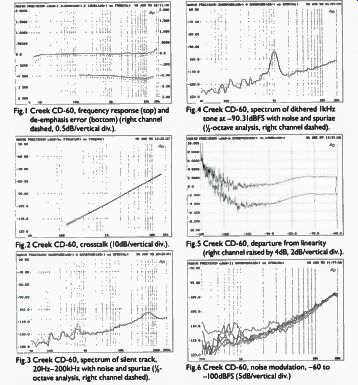
Fig. 1 Creek CD-60, frequency response (top) and de-emphasis error (bottom) (right channel dashed, 0.5dB/vertical div.).
Fig.2 Creek CD-60, crosstalk (10dB/vertical div.)
Fig.3 Creek CD-60, spectrum of silent track, 20Hz-200kHz with noise and spuriae octave analysis, right channel dashed.
Fig.4 Creek CD-60, spectrum of dithered 1kHz tone at -90.31dBFS with noise and spuriae
Fig.5 Creek CD-60, departure from linearity (right channel raised by 4dB, 2dB/vertical div.)
Fig.6 Creek CD-60, noise modulation, -60 to -100dBFS (5dB,vertical div.)
Fig.3 shows the analysis of the Creek's decoding of a track of "digital silence" (all data words zero). Note the absence of power supply problems and only a modest rise in noise at ultrasonic frequencies (typical of most, but not all, multibit players). There is a general lack of artifacts in the audible range at other than very low levels. Performing a similar spectral analysis on the player's output while it is decoding a -90dB, 1kHz dithered sinewave signal gives the result in fig.4. Only minor artifacts are visible above and below the test-signal frequency, the latter's peak showing a departure from the expected -90dB level due to some DAC nonlinearity.
Looking at this in more detail in the fade-to noise with dither curves in fig5, we see some nonlinearity below -80dB. This is reason able and not atypical performance for a multi-bit player at this price, though not up to the linearity found in many 1-bit machines.
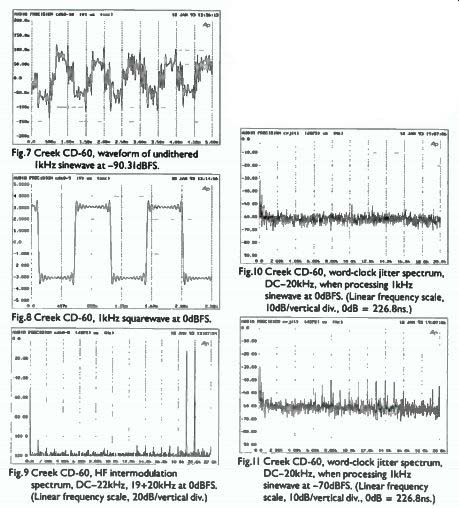
Fig.7 Creek CD-60, waveform of undithered 1 kHz sinewave at -90.31 dBFS.
Fig.8 Creek CD-60. 1 kHz squarewave at 0dBFS.
Fig. 9 Creek CD-60, HF intermodulation spectrum, DC-22kHz, 19+20kHz at 0 dBFS. (Linear frequency scale, 20dB/vertical div.)
Fig. 10 Creek CD-60, word-clock jitter spectrum, DC-20kHz, when processing 1-khz sinewave at 0-dBFS. (Linear frequency scale, 10dB/vertical div., 0-dB = 226.8ns.)
Fig. 11 Creek CD-60, word-clock jitter spectrum, DC-20kHz, when processing kHz sinewave at -70dBFS. (Linear frequency scale, 0dB/vertical div., 0-dB = 226.8ns.)
Both channels measured similarly, with the left channel-top curve-marginally better than the right (the left-channel trace is displaced 4dB for clarity). Noise modulation as a function of signal level vs frequency is plotted in fig.6. (The test signal used for this test was Track 29 on Stereophile's Test CD 2. A full description of this test is available there.) The results shown here are for six different, progressively de creasing 41 Hz signal levels, from -50dB to -100dB. The more tightly clustered the results, the better. Above 3kHz, the Creek's grouping is very good; below that the spread is not as close, although most of the noise modulation occurs at the two highest test levels, -50dB and -60dB. At -60dB the curve diverges from the group primarily between 500Hz and 1-kHz (the three spikes visible at about 600, 700, and 800Hz are from this curve), and at -50dB the divergence begins at about 3kHz and reaches a maximum at 300Hz. This is a comparatively new test; the degree of its audible significance is yet to be determined.
Fig.7 shows the waveform the Creek produces when decoding a 1-kHz, undithered sinewave at -90dB. Despite the non-linearity at low levels, the desired stairstep response (see the Meitner IDAT review below) is apparent, though overlaid with some audio band noise. The Creek is a bit above average in this respect; most of the low-cost players and processors we have measured do not do particularly well on this test. The waveform the Creek produces when decoding a full scale (0-dB) 1-khz squarewave is shown in fig.8. The result is quite typical of players using linear-phase, oversampling digital filters. (The overshoot and ringing in the Audio Precision's anti-aliasing filter have been subtracted from this plot.) Feeding a full-scale combined 19kHz+ 20kHz signal into the Creek and performing an FFT analysis of the output resulted in the plot shown in fig.9. The intermodulation artifacts are very low, with the highest--the 1-khz difference frequency--over 90dB down from the fundamental level.
The jitter was measured here in the same manner described in my review of four CD players elsewhere in this issue. The test signal was a 1-khz sinewave taken at six points: 0-dBFS, -10dB, -30dB, -50dB, -70dB, and -90dB. The discrete jitter of the DAC's word clock pin while the Creek was processing these data levels was very consistent, varying from a low of 191 picoseconds (ps) at 0-dB and -50dB to a high of 203ps at -70dB. This is a very good result. The best-case jitter spectrum (for a 0-dBFS signal) is shown in fig.10. The result here is very clean, with virtually no artifacts more than 10dB above the average except at the lowest frequencies. The -70dBFS curve, in fig.11, shows the CD-60's worst case. Note the significant increase in spikes at high-frequency harmonics of the 1-khz fundamental, from 7kHz to 16kHz.
Nevertheless, based on our limited library of results for this test to date, this is not a bad result for the worst case.
Checking the error-correction performance of the Creek with the Pierre Verany test disc indicated no problems through track 33, and only an initial glitch at the beginnings of tracks 34 through 38, following which the CD-60 sailed through these tracks without further problems. This is an excellent showing. Track 27 is the required CD minimum standard, though any CD player worth its laser should do better than that.
The measured performance of the Creek CD-60, while not exceptional, is solid across the board. Nothing in its test-bench results should compromise its listening-room performance in any significant respect.
-Thomas J. Norton
Also see:
AUDIO RESEARCH PH1 PHONO PREAMPLIFIER (review)
JVC's Akira Taguchi speaks! J. Skull
talks with the producer of the JVC XRCD line of audiophile CDs.
Four (4) 1993 CD players tested and compared
Prev. | Next |