SINCE THE LATE 1970s debate on subjective versus objective evaluation of audio equipment has often been heated. Members of the subjective camp claim to hear audible differences which existing measurements can't always verify. They are the very reason the high end audio industry exists. I sup pose subjectivists represent the “left wing”' of the audio community, but they really can't be lumped into one category. On the extreme left are the mystics. They seem to believe that everything causes a difference, perhaps even the phase of the moon. J. Gordon Holt, in his excellent book The Audio Glossary, describes a mystic as "An audiophile who attributes all unmeasurable sonic differences to forces be yond man's understanding.” Differences Acknowledged Not nearly so far to the extreme, perhaps just left of center, are audiophiles and equipment reviewers with solid technical credentials. However, members of this group also claim that the measurements we presently use don't give us enough information. These “moderates” understand, from experience, that certain circuit topologies and certain types of component parts will yield specific sonic results. Differences can even be heard among different brands of components (Roederstein metal film resistors versus those sold by Digi-Key, for example). The moderates admit that not all of the audible effects are measurable by available techniques.
They believe science has limitations, and by understanding those limitations, they can make genuine progress. The subjectivists believe in the value of long term listening, living with components for a period of time in order to assess their audible characteristics.
The scientific group argues that measurements tell us all that we need to know. Audible differences among amplifiers, preamps, and especially cables are figments of the imagination. The scientists can probably be called the “right wing' of the audio community.
They believe that if audible differences do exist, they can be verified in a double-blind A/B/X test.
One view of subjective listeners was expressed in Issue 16 of The Audio Critic by Editor and Publisher Peter Aczel. On page 9, in response to a reader's letter, Mr. Aczel calls subjective listeners “audio gurus” who are “self indulgent, posturing little people looking for groupie approval and protecting the belief system of the cult.” The reader implied that the “high end” audio community is motivated by greed.
Mr. Aczel thinks they're simply “un-tutored, fuzzy-minded, insecure and unaccountable.” Many scientists claim that audible differences are usually the result of differences in volume level, frequency response or absolute polarity.
I call these the MAAD parameters, for “Mothers of All Audible Differences.” Just right of center are some scientists who admit they can't hear differences, but willingly acknowledge their hearing abilities are not the standards by which all others are judged. They recognize that both their hearing, and their science, may have limitations.
They don't attack those who claim to hear differences.
Individual Bias
Nearly everyone involved in audio, either as an avocation or as a profession, has some fairly strong viewpoints on this subject. If I must be classified, I suppose I am just left of center. Al though my formal training is in music, I make my living as an audio engineer in a large music school. Audio and mu sic are not only my profession but my favorite avocation.
I believe tests and measurements tell us only part of what we need to know, and I certainly don't believe that all amplifiers sound alike. However, I don't believe that differences in amplifiers, preamps, cables, etc. are due to mystical factors beyond man's comprehension. A given sonic result can usually be explained by the circuit topology employed, the quality of the components used, circuit layout, power sup plies, and so on.
Readers of this magazine probably already have a pretty good idea of my views on this question and know my own biases. I'm sure many reports on the 91st AES Convention will be published, and I have no doubt that every journalist will have reached his or her own conclusions on the proceedings.
Panel Selection
The Audio Engineering Society, as an organization, has traditionally espoused the hard-core scientific viewpoints on this subject. The 91st AES Convention's theme was “Audio Fact and Fantasy-Reckoning With The Realities.” The chosen title bothered me. It sounded as though the conclusions had already been reached, and thus the purpose of the convention was to show the 'un-scientific' types how things really are.
I believe a conscientious scientist is an individual in search of the truth. In order to find the truth, they must be willing to give consideration to viewpoints which conflict with their own.
At 9:00 a.m. on Saturday, October 5th, the main event began, a three hour workshop entitled “New Cable Designs: Innovation or Consumer Fraud?' Dan Dugan chaired the session and panelists included David L. Clark (of double-blind A/B/X fame), Jeff Corey (Professor of Psychology at C.W. Post College and a member of the New York Area Skeptics), Fred E. Davis (a consulting engineer based in Hamden, CT), Wilfredo Lopez (from the New York City Department of Consumer Af fairs) plus Corey Greenberg (of Stereophile magazine). The panel was clearly unbalanced, since four of the five panelists were either skeptics or avowed nonbelievers regarding cable differences.
Only one panelist, Corey Greenberg, was chosen to represent the high-end audio press. Not one high-end cable manufacturer was asked to participate.
At the beginning of the workshop, Dugan presented advertisements for a number of high-end products, including cables, which claimed to offer various sonic performance characteristics. He paid particular attention to George Tice's $350 TPT Clock, a $25 Radio Shack clock allegedly treated to 'steer electrons in the right direction.' I was particularly disturbed by this.
To most of us in the “left of center” category, the Tice Clock is pure charlatanism, like W. C. Fields at the Medicine Show. To present the Tice Clock as representative of the entire high-end audio industry is worse than misleading-it is offensive. I'd be happy to investigate the Tice Clock if one is sent to me. Perhaps Mr. Tice has simply taken the Radio Shack clock, soldered a Panasonic Interference Suppression Capacitor (effective devices for power line noise reduction; only a few dollars from Digi-Key) across the AC line cord, added $330 to the price and passed off the results as magic.
Critical Tests
A series of double-blind listening tests were conducted, using David Clark's A/B/X switching box, with Corey Greenberg operating the audio system during the tests. The system consisted of Thiel loudspeakers driven by Spectral electronics and a Spectral CD player. The double-blind tests were sup posed to determine whether a $2,600 pair of MIT loudspeaker cables were audibly distinguishable from ordinary 12-gauge wire. The first A/B/X test actually involved comparing the expensive cable to 30-gauge wire, just to allow the audience to “get the feel“ of the testing procedure. Of course, the high resistance of the #30 wire caused an audible level difference (MAAD parameter No. 1), so no one had any difficulty distinguishing between the two cables.
After the introductory test was completed, we moved on to several comparisons between the high priced cable and the garden-variety 12-gauge wire.
The results were inconclusive, which was no surprise. First, the system was set up so poorly that no one could hear the loudspeakers properly. They were over 5' off the floor, to ensure coverage of the entire room. But, this meant that everyone was far below the proper vertical listening axis, and no one was in a position to hear any semblance of soundstage presentation. This isn't any one's fault-you simply can't set up a critical listening demonstration in a room that seats over 400 people.
Even considering these severe limitations, the system sounded incredibly bad. The midrange and top were coarse and grungy, bordering on what I would consider distortion. In fact, based on my own experiences, these were classic symptoms of a system in need of serious power line filtering. If my own audio system sounded like this, and I couldn't find a solution to the problem, I'd stop listening to music. Please don't interpret this as a negative comment on any of the equipment. I really believe that the system was suffering from the effects of a terribly noisy AC line. In a hotel in the middle of Manhattan (The New York Hilton), this is more than just a possibility-it's highly likely.
Verification Required
The scientific group, of course, took the results to mean that, once again, audible differences were proven to be non existent. Mr. Lopez of the New York City Department of Consumer Affairs, said he believed the $2,600 price tag of the high-end cable might constitute consumer fraud. Under these listening conditions, none of the more subtle characteristics which would normally be audible could possibly be heard. The tests were meaningless.
I would never pay $2,600 for a loudspeaker cable even if I could afford it.
But if you are inclined to do so, buy the cable from a reputable dealer who will give you a refund if the cable doesn't meet your expectations in your own system. Many high-end loudspeaker cables offer genuine value, such as the Livewire Indigo, which sells for around $2 per foot.
The reasons these controversies rage is primarily because many listeners claim to hear differences which can't be verified by any measurements we currently have. None of the tests avail able to us come even remotely close to simulating the dynamic conditions of real music. Music doesn't consist of one or two test tones at a fixed level.
A symphony orchestra contains 75 to 100 musicians each producing their own fundamental and harmonic series, resulting in thousands of simultaneous, individual tones. On top of this, the energy content and volume levels are constantly changing. I pointed this out during one of the question and answer sessions. David Clark didn't dispute this premise, but insisted that unmeasurable differences would have to be proven to him in an A/B/X test in order to verify their existence. More on that below.
Listening Dichotomy
I was very concerned that none of the high-end cable manufacturers were able to present their side of the story. Did they decline an invitation, or were they not invited? I visited the Monster Cable booth and spoke to two representatives of this well-known high-end cable man ufacturer. They told me they weren't invited. They surmised that the organ izers of the workshop didn't want them on the panel, since Monster Cable has measurements which show how their cables perform differently from those of other manufacturers.
This workshop was clearly a stacked deck from the start, with no possibility for the 'truth' to be found. The panel, in my view, was particularly un fair to Mr. Greenberg. The panel should have been balanced, with at least one other representative from the high-end audio press and at least two cable manufacturers.
On Sunday, October 6th, two groups of papers on “Listening Tests' filled the entire day. David Clark began with “Ten Years of A/B/X Testing” (Pre-print #3167).! Mr. Clark gave a brief overview of the history and methodology of double-blind testing using his A/B/X test box. He also put an ad for the Tice Clock on the screen, again implying that this product was typical of the workings of the high-end audio industry.
He defended his A/B/X procedure by citing a study he conducted which "tested the double-blind test.” Two audiophile groups participated in the test-Lawrence Greenhill”s Audiophile Society, a group based in Connecticut, and the Southeastern Michigan Woofer and Tweeter Marching Society. Green hill's group are subjectivists while Clark's are objectivists (in his paper Clark actually refers to the groups as “golden ears” and “engineers”).
Real Procedure
Two tests were conducted. In the first, the participants did a double-blind com parison of a nonlinear circuit producing 2.5% distortion with a bypass. For the second test, ten battery-powered black boxes, half with the distortion circuit and the other half with the by pass, were circulated to members for long-term listening.
According to Clark, Greenhill's listeners were unable to identify the distortion on either of these tests. The Michigan group also failed the identification during long-term “take home” listening, but they correctly identified the nonlinear box within 45 minutes when Clark's A/B/X testing system was used. This led Clark to conclude that the A/B/X testing method is superior to long-term listening. These tests were conducted back in 1984, at the encouragement of Audio magazine, but the results of the testing were never published.
Mr. Clark rejects the notion that critical listeners can hear differences be tween amplifiers during long-term listening sessions that A/B/X tests fail to uncover. His ten years of A/B/X testing have failed to reveal audible differences between amplifiers. Clark concludes that his testing procedure is the only one which produces results he considers “real.” A Pointed Exchange Questions followed, and two of the ex changes were quite interesting. The first questioner pointed out that audio is like race-car driving. You can't expect an inexperienced driver to be able to discern the subtle differences be tween various racing tires. By the same token, an A/B/X test won't reveal differences between amplifiers if the listeners aren't experienced with high performance audio equipment, haven't been educated to listen critically, and don't have sufficient musical experience, such as attending live concerts.
Clark agreed that it is necessary to get the right listeners in the test, but the exchange that followed is worth quoting (transcribed from the audio cassette of the session)?:
Questioner: “I think that maybe, by your characterization of those people who believe that they have the aptitude and experience to discern those differences, your openly antagonistic nature, maybe quashes any enthusiasm they would have for participating with you.” Clark: “Well, I have specifically at tempted to arrange the tests to the contrary. I've specifically gone to people who are enthusiastic, and tried to make myself as minimum as possible, and just keep it double-blind. And, the results in the ten-years experience in doing this are the same. I'd be happy to assist you, if I can, in doing tests of this Questioner: “Maybe you should turn that around and have someone from the other camp assist you.” Clark: “I have done that. I'd be happy to; I think we need the next question.” Questioner: “O.K.” Clark: “The point's well taken.” Test Limitations Jon Risch, the next questioner later gave a paper of his own titled 'A User Friendly Methodology for Subjective Listening Tests.' When pressed by Mr. Risch during their exchange, Mr. Clark made this statement: 'All we come up with on amplifier tests are negatives- that we fail to hear a difference. We cannot make the conclusion that there are no audible differences between amplifiers.” This is a truly extraordinary statement. For ten years, Mr. Clark and his colleagues have attacked those who claim to hear differences in amplifiers, preamps, cables, etc. They have been dismissed as insecure gurus with poor technical backgrounds who fail to recognize the scientific truth. Mr. Clark and his group have been insisting that double-blind A/B/X testing proves that they are right, and the subjectivists are wrong. But, after giving a 20-minute paper telling us that A/B/X testing is still the correct approach, he admits that ten years of A/B/X testing has proven nothing. Perhaps it is time to ask whether a test that has been used repeatedly for ten years, without conclusive results in either direction, is really useful. At the very least, the advocates of the test are in no position to attack those with viewpoints which differ from their own.
Michael Gerzon followed Clark's paper with a presentation titled “Limitations of Double-Blind A/B Listening Tests" (no preprint available, unfortunately). Mr. Gerzon, inventor of the Ambisonic system, discussed audible effects which may not be revealed by short-term A/B comparisons. Clark Johnsen, author of The Wood Effect, presented 'Proofs of an Absolute Polarity' (Preprint #3169). Johnsen's presentation was enormously refreshing. He has developed a test he calls “triple blind” for assessing the audibility of absolute polarity. The results show, quite convincingly, that absolute polarity is an audible phenomenon which needs to be addressed by audio engineers.
Robert Harley, Consulting Technical Editor for Stereophile magazine, was the author of 'The Role of Critical Listening in Evaluating Audio Equipment Quality’ (Preprint #3176, though it's not mentioned in the preprint list). Bob is one of the few high-end equipment reviewers who actually makes a living reviewing audio equipment.
Bob began by identifying the two extremes of the debate, citing both as being flawed. He proposed a third approach which uses objective measurements combined with critical listening.
He believes it is important to under stand the limitations of measurement based testing.
Auditory Perceptions
Bob summarized the 'scientific' view of critical listeners “We've been characterized as technically illiterate, having no knowledge of the workings of audio components; as anti-science and advocates of mysticism over rationality. We've been characterized as em bracing pseudo-scientific claims with out justification. That [we engage in collusion with other audio reviewers to agree beforehand what a certain component is going to sound like, so that every magazine publishes the same opinion. That [subjective reviewers] knowingly mislead their readers for personal gain. And, that listening is casual, superficial, cursory. Also, subjective, critical listeners have been linked to astrology-believers in the flat earth.” Bob noted that these comments were all made by presenters at previous AES conventions.
Bob contrasted those viewpoints by noting that many subjective reviewers are technically extremely competent, hold engineering degrees, and are proficient in the use of state-of-the-art test equipment, such as the Audio Precision System One and DRA Lab's MLSSA.
He noted the need for careful level matching when comparing the sound of two products, but stressed the need for long term, “single presentation' listening as well. He believes that long term listening is essential in order to quantify all of the audible characteristics of any piece of audio equipment.
He says short duration A/B comparisons tend to obscure subtle differences.
“Soundstage depth, the ability to resolve individual instrumental outlines, and resolution of fine detail are all be yond the ability of current measurements to quantify,” according to Harley.
He goes on to state that “there's not a linear relationship between the magnitude of a difference and the musical significance of that difference.” He noted that many of the measurements in use today go back several decades and have little in common with the requirements for re-creating a 'musical reality.” He is critical of those who fail to recognize the limitations of their science.
He states that “the formalized prescriptive method for evaluating audio components reflects the belief that no forms of knowing exists outside those of scientific inquiry.” Many “scientific' evaluators are so narrowly entrenched in their measurement procedures that they refuse to listen critically, and go so far as to deny any auditory perceptions as being real.
Truth and Courage
Harley considers blind testing an inherently flawed method for evaluating audio equipment in that the conditions imposed in a blind test are diametrically opposed to those found in music listening. Usually, the test manager is out to prove that differences don't ex ist, which puts pressure on the participants. Bob cites recent research on the ability of human beings to maintain their sensory abilities when the stimulation is excessive. He convincingly shows that blind testing consistently exceeds those limits.
Bob quoted the late Richard C. Heyser twice in his paper: One of the worst kept secrets in audio engineering is that what we hear does not always correlate with what we measure.
You out there. Golden Ears, the person who couldn't care less about present technical measurements but thinks of sound as a holistic experience.
You're right, you know. A number of questions and comments followed Harley's paper. First, an unidentified member of the audience made the following statement: 'I'd like to say that I think this is the most important paper that is presented at the AES convention this year.” (Applause followed.) “And secondly, I'd like to say that I think that there are equipment designers who spend a lot of time designing equipment by their ears, as well as using measurements. And, if they were doing blind testing on every cable or capacitor that they changed, I think we'd still be using amplifiers de signed in the 1940s. I'm including advancements such as high slew rate op amps, polypropylene capacitors instead of electrolytics in the circuit, and numerous other advances which are very important... So, keep in mind that listening is important. ...”
Peter Aczel had an interesting dialog with Bob which went like this: Aczel: “You say, you have written, that amplifier “A,” let us say, differs greatly in sound from amplifier “'B” at matched levels. I can't hear those differences, my associates can't hear those differences.
In carefully structured A/B/X tests, at matched levels, I'm unable to detect those differences; my associates are unable to detect those differences. You say they exist. You say that methods are flawed, so you will not apply my methods. Therefore, I have to accept your naked assertion that you hear this difference. Now my question is, since you will not subject yourself to any kind of objectified listening framework, how do I know that you are being truthful?” Harley replied that different people have differing degrees of sensitivity to the same stimulus. He cited several preternatural skills associated with humans of certain ethnic backgrounds, such as Eskimos who can identify twelve different types of snow. People who are trained listeners are much more sensitive to audible differences than people who don't do critical listening. But Aczel was apparently not satisfied with this answer and replied:
“You're not answering my question. How do I know that you're being truthful? You can't show me.” Harley: “How do I know that you're being truthful?!” (Applause).
Aczel: “You mean, you're suggesting that I hear the differences and lie about it and say that I don't, is that it!” Harley: “If you don't hear the differences, I can't help you.” Aczel: “I think we have an impasse here.” Another anonymous questioner stated that he had “a large degree of sympathy with your position and your paper, and I would also like to say that I think the reception to the high end, Gary Galo is an Audio Engineer and teacher in audio technology at The Crane School of Music, State University College at Potsdam, NY. During the summers of 1981 to 1985 he was on the faculty of the Saratoga Potsdam Choral Institute, teaching courses in high fidelity and the history of sound recording. Gary is also a Contributing Editor to Speaker Builder magazine, and he reviews historical recordings for the Association for Recorded Sound Collections Journal. He has writ ten a chapter on the history of loudspeakers for the Encyclopedia of Recorded Sound in the United States, to be published by Garland Press later this year. He has a book in progress titled The Audio Amateur’s Handbook.
or subjectivists, by members of the Audio Engineering Society, or by objectivists, if you will, has, in many in stances, been really disgraceful. And so, thank you for your courage.” Worthwhile Contribution In one of the sessions on digital technology, Dr. Gary W. Schwede of Stream Computers, Inc., presented a paper which crosses into the area of subjective listening. His paper was titled “Mechanisms of Un-musicality in Compact-Disk Sound: Measurements, Observations and Conjectures.”* Like many listeners, Dr. Schwede has found aspects of CD reproduction to be “unmusical.”' His investigations of the bitstream outputs of CD players didn't reveal any errors, so he began to investigate clock jitter. In his paper, he presented a method for reducing jitter.
He has found that the reduction of jitter goes a long way toward solving the problem of “un-musicality.” During the question and answer session, no one attacked Dr. Schwede for his subjective observations. Dr. Schwede is the type of subjective listener that Harley spoke of in his paper.
He combines solid engineering credentials with an open, inquiring mind, and an ability to listen critically. I believe engineers who trust their ears, and who have the necessary technical back ground to find solutions to problems, are the ones who ultimately make the most worthwhile contributions to the art and science of audio.
Promote Fair Debate
Some “objectivists” could be extremely disappointed in the outcome of the 91st AES Convention. Rather than resolving the issue once and for all, this convention has opened up the debate even further. Throughout these papers and workshops it was a pleasant surprise to see the number of questioners who appeared on the “subjective” side of the fence. In the past, many of these audio professionals kept their views to themselves.
I believe we will see many more papers and workshops devoted to this issue at future AES conventions. Work shops and panel discussions provide an excellent forum for debate, but the panels must be balanced, with equal representation from both viewpoints. We high-end audio designers together for a discussion of their ideas and methodologies. A panel with engineers like John Curl, Walt Jung, David Manley, and Nelson Pass would undoubtedly provide stimulating discussion of these issues. Engineers who rely primarily on measurements, like Bob Carver, should also be represented in these discussions.
Finally, it is past time that the objectivists stop the personal attacks on those with viewpoints different from their own. When personalities obscure the issues at hand, positive dialogue becomes impossible. The rules of de bate certainly allow us to disagree strongly with a person's position on an issue, and even attack that position, without assaulting his or her personal character. Harley's paper is, I believe, a model of good behavior, which strengthens his position. There's been plenty of name-calling on both sides of this debate, mostly from the extremists rather than the moderates, and it's time that it stopped. The Audio Engineering Society has an obligation to promote fair debate on these controversies. The 91st Convention has given them a mandate to do so.
REFERENCES
1. Holt, J. Gordon, The Audio Glossary, Audio Amateur Press, 1990.
NOTES
1. Preprints of AES papers are available from the Audio Engineering Society, Inc., 60 E. 42nd St., Room 2520, New York, NY 10156-0075, (212) 661-2355. A nearly complete list of 91st Convention preprints, with prices and an order blank, is available free.
2. All Audio Engineering Society Convention workshops and papers are available on cassette tape from: Conference Copy, Inc., 2222 Avenue X, Brooklyn, NY 11235, (718) 934-2678. (Mr. Clark's paper is cassette #118E-K1. Bob Harley's is #118E-L2). A complete list is available free. All quotes from these papers have been transcribed from the Conference Copy audio cassettes. For this reason, there are some discrepancies in language between the AES Preprints and my transcribed quotes.
3. After I had finished this report, the January 1992 issue of Stereophile arrived. It contains a slightly edited version of Bob's AES paper titled 'The Listener's Manifesto.' If you read Stereophile, you won't need to track down the AES Preprint.
4. The correct spelling for the digital storage medium is Compact Disc, not Compact Disk. The term “disk” is normally used for computer storage devices, but Sony and Philips chose “disc” for the CD, and this spelling appears on every piece of software bearing the name.
ADs (below):
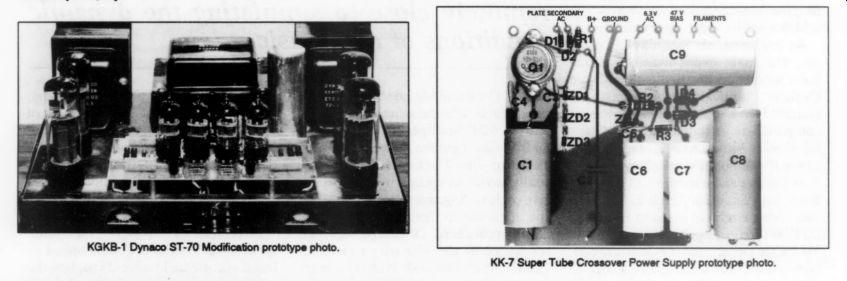
KITS DYNACO ST-70 MODIFICATION KGKB-1, Joseph Curcio, $349
In this popular mod, Mr. Curcio has regulated all voltages in his amp design (except filaments) and drives the outputs with a constant current cascode differential driver, capacitively-coupled to a pentode-wired out put stage. Field-tested for two years in over two dozen sites, the Curcio ST-70 fits within the existing chassis, using the power and output trans formers as well as several other parts from the original unit. Old Colony's kit includes boards and all needed parts right down to new mica-filled sockets for the output tubes. All parts in this kit are of exceptionally high quality and the sound is the best available from the venerable ST-70 chassis. [GA 1/89] KGKB-1 Dynaco ST-70 Modification prototype photo.
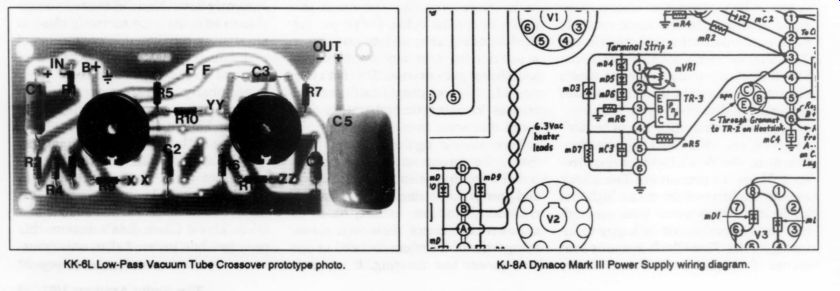
LOW-PASS VACUUM TUBE CROSSOVER KK-6L Brian Waldron $69 This venerable standby is a variable corner frequency, low-pass filter of the Butterworth 18dB/octave type, featuring a three-gang pot, level control, three frequency determining capacitors, 12AX7 tubes, a 214” x 4%” PC board, and everything else needed, including article reprint. Case not included. Each kit is for a single channel. PLEASE SPECIFY ONE FREQUENCY RANGE FROM THE FOLLOWING: 19-210; 43-465; 88-960; 190-2100; 430-4650; 880-9600; 1900-21kHz. The KK-7 Super Tube Crossover Power Supply is recommended for up to four filters (a stereo, bi-amp system). [TAA 3/79] KK-6L Low-Pass Vacuum Tube Crossover prototype photo.
HIGH-PASS VACUUM TUBE CROSSOVER KK-6H Brian Waldron $74 This kit is the high-pass version of KK-6L. PLEASE SPECIFY ONE FREQUENCY RANGE FROM THE FOLLOWING: 19-210; 43-465;
88-960; 190-2100; 430-4650; 880-9600; 1900-21kHz. [TAA 3/79) SUPER TUBE CROSSOVER POWER SUPPLY KK-7 Brian Waldron $119 Designed to power the Waldron vacuum tube crossovers (KK-6L/H), this kit is capable of powering four crossover boards, a total of eight 12AX7/ECC83 tubes. Maximum output for the supply is 300V at 70mA regulated and 12.6VDC at up to 1.5A for filaments. In addition, a positive bias of 47V regulated at S00mA is available. The kit comes complete with all needed parts, PC board (5'4” x 5548”), transformer, capacitors, semi conductors, fuse, and line cord. Case not included. [TAA 3/79] ay BIAS FILAMENTS KK-7 Super Tube Crossover Power Supply prototype photo.
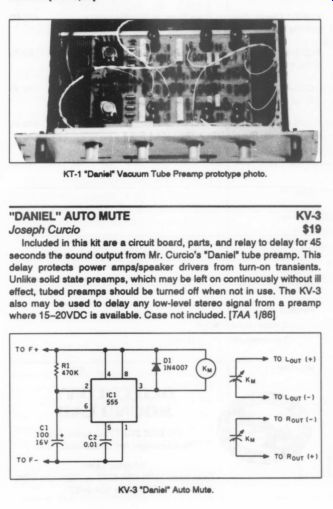
DYNACO MARK lll POWER SUPPLY MOD KJ-8A James E. Boak $39 This kit provides an inexpensive way for the Dynaco Mark Ill owner to upgrade an already superior power amplifier. After the modification, hum and noise are down an additional 11dB, full load B+ is up 10%, and the output at 20kHz is raised 4W. Response is flat within 0.05dB over the range 20Hz-20kHz. Also included are all the parts necessary to add a balance control and an adjustable, independent bias control for the Mark ll. [TAA 1/78) KJ-8A Dynaco Mark Ill Power Supply wiring diagram.
“DANIEL” VACUUM TUBE PREAMP KT-1, Joseph Curcio $399
Mr. Curcio's no-compromise vacuum tube/semiconductor hybrid pre amplifier pays special attention to the issues of sensitivity, low noise, stability, and the sonic contribution of the individual components. Each channel has three gain stages. The first is a modified cascode configu ration offering wide dynamic range, low noise, and two possible levels of gain: either 38dB, which is sufficient for most moving-coil cartridges, or 32dB for high output cartridges. The second stage is a parallel dual triode fixed at 26dB gain. Between these stages Curcio implements the RIAA equalization with a passive RC network. Output is available after the second stage or, for an added 26dB, at the output of an identical third stage. Output impedance in either case is 20k-Ohm. The 6DJ8 dual triode vacuum tube is used throughout the amplifier.
The most notable feature of the design is the on-board regulation of each tube's B+. Filaments are powered by separately regulated DC for each channel. The power supply primary AC is switched by low voltage DC. Thus, no 60Hz current is present on the main board, always a potential noise problem in low level gain stages. Within the power supply housing, the filament and B+ are switched by an optically coupled, zero-crossing triac and an electromechanical relay. The kit is complete with all needed parts for the amplifier and its power supply. Not included are housings for the amplifier or power supply and knobs for the rotary controls. [TAA 2/85]
--- KT-1 Daniel Vacuum Tube Preamp prototype photo.
“DANIEL” AUTO MUTE KV-3 Joseph Curcio $19 Included in this kit are a circuit board, parts, and relay to delay for 45 seconds the sound output from Mr. Curcio's “Daniel” tube preamp. This delay protects power amps/speaker drivers from turn-on transients.
Unlike solid state preamps, which may be left on continuously without ill effect, tubed preamps should be turned off when not in use. The KV-3 also may be used to delay any low-level stereo signal from a preamp where 15-20VDC is available. Case not included. [TAA 1/86]
TO Loyr (+) TO Lour (=) TO Royr (=) TO Royr (+) KV-3
Daniel Auto Mute.
BOOKS SAGA OF THE VACUUM TUBE BKAE1
Gerald F.J. Tyne $16.95
In his research of vacuum tube history through 1930, former Rensselaer Polytechnic Institute professor Gerry Tyne became acquainted with many pioneers involved in the development of tubes, including De Forest, Schottky, Mullard, and many others. European manufacturers made their records available and opened their archives, and during Tyne's many years of verifying and cross-checking stray bits of information, numerous European historians and archivists supplied elusive missing links to authenticate this history. From such sources comes the documentation for this book, a fascinating study of the evolution of the tube widely acknowledged as the standard in the field. This book is a “must” for every tube freak. Fully indexed and referenced, 485 illustrations. 1977, 494pp., 538 x 814, softbound.
WIRELESS: THE CRUCIAL DECADE, 1924-34 BKIE1, Gordon Bussey $69.95
This book describes broadcasting trends and receiver developments in Europe and America during this critical period, and includes a detailed account of wireless development in Britain. Vital changes in radio tubes are described, in addition to a fascinating account of the rise and eventual fall of the home construction of wireless receivers from kits of parts. The collapse, of course, came about because sets had become too complex for the amateur at the same time that commercially produced sets became available at prices almost as cheap as those of kits. Contents include: The scene to 1924; Technical background; Broadcasting trends in Britain and continental Europe; British radio valves (tubes); Receiver developments in America, Germany, and France; British domestic wire less--historical background; The trend in receivers; Transition; Transformation; Turning point; Homa construction and kit sets. United Kingdom, 1990, 121pp., 534 x 9, hardbound.
THE VTL VACUUM TUBE LOGIC BOOK BKVT1
David Manley $12.95
Produced by Vacuum Tube Logic of America, Inc., this cult classic is now available in its second edition. Along with reviews of equipment, circuit designs, tube specifications and substitution information, tube history, and VTL equipment schematics, the handbook also provides a host of general tube information without which no tube library is complete.
The book is very easy to read, written in a light and puckish style.
Contents include: A Little Night History; Measurements; The Human Ear; Loudspeakers; Room Acoustics; Cables and Interconnects; Preamplifiers in General; Tube Power Amplifiers; and The VTL Manual. Another “must” (along with BKAE1) for every tube aficionado. 1989, 238pp., 53 x BV4, softbound.
THE WILLIAMSON AMPLIFIER D.T.N. Williamson In April 1947, D.T.N. Williamson's power amplifier, using excellent quality push/pull output tubes, a special output transformer, and a highly filtered power supply, became an overnight success. Here, Williamson takes his reader deep into the design considerations for his power amp and why he made the decisions he did. He offers a lot of practical advice on how to build the units, as well as clear, concise instructions on setting up the new amp.
Published by exclusive arrangement, this booklet is not only a singular resource, but also an important historical document which will give the reader unique insights into the tube designer's problems and compromises. More than 40 detailed illustrations, many of them quite extensive, as well as parts lists, provide complete construction details. Chapters include: Introduction; Basic Requirements--Alternative Specifications; Details of Chosen Circuit and Its Performance; Design Data--Modifications, Further Notes; Design of Tone Controls and Auxiliary Gramophone Circuits; Design for a Radio Feeder Unit; Replies to Questions Raised by Constructors; and Modifications for High-Impedance Pickups and Long Playing Records. 1947, 1990, 40pp., 7 1/4 x 9 3/4, softbound.
DYNACO STEREO-70 MODIFICATION MANUAL BKAA22, Audio Research $4.95
Formerly carrying Old Colony's product number KH-6B, this is the manual for the very popular KH-6B Audio Research ST-70-C3 Super Modification Kit, which unfortunately is no longer available. The manual describes in detail how to rework the circuitry of the venerable ST-70 power amplifier into William Z. Johnson's vacuum-tube, totally push/pull design, while retaining the original chassis and transformers. The result is a moderate power (30W/channel) unit with substantial improvement in performance. The audiophile, novice or veteran, who values the special qualities of vacuum-tube systems will find this mod an economic route to high-quality sound. Introduction by Edward T. Dell, Jr.; parts list, 4 photos, 17 illustrations. 1978, 14pp., 8 .5 x 11, softbound.
THE BRUTE: A SUPER AMPLIFIER BKAA23, FOR THE DO-IT-YOURSELF PERFECTIONIST, $4.95, Edward T. Dell, Jr.
Complete with photos, drawings, parts list, and schematic, this reprint by permission of Stereophile describes the construction of a tube-type amplifier which is a deluxe version of the Dynaco Stereo 70. For learning or perfecting construction skills, not to mention acquiring a knowledge of amplifiers only hands-on experience brings, this is the ultimate project.
The amplifier itself is beefed up by a massive power supply, equipped with metering facilities for all voltages, and constructed from components that all amplifier manufacturers might well be using if they didn't have to consider the price of their products. 1966, 12pp., 81% x 11, softbound.
PRINTED CIRCUIT BOARDS
Old Colony's circuit boards are made of top-quality epoxy glass, two-ounce copper and reflowed solder-coated material for ease of constructing projects which have appeared in Glass Audio and The Audio Amateur magazines. Each of the boards below is supplied along with the appropriate article reprint, and all except PCBK-6 and PCBK-7 also have the component layout printed right on the board! [Article references are shown in brackets.)
PCBGK-B1A Curcio ST-70 Power Supply [GA 1:89] $27.00
PCBGK-B1B Curcio ST-70 Driver [GA 1:89] $17.00
PCBK-6 Waldron Tube Crossover (two needed per two-way channel) [TAA 3:79] $12.00 4/ $40.00
PCBK-7 Waldron Tube Crossover Power Supply (TAA 3:79) $7.00
PCBT-1 Curcio Vacuum Tube Preamp Amp/Regulator [TAA 2:85] $27.00
PCBT-1A Curcio Vacuum Tube Preamp Master Power Supply [TAA 2:85] $8.00
PCBS-6 Curcio Vacuum Tube Pre-Preamp Amp/Regulator (kit not available) [TAA 5:84] $12.35
PCBS-6A Curcio Vacuum Tube Pre-Preamp Master Power Supply [TAA 5:84]
----------
CASSETTES
A HISTORY OF MUSIC OF THE WESTERN WORLD, 1100-1980 Sussex Tapes/Audio-Forum In this series of twelve deluxe, gift-boxed audio cassettes, informative discussions by world-renowned authorities are followed immediately by authentic musical examples created by major international orchestras and chamber groups, enabling the musical past to be presented in a single, easily-listened-to format. Sorry, cassettes not sold separately.
Contents: Cassette #1--New Arts for Old: Music of Medieval Times, 1100-1480. Side One: Christopher Page explains the early domination of Gregorian chant, and takes the listener from the flowering of love poetry in France to the development of polyphonic music in the 13th century. 12 examples. Side Two: From the Ars Nova of France the listener turns to Landini's Italy and the England of John Dunstable. Liberal use of musical examples helps to convey the extrovert boldness and excitement of medieval music. 10 examples.
Cassette #2--Musick's Feaste: Music of the Renaissance, 1480-1600. Side One:
Anthony Rooley talks about the musical renaissance in Europe and traces the spread of the Flemish School through France to Italy. 9 examples. Side Two: The discussion concentrates on the English renaissance and shows how the Flemish style was absorbed by English composers. 10 examples.
Cassette #3--A Pearl Distorted: Music of the Baroque Period, 1600-1750. Side One:
What does “baroque” mean? Christopher Hogwood and Michael Oliver discuss the different types of music which this complex period embraces and show how, in geographical terms also, the era covered a very large area. 8 examples. Side Two:
Opera is considered as the great dramatic spectacle of baroque current interest in authenticity of musical performance is examined. 7 examples.
Cassette #4--Sonata and the Creative Ideal: Music of the Classical Period, 1750 1830. Side One: Alan Hacker first explains the principle and importance of classical sonata form, with the aid of keyboard examples played by Richard Burnett on an eighteenth-century traveling square piano. 6 examples. Side Two: The listener moves to Vienna, for the artist the “richest, happiest, and most agreeable residence in Europe,” as Peter Wilson discusses opera and the reforms of Gluck before looking ahead to the Romantic period through the music of Schubert and Weber. 8 examples.
Cassette #5--Expression and Extravagance: Music of the Romantic Period, 1830 1900. Side One: Conductor Norman Del Mar and critic John Amis discuss the meaning of “romanticism” in music. In addition, they examine the role of the virtuoso and compare large-scale opera with the compressed drama of the Lied. 13 examples. Side Two: The speakers look at the rise of nationalism within the period and trace the development of the orchestra. 12 Cassette #6--Reaction and Revolution: The Modem Period, 1900-19845. Side One:
Wilfrid Mellers takes the listener from Wagner to Schoenberg, as he discusses the changes In musical language around 1900. 8 examples. Side Two: The speaker considers some of the less radical elements of twentieth century music, finishing with the place of jazz in the period. 8 examples.
Cassette #7--Music Now: Music, 1945-1980. Side One: Hugh Wood appraises the entire post-World War 2 period, with illustrations from the music of composers such as Boulez and Stockhousen. 11 examples. Side Two: As above. 9 examples.
Cassette #8--Approaches to Popular Music. What Is popular music? Edward Lee and Graham Vulliamy explore popular music as culture and look at its esthetics, as they trace the impact of Afro-American music on traditional classical European music to produce an entirely different musical form and discover that different musical traditions need to be evaluated against different criteria. Illustrations by the speakers themselves.
Cassette #9--From Cave to Cavern: The History of Percussion Instruments. Side One: James Blades shows the importance of rhythm to all cultures, and then traces the history of percussion instruments through the Middle Ages and Renaissance to the Classical Period. Side Two: How the nineteenth century demanded marked changes of color in the section is shown, including the emergence of tuned percussion.
Blades then brings the listener up-to-date with a consideration of the increased technical requirements which the twentieth century has made on old and new percussion CAS1
$89.50 instruments. 10 examples.
Cassette #10--Islands in the Sun: The Story of Reggae and Calypso. Side One: Felix Cross traces the progression of music in the Caribbean from Rhythm and Blues to Reggae. Side Two: An outline history of the calypso form of music, ending with a demonstration of how a simple calypso tune can be composed and performed. 7 e 3 Cassette #11--A Jug of This: An Introduction to English Folk Music. Side One: Roy Palmer explores the history of English folk music, as well as its functions in ritual, work, and recreation. 8 examples. Side Two: Folk songs as an illustration and illumination of social history, dealing for example with love, marriage, and affairs. Palmer also recognizes our debt to the folk song collectors of the early twentieth century. Examples on both sides of the tape range from Elizabethan times up to the modern period. 7 examples.
Cassette #12--Instruments Around the World. Side One: Andy Jackson presents a collection of examples from musical instruments from around the world, including the quena (Andean flute), koto (Japanese zither), atumpan (talking drum from Ghana), duda (Hungarian bagpipe), didjeridu (Australian trumpet), and sitar. Side Two: As above, with gender (Indonesian metal xylophone), mbira (Zimbabwean linguaphone), sheng (Chinese mouth organ), peyote water drum, and hardanger fiddle (Norwegian folk violin).
CDs
DIGITAL TEST: 106 DIGITAL TESTS AND DEMONSTRATION TRACKS Disques Pierre Verany After painstaking research and several trial pressings, here is the most complete and functional test package available. Created in the studios of Pierre Verany, with the collaboration of the French audiophile magazine Compact, the final product was submitted to the creators of the CD concept--Philips of The Netherlands. Their verdict: “a beautiful piece of work!” Contents: CD #1, DEMONSTRATIONS--[1] Fireworks. [2] Rumanian folk music. [3] Bluegrass. [4] Guitar. [5] Contemporary music with brass and percussion. [6] Voice.
[7-8] Ancient instruments. [9] Flute concerto. [10] Philharmonic orchestra. [11] Baroque organ. [12] Great symphonic organ. CD #1, TESTS--[13] Maximum cutting level. [14-15] Left/right identification and channel separation. [16-17] Frequency response 20Hz 20kHz. [18-32] Harmonic distortion measurements. [33-34] Signal-to-noise ratio measurement. [35-38] Analog de-emphasis circuit control. [39-42] Transient response on squarewave signals and tone bursts. [43-46] Audible differences in quantization: 16-, 15-, 14-, and 8-bit-encoded music. [47-48] intermodulation by crosstalk. [49-51] Inter modulation distortion measurements. [52-56] Digital/analog converter overload effect.
CD #2, TESTS--[1-8] Variations of linear cutting velocity. [7-11] Variations of velocity/track pitch. [12] Return to normal parameters. [13-18] Variations of track pitch.
[19-24] HF detection level. [25-38] Dropout tests. [39] Return to normal parameters.
[40-43] Dropout size variations/minimum track pitch. [44-50] Ability to correct successive dropouts.
From France; two discs; 73:47, 50:00. Verany #PV88031/32 (AD124).
65-page French/English companion booklet included. Also available in Special CDPV/S elsewhere in this section.
CDPV/2
$37.95 COMPACT TEST: DEMONSTRATIONS AND TESTS CDPV/3 Disques Pierre Verany $18.95 Contents: MUSICAL TRACKS—[1] Steam train. [2] Big band (Tribute to Benny. Walker Jazz Band). [3] Percussions (“Rhythmotom 1,” Mamba Percussions Ensemble).
4] Paraguayan harp (“Pajaro Campaa,” Ignacio Alderete). [5] Country music (*Rattle snake,” Banjo Express Ensemble). [6] Provence (southern France) music (“Bon Joseph, Ecoute-Mol,” Fleur de Rose Ensemble). [7] Nightingales (“Dawn on Saint John's Day”).
[8] Organ and orchestra (Vivaldi: “Concerto in G Minor Op. IV No. 6,” Munich Pro Arte Orchestra). [9] Harpsichord (Soler: “Sonata No. 99 in C Major: Rondo Pastoril,” Jean-Marie Puli). [10] Baroque organ (Clerambault: “Suite du Premier Ton: Basse et Dessus de Trompete,” Pierre Bardon). [11] Choirs (Poulenc: “The Face of Man: With Laughter for the Sky and Planets,” Ensemble Vocal de Provence). [12] Ancient music (Alphonse le Sage: “De Grad'a Santa Maria,” Polyphonia Antiqua Ensemble). [13] aE (Uiszt: Fantasy and Fugué on “Ad Nos, Ad Salutarem Undam,” Chantal de Zeeuw).
TECHNICAL TRACKS--[14] of left and right channels; diaphony test. [15] Dynamics and noise. [16] Loudspeaker phasing. [17] White noise. [18] Pink noise. [19] Response curve of the equipment (sinusoidal signals). [20] Colorations and resonances; equalizer adjustment; loudspeaker testing.
From France; one disc; 57:39. Verany #PV784031 (AD100). 19-page French/English companion booklet included. Also available in Special CDPV/S elsewhere in this section.
CDV TEST: HOW TO SET UP YOUR CDPV/4 AUDIO-VIDEO EQUIPMENT $18.95 Disques Pierre Verany Contents: AUDIO DEMONSTRATIONS--[1] Philharmonic orchestra (Moussorg skyRimski-Korsakov: “Une Nult sur le Mont Chauve [extract], Pays de la Loire Philhar monic Orchestra). [2] L'Epée Music Box (Planquette: Corneville Bells ). [3] Gilardenghi barrel orchestrion (“Traditional Italian Air”). [4] Frati cardboard coin-operated orchestrion (Waldteufel: “Dolores”).
AUDIO TESTS--[5] identification signal to be heard on the left.
[6] identification signal to be heard on the right. [7] Filtered sound, in phase. [8] Filtered sound, out of phase. [9-28] Room resonance and speaker remoteness from walls (sound measuring signals): 1k, 16, 20, 25, 31.5, 40, 50, 63, 80, 100, 125, 160, 200, 250, 315, 400, 500, 630, 800, 1k Hz. VIDEO TESTS--[29] Absolute white. [30] Absolute black.
[31] Contrast control and adjustment (gray scale). [32] Color rendering control (color bar pattern). [33] Streaking and focusing (dot pattern). [34] Convergence and geometric distortion (black and white grid).
From France, in collaboration with Stéréo HiFi-Vidéo; one disc; 21:55.
Verany #PV789032 (AV100). 23-page French/English companion book let included. Please note that this disc has been designed to be read by all CDV players sold in Europe and manufactured to the European standard. It is not compatible with NTSC-standard devices such as those made in Japan, Canada, and the USA. Also available in Special COPV/S elsewhere in this section.
PIERRE VERANY TEST CD SET SPECIAL! CDPV/S Disques Pierre Verany $69.95 The complete Verany Test CD Set (CDPV/2, COPV/3, CDPV/4), ata savings of $5.90! From France; four disks, three booklets.
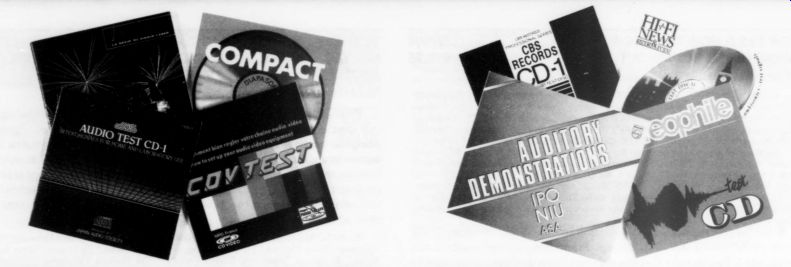
CD-1 COMPACT TEST DISC CD1 CBS Records $45.00 The CBS Records CD-1 test disc is a highly accurate signal source specifically designed for those interested in making a full range of demanding performance measurements on CD players. Because of the convenient nature of the CD medium and high quality of the recorded signals, the disc is also suitable for use as a source for testing a variety of audio systems or components, including tape recorders, amplifiers, and speakers. All 16-bit digital audio test signals contained in the 21 tracks and over 71 minutes of playing time have been computer-generated and transferred in digital form to the CD. The latest knowledge and technology in digital audio engineering has been used to provide a comprehensive set of test signals in a format with user requirements in mind. This arrangement includes all Electronic Industries Association (EIA)-specified test signals, plus CBS Records enhancements which allow the concerned evaluator the ability to obtain even more critical performance data than required by the corresponding EIA measurement standard.
Contents: [1] Reference, L & R, 0dB, 1kHz. [2] Left separation, 0dB, 1k, 125, 4k, 10k, 16k Hz. [3] Right separation, 0dB, 1k, 125, 4k, 10k, 16k Hz. [4] Signal/noise, L & R, Infinity zero w/o emphasis. [5] Dynamic range, L & R, 1kHz, ~60dB w/o emphasis.
[6] Frequency response, L & R, 0dB, 4, 8, 17, 31 Hz. [7] 61, 127, 251, 499 Hz. [8] 997, 1999, 4001, 7993 Hz. [9] 10,007; 12,503; 16,001; 17,989 Hz. [10] 19,997 Hz (also used for piich error). [11] Sweep frequency response, 0dB, 5Hz, -22.05kHz. [12] De-emphasis error, L & R, 1k 125, 4k, 10k 16k Hz. [13] intermodulation distortion (SMPTE, twin-tone), L & R, 80Hz + 7kHz, 11kHz + 12kHz. [14] Wow and flutter, L & R, 0dB, 3150Hz.
[15] Access time, L & R, 0dB, 317Hz. [16] Squarewave, L & R, 0dB, 1002.27Hz. [17] Impulse and polarity test, L & R, 0dB. [18] Linearity, 997Hz, L & R, 0dB, -1, <3, -8, -10,
-20, -30, -39.99, 49.97, -59.94, -70.31, -80.77, -80.31 dB. ADDITIONAL TEST TRACKS: [19] Linearity with dither, L & R, 997Hz, -70.31, -80.77, 80.31, -100 dB.
[20] Fade to noise with dither, L & R, -80dB, 500Hz. [21] Monotonicity, L & R, 1102.5Hz, 10LSB.
One disc; 71:00+. CBS #CD-1. 8-page companion booklet included.
TEST DISC 2: MUSIC, SOUND EFFECTS
MIC TECHNIQUES, ANECHOIC, $30.00 AMBISONICS, TEST SIGNALS
Hi-Fi News & Record Review Produced by Martin Colloms and Trevor Butler, this comprehensive test disc offers a unique package of music tracks and test signals designed for both subjective and objective analysis of hi-fi systems or components. Although the technical section provides a uniquely comprehensive and up-to-date signal source for laboratory measurement of hi-fi equipment, this disc will be invaluable for even the most nontechnical enthusiast who wants a range of suitable material for setting up, evaluation, and comparison.
Contents: [1] Ambisonic and channel identification. sg p- Hodgson: “Base Desires.” [4] The making of “Base Desires.” [5] Loulss: “Blues for Klook.” [6] Sousa: “Stars and Stripes Forever,” The Wallace Collection. [7] Holst:
*Neptune® from “The Planets,” Philharmonia Orchestra. [8] Britten: “Aria ltaliana, A aT bs Orchestra. [9] Beethoven: “Coriolan Overture,” Hanover Band. Ro orchestral music recording. RECORDING TECHNIQUES--[10] Mozart:
Overture, “Le Nozze di Figaro,” Minoo Civic Hall, Osaka. [11] “Le Nozze,” with addition of Vienna Musikvereinssaal's reverberation. [12] “Le Nozze,” with addition of -
dam Concertgebouw’s reverberation. [13] “Le Nozze,” with addition of Boston phony Hall's reverberation. MICROPHONE TECHNIQUES--[14] “Le Nozze,' omni/single pickup miking. [15] “Le Nozze,” with single mic and time coherence.
“Le Nozze,” with single unidirectional mic. [17] “Le Nozze,” with multi-mic pickup. [18] “Le Nozze,” with multi-mic and time coherence. [19] Handel: of the Queen of Sheba,” Scottish Chamber Orchestra. [20] “Entry,” London Festival [21) Big Ben. [22] Fenny poppers (cannonades). PRECISION SIGNAL GENERATOR TRACKS
-[23-25] Balance and phasing. [26-39] Calibrated levels. [40-66] Spot frequency response. [67-69] Swept frequency response. [70-71] Signal/noise ratio test.
Impulse test, L & R. [73-74] intermodulation test. [75-79] Pre-emphasis check.
Fade-to-noise test. [81-92] Noise signals. [93-05] Tape recorder test signals. [96] Monotonicity (10 levels). [97] 1kHz toneburst, L & R, 0dB. [98] 100Hz squarewave, L & R, -15dB. [99] 1kHz squarewave, L & R, -5dB.
From the United Kingdom; one disc; 73:51. HFN #015. 8-page companion booklet included.
STEREOPHILE TEST CD CDSTPH
Stereophile $9.95
Produced by John Atkinson and Robert Harley, Stereophile's test CD contains channel identification and phasing tests, but not with the usual boring test tones or pink noise. Publisher Larry Archibald”s dog Ralph provided a healthy bark for these tests. Perhaps the most interesting part of this disc is the microphone comparisons, for which Stereophile founder and The Audio Glossary author J. Gordon Holt reads from his 1963 article, “Why Hi-Fi Experts Disagree.” Eighteen different mics are used in succession, and even those who are not amateur recordists will find the widely varying sounds of these professional recording mics highly educational.
Contents: [1] Reference tone, L & R, mono. [2] Channel identification. [3] Channel phasing. [4] Pink noise at -20dB, L & R, uncorrelated for 1:04 of 2:15. [5] “Why Hi-Fi Experts Disagree,” mic comparison, mono. [6] E.E. Bagley: “The National Emblem,” Nether Providence High School Band, mono. [7] Theodore Dubois: “Les Sept Paroles du Christ,” Philadelphia Oratorio Cholr, excerpt. [8] Maurice Ravel: “Chanson Hébriique,” absolute polarity test. [9] Armas Jamefelt: Praeludium, Delaware Sym phony Orchestra. [10] Frederic Chopin: “Scherzo in B-Flat Op. 31,” plano. [11] Jerome Kem: “I'm Old Fashioned,” acoustic guitar. [12] Bruce Dunlap: “Threediedum,” guitar and double bass. [13] George Gershwin: “Summertime,” soprano, Stereophile magazine's “The Lesley Test.” [14] Robert Schumann: “Romance, Op. 84, No. 1,” flute and piano. [15] “Romance, Op. 94, No. 2.” flute and piano. [16] “Romance, Op. 94, No. 3,* flute and piano, 128 x oversampling A/D. [17] “Romance, Op. 94, No. 3,” flute and piano, Sony PCM 1630 A/D. [18] “Romance, Op. 84, No. 3,” flute and piano, ADC comparison.
[19] J.S. Bach: “Concerto in D,” organ. [20-31] 1/3-octave warble tone tracks for testing loudspeakers and rooms: -20dB; 20, 25, 31.5, 40, 50, 63, 80, 100, 125, 160, 200Hz, 1kHz One disc; 70:54. Stereophile #STPH 002-2. 15-page companion booklet included.
AUDIO TEST CD-1: CDJAS 91
TEST SIGNALS FOR HOME AND LABORATORY USE Japan Audio Society $31.95 An extremely well thought out package, this disc contains a number of tests not found on other test CDs, and the individual track numbers on each tone and test make it a pleasure to use. Although this disc was intended for testing various playback signal characteristics of CD players, it is also useful as a versatile sound source for testing numerous characteristics of tape decks, amps, speakers, and other components, as well as the acoustics of listening rooms. The contents of the disc were prepared under extensive scrutiny and approved by both the Technical Audio Research Committee of the Electrical Industries Association of Japan and the Technical Measurement Committee of the Japan Audio Society.
Contents: [1-4] Channel check signals. [5-7] 1kHz sinewave reference signals. [8-38] Spot sinewave signals, 20Hz-20kHz. [39-44] Sweep signals, 20Hz-20kHz. [45] Step signals, 4Hz-125Hz. [46-47] Double tones for measuring intermodulation distortion, 0dB, ~10dB. [48] White noise signal, -20dB. [49] Pink noise signal, ~20dB. [50-52]Weighted noise signals, -20dB: United States of America Standards Institute (predecessor to ANSI); International Electrotechnical Commission Publication 268-1; Electronic Indus tries Association of Japan RC-7603. [53-82] 1/3-octave band noise signals, -20dB. [83] Band noise signal, 200Hz-800Hz. [84] Band noise signal, 100Hz-8kHz. [85] Electrical Industries Association/Institute of High Fidelity tone bursts, 1kHz. [86] Tone bursts, -10dB, 20Hz-11.025kHz. [87] Peep signals, tone bursts limited by humming window, -10dB, 20Hz-11.025kHz. [88] Raised cosine wave, -10dB. [89-90] Impulse signals, 0dB, L & R. [90] Starter's pistol, anechoic.
From Japan; one disc; 58:44. JAS #YDDS-2. 34-page Japanese/English companion booklet included.
AUDITORY DEMONSTRATIONS Institute for Perception Research; Northern Illinois University; Acoustical Society of America In 1978, a set of auditory demonstration tapes was released by the Laboratory of Psychophysics of Harvard University. These demonstrations had been prepared by a team led by Professor David M. Green and were sponsored by a grant from the National Science Foundation. The tape set, which contained 20 recorded demonstrations on psychoacoustics plus an explanatory booklet, became so popular that all copies were quickly distributed and the set was no longer available.
In 1984, the Acoustical Society of America's Committee on Education in Acoustics requested T.D. Rossing and W.D. Ward to look into the feasibility of re-issuing the “Harvard tapes.” The decision was made to update the demonstration material and to issue it on a high-quality sound reproduction medium. The Institute for Perception Research (IPO) in Eindhoven (The Netherlands) was engaged to produce the audio material. Both the Eindhoven University of Technology and the Philips Company, the joint sponsors of IPO, made manpower available for the project.
Philips Polygram and Philips & DuPont Optical (PDO) agreed to handle CDAC
$27.95 the digital tape mastering and the production of a CD. Northern Illinois University supported the project through a grant for improvement of undergraduate education, and the Acoustical Society of America agreed to provide further financial backing for the project. Among many, A.J.M.
Houtsma, T.D. Rossing, and W.M. Wagenaars can be singled out for their production contributions.
Contents: [1] Canceled harmonics. [2-6] Critical bands by masking. [7] Critical bands by loudness comparisons. [8-11] The decibel scale. [12-16] Filtered noise. [17-18] Frequency response of the ear. [19-20] Loudness scaling. [21] Temporal integration.
[22] Asymmetry of masking by pulsed tones. [23-25] Backward and forward masking.
[26] Pulsation threshold. [27-28] Dependence of pitch on intensity. [29] Pitch salience and tone duration. [30] Influence of masking noise on pitch. [31] Octave matching. [32] Stretched and compressed scales. [33] Frequency difference limen (DL) or just notice able difference (JND). [34-35] Logarithmic and linear frequency scales. [36] Pitch streaming. [37] Virtual pitch. [38-39] Shift of virtual pitch. [40-42] Masking spectral and virtual pitch. [43-45] Virtual pitch with random harmonics. [46-47] Strike note of a chime.
[48] Analytic versus synthetic pitch. [49-51] Scales with repetition pitch. [52] Circularity in pitch judgment. [53] Effect of spectrum on timbre. [54-56] Effect on tone envelope on timbre. [57] Change in timbre with transposition. [58-61] Tone and tuning with stretched partials. [62-63] Primary and secondary beats. [64-67] Distortion. [68-69] Aural combi nation tones. [70] Effect of echoes. [71] Binaural beats. [72-74] Binaural lateralization.
[75-79] Masking level difference. [80] An auditory illusion.
From The Netherlands; one disc; 64:55. Philips #1126-061. 93-page, extremely detailed and referenced companion booklet included.
DEMONSTRATION OF STEREO MIKING TECHNIQUE
CDSM Performance Recordings $21.95 Produced by James Boyk, Mark Fischman, Greg Jensen, and Bruce Miller, this disc allows you to hear not only the very different images produced by various mikings, but also how different types of microphones give different images with the same miking. Each miking occupies two tracks: the first identifies it and the second lets you hear it. This enables the second track to be used by itself for blind testing.
Contents: SPOKEN INTRODUCTION--[1] Title. [2] Description of sound source. [3] Placement of microphone arrays. [4] Image accuracy. [5] Variation of nominally identical arrays. [6] Differences in character of sound. [7] Sound variation, off-axis versus on-axis.
[8] How best to use your own microphones. [9] Dynamic test of channel matching. [10] Miking not a science. [11] Introduction.
EIGHTEEN MIKINGS (Principle, Geometry of Stereo Array)--[12-13] Condenser, cardioids at 90 degrees. [14-15] Condenser, cardioids at 120 degrees. [16-17] Condenser, hypercardioids at 90 degrees. [18-19] Condenser, M-S: cardioid plus figure 8. [20-21] Ribbon, M-S: two figure 8s. [22-23] Condenser, figure 8s at 90 degrees (“Blumlein”). [24-25] Condenser, figure 8s at 85 sad ( Blumlein ). [26-27] Ribbon, figure Bs at 90 degrees (“Blumlein”). [28-29] Condenser, two 23% Conder 6 feet apart. [30-31] Condenser, three omni-directional, 6 feet span. [32-33] Condenser, ORTF: cardioids at 110 degrees, 17 cm apart. [34-35] Suh NOS: cardioids at 90 degrees, 30 cm apart. [36-37] Dynamic, cardioids at 90 degrees. [38-39] Dynamic, cardioids at 120 degrees. [40-41] Condenser, two omni-directionals 6 feet apart. [42-43] Dynamic, ORTF: cardioids at 110 degrees, 17 cm apart. [44-45] Dynamic, NOS: cardioids at 90 degrees, 30 cm apart. [46-47] Condenser, two figure 8s at zero degrees, 17 cm apart. One disc; 19:18. Performance Recordings #PR-6-CD. Companion booklet included, which contains Quick-Start Guide, “About Microphones & Stereo” primer, complete transcript of spoken introduction, and computer graphics of microphone patterns.
“ELECTRONICS AND YOU” VIDEO ELECTRONICS COURSES UCANDO VCR
Educational Products Company These high-quality, computer-animated VHS videos are among the best we have seen, suitable for at-home self-instruction as well as for classroom use. In color. Also available in other formats--please inquire.
Purchasing options available:
VDVT201 PART 1--DC: Series and parallel circuits; Ohm's Law; digital multimeters; converting series-parallel circuits into simple equivalent circuits; using the DMM to measure voltage, current, and resistance. 53:00. $34.95
VDVT202 PART 2-AC: Coils; transformers; capacitors; the difference between effective, average, peak, and peak-to-peak voltage; calculating values for coils and capacitors in series and parallel. 71:00. $34.95
VDVT205 PART 3--SEMICONDUCTORS: Basic semiconductor theory; 15 different devices; how diodes, phototransistors, FETs, SCRs, and other voltage-controlling devices are de signed to perform specific tasks; how an IC is designed and built. 47:00. $34.95
VDVT206 PART 4-POWER SUPPLIES: Different sections of a PS; half-wave, full-wave, and bridge rectifiers; filter circuits;
shunt, series, and current regulators; overvoltage protection circuits such as crowbar; troubleshooting power supplies. 55:00. $34.95
VDVT207 PART 5-AMPLIFIERS: Basic amplifier circuits such as Class A, B, C; operational amplifiers; amplifier use in audio, video, and testing equipment. 54:00. $34.95
VDVT208 PART 6--OSCILLATORS: Resonant LC tank circuits; LC, RC, crystal oscillators; Hartley, Colpitts, Ultra Audion, collector-coupled, emitter-coupled, UJT relaxation, tunnel diode oscillators; multivibrator circuits. 54:00. $34.95
VDVTXXX COMPLETE SIX-PART “ELECTRONICS AND YOU” COURSE, as above, at a savings of $29.75! $179.95 .& BOTTLES:
THE TUBE AMP UCAN DO -n VIDEO NY VOR EK ATIONAL PRODUC TS COMPA min FOR THE OWNERS OF VACUUM-TUBE AUDIO EQUIPMENT BOTTLES: THE TUBE AMP VIDEO VDBOT Corax Productions $29.95 The tube has many qualities that make it perfect for audio amplification--low distortion, clear midrange and treble, extreme ruggedness, and tremendous surge-power ability, plus the maturity of a classic technology.
Produced by Eric Barbour, this video is about tube amplification--types and brands, applications, and a user's manual for the care and feeding of “bottles.” A great owner's reference, it deals with all the details of owning a vacuum-tube amplifier. Subjects covered include: the history of tube high-fidelity equipment; a short look at the history of tube guitar amps; speakers for tube amps; owner maintenance; modifications for tube equipment; a summary of common audio tubes; and safety considerations. The history section in the first half is especially interesting, showing many classic tube amplifiers and preamps from the late “40s right up through today. VHS, color/NTSC format, 85:00.
ELECTRONIC KIT BUILDING MADE EASY VDETD
Edward T. Dell, Jr. $19.95 In careful production for several years, this striking 30-minute VHS video cassette introduces kit building techniques to newcomers to electronics. Narrated by Ed Dell of Audio Amateur Publications, the presentation takes the viewer step-by-step through construction of a simple two-way electronic crossover, explaining the concept in simple terms, defining the basic concepts of circuit action and component function. The advantages of electronic crossovers versus passive ones (used in most loudspeaker systems) are discussed. Basic tools, soldering, circuit board use, component mounting, wiring, layout, and drilling of the enclosure, as well as final assembly, are all demonstrated clearly. Although the demonstration project is used for upgrading speaker systems, the techniques are applicable for building almost any electronic project, whether from a prepackaged kit or parts and supplies purchased separately.
Suggestions for other resources and where to find more assistance in the form of plans, components, kits, and literature complete the program.
VHS, color, 30:00. IN PRODUCTION; PLEASE INQUIRE ABOUT AVAIL ABILITY.
PROFESSIONAL AUTOSOUND INSTALLATION TIPS
Scosche
This training video follows an autosound installation from beginning to completion, providing detailed “how-to” information which examines the subtle and not so subtle differences between a competent, professional quality job and a “slap-shop” one. The format is light and easy to watch and follow. Topics covered include Pre-Planning, Front Speakers, Wiring Tips, Rear Speakers, Amplifiers, and Head Units. VHS, color, 27:00.
VDAEV2 $19.95 EIA/CEG CAR STEREO VIDEOS
Electronic Industries Association/Consumer Electronics Group These videos offer an introduction to car stereo installation, with VDBIV oriented more toward setting up a shop and dealing with customers while VDPIV delves more into actual installation techniques. Features include: outfitting a shop; car stereo chassis styles and sizes; recommending a particular size; preventing noise problems; an after-installation checklist; and installation kits and how to get them. VHS, color. VDBIV:
25:49; VDPIV: 27:30.
Purchasing options available:
VDBIV Basic Car Audio Installations $27.95
VDPIV Professional In-Dash Car Stereo Installation $27.95
VDSIV Complete EIG/CEG 2-Video Set (VDBIV, VDPIV), at a savings of $3.95! $51.95
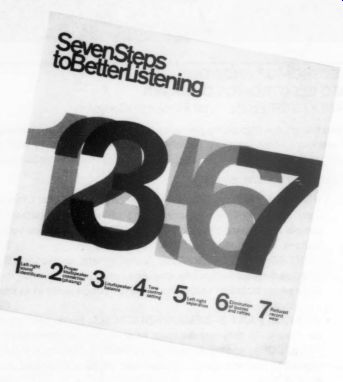
SEVEN STEPS TO BETTER LISTENING LSTR101 CBS Laboratories $8.95 Through easy-to-make tests and simple narrative, this 33 1/3-rpm LP will help you to blend electronic components, room acoustics, and the characteristics of your own ears into one well-tuned system for the enjoyment of all recorded sound. You will be able to assure yourself that your LP-playing equipment functions properly, as well as learn how to “tune” your player to your own hearing and to the acoustics of the room in which you are listening. Program notes by Audio's noted reviewer Edward Tatnall Canby. 1964.
Contents: [1] Left- right sound identification: proper placement and connection of speakers and/or console for true rendition of stereo sound image. [2] Loudspeaker connection: using a simple sequence of tones to determine proper speaker connections.
[3] Loudspeaker balance: simple adjustment. [4] Tone control: adjusting the tone controls until pilot tones and test tones correspond. [5] Left/right separation: eliminating test tone blend to ensure origination at proper speaker. [6] Elimination of buzzes and rattles: detection and remedy methods. [7] Reduced record wear: tips and tests for peak pickup performance.
One vinyl LP with jacket. CBS Laboratories #STR-101. 16-page companion booklet included. Limited quantities available: TELEPHONE ORDERS ONLY, PLEASE.
AD:
THE WORLD'S FINEST RECREATIONAL ELECTRONICS JOURNAL
THE POWER
Elektor Electronics USA is a 76-page monthly with an average of 14 articles per issue, covering virtually every technology. Over 80% are construction features which include circuit diagrams, schematics, parts lists, and sources. The magazine's service department will supply circuit cards, software, firmware, and front panels for most projects.
Tutorial articles by outstanding authorities explain the latest technological developments.
Elektor Electronics USA construction projects are writ ten, with few exceptions, by staff engineers who design and test them with the aid of staff technicians and sup port people. All project prototypes are built and thoroughly tested before publication and also reviewed by the Dutch government's equivalent of the US Under writers Laboratories.
Elektor Electronics USA originates in Beek, The Netherlands. The multilingual staff not only produces the magazine's content, but also translates the articles into Swedish, English, French, German, Spanish and Portuguese. The magazine is published in separate editions for Sweden, Germany, England, The Netherlands, France, Spain, Portugal, Greece, India and Pakistan-and now The United States and Canada. The North American edition will feature new product and conference news as well as reader correspondence and free classified ads.
SAMPLES FROM SIX RECENT ISSUES:
A Facsimile Interface for the IBM-PC, Automatic Power-down for PCs, A Mini EPROM Viewer, A MIDI Master Key board, Remotely Controlled Strobo scope, Rear Window Wiper Coupler, A Four-sensor sunshine recorder, Power Zener Diode, An Electronic Load, PLL sine wave generator, A Horn Loud speaker, Intro-scan for CD Players, A PC Servicing Card, Centronics A-D/ D-A converter, Acoustic Temperature monitor, Experimental all-waveband ferrite rod antenna, Image segmenta tion, Budget sweep/function generator, Transistor characteristic plots, An RS-232 Splitter/Multiplier, Digitally controlled preamplifier, All Solid State Preamplifier (2 parts), A Visual Hard Disk monitor, Coded locking security circuit, The digital model train: (13 parts), A wiring allocation tester, A video line selector, A Q meter, A Video mixer, Bridge Rectifiers for high output AC-DC and Multiplier use, Automatic Power line isolator switch, A 3-pen, 20” plotter with parallel port, An AC Millivoltmeter, An FM tuner board for your PC.
--------
BY GARY A. GALO, Contributing Editor
Also see:
A NEW CONTROL PREAMP: BACK TO THE FUTURE PART 1