CD Repair Kits Reviewed
by Gary A.Galo
SkipDoctor CD Scratch and Repair Device. Digital Innovations, LLC, 906 University Place, Evanston, IL 60201, 1-888-SMART-58, E-mail sales@digitalinnovations.com, Web site www.digitalinnovations.com. $34.99.
DiscRestore. DiscRestore, 1190 Spruance St., San Jose, CA 95128, (408) 298-9008, FAX (408) 298-0607. $14.95 (enough fluid for 50 uses), $19.95 (100 uses).
When Sony and Philips introduced the Compact Disc, consumers were not just assured of "perfect sound forever," but we were also told that the new silver discs were indestructible. Finally, there was an audio storage medium requiring no care whatsoever. Scratches and fingerprints would have no effect whatever on the "perfect sound," since the miracle of digital error correction would replace any missing data caused by mishandling.
It wasn't long before music lovers realized that the hype had been grossly overstated (just like the perfect sound of the early discs and players).
Error correction can certainly mask minor scuffs and scratches, but beyond a certain point, disc damage will cause discs to skip, distort, or simply not play at all.
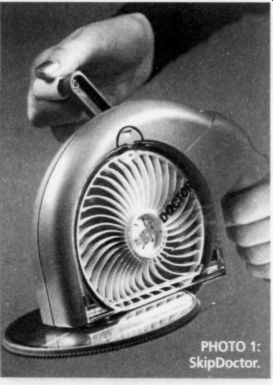
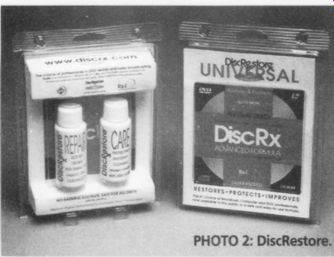
SkipDoctor and DiscRestore are designed for repairing scratched CDs (Photos 1 and 2). Disc-Restore comes with a bottle of re pair fluid (light tan in color), a bottle of care fluid (clear), blue and white buffing cloths (called Opticloths), and two ultra-fine cushioned polishing sheets.
To repair a scratched disc, place the CD on a newspaper or paper towel, label side down. If the entire disc is scratched, the manufacturer suggests pouring about five drops of repair fluid around the disc.
Otherwise, just place a drop or two on the scratched area. Then, firmly buff the entire surface of the disc with the blue Opticloth until the tan fluid disappears.
The manufacturer notes: "You have now created the miracle of DiscRestore." If this process is ineffective- which it may be on a severely damaged disc-use the ultrafine polishing sheets to buff the problem areas of the disc.
You first use the coarser of the two sheets (#2), followed by the finer (#1).
After successfully repairing the disc, use the clear care fluid, along with the white Opticloth, to buff a damage-resistant finish onto the disc.
SkipDoctor is an unusual repair sys tem that involves a large plastic hand cranked buffing tool, consisting of a rotating disc holder and a flexible plastic buffing wheel. The buffing wheel's mild ly abrasive surface resembles the coarser of the two polishing sheets supplied with DiscRestore. To repair a scratched disc, open the lower jaw on SkipDoctor, insert the disc into the CD holder, and spray the disc surface with the supplied resurfacing fluid (which is simply filtered water).
Now, close the jaw and turn the hand crank until the CD has completed one counterclockwise revolution. Then, flip the reversibility switch and turn the crank until the disc has made a complete clockwise revolution. Open SkipDoc tor's jaw, remove the disc, and dry it completely with the supplied aqua drying cloth. Finally, place the CD label side down on the folded drying cloth and buff the entire surface, radially, with the felt buffing square.
SkipDoctor supplied a CD and a piece of fine steel wool with my press kit and suggested scratching an area on the in side of the disc until the player would no longer index the CD. Scratches on the inside edge of the playing surface dam age the lead-in portion of the disc, including the table of contents area. If the scratches are severe enough, the CD will be unreadable.
I was able to successfully restore the damaged disc to playing condition, with no skipping. The SkipDoctor process leaves radial marks on the CD, which the felt buffing square is supposed to remove nearly completely. Even with vigorous buffing, however, the radial marks are clearly visible. In order to render a use less disc playable once again, the sur face of the disc will be made less shiny than it was when it was new. If only a portion of the disc is damaged, it isn't necessary to make a complete revolution with the SkipDoctor. By using the reversibility switch, you can go back and forth over only the damaged por tion of the disc.
Ultimate Test
I used the steel wool supplied with SkipDoctor to damage another CD, which I then tried to repair with Disc Restore. I found that DiscRestore was just as effective in repairing the dam aged disc as SkipDoctor, and I liked the fact that DiscRestore didn't leave permanent radial markings on the CD. I then decided to give both repair systems the ultimate test.
Using a screwdriver blade, I put a wide, deep scratch on two different CDs, rendering both unplayable. I had to be very persistent, but both systems allowed me to at least restore the disc to the point where my CD player would index the disc and begin play back of Track 1. Both discs still exhibited some skipping, which I was unable to correct.
SkipDoctor is also marketed as Game Doctor, dvdDoctor, and DataDoctor. All four products are the same-simply targeted toward different markets. The manufacturer claims that the products are equally effective in treating CDs, PlayStation discs, other CD/DVD-based games, DVDs, CD-ROMs, recordable CD Rs, and photo-CDs. DiscRestore makes similar claims for its product, noting that it is "100% effective" on all optical storage media, including CDs, CD-ROMs, Laserdiscs, and DVDs.
Both DiscRestore and SkipDoctor are quite effective in repairing discs with mild scratches and abrasions. While a severely damaged disc may be restored to a playable condition, it may still exhibit some skipping no matter how many times you repeat the process.
Given a choice between the two, I have a slight preference for the DiscRestore system, since it is easier to work on a specific area of a disc without leaving permanent marks elsewhere on the CD.
DiscRestore will be the only choice for repairing 12" video Laserdiscs, which are too large to fit SkipDoctor's mechanism. On the other hand, discs which are more or less evenly scratched around their entire surface will be easier to re store with SkipDoctor.
There is no substitute for proper care of CDs and other optical discs. If you take good care of your recordings, you won't need either of these products.
But, when accidents do happen, you may find one of these products extremely useful.
Manufacturer's response:
SkipDoctor automatically provides fixed, even pressure across the entire surface of the disc, offering the greatest chance of repairing a dam aged disc, without risk of further damage. With paste and sandpaper Kits, the pressure is applied by hand, so manufacturers must decide to make the abrasive either fairly aggressive and risk burning the disc or so mild that it isn't very effective for the average user. As a result, the hand-applied kits can be somewhat effective for the skilled user (such as the reviewer), but are usually not very satisfying for the average consumer.
SkipDoctor works great for both the typical consumer who doesn't care to inspect the disc and make decisions about where and how hard to apply the repair, and for the more advanced user who prefers to make focused repairs on more severely damaged discs. This is why over a hundred thousand consumers (for home use) and a thousand game and video rental stores (for in-store repair of rental discs) purchased SkipDoctor in 1999, its first year on the market.
The value of SkipDoctor was also recognized at the recent Consumer Electronics Show, where it was selected "Best of Show" in the highly competitive Audio Products division.
In addition to being harder to use than Skip Doctor, most paste-based kits are toxic. SkipDoc tor uses only filtered water as a lubricant and is completely safe and environmentally friendly. It can be used by kids and will not stain your car pet or furniture.
As noted, SkipDoctor does leave behind a light radial pattern that is visible from an angle to the light. This pattern is invisible from straight on (which is how CD players read the discs) and has been shown by extensive scientific testing and, more importantly, the experience of our customers to have no effect on performance.
Despite the claims of some manufacturers of paste and sandpaper kits, no product is 100% effective in repairing damaged CDs. The good news is that most of them can be repaired-with the right product. We invite consumers wishing to know more about how CDs are made, how they work, and how to care for them to visit the
"About CDs" section of our web site at digitalinnovations.com.
Collin D. Anderson, President Innovations
While Gary Galo did mention our Care solution "to buff a damage-resistant finish onto the disc," it would have been informative for your readers if he'd actually conducted another "damage test" after so treating a disc. We highly recommend use of this second stage of our kit to protect restored discs against further damage as well as treating new and undamaged discs.
We've found that application of the Care solution very effectively prevents further damage (including intentional damage via application of a steel wool pad as Gary did in his tests) to re stored discs as well as protecting new and un damaged discs from ever becoming unplayable in normal use.
Malfunctioning disc trays and changer mechanisms are the culprits we've most frequently encountered, in addition, of course, to the usual "ohmigods" of dropping discs on the floor (where, in the time-honored manner of peanut butter and jelly sandwiches, they generally tend to land exactly the opposite of how we'd prefer). Everyone who uses digital discs (whether they be audio CDs, DVDs, CD-ROM discs, LaserDiscs, or game discs) will eventually encounter discs that have become damaged, and DiscRestore will simply and easily restore about 98% of them to full playability.
We've actually field-tested our kit with 10 year-old girls at an elementary school, and, with no instruction other than the printed one included with each kit, each of them was able to fully restore an unplayable disc in less than 10 minutes! And, because our patent-pending sys tem uses no machines or solvents, it is completely safe for use by just about anyone old enough to read and follow the simple instructions.
Based on initial experiences with our new Rx4 formulas, we strongly believe that we have the world's best disc repair and preventative solution for the more sensitive data areas of DVD, CD-ROM, and game discs. During CES 2000 we were able to effectively restore dam aged DVD demonstration discs for several other exhibitors, including one on which repair had already been attempted by a considerably more expensive "machine based" repair system.
Should Gary have a bit of time to conduct some further tests, we believe he'd be amazed at how much more effective DiscRestore is at repairing these higher-density discs than any of our competitors.
While we're admittedly a bit prejudiced on the subject, it is our belief that DiscRestore is the simplest, safest, and easiest-to-use digital disc restoration and protection system available today, in addition to being the best value. WH Rob Robinson TRG Marketing (for DiscRestore)
Also see: