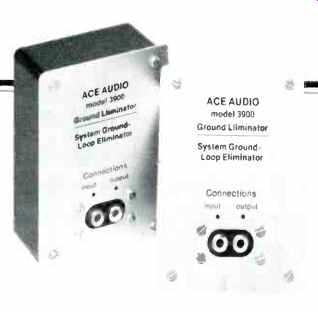
ACE Audio Model 3900 Ground “Lliminator”
Manufacturer's Specifications:
Dimensions: 3 x 4 x 1 3/8 in. (76 x 105 x 38 mm).
Weight: 0.3 lbs. (0.13 kg). Price: $16.25, kit; $20.75, wired ordered direct, sent postpaid.
The Ace Audio Model 3900, which is designed to eliminate ground loops in high-fidelity systems, is actually a very simple device. It is a small box with two phono jacks, input and output. The center, or signal, terminals are bent and soldered together, and the input shield/ ground is tied to the metal mounting plate. The output ground, however, is not connected to the input ground or the box plate in any way. In this fashion, the ground path is broken; only the signal path is carried through.
It is possible in a stereo system for there to be serious ground-loop problems in the stereo cabling, sometimes because the left and right connections are quite some distance apart on the chassis. If this is the cause of a hum problem, the 3900 may gain a great improvement by breaking one of the ground paths. It cannot be used where only one cable carries the ground, and it might not be the solution for a particular hum problem.
For those adept with tools, the Ace Lliminator might be unnecessary, since a similar unit is easily made on the bench.
For those less inclined to do such things, the Model 3900 does facilitate breaking one of the stereo ground paths with ease and the price is quite nominal.
-Howard Roberson
Technics Model SH-50P1 Stylus Pressure Gauge
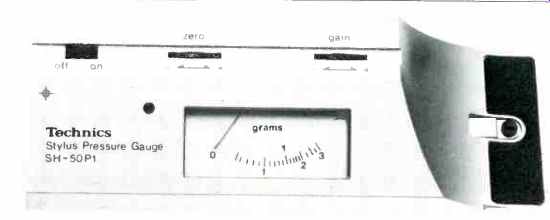
Manufacturer's Specifications
Semiconductors Used: Two Type: Semiconductor strain gauge electronic stylus pressure gauge, with "0" point adjustment and gain control mechanism.
Power Source: Two d.c. 3-V silver oxide batteries (SR44 types).
Stylus Pressure Measurement Range: 0.5 to approximately 3 grams.
Semiconductors and one LED. Dimensions: 53/4 in. (14.60 cm) x 2 in. (5.08 cm) x 15/16 in. (2.38 cm). Weight: 4.4 ounces (125 grams). Price: $50.00.
To the best of my knowledge , this is the first electronic stylus pressure gauge to be marketed. The device is a precision instrument housed in a gray plastic case. The meter scale (1 3/4 x 3/4 inches), calibrated to read directly in grams, is easy to read. For calibration accuracy, the SH-50P1 comes with an accurate 1.5-gram calibration weight. The gauge is a high sensitivity design which employs the piezo resistance effect to change pressure into electric resistance.
The device makes use of a pair of semiconductor strain gauges to compensate for temperature changes, giving added reliability and extra sensitivity.
The gauge is simple to use. First insert two silver oxide (type SR44) batteries into their compartment, making certain that their polarities are aligned.
When the unit is turned on, the LED illuminates. Immobilize the turntable platter when using the instrument, and place the gauge on the turntable mat (not on a record) with the center spindle inserted into the end slot of the unit. The meter is calibrated to 1 .5 grams with the supplied calibration weight and the gain control, and the zero adjust knob is used to zero the meter needle. To measure the stylus pressure (tracking force), place the stylus tip in the dimple on the stylus plate and read the tracking force directly from the meter. To prevent damaging the stylus, remove it from the gauge each time the tracking force is readjusted.
I have used the Technics SH-50P1 stylus pressure gauge for several months, and it surpasses for accuracy any stylus pressure gauge I know of. Its scale accuracy was tested with analytical balance weights and found to have an accuracy of 0.05 gram (50 mg). I recommend this stylus pressure gauge without reservation to anyone in need of such a device.
-B. V. Pisha
=============
ADs:
Sansui. The story of high fidelity.

1982 NEW TECHNOLOGIES TO COME.
1981 DYNA-SCRAPE FILTER. DIGITAL EQUALIZER.
1980 SUPER FEED-FORWARD. LASERDISC PICK-UP.
1979 D-O-B TONEARMS. SUPER COMPO
1978 G-RECEIVERS. DD DC AMPLIFIERS
1976 AM STEREO 1970 QS 4-CHANNEL.
1966 U.S. OPERATION BEGINS.
1965 STEREO RECEIVER.
1958 STEREO AMPLIFIER.
1947 SANSUI FOUNDED
High fidelity was born just a generation ago. So was Sansui. In 1947, when the transistor was invented, we began as a manufacturer of high-quality audio transformers. Since then, Sansui's dedication to the sound of music and our extensive R & D have led to countless technological breakthroughs and products that have continually advanced the art and science of high fidelity. Some highlights:
1958: The year of the first stereo recordings also brings the release of our first stereo amplifier.
1965: As hi-fi widens its appeal, we introduce our first stereo receiver, the TR 707A.
1966: Sansui's U.S. subsidiary, destined to be outgrown in little more than a decade by our new headquarters in Lyndhurst, N.J., begins operation.
1970: QS, Sansui's patented 4-channel system, gains worldwide recognition.
1976: No less a leader in broadcast than in consumer audio technology, Sansui introduces two stereo AM systems at the Audio Engineering Society convention.
1978: Psychoacoustic research into the subtle but very real deficiencies in bass and in transient response in music reproduction results in Sansui's introduction of DC amplifiers, the renowned G-series receivers, and our patented DD/DC circuitry.
These advanced technologies reduce distortions whose very existence had been questioned until we developed a straightforward measurement technique to verify on a meter what listeners' ears had long told them.
7900Z RECEIVER
1979: Sansui's patent-pending D-O-B (Dyna-optimum Balanced) method of optimally locating the pivot point results in significantly lower tonearm susceptibility to unwanted vibrations. The same year Sansui introduces the first member of our trend-setting system approach to hi-fi componentry, the Super Compo series.
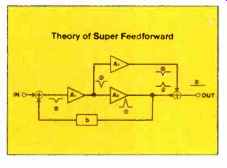
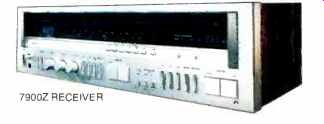

1980: Developing a theory first suggested in 1928, Sansui presents the first Super Feedforward amplifiers, the realization of a design that eliminates even the last vestiges of distortion that not even negative feedback could combat.
This development inaugurates a new era in the reduction of amplifier distortion and firmly establishes Sansui as a world leader in this important work. Eager to maintain its technological leadership, now also in video, in the same year Sansui develops an ultra-compact gas laser-optical pickup, some 40 times smaller than conventional detector systems, that promises to play a vital role in future compact digital audio disc players.
1981: Modulation noise, long a problem in cassette recorders, is reduced to virtual inaudibility by Sansui's patent pending Dyna-Scrape Filter. Equalization that's simple enough for practical home use is realized with Sansui's computerized SE-9 equalizer, which not only achieves professional results in record or playback, but also permits storing up to four instantly selectable equalization curves.
At the 1981 NY AES, we presented four major papers outlining breakthroughs in both audio and video engineering, each of which will lead to products to enrich all our lives.
Sansui's story and the story of high fidelity. They are really one ongoing story, and the future is bright for both.
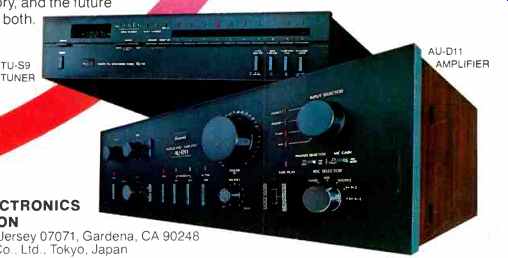
TU-S9 TUNER
AU-Du1 AMPLIFIER
A LASER MONITOR FOR THE PRIVILEGED FEW.
The new Celestion SL-6 has two drivers, a crossover network and an enclosure.
None of them like any other in the world.
Designed with a laser, a computer and a blank sheet of paper by a new generation of engineering talent, it achieves a level of performance that limits ownership to a select group of music lovers with the sensory and, yes, the financial resources to appreciate it.

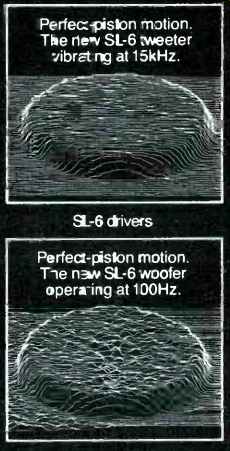
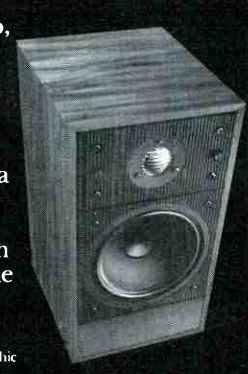

Its design philosophy is elegant simplicity. Simplicity made possible by a new understanding of how and why conventional drivers misbehave. And the freedom to eliminate these problems during the speaker design itself, rather than compensate for them by trial and error.
We began with something never seen before. The microscopic vibrations of drivers in action, frozen in time. Scanned and plotted in exquisite three-dimensional detail by a laser-computer system we call ULTRA.
What this revealed--in even the best conventional speakers--was distressing: Cone breakup, bell modes and other types of vibrational distortions.
Undesirable—and unexpected--resonances. Driver cones and surrounds so out of phase, they all but cancel at certain frequencies. All caused, incredibly, by the design of basic elements like voice coils, dust caps, diaphragms, surrounds, crossovers and enclosures.
---Conventional drivers :
ULTRA scan of bell mode cone behavior, long theorized but never before seen.
ULTRA scan of distortion-producing cone breakup.
So we started at the beginning--with two radically different transducers. For high frequencies, a self cooling treble «unit whose precision formed dome actually functions as the voice coil's core. Directly transforming electrical energy into perfect-piston motion, while acting as a heat sink for the voice coil.
Held in place by an ultra-thin suspension, for accurate response to beyond audibility. The low frequency driver is no less unique. A unified cone and neck, made more rigid by replacing the dust cap with a molded center terminator. Molecularly bonded at its rim to a long throw surround made of chemically related material.
Resulting in a moving structure that is essentially one piece, from center to edge, for accurate, perfect-piston response throughout the driver's range.
There is more. And it is less.
Less crossover network, because the drivers are so perfectly matched-- in response and efficiency. Less damping, because the drivers are so accurate. And leas: of all, size.
The SL-6 is the first compact loudspeaker of studio-monitor quality. Smaller than many "bookshelf" units, yet effortlessly handling up to 200 watts per channel.
There is much more to tell. But the most eloquent way to hear it is musically, from the loudspeaker itself, at one of a select group of audiophile dealers.
But before you do, a word of caution: only a limited number are planned for production.
Which will limit its pleasures to a privileged few.
If the idea of being among them intrigues you, write or call for more information.
*Ultra-accurate Laser Topographic Response Analysis.
-- SL-6 drivers
Perfect-piston motion.
The new SL-6’s tweeter vibrating at 15kHz.
Perfect-piston motion. The new SL-6 woofer operating at 100Hz.
celestion [ speakers
You'll know -- in an instant
Celestion Industries Inc. , Kunholm Drive, Box 521 Holliston, MA 01746, USA.
Bob Carver explains (briefly) how the Magnetic Field Amplifier works.
(Others tell how it sounds.) inefficient approach "clip", generating speaker say that does. More con-
Q. How is it possible for an amplifier as small and as light as the M-400 to deliver so much power and to cost so little?
A. The M-400's size (less than 7 inches) and weight (less than 10 pounds) reflect the advanced technology and the new patented designs used in both its power supply and amplifying stages--and the innovative relationship between them. (Not to mention the incredibly low price that resulted: $399.)
Q. What is different about the M-400's power supply and amplifying stages?
A. In any amplifier, the power supply produces and stores energy for use by the amplifying circuits.
Conventional amplifier power supplies are very inefficient because they produce a constant high voltage level at all times-irrespective of the demands of the ever-changing audio signal-and even when there's no audio in the circuit at all!
----Conventional power amplifier
----Solid line: audio output signal Broken line: power supply voltage Shaded area: wasted power Vertical lines: power to speakers
Magnetic field amplifier

This inefficient approach demands large and expensive power transformers and electrolytic capacitors. Large heat sinks are also needed to get rid of the heat associated with the constant high voltage of conventional power supplies.
In sharp contrast, the M-400's "smart" power supply produces only the power that the amplifier section needs from moment to moment to handle the signal accurately. In effect, the M-400's power supply is signal-responsive. As a result, overall efficiency is extraordinarily high.
Q. Do I really need 200 watts per channel?
A. Yes! If you want to hear music reproduced with full realistic impact and dynamic range, the musical peaks must be handled without compression, clipping or overload.
You'll be amazed at the improvement in openness and clarity when your system is able to deliver the power that music really requires.
When full digital audio arrives, dynamic-range capability will be even more significant. And the M-400's power will be even more necessary-with its ability to deliver 500 watts in mono, 900 watts for brief time periods, and more than 1200 watts on peaks!
Q. Now I understand why the M-400's power capability will improve my system, but can my speakers take it?
A. Speakers with a power rating of 50 watts or so will have no problem with the M-400. That's because speakers are not generally blown out by high, clean power, but rather by low powered amplifiers pushed beyond their overload points.
These low-powered amplifiers "clip", generating speaker damaging transients.
In addition to providing better sound and sufficient power, the M-400 has special protective circuits that guard both itself and your loudspeakers from almost any conceivable damaging circumstance. These include long and short-term overload, sudden overdrive signals (such as from dropped styli), shorted speaker leads, etc.
---M-400 Magnetic Field Amplifier
201 watts minimum continuous power per channel (500 watts mono) into 8 ohms, 20 Hz to 20 kHz, with no more than 0.05% total harmonic distortion.
All this protection operates via the signal-controlled power supply circuits, not the amplifier stages, so there's absolutely no chance of the typical distortions caused by conventional protection circuits.
Q. Aside from the technical innovations in its design, how does the M-400 sound when it comes to music?
A. My design goal was to make it sound musically accurate, and I'm proud to say that it does. More convincing perhaps, others confirm this. Leonard Feldman in Audio reported: "Music reproduction was superb and completely free of any false bass coloration or muddiness. The amplifier handled the toughest transients we were able to feed to it with ease...there was none of the brittle quality that one often detects from amplifiers that are beginning to strain." Julian Hirsch reported in Stereo Review that "...Its distortion and noise levels are entirely negligible... hardly conceivable that a small, inexpensive, lightweight cube such as this could deliver as much clean power as any but a few of the largest conventional amplifiers on the market-but it does."
Q. Is the M-400 limited to systems with separate amplifiers?
A. No. The M-400 can be used in many different types of systems, including those with receivers and integrated amplifiers. With our new Z-coupler device, you can upgrade your existing low power system into a superb 200 watts-per-channel system. What's more, the M-400 is easily connected without accessories to put out 500 watts mono!
Q. How can I get more information?
A. Easily. For literature, test reports and the address of your nearest Carver dealer, circle the number below. For faster response, write to us directly.
CARVER CORPORATION
P.O. Box 664, 14304 N.E. 193rd Place Woodinville, Washington 98072, USA.
SCOTT. The only stereo type in the family.
Michael Roberts, Vice President, Finance.
"To me, Scott speakers are a sound investment."
"I think in logical, practical terms. That's why I just bought Scott speakers.

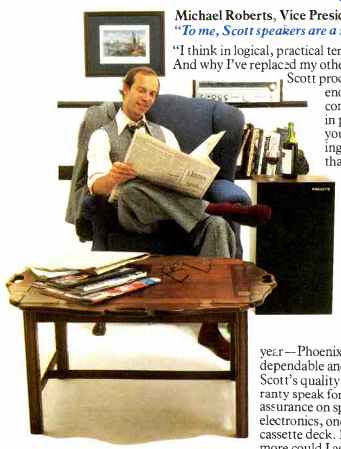
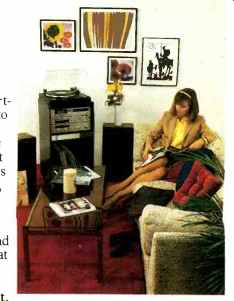
And why I've replaced my other components with Scott. Dollar for dollar, Scott products are the best buy. Their variety is enormous-speakers, turntables, receivers and complete systems. And Scott offers features found in products costing a great deal more. With Scott, you get the features you really want, without having to pay for those you simply don't need. To me, that's real value."
Ellen Roberts, sales representative.
"My Slimcom system and its 5-3-1 warranty fit my hectic lifestyle." "My Scott system is so easy. Easy to feel comfortable with. Easy to fit into a lifestyle like mine.
My company moves me around quite a bit. Next year-Phoenix. So I need a system that's dependable and durable. In that regard, Scott's quality and comprehensive warranty speak for themselves. Five years assurance on speakers, three years on electronics, one year on the turntable and cassette deck. Besides a promotion, what more could I ask for?"
Doug Roberts, engineering student.
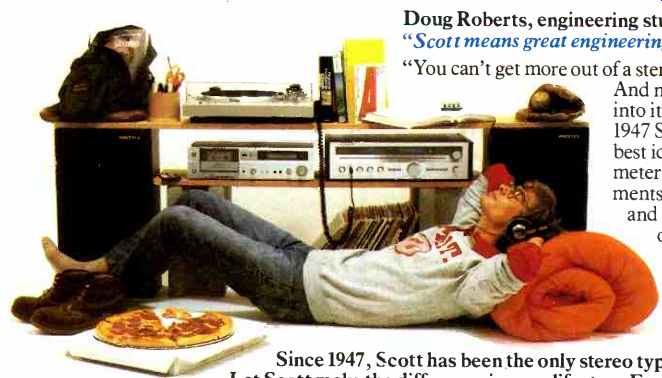
"Scott means great engineering, superb sound."
"You can't get more out of a stereo than the engineering that goes into it.
And nobody puts more engineering experience into its products than Scott. After all, since 1947 Scott has earned over 160 patents for its best ideas. And their new auto-range power meters are the latest in engineering developments. For me, Scott means great engineering and superb sound. Believe me-because no one knows engineering like I do. At least no one in the Roberts family."
Since 1947, Scott has been the only stereo type in the lives of countless families.
Let Scott make the difference in your life, too.
For more information, contact:
Dept. C, H.H. Scott, Inc., 20 Commerce Way, Woburn, MA 01888 U.S.A.
(617) 933-8800 Telex 20-0177
The Scott warranty: Five years on speakers, three years on electronics, one year on turntables and cassette deck.
SCOTT
The Name to listen to: Makers of high quality high fidelity equipment since 1947.
Technics linear-tracking turntable.
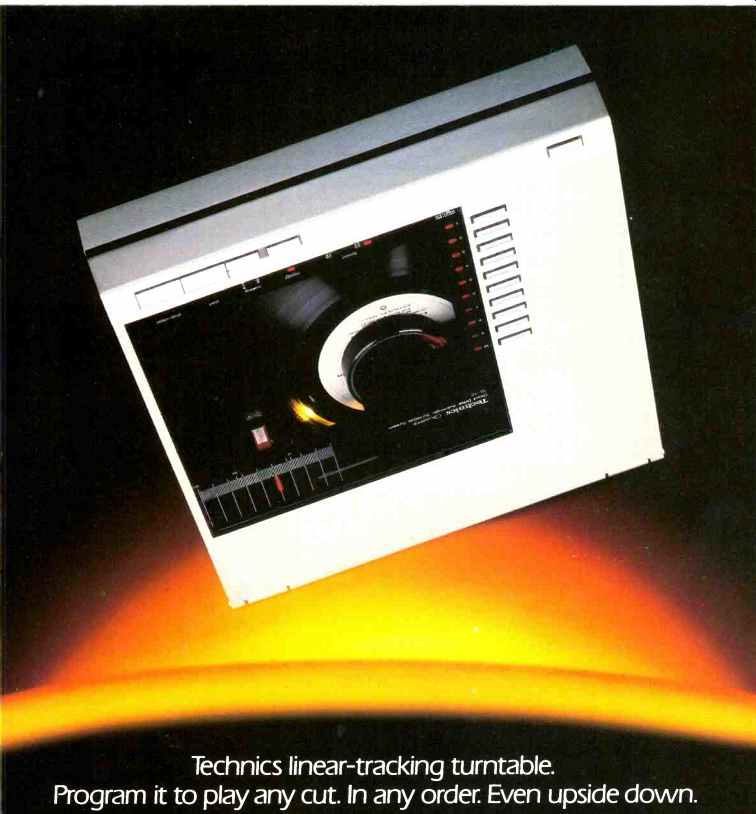

Program it to play any cut. In any order. Even upside down.
Technics direct-drive SL-15. It automatically plays the record selections you want and skips the ones you don't. It completely eliminates tracking error and is so advanced it can even play upside down.
The SL-15's microcomputer and infrared optical sensor let you play up to 10 cuts per side, in any order. Just press the program keys in the order of the selections you want to hear. And with the repeat button, the SL-15 can repeat the entire program or any selection.
The SL-15 performs virtually any function, automatically.
It accurately selects the record size and speed, finds the lead-in groove and begins playback at the touch of a button.
More proof of the SL-15's accuracy is its quartz-locked, direct-drive motor and dynamically balanced, linear-tracking tonearm. In addition to tracking perfectly, the SL-15 plays a record as accurately upside down as it does right side up.
Technics also offers other linear-tracking turntables, including our famous SL-l0 and SL-7. Audition one and you'll agree when it comes to linear tracking, Technics is a cut above the rest.
Technics The science of sound
Revox.
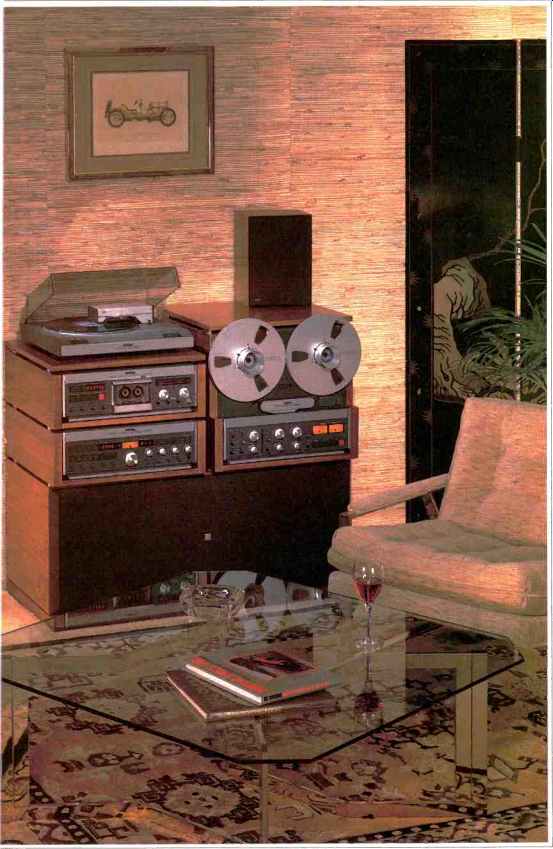

An audible expression of Swiss design and engineering.
In today's "me too" world of audio components, the Revox system stands apart.
The look is reserved, functional, elegantly understated.
The sound is natural, smooth, breathtakingly transparent-the result of over 30 years' experience in both professional and home audio.
The Revox system is a complete, flawlessly engineered combination of ideally matched components.
The new B710 microcomputer controlled cassette deck. The B795 turntable with the exclusive Linatrack tonearm.
The B780 receiver with ultra-low distortion, microprocessor tuning, and 18 programmable stations. The B77 open reel deck for uncompromising professional sound reproduction. And the Triton subwoofer/satellite speaker system with built-in component shelving.
Revox audio components are designed in Switzerland, and manufactured in Switzerland and Western Germany. You may hear them today at your nearest Revox dealer For more information, please write or call: Studer Revox America, Inc.
Dept. A,1425 Elm Hill Pike, Nashville, TN 37210.
(615) 254-5651
REVOX Professional standards in audio components
(Source: Audio magazine, Dec. 1982)
Also see:
High-Quality Moving Magnet (MM) IC Preamp
Ace Audio Model 4100 Filters (Mar. 1982)
= = = =