by Bert Whyte
THE AUDIO industry has always seemed to be particularly plagued by the "chicken and the egg" syndrome. Many examples come to mind, and were it not for the pioneering efforts of some far-sighted individuals who were willing to "go out on a limb," and introduce new (and usually controversial) audio products, we probably would still be playing 78 rpm records with cactus needles. A classic example of the syndrome is the pre-recorded cassette.
Even the most ardent advocate of the cassette system will admit that the major failing of music cassettes has been the intolerably high level of tape hiss. The cassette has other problems, but this factor alone has kept the cassette out of consideration as a medium for high quality recorded music. Tape hiss in professional master recordings had been successfully overcome by use of the Dolby A301 Noise Reduction System. While applicable to the cassette hiss problem, at nearly $1500 the A301 was hardly a consumer product! Dr. Dolby came to the rescue by introducing the "B Type" noise reduction system, a simplified single-band version of the professional system. To make the Dolby "B Type" system a practical reality in terms of pre-recorded cassettes, one would need a reasonably priced noise reduction unit in the home, which would be used to "expand" in a mirror image, pre-recorded cassettes issued in "compressed" form by the various record companies. In this manner the consumer would get the benefit of the 10 dB reduction of tape hiss afforded by the "B Type" system. At this point we reached the "chicken and egg" problem.
To wit: which comes first ... the noise reduction unit or the specially recorded cassettes? Fortunately the problem was eventually resolved. because the "B Type" system was designed for recording as well as playback. thus allowing a more "saleable" unit. With this as a plus factor. the Advent Corp. made the decision to manufacture a "B Type" record/playback noise reduction unit, which could be used with existing types of consumer tape recorders. As you know, this resulted in the marketing of the Advent Model 100, and a simplified less expensive unit, the Model 101.
Having done this, Advent felt there was a market for a cassette recorder with built-in Dolby "B Type" noise reduction system. Thus we have had for some time the hardware for making Dolby "B Type" recordings and for playback of Dolbyized cassettes. The rub of course was that no such cassettes existed.
From the record companies' viewpoint, it was felt that they could not undertake the manufacture of Dolbyized cassettes on a low volume, "specialized product" basis. The alternative was to Dolbyize practically all of their cassette output, which on this mass basis would add little cost in the manufacturing process.
The question here was whether such "compressed" cassettes would play satisfactorily on standard equipment without the Dolby noise-reduction circuitry.
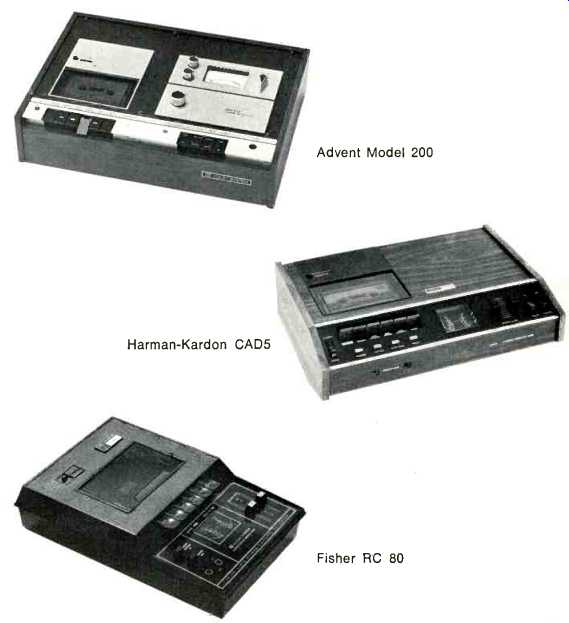
-----Advent Model 200 ; Harman-Kardon CAD5 ; Fisher RC 80
After we all agonized about this for some time, Ampex Stereo Tapes, by far the largest manufacturer of prerecorded cassettes, conducted experiments which proved to their satisfaction that not only could Dolbyized cassettes playback on typical consumer equipment, but that the slight added "brightness" often enhanced the sound. Those who felt the sound was over-bright could always turn down their treble controls.
On the strength of their experiments, Ampex announced they would be issuing Dolbyized cassettes. Either on their own volition, or spurred by the Ampex announcement, several record companies indicated interest in releasing Dolbyized cassettes. Finally, Vox and London/ Decca announced their definite plans to issue Dolbyized cassettes, and other record companies are soon expected to follow suit.
After months of eager anticipation, I now have before me Dolbyized cassettes from Ampex, Vox, and London/ Decca. There are only seven cassettes to be sure ... but I know of at least 15-20 more in the works in the immediate future, and I feel confident that the dam will burst soon and we will see Dolbyized cassettes from many record companies. To playback these Dolbyized cassettes, I used a Wollensak/3M cassette deck in conjunction with the Advent Model 100 Dolby noise reduction unit.
In order to have some sort of reference when evaluating these cassettes relative to their noise content, I set up a General Radio sound level meter 12 feet from my loudspeakers. I then adjusted my playback levels so that the loudest peaks in the music on the cassettes registered 100dB on the meter.
At that level, I listened to the pianissimo sections, and especially noted the hiss background whenever there were rests in the music and no sound at all was being produced. Admittedly, this assessment is partially subjective, but I think it works well enough to provide useful information. You may have raised an eyebrow at the figure of 100 dB. Remember this is on peak passages and is by no means average playback level.
I wanted to playback the cassettes at what I would call a psychoacoustic equivalent of concert hall level when sitting no further back than about the 20th row of seats. The loudness perception you would get from this level would depend on the size of your listening room. Obviously, if one sets the playback level in a room at an excessively low point, the hiss level you perceive will be lower. The problem with prerecorded cassettes up to now is that even at comparatively low playback levels, tape hiss was obtrusive.
The first Dolbyized cassettes from Ampex were the operas "Tosca" and "Norma," drawn from the London/ Decca catalog. I played "Tosca" first and then "Norma," and in listening to the quiet sections discovered I still could hear some residual hiss. Upon investigating, I found that Ampex had made a merchandising boo-boo. Instead of putting their best foot forward in this new enterprise and drawing from the wealth of Dolby A301 masters in the London catalog, they choose "Tosca" and "Norma," which were made before the Dolby System was in use. This brings up an important point.
You must first understand that when I say I heard some hiss from these operas, it was far below the level that I would have heard if these had been standard non-Dolby cassettes. The improvement was very audible and definitely worthwhile. Now quite obviously, the vast majority of classical recordings in the various catalogs were made prior to the introduction of the Dolby System. The signal-to-noise ratio of the recorders on which these productions were made, even going back as far as 1958, was on the average about 60-62 dB. This is pretty quiet and would satisfy a lot of people. If the actual master and not a "sub" or "working" master several generations removed from the master is processed for Dolby "B Type." the subsequent cassettes in the majority of cases should be quiet enough to warrant their release. Nonetheless, there is no question that the optimum noise reduction in cassettes is going to be those that are processed from Dolby A301 masters.
The Ampex/London "Tosca" in this Dolby cassette release is astonishing for its big, full-bodied sound, generally quite clean. The sound is definitely wide range and of course the dynamic range is quite wide due to the Dolby processing. You won't believe the solidity and weight of the cannon that are so prominent in this opera. Ampex scores high on the mechanical side ... the cassette winds smoothly, and it is in only two or three spots that a flute or an oboe has a slightly "burbly" sound due probably to irregularities in the lining of the cassette. While it would have been more desirable if Ampex had released a production made from a Dolby master, the present cassette is very much worthwhile. "Norma" is not nearly as good as "Tosca" in several ways. Tape hiss is a shade more prominent, there are more "burbly" sounds in exposed woodwind sections of the score. The orchestral sound is impressively full. The most glaring fault is a shrillness and stridency to the voices that really grates on one's nerves.
It would appear that equalization is off in some respect. It doesn't jibe that the orchestral sound is fairly well balanced, while at the same time the voices appear to be loaded with, high frequency distortion.
The London/Decca Dolbyized cassettes were sent to me from London and represent somewhat of a departure for this company. in that their cassettes will be distributed through London Records offices in this country. As you are probably aware, all London tape products have been made and distributed in this country by Ampex Stereo Tapes for quite a few years. London/ Decca claims there is no conflict of interest in their new distribution venture, that their contract with Ampex will remain in force. Whatever the case.
I have listened to Albèniz-Suite Espanola. Vienna Imperial, and Serenade For Strings and Souvenir De Florence by Tchaikovsky. all Dolbyized stereo cassettes, and to put it mildly.
I am absolutely amazed at the superb quality. This is what the game is all about. This represents a new ball game .. . one can no longer dismiss the cassette as a "toy." The best of the lot is the "Suite Espanola," and this comes so close to the quality of a good disc, it is frightening. It doesn't have quite the wide frequency response, low distortion, and transient response of the disc, but it is very, very good. On the plus side for the cassette, there is the dead quiet background ... no audible tape hiss even though this too was played back with peak levels of 100 dB. Then too, there are no "ticks" or "pops" or "scratches," which can be so distracting and annoying when listening to a disc. The overall sound is beautifully clean and has great sonority. Strings are very smooth, showing exceptionally low levels of high frequency distortion.
Percussion was sharply defined and extended all the way to the lowest frequency. Brass was big and bright. In all, there was no feeling of compression so common with standard pre-recorded cassettes. One friend for whom I played this cassette just wouldn't believe he was listening to a cassette and went over and pressed the pause control on the Wollensak to convince himself! Mechanically the cassettes were good too, with just one "burble" sound on a solo flute, the only fall from grace.
Much the same praise can be lavished on the Tchaikovsky pieces and the Vienna Imperial, with just a shade less stability and a bit of high frequency distortion showing up occasionally. In terms of dynamic range and tape hiss they were on a par with the Suite Espanola, which is accolade enough. It goes without saying that all three Dolbyized cassettes were processed from Dolby A301 masters . .. and it sure makes a great difference! There is no doubt that the use of chromium dioxide tape would allow more headroom and even lower values of high frequency distortion, but strictly from the viewpoint of signal-to-noise ratio these London/Decca Dolbyized cassettes leave scant room for improvement.
The full report on the Vox Dolbyized cassettes will have to wait until next month, since I have discovered a slight mechanical problem with them and need new copies. As a preliminary observation they are of roughly the same quality as the London/Decca cassettes, although there seems to be a tiny wisp of tape hiss still audible.
(Audio magazine, 1971; Bert Whyte)
= = = =