Audioclinic
by Joseph Giovanelli
Magnet Weight
Q. What is the different in meaning between the terms "magnet weight" and "magnet structure weight" in speaker specifications?
-Edward Esposito, Brooklyn, N.Y.
A. Magnet weight simply refers to the weight of the magnet used in the loudspeaker. Magnet structure weight includes not only the weight of the actual magnet but also includes the weight of all the iron which surrounds it and the pole-piece in the center.
In either case, the terms are not really pertinent because they do not convey anything about the amount of magnetic flux appearing in the gap to move the voice coil. One naturally tends to think that the greater the weight of the magnet used in a design, the more intense will be the field strength for the voice coil. While this is partially true, there are, however, many other factors which influence the design, including relative strength of the magnet for its weight, gap distance, length of wire in the coil, etc.
Four-Speaker Hook-up And Placement
Q. I have two pairs of speakers, both by the same maker, however, each pair is a different model. Pair-A speakers are two-way, bass-reflex systems, with 12-in. woofers and 2 1/2-in. tweeters. Pair-B units are three-way, bass-reflex designs, with 10-in. woofer, 3 1/2-in. midrange, and 2 1-in. tweeters. Pair 8 has a three-position high frequency adjustment, while pair A does none.
If I place them in a four-corner arrangement for stereo, how should I pair the speakers? Also, if I decide to go to a synthesizer for four-channel sound, which ones would you suggest be used for the rear speakers?
-F. T. Overby, Jr., Richmond, Va.
A. It is best to have all speakers be of the same make and model in situations of the kind you describe. When this is not possible, pick the two speakers you prefer and use them up front and use the ones you like least in the rear positions. The particular design parameters of the speakers should not influence your choice here, though you may have to add a level-control pot if their efficiencies are very different.
In the case of a four-corner stereo set-up, the front and rear speakers for a given channel may be paralleled.
Their combined impedance, however, must not be lower than the minimum impedance that can be handled by your amplifier. The important thing here is to find out from a test report or the manufacturer what the MINIMUM impedance is, since in many cases this is significantly lower than the nominal or rated impedance.
For either synthesized or true four channel set-ups, those speakers whose sound you prefer should again be placed up front. The exact manner of speaker hook-up will depend on the equipment employed, and generally the maker of the unit will have some specific recommendations.
Speaker Impedance With Separate Amps
Q. I have two pairs of 6-ohm speakers. If I connect one pair normally to my receiver and the other to a separate amplifier fed from the Tape Out jacks of the receiver into the AUX inputs of the amplifier, does it make any difference that the speakers' impedance is less than 8 ohms? Would it make any difference if a four-channel adaptor was connected between the receiver and the amplifier?
-Marvin Foley, Portland, Maine.
A. So long as your speakers are connected to two separate power amplifiers, there is no interaction between them, which might lower their impedance. This is also true with a four-channel decoder interconnecting the two amplifiers.
=============
Tape Guide
by Herman Burstein
Left-Channel Dropouts
Reader Bob Nicholas, Long Beach, Calif., provides a possible cause of left-channel dropouts: "I have encountered dropouts and loss of highs on certain reels of tape, even supposedly high-quality mastering tape made by some well-known companies. The cause of the problem, sometimes, are wide spots in the tape.
This causes the tape to 'hang up' in the guides, with the result that the outer edge breaks contact with the tape head. It is easy to tell when this is happening, if the deck has tension arms, because the drag caused by the hang up causes the arms to flip until the tension is normal again.
"When the reel is wound smoothly, I can even see the overhang of the wide spots. My tape supplier can't believe this is a problem even though I have shown him the defective reels of tape. I guess the cause is improper adjustment of the tape slicers during the cutting process."
Evaluating a Deck
Q. I had my American-made tape deck tested by Revox engineers. Their analysis showed for channel A ragged bass response between 20 and 50 Hz, a steady rise in response from 50 Hz to 15 kHz, signal-to-noise ratio of 40 dB at 0 VU, and wow and flutter of 0.5 percent at 7 1/2 ips. Could you please explain the ragged response at very low frequencies? Why is there a steady rise from 50 to 15,000 Hz? Why is there 3 percent distortion at 0 VU on this channel and what is the significance of the 40-dB signal-to-noise ratio?
A. F. Hasson, Carlstadt, N.J.
A. The ragged response at the bass end is rather usual, due to the fact that at low frequencies where the recorded wave length is long, the entire head and not just the gap tends to react to the magnetic patterns on the tape. The treble rise may be due to insufficient bias current or to a fault in record treble boost or both. At 0 VU you should have about 1 percent distortion, rather than 3 percent THD. The excessive distortion appears due to insufficient bias, and this is consistent with the excessive treble response, which can also result from too much bias. The 40-dB S/N ratio is quite poor. At 0 VU, corresponding to 1 percent harmonic distortion, S/N ratio should be about 48 dB in a high quality machine. With reference to 3 percent distortion, S/N ratio should be somewhat higher, about 55 dB.
Adjacent-Channel Crosstalk
Q. I purchased a Revox A77 to dub my tape collection onto larger reels, but whenever 1 record music with much low-frequency energy, I can hear crosstalk on the other side of the reel, especially between selections.
The amount of crosstalk also seems to vary with tape thickness, thin tapes giving less crosstalk than the thicker ones. How much crosstalk is normal with a quarter-track machine? I told my dealer about this and he measured the deck, reporting that separation between channels was-52 dB or seven dB better than the maker claims. He also stated flatly that audible crosstalk interference is normal in quarter track machines.
-Peter Thrift, Bellevue, Neb.
A. Your dealer is wrong. In measuring channel separation, it seems he measured separation between the left and right electronics of the tape deck, rather than between adjacent tracks of a recorded tape. His measurement has nothing to do with adjacent-channel crosstalk. The NAB standard says that crosstalk must be down 60 dB at all frequencies from 200 to 10,000 Hz, which is inaudible. Your problem is probably due to vertical mis-position of the heads or (much less likely) to a manufacturing defect which resulted in excessively long gaps in the heads.
============
Behind The Scenes
by Bert Whyte
Autumn in New York, a beleaguered city with the fiscal hounds yapping at its heels, a creaky old vessel floundering in a sea of red ink, the Big Apple riddled with the worms of worry--is this any place to hold an. Audio Engineering Society Convention? Why not? There still is a venue there called the Waldorf-Astoria and, nothing daunted, this is where the AES held its 52nd Convention on October 31 to November 3rd of last year.
Inevitably, some AES conventions are more interesting than others.
Some have the excitement of new technical breakthroughs or the introduction} of quadraphonic sound, for example. While no rockets were launched at this 52nd convention, there were some noteworthy papers presented and some interesting new equipment was on display. As usual, the Grand Ballroom of the Waldorf was crammed with the tools of the audio engineer's trade: multi-channel tape machines, mixing consoles, noise reduction equipment, delay units, microphones, measuring equipment, etc. Darned if I know the reason why, but the "hot" item on the floor seemed to be portable mixers. I lost count of the offerings, but there were units in every possible input/output configuration. A new piece of equipment that was getting plenty of attention was United Recording Electronic Industries Model 200 Automatic Response Plotting System. The result of an unusual collaboration between UREI and Hewlett-Packard, this combines a basic Hewlett-Packard X-Y plotter with a UREI audio analysis plug-in module. The first of a series of modules, the Model 200 has an automatic frequency sweep generator and receiver, which can be used for such things as EQ and filter measurements, tape machine response, sine-wave loudspeaker and microphone response, room acoustics analysis, etc.
An important feature of this unit is a rate-sensing device, which automatically slows the sweep rate when rapid amplitude changes are encountered and resumes the normal sweep rate following these large excursions. I can think of plenty of audio applications for this item, and although the price of the unit is $2250, it is claimed that this is less than half the usual cost of such an instrument.
At the Bruel and Kjaer stand, they were demonstrating their always fascinating1/2-octave analyzing equipment, along with the new gating-technique equipment for analysis of transducers and new IM analyzers for making swept IM measurements to 200 kHz.
Henning Moller and Carsten Thomsen, both of B&K, presented papers of these devices and their applications, and it is claimed that the gating technique will give more meaningful data on loudspeaker performance than the usual testing in anechoic rooms.
The Tandberg people were showing their new 10 1/2-in. reel machine with crossfield head and built-in Dolby-B noise reduction, for which a S/N ratio of some 73 dB is claimed. Point of pride was their new three-head monitoring cassette machine, which incorporates such niceties as azimuth adjustment. This unit, which costs just under $1000, will be available in the spring of 1976.
Ampex was showing a production version of their tape counter for the MM1100 tape machine, and it is such a useful accessory, I once again plead the case for such a unit for the 440C tape machines.
The 5th floor of the Waldorf houses the active demonstration rooms and is more than ever beginning to resemble a mini hi-fi show. Pioneer was on hand with their new dynamic range expander. Variable controls on the unit permit as much as 15 dB expansion, depending on the source material. It must be used judiciously, for too heavy a hand and you can hear the system "working" or "breathing." At the point where the action is not perceptible, there is still 7 or 8 dB of usable expansion, and it is disheartening to hear how much limiting and compression is used even with classical recordings. Used with discretion, the system works quite well. Pioneer was also showing a prototype 10 1/2-in. open-reel tape recorder. The interesting feature on this machine is that it is expandable to four channel with a change of heads and the addition of an amplifier module. Another big plus is that finally on a consumer tape recorder the bias and equalization controls are easily accessible on the front panel. Pioneer's high-polymer film, which was such an interesting item at the last New York AES convention, is now used in the high frequency section of an imposingly large speaker system. Unfortunately I didn't really hear it long enough to venture an opinion on overall quality, but the top end did indeed sound very smooth.
Down the hall, Teac/Tascam were showing some interesting items, such as a 16-channel deck using one-inch tape, with built-in dbx noise reduction as an option. There is a strong possibility that Teac will offer dbx in some of their audiophile tape machines and perhaps even in a cassette recorder! dbx had their own room and were demonstrating their noise reduction system in various configurations. What was startling there was to hear some very high level Karl Heinz Stockhausen percussion music suddenly assault your ears from a tape with an utterly silent background.
In the Yamaha room, much attention was centered on their big V-FET B-1 amplifier and their new pre-amp powering their monitor speakers with the interesting beryllium diaphragm mid-and high-frequency units.
Sennheiser had one of the most unique items at the AES convention, a remote control system for microphones and headphones utilizing an infrared carrier system, in other words, wireless mikes and headphones. Reportedly the system is in use in some TV sets in Europe. In this application, it is possible to view a TV set, with private listening via the infrared system wireless headphones.
You hear a lot of propaganda these days about the low status of quadraphonic sound. Maybe so, but the people at the Columbia SQ, the Sansui QS, and the JVC CD-4 demonstration rooms were putting on first-class shows, and the excellence of their quadraphonic sound was keeping the rooms well filled. I met former AES president John Eargle at the JVC room, and he showed me an interesting thing about the new JVC-1000 professional demodulator! By adjusting the controls in a certain way, it was possible to hear the carrier channels, without the baseband channels. To prove that we were hearing only the carrier channels, John removed the pickup from the record and flicked the stylus ... and no sound was heard from the speakers!
AES Banquet
At the AES awards banquet there is always a guest speaker, and on this occasion it was none other than Avery Fisher. Mr. Fisher spoke entertainingly about his early days in the audio industry and touched on some of the highlights in his career. Then he went on to detail some of the aspects of his munificent gift to the New York Philharmonic Society which as you probably know renamed Philharmonic Hall as Avery Fisher Hall in gratitude for his generosity. Then, most importantly, Mr. Fisher discussed the acoustic problems that have plagued Avery Fisher Hall.
The hall was designed by the very well-known acoustical consultants, Bolt, Beranek and Newman. The hall design was based on extensive studies of acoustic principles and theory. It was a reasoned scientific approach, with no loom for "cut and try" techniques or strictly intuitive thinking. All the resources in the armamentarium of acoustical science were applied to the project. Nonetheless, when the hall was built, the acoustics were disappointing. The sound of the New York Philharmonic Orchestra was thin, with poor projection and attenuation of bass frequencies. An acoustic "facelift" was undertaken some time later, but the improvements were marginal. The last time I was in Avery Fisher Hall, the Boston Symphony orchestra was performing the massive Mahler 5th Symphony. What I heard was a disaster. In the big tutti and forte passages, the string sections were sawing madly away, and I could barely hear them. The huge concert bass drum was being lustily whacked, but instead of a bang, all I got was a whimper. Instead of a great outpouring of sound, what I heard sounded compressed and attenuated.
The hall was like a sponge, and frankly I haven't been back to the hall since. Thanks to the generosity of Avery Fisher and his very strong feelings that New York should have a fine concert hall with really good acoustics, a new project has been undertaken to reconstruct the hall and hopefully achieve this goal. It was obvious that some drastic measures were going to be necessary to change the acoustics of the hall, but I wasn't quite prepared for Mr. Fisher's announcement that beginning in May-1976, the entire interior of the hall would be removed, leaving only the steel and concrete shell of the building! As Mr. Fisher remarked, "we're going to start from scratch." He then told us some of the details of the new hall, the fact that it was expected to reopen in October 1976, and that the architect/ acoustician on the project was Cyril Harris, designer of the new Orchestra Hall for the Minnesota Orchestra.
Therein lies the tale I will relate to you next month. But before I close this month's edition, let me extend a warm and heartfelt round of public applause to John Woram, Iry Diehl, and all those others who helped make their production of The Magnificent Men and Their Music Machines the entertainment event of this year's Convention. This retrospective view of electronic music synthesis and applications featured, along with Robert Moog and Michael Colchimaro, Suzanne Ciani on her Buchla system. Well done, all!
============
Dear Editor:
Another Sage Down Under
Dear Sir:
It was indeed a pleasure to read Ray Newman's discussion of the monumental work of A. N. Thiele in the August issue of Audio. I have no complaint with the technical content of this article, but I think it might be well to put the article into a better perspective with a few historical notes and additional references.
Primarily, I feel that Ray has understated the role of Dr. Richard H. Small of the Univ. of Sydney in building on the foundation laid by Thiele. In early 1971, Dick Small sent me a copy of Thiele's paper and, after the first reading, I called the editorial office of the Journal of the Audio Engineering Society to arrange for reprinting.
Thus, credit for making this work known outside of Australia really belongs to Dick.
From a theoretical standpoint, the credit for the understanding of the box-volume, efficiency, and low-frequency cut-off exchange must also go to Dick Small (20, 21, 22), and the quantitative relationships for cone excursion (really, displacement volume) were developed by Small. The foundations were in Thiele's work, but the extension was done by Small.
Finally, it might be well to mention Small's work on closed-box (sealed, acoustic suspension, etc.) systems (21). Throughout his article, Ray preaches my sermon that vented boxes can be 3 dB better than sealed boxes, but Thiele said nothing about sealed boxes. Don't forget, most acoustic suspension systems are near or remote copies of Villchur's AR-1 of 1955 (23). Until Small's 1973 work, there was no complete design theory for closed boxes to compare with Thiele's 1961 theory for vented boxes. (Here in this country, the marketplace was the opposite-closed boxes have long been closer to optimum than commercially available vented boxes. The Klipsch Cornwall, designed in 1959, is the exception to prove the rule.) It was only when Small put closed and vented boxes on the same level of theoretical design excellence that the 3-dB advantage for vented boxes became "obvious to the most casual observer." J. Robert Ashley Prof. of Engineering Univ. of Colorado; Colorado Springs, Colo.
References
(Note: The numbering takes up where Newman left off.)
20. R. H. Small, "Direct-Radiator Loudspeaker System Analysis," IEEE Trans. Audio and Electroacoustics, Vol. AU-19, No. 4, p. 269, Dec. 1971. Also, J. Audio Eng. Soc., Vol. 20, No. 5, p. 383, June 1972.
21. R.H. Small, "Closed-Box Loudspeaker Systems" (in two parts). "Part 1: Analysis," J. Audio Eng. Soc., Vol. 20, No. 10, p. 798, Dec. 1972. "Part 2: Synthesis," J. Audio Eng. Soc., Vol. 21, No. 1, p. 11, Jan. 1973.
22. R. H. Small, "Vented-Box Loudspeaker Systems" (in four parts). "Part I: Small-Signal Analysis," J. Audio Eng. Soc., Vol. 21, No. 5, p. 362, June 1973.
"Part II: Large-Signal Analysis," J. Audio Eng. Soc., Vol. 21, No. 6, p. 438, July/Aug. 1973.
"Part III: Synthesis," J. Audio Eng. Soc., Vol. 21, No. 7, p. 549, Sept. 1973.
"Part IV: Appendices," J. Audio Eng. Soc., Vol. 21, No. 8, p. 635, Oct. 1973.
23. E. M. Villchur, "Commercial Acoustic Suspension Speaker," Audio, Vol. 39, No. 7, p. 18, July 1955.
Editor's Note:
Mr. Newman's article was submitted in Sept., 1972, having been written the previous summer. As nearly all of the above referenced articles were thus not available to him, he should receive credit for independently working out the theory.
Addendum: Audio Oscillator October, 1975
The values for resistors R4A and R4B were inadvertently dropped from Table 2, the parts list, though they might have been calculated from the Wein bridge formula. The proper values are 143 kOhms.
Save O-R Prerecorded Tapes
Dear Sir:
As you may have read in our literature and various newspaper articles, Ampex has decided to leave the prerecorded tape business which may prove to be the death knell of the prerecorded open-reel format. Those of us who have been with Ampex's direct-mail programs since 1970 are trying to keep that from happening. But we need your help!!! Your support of our most recent efforts has caused the General Manager to take a second look at reel-to-reel, and I believe we can change his mind but there are two things we must prove. First, we must show him that the market exists. Industry figures show that the reel market is minute, but past experience has shown me that your loyalty more than makes up for small numbers. Second, we must show him that this market can be developed and serviced profitably. I'm certain we can do both! We have taken a long, hard look at our manufacturing costs and the methods of operating The Tape Society. I think we have come up with some significant cost-saving ideas which, if implemented, could change the management's position.
Please take a few minutes to write to me, even if you've never purchased tapes from The Tape Society; I'm still interested in your opinions on open reel. There are two major things I need to know about your tape library: first, is the bulk of it prerecorded or is it home made? Second, if it was home made, was it that way by necessity, i.e. because you could not find a source of the prerecorded tapes you wanted? I'm a reel-to-reel freak myself, and I don't want to see it go the way of the 78. Become a vocal minority! Let your opinions be heard! If you don't speak out now, you'll leave no one to blame but yourself if this campaign fails!
Russell Fields, Manager, Direct Marketing/Advertising Ampex Corp.
2201 Lunt Ave.; Elk Grove Village, III. 60007
==========
==========
ADs:
BSR Silent Performers

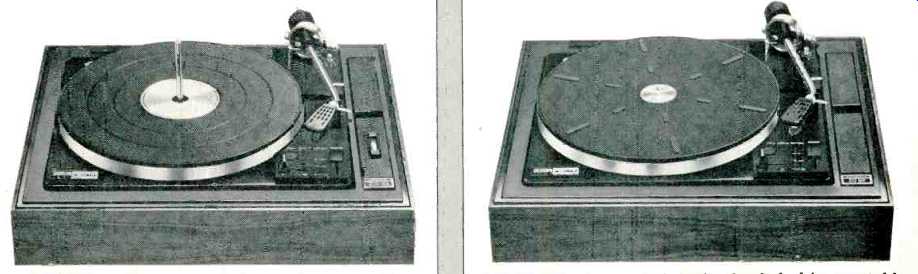
State-of-the-art belt-drive turntables at today's state-of-the-wallet prices.
For years most expensive manual record playing devices have used belt-drive as a smooth, trouble-free--and most important--silent method for transmission of power.
Now, our engineers have succeeded in integrating a highly-refined belt-drive system into more affordably-priced turntables.
They offer a combination of feature and performance not yet available in even more expensive competitive models. We call them the Silent Performers.
Four models are available. The 200 LAX is the deluxe automatic belt-drive turntable.
Full automatic capability is achieved with a gentle yet sophisticated 3-point umbrella spindle. It has a heavy die cast platter, high-torque multi-pole synchronous motor, tubular "S" shaped adjustable counterweighted tone arm in gimbal mount, viscous cueing, quiet Delrin cam gear, automatic arm lock, dual range anti-skate, stylus wear indicator and much more. Included are base, hinged tinted dustcover, and ADC VLM MKII cartridge.
The 20 BPX is an automated single-play belt drive turntable. It has the "S" shaped tone arm and features of the deluxe automatic model with a precision machined patter and ADC K6E cartridge. It comes complete with base and dustcover. Model 20 BP is identical but without cartridge.
Model 100 BAX ( not shown) automatic belt drive turntable has a low mass aluminum tone arm with square cross section Rand a precision machined platter.
It is packaged with base, hinged tinted dustcover, and ADO K6E cartridge.
BSR 200 BAX-Deluxe automatic belt-drive turntable
BSR 20 BPX-Automated single-play belt-drive turntable
============
Sony
"The Sony TC-756 set new records for performance of home tape decks.” (Stereo Review, February, 1975)
Hirsch-Houck Laboratories further noted, "The dynamic range, distortion, flutter and frequency-response performance are so far beyond the limitations of conventional program material that its virtues can hardly be appreciated”. The Sony TC-756-2 features a closed loop dual capstan tape drive system that reduces wow and flutter to a minimum of 0.03%, logic controlled transport functions that permit the feather-touch control buttons to be operated in any sequence, at any time without spilling or damaging tape; an AC servo control capstan motor and an eight-pole induction motor for each of the two reels; a record equalization selector switch for maximum record and playback characteristics with either normal or special tapes; mic attenuators that eliminate distortion caused by overdriving the microphone pre-amplifier stage when using sensitive condenser mics; tape/source monitoring switches that allow instantaneous comparison of program source to the actual recording; a mechanical memory capability that allows the machine to turn itself on and off automatically for unattended recording.
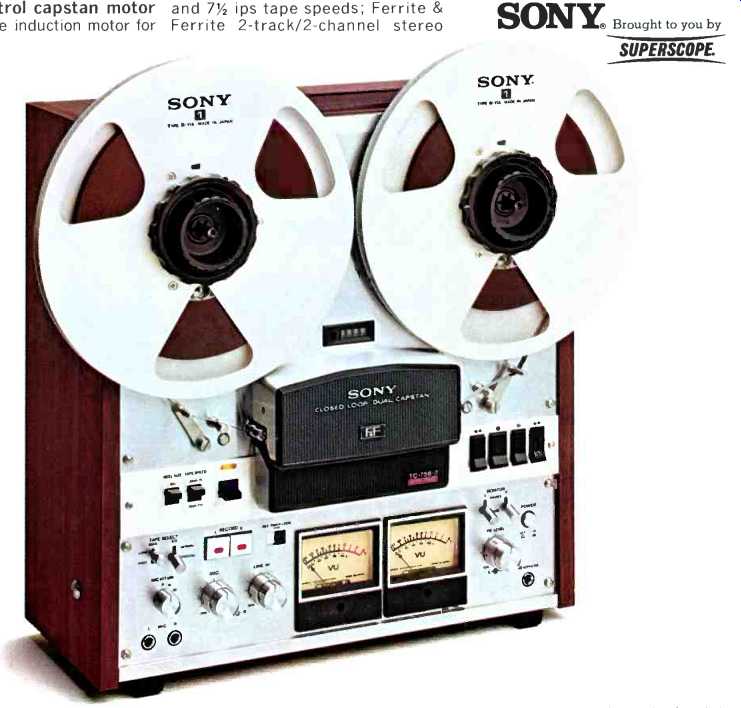
In addition, the TC-756-2 offers 15 and 7 1/2 ips tape speeds; Ferrite & Ferrite 2-track/2-channel stereo three-head configuration; and symphase recording that allows you to record FM matrix or SQ* 4-channel sources for playback through a decoder-equipped 4-channel amplifier with virtually nonexistent phase differences between channels.
The Sony TC-756-2 is representative of the prestigious Sony 700 Series--the five best three-motor 10 1/2-inch reel home tape decks that Sony has ever engineered. See the entire Sony 700 Series now at your nearest Superscope dealer starting at $899.95
SONY--Brought to you by SUPERSCOPE.
------------
++++++++++
--------------
(Audio magazine, 1976)
Also see:
Record Cleaners Revisited/B.V. Pisha
Audio's Crescendo Test/Richard C. Heyser
= = = =