AURICLE--MSB TECHNOLOGY LINK D/A CONVERTER; CREEK 4330SE INTEGRATED AMP .
------------------------
MSB TECHNOLOGY LINK D/A CONVERTER
Company Address: 14251 Pescadore Rd., La Honda, Cal. 94020; 650/747-0400
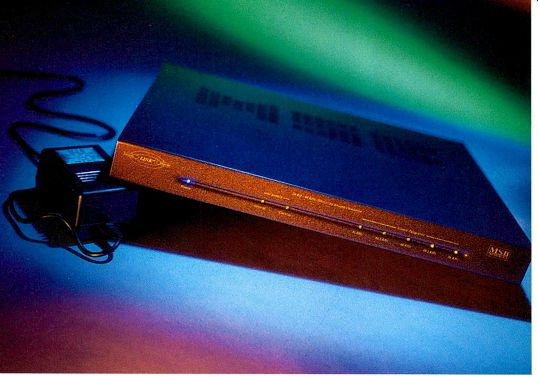
Good things can come in inexpensive packages. At $349, the Link won't be considered an assault on the state of the art, yet this MSB Technology D/A converter is one of the first 24 -bit models available and one of the first to handle sampling rates as high as 96 kHz. Since it also accommodates standard sampling rates from 32 to 88.2 kHz, it can convert satellite broadcasts, CDs, and the 24-bit/96-kHz DVDs that are just starting to appear.
The Link is even upgradable, to an extent. Although it did not arrive in time for me to try, a plug-in virtual -surround card is available, at $149, to provide more spacious imaging from Dolby Surround and some stereo recordings. And MSB promises that it will offer a reasonably priced decryption upgrade if a copy -protection system now sought by some software producers is adopted. (These companies want to limit the digital output from DVD players and trans ports to 48 -kHz sampling, even on 96 -kHz recordings.) As might be expected at the Link's relatively low price, its front panel is not crammed with controls. There are none, in fact just LEDs to tell you when the converter is on, which of its digital inputs is active, and what the signal's sampling rate is.
Despite the absence of a selector switch, the Link has three inputs: coaxial and Toslink digital and a pair of analog RCA jacks. The Link automatically selects whichever digital input is active (if both are active, it chooses the coaxial); if neither is active, analog input signals are passed straight through to the output jacks.
The MSB's analog input enables you to add two digital sources to your system without giving up one of your preamp's analog inputs.
The Link's digital circuitry seems very well engineered for the price.
The DAC chips are Burr -Brown PCM1716s, with what that company calls Enhanced Multilevel Delta -
Sigma modulator architecture. The Crystal CS8414 digital receiver chip supports just about every professional and consumer digital signal format. And a phase -locked -loop anti -jitter circuit is said to provide 27 dB of jitter rejection.
The Link's analog circuitry is direct -coupled, to ensure good bass quality, and rated response extends down to 0 Hz. To keep these circuits entirely free of capacitors, MSB uses a servo loop to eliminate DC offset in the output signal.
The power supply is external, to keep AC out of the unit. Four voltage regulators keep the power clean.
A D/A converter with true 24 -bit resolution would have an S/N ratio of 144 dB; even a 20 -bit DAC should theoretically achieve about 120 dB.
Yet no D/A converter I know of can lay claim to such S/N, so I'm not perturbed that the Link's rated dynamic range and S/N are 106 dB (about 10 dB better than a perfect 16 -bit DAC).
The real advantages of a 24 -bit DAC are its ability to handle 24 -bit inputs without truncation and its potential to minimize crossover distortion.
Sonically, the Link is not a world beater, but it does deliver very clean sound from conventional CDs and DATs, with less digital haze and hardness than most D/A converters in its price range. However, it is a bit lean in the lower midrange. And its MSB, continued from page 75 dynamics and transients, though good to very good, are not quite excellent. Imaging is very natural, but the soundstage could stand more depth. The bass is very good to excellent, especially considering the Link's price, and there's plenty of power and definition. You can find D/A converters that equal the Link in warmth and other nuances, but you would probably have to spend at least three to four times as much to get anything cleaner or decidedly better.
The Link does enable you to clearly hear the differences between conventional 16 -bit sources and the new 24-bit/96-kHz DVDs.
Although its sound is not at the level of the dCS Elgar or Theta Digital's converters, its dynamics, transients, transparency, low level detail, and natural musical overtones and harmonics are noteworthy.
Only a few DVD decks provide the 96 -kHz output you need to hear the Link at its best. Check any DVD player before buying it to make sure its output is actually 96 kHz and that it will light up the proper sampling -rate indicator on a D/A converter with 96 -kHz capability. Most DVD players down-sample 96 -kHz signals (from those few discs that carry them) to 48 kHz before feeding them to their digital outputs. The only exceptions I know of are Pioneer's DVD decks, including the new DV-414D (which costs around $400). Other inexpensive DVD players with 96 -kHz output capability may be available soon, however, and for $385 MSB will upgrade any DVD player for 96 -kHz output.
The new Classic Records and Chesky 24 bit/96-kHz DVDs make a powerful argument for the world beyond CD. Classic has outstanding new Terry Evans, John Lee Hooker, and Jimmy Rushing re-masterings, while Chesky has a variety of vocals, jazz, and classics. I was particularly struck by Evans' Blues for Thought (Classic DAD - 1014) and by Kelly Flint's vocals and the instrumental passages on Dave's True Stories' Sex Without Bodies (Chesky CHDVD-174).
Track 4, "I'll Never Read Trollope Again," is truly witty (possibly a first for a female vo cal on a high-end recording).
Yes, such recordings present a powerful argument for the next leap in audio. But it takes an excellent, affordable D/A converter like MSB Technology's Link to make that argument compelling.
+++++++++++++++++
by ANTHONY H. CORDESMAN; AURICLE KEN KESSLER
CREEK 4330SE INTEGRATED AMP
Company Address: c/o Music Hall, 108 Station Rd., Great Neck, N.Y. 11023; 516/487 3663
If I had to define the "Britishness" of hi-fi equipment built in the United Kingdom, all I would need to cite is two product types: small, two-way speakers and minimalist integrated amplifiers.
Sure, there are other U.K. specialties--cable fetishism, belt-drive turntables, and mandatory ugliness or user-unfriendliness--but compact two -ways and integrated amps are universally identified as two thirds of what constitutes a typically British system. The supremacy of U.K. brands in these market segments has yet to be challenged, just as American companies remain the leaders in the manufacture of huge speaker systems and powerhouse amplifiers.
But lately, the British seem to have lost faith in the Old Ways, abandoning the classic simplicity of clutter -free amps, some of which sold in the tens of thousands. (Arcam, for in stance, is said to have moved 60,000 units of the A60.) Whereas small two -ways continue to flourish, helped by the fact that they can be used in home theaters, purist amps have suffered.
Because the British have yet to recognize that the world has gone multichannel, they've decided to tackle consumer needs in the '90s with slick styling, added features, remote or programmable functions, and nods to multiroom capability. This has resulted either in attempts at matching the commercial skills of Denon, Marantz, Pioneer, et al. or in the creation of a breed of weird integrated überamps that are generally too iconoclastic, too poorly made, or too ugly to challenge the likes of Krell's KAV300i or other high -end integrateds. The British company Creek, on the other hand, knows what it does best and what still appeals to that solid, dependable market of aspiring high-enders.
Along with too few others, Creek remains willing to produce integrated amplifiers for impoverished music lovers prepared to swap novelty value for sonic worth.
It has always eschewed high-priced wares in favor of good, honest fare; the 4240, launched in 1993, and its deluxe sibling, the 4240SE, carved a respectable niche in a market swamped with competent 40-watters sans tone controls. The 4240 was supplanted by the $495 4330, and now it, too, has an SE version, priced at $900.
Creek amplifiers are deceptive be cause they're so understated. The first thing you notice is that they're tiny. True, the company knows the world is full of components whose front panels are 16 to 17 inches wide, so the 4330SE is a diplomatic 16 1/2 inches across.
2 1/4 inches tall and is a mere 9 inches deep (not counting the knobs and connectors), so you might not take it seriously. Yet when you heft it and discover that it weighs a decent 13 pounds, you know that the enclosure houses more than air.
Following what is pretty much standard practice for quality amplifiers of an affordable nature, the 4330SE contains a large toroidal transformer occupying one-third of the chassis.
The remainder is filled with a large, nicely made motherboard holding the active circuitry, large heat sinks, and directly connected controls and jacks. Internal wiring is limited to the ground, the power -supply connections, and the on/off switch.
On the back panel are multiway binding posts that address the odious European CE requirements by having the jacks for banana plugs blocked.
(Ironically, the hole in the pillar that accepts bare wire just happens to be large enough to take a ba nana plug sideways.) There are RCA jacks for four line -level in puts, tape in and out, and preamp outputs, plus a grounding post for a turntable.
A phono stage is optional ($60 for the CMM moving-magnet board, $95 for the CMC moving -coil), as is an active gain stage for the preamp section (the $60 CGAIN plug-in board). I mentioned sever al sub -fetishes that have taken hold in the U.K.; another is a continued flirtation with passive preamps. (Full marks must go, however, to the late, lamented Mod Squad for popularizing passive preamps in the United States and for lifting them out of the low -end, price-driven U.K. mire.) The 4330SE has a passive preamp section, whose advantages and disadvantages can easily be summed up in a single mantra: less noise and distortion but less oomph and gain.
The limitations of passive operation are more obvious in stand-alone passive preamps than in integrated amps, where pre-amp -to -power -amp impedance mismatch es can be prevented and no interconnects are required. But you still notice an overall sense of restraint, so I wouldn't be surprised if a large number of 4330SE owners eventually opt for the turbo boost provided by the optional preamp module's extra 3, 6, or 9 dB of gain. If, on occasion, the 4330SE will be used as a stand-alone preamp, then the module is a must if you're to avoid the constraints of passive operation.
A British integrated amplifier's street cachet is based on paucity of controls. Why? Because the British believe, to a man, that anything superfluous, such as styling fillips, means money spent on some aspect other than sound; it's a wonder that no enterprising flat-earther has yet produced an integrated amplifier without a case, which he could argue does little more than clothe the circuitry.
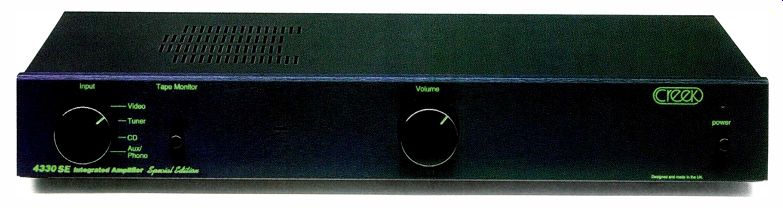
Anyway, the Creek 4330SE makes all the right moves, sporting only a rotary source selector, a tape monitor button, a centrally positioned rotary volume control, and an on/off button. Any thing less, and it would be inoperable.
(Brickbats for the schnorrer in the back who said, "Bring back the combination power switch/volume control!")
But Creek is wise enough to know that, although its heart is firmly with the minimalists, it must sell its wares to real people.
So the 4330SE comes with a remote for volume and muting. Add to this the choice of passive or active preamplification and the luxurious touch of a three -color (red/ green/yellow) LED to indicate power on, muting, and volume adjustment, and you can see that minimalism needn't be an exercise in masochism.
What you find under the hood, though, is what counts most, and Creek has made sure that the 4330 will drive tough loads (allegedly down to I ohm). High-current MOS-FETs are the active devices of choice, and high sensitivity in the output section enables Creek to use passive preamplification without kneecapping performance. An overkill power supply, DC coupling from input to output, and sophisticated servo circuitry to monitor the amp's behavior:
This is classic "BritAmp" technology. But the SE adds more spice.
Where the standard 4330 uses zinc-plated RCA jacks, the SE's are gilded. The steel and alloy enclosure of the 4330 is, in the SE version, an all -aluminum substitute, and the 120 -volt-ampere toroidal transformer of the 4330 is replaced by a 160-volt-ampere unit. Power -supply capacitance has been increased from 20,000 microfarads in six devices to 28,000 microfarads with 12 devices. The standard 4330's 16 -millimeter Soundwell volume control has been replaced with a sexier, 27-millimeter Alps Blue Velvet. And, most important, the 4330's quartet of 25 -ampere output transistors have been replaced with 40 -ampere devices. All this, plus supplied remote control, for a mere $405 premium over the price of the basic 4330. (Editor's Note: An intermediate model, the 4330R, is $595 and includes a remote control.-A.L.) Number crunchers will note only one key specification change, but it's crucial: In stead of a power output rating of 40 watts per channel into 8 ohms, the SE version is rated to deliver 50 watts per channel. But, as defenders of gutless wonders have always been at pains to point out, wattage isn't al ways the key to an amp's usability-even though the 4330SE can boast of 400 watts of peak power into 1 ohm. What was evident throughout my listening sessions was that the Creek didn't care what kind of load it had to feed. Thus liberated, I played with speakers ranging from a sane, nominally 8-ohm speaker with a rated sensitivity of 90 dB at 1 watt/1 meter, to a particularly nasty 4-ohm load of the less-than -85 -dB type, to both old and current Quad electrostatics, 15 ohm LS3/5As, and even the quirky Optimus LX5 Pros.
Experiencing a British amp for the first time must be a shock to those weaned on behemoth designs with wattage in triple figures. What one learns not to use as an arbiter (of quality) is playback level-real, imagined, maximum, what -have -you. At no point did I ever crave the active preamp module, but neither did it seem as if the Creek would do justice to the weight and majesty of, say, Deep Purple in full cry. After carefully measuring sound pressure levels and settling on a selection of like -priced rivals from Roksan, Musical Fidelity, and others, I felt time and again that Creek had consciously chosen finesse over grandeur, detail over scale, transparency over rich- ness. It was as if the 4330SE were designed with the sole purpose of optimizing the performance of, say, top-quality, two-way mini -speakers.
Confusing though it may seem, the trade-offs work, provided they're assessed in that context. However un-fussed the Creek 4330SE may be about ornery loads, however loud it goes in practice, it, like the NAD 3020, must be carefully matched to speakers that favor this sort of presentation.
And if you remember the way the original NAD 3020 was sold, it was always driving small two -ways. What the Creek does for that recipe depends on the caliber of speakers to be addressed.
Because it is so smooth and detailed, and so coherent and transparent as to suggest
a much higher price tag, the 4330SE is a dream companion for refined designs like the small Sonus Fabers, any of the BBC LS3/5As, and the Quad 77-10Ls. What seems to upset the Creek-or, if your glass is half empty, upstage it-are shouty speakers or those voiced to exaggerate the treble.
Alas, this includes numerous bargain -basement American -made speakers, so a full appreciation of the Creek encounter is most likely with British or, at least, European speakers.
Those of you with horrible memories of the NAD 3020 should discount my likening of the Creek to that rather overrated anomaly. Instead, you should consider its precursor that sublime, if equally restrained, integrated amp from Dynaco, the SCA-35. That I'm prepared to liken, in print, the Creek 4330SE to a tubed classic (and I do mean classic) should be enough to alert all of you who can't spend more than $900 to a little treasure that just might have passed you by in its relative obscurity. I mean, are Creek dealers as plentiful as those of Denon, Pioneer, and the like? More to the point: How many of you have even heard of Creek? Now you have no excuses.
(Audio magazine, 1999)
Also see:
THE AUDIO INTERVIEW -- Bob Carver--the boy wonder...all grown up
= = = =