Dr. David M. Lipscomb
[About the author. Dr. David M. Lipscomb is Professor in the Department of Audiology and Speech Pathology at the University of Tennessee, Knoxville, directing the department's Noise Research Laboratory. Author of numerous professional articles and frequent lecturer, Dr. Lipscomishas recently published a lay-oriented book: Noise--The Unwanted Sounds (Nelson-Hall, Chicago, 1974). ]
CONSIDERABLE CONCERN has been expressed about the possible damage caused to the ears and hearing of young persons as a result of their exposure to loud music. Interesting research observations have led to a confounding situation in which it has been noted that rock musicians have suffered surprisingly little hearing loss. It is the purpose of this article to review the information gathered to date and then to speculate on a possible explanation of this seemingly contradictory situation.
Hearing Loss Most people have had at least one hearing test in which a tone is presented to the ear. If the tone is heard, the person responds. The test is continued until "thresholds" for hearing are found for several frequencies ranging from 250 Hz to 8000 Hz. These thresholds are the presentation levels of tones at which one can just hear the sound. In testing young persons, it is anticipated that their hearing responses will be within the normal range according to standards which have been established by the American National Standards Institute. A rather disconcerting trend has been noticed in some of our audiometric data as can be seen in Fig. 1.
In a series of tests, it was observed that the prevalence of high frequency hearing impairment (HFI) increased dramatically. It is axiomatic that the first indication of noise-induced hearing loss is a reduction in hearing sensitivity for those frequencies above 2000 Hz.
In the Spring of 1968, three studies were undertaken in city schools. In each study, a total of 1000 students at three grade levels were given modified hearing screening tests in order to determine the prevalence of screening failures for those pure tones above 2000 Hz. Of the sixth graders tested, only 3.8% of the students failed the criterion for normalcy. This figure rose to 11.0% for the ninth grade population and held at approximately the same level for the high school seniors (10.6%). This apparent trend to greater HEI failure rates caused us to conduct a similar survey of college students.
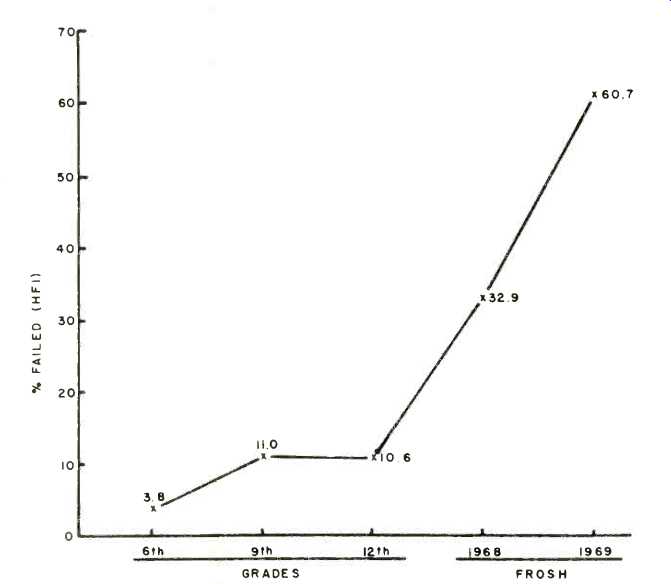
Fig. 1-Results of hearing tests of 7129 students. See text for discussion of this data.
In the Fall of 1968, a total of 2769 incoming freshmen between the ages of 16 and 21 years were given the same modified screening test used earlier in the public schools. The staff was concerned to note that 32.9% of the students fell into the HFI category. To confirm that striking finding, a portion of the incoming class (1410 students) was screened for hearing in the Fall of 1969. Rather than there being a decrease in the prevalence of HFI, the reverse was true; the survey yielded an incidence indication of 60.7%. These data offer evidence, based on measured hearing levels of 7179 young persons age 21 or younger, of a trend toward loss of high frequency hearing of serious proportions. It must be emphasized that nearly all of the students did not manifest serious hearing impairments, in fact, most of those who were found to have HFI were unaware of any loss of hearing.
The point remains, however, that persons in the age range tested should have better hearing than we found.
It is interesting to point out that all of the hearing defects we saw were seen much more often in the young men than in the girls. This sex difference in the susceptibility to ear damage in response to high level sound stimulation is an observed fact. There are many studies which support that condition. We have speculated as to why this is the case, but it is not fully understood why the females, as a group, have "tougher" ears than males.
We have never attributed the rise in prevalence of HFI singularly to noise exposure. It is reasonable, however, to suggest that the popularity of high intensity recreational sound sources, such as live rock music, sport shooting, motorcycling and sport racing, coupled with the apparent rise in community noise levels should be considered potentially to have a distinct effect on the auditory sensitivity of young persons.
Laboratory Data
We have found, with the use of experimental animals, that high intensity sound is capable of causing widespread destruction to the irreplaceable sensory cells in the inner ear (cochlea). A comparison of sensory cell tissue removed from a guinea pig appears in Fig. 2. Arrows point to sensory cells which were irreversibly destroyed by exposure to intense rock music. This animal was subjected to a total of slightly over 88 hours of music in 27 different listening periods over a 58 day period. Some days, the exposure would be for 30 minutes; other days, the stimulation would last for nearly four hours. Some days, there would be no exposure at all. This schedule was selected as an attempt to duplicate the type of intense sound exposure many young persons experience in listening to live rock music. It is not possible however, to generalize these results to human response for many good reasons.
Fig. 2--A composite illustration of guinea pig ear tissue. The left half shows normal cells removed from an ear which had no noise exposure. On the right, two arrows point out damaged sensory cells, the result of high level noise exposure.
Implications
It has appeared to us that there is an unfortunate paradox in our modern acoustic environment. Industry is becoming more aware of the need for hearing conservation among its personnel, and this interest was heightened by Federal regulations forcing compliance. Yet, on the other hand, the non-occupational and recreational environment is becoming glutted with high intensity sounds which are hazardous to the delicate structures of the auditory mechanism.
Thus, it is entirely possible that an industrial worker might be protected from damaging noise in his work environment only to go into his non-occupational surroundings and suffer ear damage from a multitude of intense sound-producing items.
Among all the available high intensity sound sources in the recreational environment, we have considered live rock music to be the single most oto-hazardous in terms of the amplitude of the sound, the broad spectrum of sound energy, the impulsive character of the music, the duration of exposure to the sound by individuals and the number of persons who are exposed to the sound source.
We have extended the above statement to include earphones. Numerous commercially available stereo receiver sets used in conjunction with high efficiency stereo earphones are capable of providing sound levels which hover in the 135 to 140 dBA range for extensive periods of time when driven by contemporary rock music tapes.
Rock Musicians
From all of the above information, it would seem reasonable to assume that rock musicians would suffer great hearing deficits. To the contrary, they have been found to have an inordinately small degree of hearing loss when compared with other young persons who are engaged in high noise pursuits (industrial workers, etc.). One of the first studies which emphasized this was conducted at Michigan State University by Dr. William Rintelmann and Judith Borus. They reported that of 42 musicians actively engaged in rock and roll combos, only two (5%) were found to have hearing thresholds outside the normal range. In reviewing their data, they observed that rock music was intermittent, with an on-time of about three minutes and a one minute off time. They postulated that this off time, brief as it was, is apparently sufficient to allow at least partial recovery from auditory fatigue. Although it was not a popular concept among their colleagues, Rintelmann and Borus suggested that rock music does not appear to pose any particular threat to the ears of rock musicians. Perhaps, to a certain extent, they were right.
A Possible Reason
There may be an interesting "protective" mechanism which modified the damage potential of loud sound.
But, before it is discussed, it is necessary to review some of the possible mechanisms for causing ear damage after exposure to intense sound.
1. Physical force. High intensity sound creates quite a stir in the fluids and tissues of the inner ear. These tiny and delicate membranes may yield to the force exerted by the sound so that damage occurs as a gradual weakening of the tissues from continuous bombardment by sound pulses.
2. Structural damage. Just as a hurricane will uproot trees and smash houses, sudden blasts of acoustic energy may tear and dislodge the tiny components in the inner ear.
3. Lack of blood. Veins and arteries constrict in the presence of high-level noise. Blockage of the delivery capacity of the oxygen-bearing blood cells may play a role in damaging the inner ear.
All of these factors in various combinations may ultimately be found to contribute to noise-induced hearing loss. There is, of course, the possibility that none of these are as important as some yet-to-be-discovered factor.
In addition to there being a distinct effect in the ear, high level noise stimulation can give rise to numerous physiological reactions in the body.
Perhaps the most significant of these is the vaso-constrictive reaction mentioned above. It is interesting to ponder the interrelationships which may exist between stress reaction and ear damage. It certainly is not wise to state that there is a direct cause/effect situation where ear damage will occur each time a person becomes upset.
There is more than a simple chance correlation between the two aspects, however.
As indicated earlier, there are some confusing findings regarding the hearing status of some individuals who engage in extremely noisy occupations. Although their exposure conditions would lead us to believe that they should have remarkable hearing deficits, they do not.
At this point, it is mere speculation, but eventually, it may be discovered that the less stressful a sound is considered to be, the less prone the recipient of the acoustic signal will be to cause auditory damage. As an example, two men working side-by-side in an industry are exposed to the same amount of noise. The hypothesis just advanced would suggest that if one of these men enjoyed his job and accepted the noise as part of it, he would suffer less ear damage. The other man would likely consider the noise to be just another part of that shitty job. With that attitude, the combination effect of the noise beating on the delicate ear tissues and the lessening of blood supply because of his anger and stress reaction could create havoc in his ear.
In the case of rock musicians, that sound (called noise by some) is their baby. They created it. It is the product of their planning and teamwork. They have nurtured and produced the sound which possesses "that certain quality." The pulsing, throbbing, screeching expression of their innermost being comes back to their ears as if it were a balm (not bomb). If there is any bodily stress, it is most likely from unadulterated ecstasy.
Lest I be misunderstood, I must emphasize the probability that some ear damage is occurring. But absent are the additive effects promoted by incurring extreme internal distress resulting in a reduction of blood supply.
Consequently, since the musicians are not unduly stressed, their ears may not be placed in the same double jeopardy as would be the case if they were forced to endure a sound they could not tolerate. If this theory is ultimately borne out, it will be another great insight into the forethought which must have been applied in the creation of the human body. This pleasure principle simply adds another dimension to the already crowded list of factors which have a bearing on the human response to sound and the prospects of ear damage from immersion into high intensity sound.
I believe it was the great philosopher A. N. Whitehead who advised us to seek simplicity but not to trust it.
The material in this review has been simplified to make it interesting and readable. Concepts treated in this presentation are extremely complex because we are dealing with human response. The theory set forth should in no way be interpreted as license to overexpose oneself to noise. It is, rather, an attempt to explain to an interested audience some seemingly baffling observations. In our laboratory, we are currently undertaking a series of experiments to shed more light on this subject. Perhaps a sequel on this will appear in the not-too-distant future.
===========
(Audio magazine; Mar. 1976)
Also see:
Harmonic Distortion by Richard C. Heyser (Feb. 1976)
Understanding S/N Ratios (Sept. 1976)
Build a Low TIM Amplifier (Feb. 1976)
= = = =