Departments (March 1983)
AUDIO ETC
EDWARD TATNALL CANBY
TALKIES, STEREO STYLE
I think maybe I'll stay with pure audio, two-channel, for awhile longer.
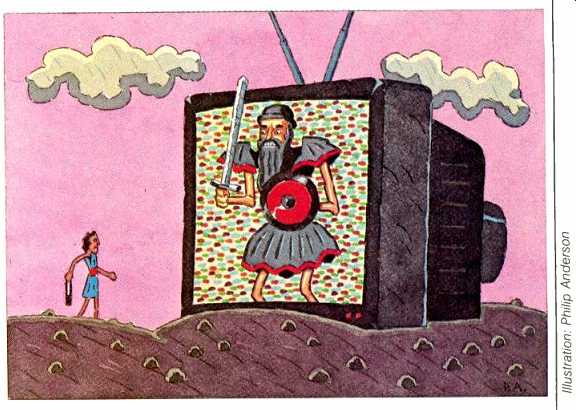
My first experience with homemade hi-fi stereo sound wedded directly to the TV image was, shall I say, soul shaking. It was David (me) and Goliath, but David didn't win. I'm not discouraged! There's a gleam in my eye, and I'll be back. Meanwhile, I've played around with some of the fanciest equipment, a brand-new VCR equipped with-yes-two discrete channels of audio. And a video camera to match.
My thought was simple and, I think, a valid one. Hi-fi stereo and color video pictures are at last getting together for the consumer. Terrific idea but why limit it? As noted last month, there is more to come, much, much more. All in due time, but do you think I'm going to wait? I wanted to try for myself, insofar as I could, ahead of time. All you really need, my argument went, would be one of the new VCRs that will take down any two-channel audio you want, instead of the obstinate mono of all previous equipment. And, if you want to make your own, not merely copy things off the professional tube, you'll need a set of mikes and that camera.
Well, it's one thing to limit yourself to ready-made professional offerings and quite another to get out there and do your own, as anybody ought to know, including me. You very quickly learn respect for the pros, the people who provide us with most of our vaunted hi fi sound, ready to play, and those who produce the home TV image. You don't just transfer all that technique to the home consumer area with a couple of snaps of the finger. Hobbyist stuff is a lot trickier than we sometimes think.
Yet the old human spirit won't be kept down and "hobbyism" usually gets there, eventually, if with modifications. Thus it becomes "commercial" again and again. In every area of this sort there is a steady outflow from the professional into home hobby, a sort of leakage. The line between the two is never really sharp. The better the pro stuff gets, the more are the amateurs inspired. And so, as it specializes and adapts, do-it-yourself becomes an enormous market with its own ever-so-definite demands on the designers and manufacturers. From the very first Kodak Brownie right up to instant Polaroid, from Edison's Philips' cassettes, we on the outside have horned right in on technology to demand equipment that we can use.
I do see it coming. First, "home" video pictures with home sound attached, versatile, with those dual audio channels, apt for all sorts of marvelous new things, once that revolutionary Phase III gets started: Micro miniaturization of video components, the elimination of the Tube, a whole new age of video technology. Hitachi already has its video camera without a tube and talks busily in its ads of cameras thee.
size of cigarette packs. Just go on from there-that's what I mean.
So I borrowed an Akai VS-7U video cassette recorder, VHS and stereo capable. Also a video camera, the VC- X2, a little five-pounder (tiny as com pared with studio pro cameras). With enthusiasm, I set about making for my self a few futuristic examples of AN, home pictures combined with home hi fi. Phew! Did I soon begin to sweat.
Yes, in the end I got a few shaky home-type "movies" of self and friends-like so many home films the very first time you try. I was embarrassed at myself-I thought I knew how to take movies, but this was something else again. No, video is not merely an electronic version of old-fashioned film! Wish I could go into details-later, later. But what matters is this: Yes, talked, visibly and audibly, right there on my giant 19-inch monitor. With instant playback, faster than Polaroid.
Shaky or no, my friends were astonished and delighted to see and hear themselves too. The potential was obvious! This could be far ahead of any thing that ever previously moved and talked via recording, consumer-style.
But it's still today, and by the time I got all this to working, more or less, I had accumulated maybe 200 pounds of decidedly non-portable gear and a roomful of cables. Reminded me of my first experiments with "home" stereo recording, long before the audio cassette. The nearest I got to the great outdoors, where most consumer pictures are made, was the steps of my front porch via extension cables. No matter. I got the feel of what is in the future. Yes, I know there are portable VCRs, including JVC's little five pounder. Steps along the way. But it'll take more than that to open up this new entertainment in commercial form. I got the essentials out of the strictly indoor VS-7U, and so can you, even if it won't fit into a hip pocket.
Note that these experiments were to wards "movies," pictures with sound added. How about the opposite-our familiar hi-fi recording in stereo, but with pictures? A different emphasis but just as promising. Music. Take down your local orchestra or pop group or opera in hi-fi stereo sound, and also in pictures. An all-new idea, never feasible before (at .least in the home-based consumer world). With stereo, the sky's the theoretical limit. Keep in mind our present top-grade stereo cassette recorders. Do you think a rough equivalent with video would be any less popular? Big potential, I say. Just a few li'l problems to be solved before we get down to Walkman size.
When you do add video to your hi-fi recording, you will have some new things to learn, of course. The two elements have to match and that isn't so easy. As I've already found, you run right into the inevitable "simulcast" problems, namely, a wide spread of sound in the stereo playback and a narrow spread in the picture. Not necessarily contradictory, if you are careful how you do your recording. You must stress ambience in your stereo music, rather than too-discrete directionality. Don't get too close! A close up singer, heard way over to one side, will be seen just away from the center of the tube. When the sound source moves yards, the picture moves inches. This can be crazy and you'll have to give it a thought. Avoid, avoid. But with less obvious directionality and more ambience-this can be a splendid sound-you will have no trouble with the sound-sight combination.
On the other hand, if you are into people and people talking-the "home movie" approach, again, I found that an exaggerated sonic separation offers some surprising new effects in an oddly literal way, as you record (and photograph) people. What you do is to extend your working "stage" far off to the left and right beyond the tube itself.
The sides are audio only. The center brings the people into view. It's amazing! You can have conversations be tween people off to one side, invisible, and people in the picture. Audio ghosts, you might say. Your folks can walk casually on and off the tube, or stand just outside it, even stick a hand into sight or peer around the edge of the TV display. Tell me where that has ever been done before! The tube in this case is like a window in a wall. But the wall is transparent to sound.
Note that the video makers today, as might be expected in Phase II of audio/ video equipment consolidation, are emphasizing stereo pairs of loud speakers that sit right next to the tube itself on each side. Good for TV mono sound, natch. Not very good for stereo. Not at all good, indeed, unless you move up so close that the picture hurts. You will be wise to keep your options-use your speakers freely in wide and narrow spacing, according to need, leaving plenty of room. For those new "offstage" effects, the wide spacing is far more dramatic. Also, of course, for ambient music, though again you must watch out for the directional disparities.
As to mike settings, my camera was a mono model. Evidently the two-channel idea is going to be slower to reach this area. The VCR operates in mono too with all standard TV, and with this mono camera. Necessary at this point.
There's a built-in mike on the camera, electret, extendable forward on one side. You can plug in another, of your own (watch out for loud raster buzzing if it gets too near the camera tube), but the signal's still mono, feeding the VCR's left channel. For stereo, you must plug the right-channel mike into the VCR's right mike input; for the left, you can use the camera mike, or plug a second mike into the camera or the VCR's left-channel mike input.
Rather to my surprise, the "binaural'' setup, two mikes close together with some solid object between-the cam era, a head, even a block of wood or plastic-gave surprisingly useful loud speaker directionality to my pictures. It might be the best way for many home purposes. Especially speech. But don't get too far away, and keep the room sound dead-or go outdoors. In this sort of speech recording, ambience merely means off-mike, an amateurish voice quality. Maybe Bob Carver and Sound Concepts and JVC could help here with their respective binaural-for-loudspeaker circuits? As we all know, the techniques for good voice sound do not match those for camera placement-especially with a prodigious zoom such as the one Akai has on its VC-X2 video camera. You've seen the TV reporters stick their mikes into people's faces. That's the pro way, or via lapel mikes, mikes overhead but unseen, and so on. So get close for people, more distant for music.
All of this, of course, is really for the future, or assuming that you can experiment with present two-channel equipment as I did. And assuming muscles and patience in the hooking up. We do have a way to go before we have home-recorded video "movies" with equipment expressly designed for the purpose. That is for Phase III when video goes truly miniature-or maybe gigantic, wall to wall. But you can fuss with it now, as soon as you can get hold of two channels. And camera.
AUDIOCLINIC
JOSEPH GIOVANELLI
Subsonic Energy
Q. What damage do sub-sonics cause to bass drivers? When will this damage most likely occur? My equalizer's filter cuts off sound at the rate of 18 dB per octave below 20 Hz. Will this be sufficient?
-Bob Connelly, Green Bay, Wisc.
A. There is no real answer to the questions you have asked. Much depends on the amount of subsonic energy which is present and on the power-handling capacity of the bass drivers.
Bass drivers are made to handle power and should "expect" a certain amount of such subsonic energy.
I would think that your 18 dB roll-off below 20 Hz would be sufficient to re move any possibility of damage, except where there is a case of acoustic feedback at frequencies above the 20 Hz we have just discussed.
Laterally Cut Discs
Q. I have read that a mono switch on a preamplifier is best set to the mono position when playing laterally cut mono records, to cancel vertically modulated components. What are "laterally cut" records? And will the mono records now being produced benefit from being played this way?
-Paul Tomatani, Honolulu, Hawaii
A. All of today's mono records, and most of yesterday's, are laterally cut; that is, the groove is modulated from side to side, rather than up and down.
Stereo records are cut with monophonic information common to both channels, modulating the groove laterally, while stereo difference information is a vertical modulation.
Setting the preamp switch to mono will clean up some mono records-and even some noisy stereo ones, if you don't mind hearing them in mono. It will only help, however, if the noise is in the vertical components, such as vertical rumble (in the recording or the play back turntable) or stylus motions due to "pinch effect." The mono switch will also clean up noisy FM stereo broad casts, though it's better to switch to mono at the tuner, where possible.
Old Edison, discs and cylinders (and, I think, Pathe discs) were cut with vertical modulation, as were some radio transcriptions on 16-inch discs. If you collect these, you can play them with a modern stereo cartridge by wiring its two channels together out of phase-the exact opposite of the connection made by a preamp's mono switch.
Outer Groove Record Noise
Q. I notice that, when playing phonograph records, a "roaring" noise occurs somewhat before the start of the program. I am puzzled because, when I hear recordings over my tuner, there is absolute quiet.
-Victor Ogorodnick, Narrowsburg, N.Y.
A. Phonograph records tend to be noisy at their unmodulated outer edges. Most of this noise has to do with problems in molding the raised area at the outer edge, sometimes known as the "groove guard." If you could start playing your discs at the point just prior to the start of the pro gram, this noise would not usually be heard (except where modulation be gins too early or where the raised area extends too far into the disc).
That's how the broadcasters do it (though they do it primarily to have the selection start right after it's announced, without "dead air"). And some stations play tape recordings of their records rather than the records themselves; this allows the edge noise to be edited out and prevents subsequent wear on the records.
"Bad Vibrations" Again
I recently moved from the comforts of a semi-soundproof home to a very "hard," reflective apartment. My Thorens TD160 MKIIB turntable does not "like" its new location. After setting up my SME Type II tonearm (fitted with a Shure V15 Type IV cartridge), I got acoustic feedback when the volume control was advanced a very small amount. The frequency of the feed back was in the range of 30 to 40 Hz.
My turntable sat on a base, suspended from the ceiling, to prevent "bumps" from heavy footsteps and direct vibrations from stands, tables, etc.
There was quite a pronounced bass resonance.
I attempted to stop the "bad vibes" by adding weight to the base, by surrounding the base with soft materials, and even by putting cord and foam under the feet of the table. No luck! In a last-ditch effort, I bought a tube of silicon rubber and proceeded to line the entire inside of the table, with the exception of wires and moving parts.
Success at last!!! No feedback!!! Sound is great, with the volume control well advanced. The turntable now sits 3 1/2 feet from a loudspeaker. The undesired bass resonance is also completely gone.
-Victor Wasend, Vancouver, B.C., Canada
I try to answer all questions, but it is also very nice to receive comments of this kind. Information of this sort broadens our knowledge. I wish, therefore, to thank all of you who have taken the time and effort to share your problem-solving experiences.
Mixing Buss
Q. Please explain what a buss is, as applied to recording gear.
- Christopher Berry, New York, N.Y.
A. A buss is any electrical line used by several different circuits at once.
Recording mixers usually have several signal busses. At a minimum, there will be one such mixing buss for each out put channel, and all inputs assigned to that channel will feed that buss. There may also be effects busses (feeding signals to echo or delay systems), equalizers and other signal processors whose outputs are fed into the output buss. Monitor busses control which signals within the console feed each monitor speaker. Busses are also used for ground and power.
Load Impedance and Amplifier Power Output
Q. Why does an amplifier put out more power into a lower impedance?
-Bob Robinson, Warrensville Heights, Ohio
A. The lower the impedance of a load, the more power that can be sup plied by an amplifier feeding that load.
This is true because the lower the load impedance, the closer to an impedance match that load becomes. We never match loads to the output stage of an amplifier. If we did, the amplifier would attempt to supply more power than could be dissipated as heat, and the amplifier would be destroyed.
TAPE GUIDE
HERMAN BURSTEIN
Graphic Realism
Q. I notice that reviews of cassette decks specify the frequency response curves at-20 dB, and of course the high-end response always looks good on the graphs. But is this realistic? Everyone knows that we tape at levels typically around 0 dB, and I am sure the high-end response will then droop.
-Alfred Chiesa, Springfield, Mass.
A. It is true that when tested by a series of constant level audio signals, a cassette deck will ordinarily show treble droop if the recording level is in the vicinity of 0 dB (such droop is less with metal tape and when noise reduction is employed). However, in most music and other program material, the relative amplitude of the high frequencies is substantially lower than the amplitude of the mid-frequencies. Hence, one can usually record on cassette at 0 dB level, particularly from FM or disc, without noticing treble loss. Of course there are exceptions, particularly when recording live material with strong transients, such as guitar. But these are exceptions for most people, and in such cases one can reduce the re cording level to preserve the high frequencies, albeit at the cost of reducing the signal-to-noise ratio, too. Considering the very high S/N ratios achievable today (thanks to advanced noise-reduction systems), sacrificing a few dB of S/N usually entails little if any reduction in listening pleasure.
Tape Deck Mis-Phasing
Q. I feed a mono source into both channels of a stereo tape recorder; in playback, both outputs are combined and fed into another unit with mono input. When the playback signals are combined, the sound seems to lose its original quality and level. Even if I bring the level up, there is a loss of quality. If I disconnect either playback channel, the sound regains its original quality.
Any help will be appreciated.
- Cicero LaHatte, Jr., Vicksburg, Miss.
A. There is a probability that your tape deck's output signals are some what out of phase with each other, resulting in partial cancellation. Even though there is no phase problem when the mono signal enters the deck, phase differences occur at the output owing to characteristics of the heads and perhaps to the electronic circuitry.
Conceivably, there is a gross wiring error in your deck which has changed phase of one of the channels by 180C from which it should be. This would, of course, produce gross cancellation when the outputs are combined. It seems that your best course is to use just one channel of your deck for mono recording until you can get it fixed.
Bias Percentages
Q. Why is bias measured in per cent? To wit, I have seen that Type I tape requires 100% bias; Type II, 150%; Type Ill, 250%.
-H. P. Kornick, Sanford, Fla.
A. Type I tape (ferric oxide of the low-noise, high output type) provides a reference standard for the amount of bias required, and therefore is arbitrarily rated as requiring 100% bias The actual amount of bias current fed to the head would depend on the bias frequency, on the head construction, and on the deck maker's judgment as to the trade-off he wishes to make be tween extended treble response (requiring reduced bias) and other performance characteristics, namely low distortion and low noise (requiring more bias). If Type I tape requires a certain amount of bias current in a given deck.
Type II would require about 50% more than Type I and Type IV would require about 2 1/2 times as much as Type I.
Format Fuddlement
Q. I am going to buy a tape deck and am oscillating between cassette and open-reel units. In my opinion, one can get better reproduction at a high tape speed than at a lower speed. So, at the same price, should I buy a cassette or open-reel deck?
-George Nour, Reading, Pa.
A. There is no definite answer to your question. It depends upon your personal needs and expectations.
Owing to improvements in tape, in deck electronics, in heads, and in mechanical design and construction, a high-quality cassette deck is capable of truly high-fidelity performance: Wide and flat response extending to 15 kHz or better, low distortion, high signal-to noise ratio, low wow and flutter, and accurate speed.
In fact, those improvements have been given most prominently to cassette decks, both because cassette's slower speed (1 7/8 versus 3 3/4 to 15 ips) puts it in greater need of these benefits and because there is more demand for cassette decks. This has helped narrow the gap between the formats.
Open-reel's advantages of greater high-frequency headroom (ability to re cord high frequencies at higher levels without tape-saturation distortion) and easier editing are more significant in live recording than when taping off the air or copying phono discs. Cassette's chief advantages are low tape cost, convenient loading, compactness (especially for tape storage) and a plethora of convenience features such as automatic tape-selection programming on some decks.
Listen for yourself, to see how much difference you can hear, and how significant those differences are to you.
High-Speed Cueing and Head Wear
Q. A friend of mine refuses to use the cue feature on his cassette deck that is, he never fast-forwards the tape while the deck is in play mode. He claims that running the tape at fast speed while it's in contact with the heads will wear out the heads. If I cue my tapes a lot, am I decreasing the life of my tape heads?
-Garth Whetzel, Sharon, Pa.
A. Yes, cueing the tape past the heads at fast speed will accelerate head wear. However, depending on the type of head, it may outlast the rest of the cassette deck. This is particularly true of ferrite heads, which are claimed to have lifetimes of at least 20,000 hours and up to as much as 150,000 hours in a cassette deck at normal operating speed of 1 7/8 ips. Al lowing for a reduction owing to cueing, they should still have a very long period of serviceability. With other types of heads, there might be a problem, but probably not for a long time.
[I believe there are some decks which hold the tape a minute distance from the heads during high-speed cue, which would eliminate the problem al together. –I.B.]
ADs:
Audiophile, heal thyself!
OMNIDISC--A COMPLETE SYSTEM CHECKUP FROM STYLUS TO SPEAKERS. TWO RECORDS PLUS INSTRUCTIONS. TEL-10073/10074. $29.95
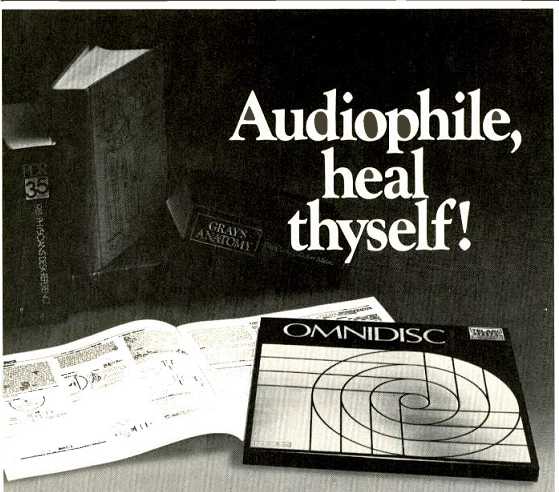

Without test equipment of any kind except your two ears, and without prior experience, you can test and adjust your stereo system for optimum performance with the new OMNIDISC from Telarc.
Use Side 1 to insure correct mechanical alignment of your tone arm and cartridge in every plane. Then use the test tones on Side 2 to verify correct wiring, speaker placement, and control adjustments.
Side 3 tells you clearly how well your phono system tracks high level music, while Side 4 uses both popular and classical music to reveal stereo separation, imaging, and overall sonic accuracy.
An illustrated instruction manual leads you step-by-step through each test, explaining every detail. If you have a great system, OMNIDISC will prove it. And if you have a problem, or suspect one, OMNIDISC will find it and help you solve it.
OMNIDISC from Telarc. Check it out today!
audio-technica
AUDIO-TECHNICA U.S., INC., 1221 Commerce Dr., Stow OH 44224
-----------------
--------------
(Audio magazine, 1983)
Also see:
Record Cleaners Revisited/B.V. Pisha
Audio's Crescendo Test/Richard C. Heyser
= = = =