By GENE PITTS (EDITOR)

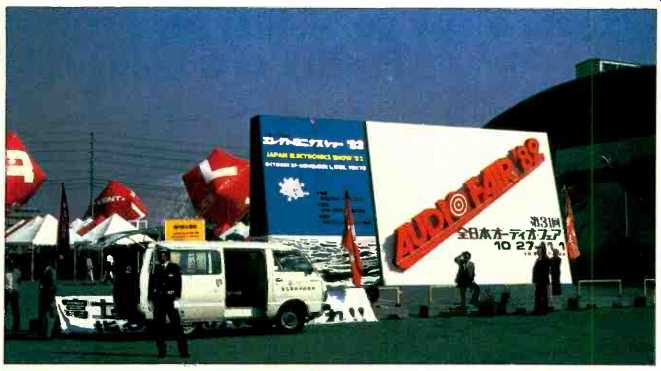
--------- Large balloons and a billboard announcing the 31st All-Japan
Audio Fair were located in the mall at Tokyo's Harumi Exhibition Grounds
(top photos).
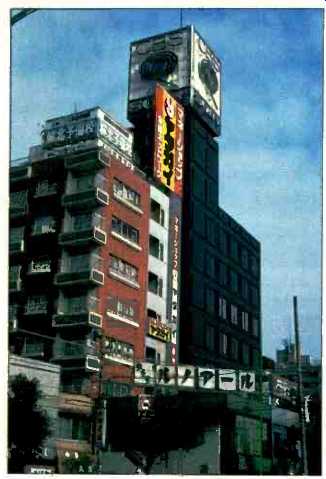
--- CBS/Sony headquarters in the Ichigaya section of Tokyo
(above).
It was the best of Fairs, it was the worst of Fairs there was a whole new technology, there was much new standard gear, but it was noisy, and crowded, and hot. But, most importantly, it was the first public showing of the Compact Disc, which is hailed by some as the most important development since stereo.
In the places where I have lived, save for some few very cheap hotel rooms, there have always been telephones, ones with the double-letter code for exchanges such as LOngacre and ROgers Park. There have not al ways been television sets, there still isn't a color set-nor a computer nor a videodisc player. Thus change.
We are, in these few past and coming months, seeing what I believe is the largest change in audio technology of the last decade-the biggest apparently since the compact cassette (and again, at least partially, from Philips) go sliding past with all the inevitable finality of a cold air front. Thus change.
It was warm, humid, and overcast during the five days, beginning October 27th, I spent at Tokyo's Harumi Exhibition Grounds where the 31st All-Japan Audio Fair was held in conjunction with the 1982 Japan Electronics Show. I'm told that more than 300,000 people went through the turnstiles, where the featured attractions were Compact Disc players carrying more than 20 brand names. Some of these players share common parts; indeed, several are made on an OEM basis, so that the actual makers presently number about 15.
Let me recite the brands: Aiwa, Aurex by Toshiba, Denon (Nippon Columbia), Diatone by Mitsubishi, Hitachi, JVC, Kyocera, Nippon Marantz (Phil ips), Matsushita (the parent of Technics, whose player we reviewed last month), NEC, Onkyo, Otto by Sanyo, Pioneer, Sansui, Sharp (whose player is reviewed elsewhere in this issue), Sony (whose player we discussed in November and January), TEAC, Trio Kenwood, and Yamaha. Prototypes were also shown by Akai, Alpine-Luxman, and Harman/Kardon Japan. Poly gram had a rather large booth with some 270 CD albums on display from companies such as London, Deutsche Grammophon, Casablanca, RSO, Polydor, Archiv, and Philips. There was no obvious duplication of titles. At the time of the Fair, CBS/Sony had announced over 75 titles as being avail able in Japan, but a moderate portion would be suitable for that market only.
At a meeting at the Denon studio and office complex in Tokyo's Akasaka district, 10 more titles and a sampler were shown, and Toshiba/EMI has announced release of 10 discs in the format. It appears to me that about 50% of all announced titles are of classical music.
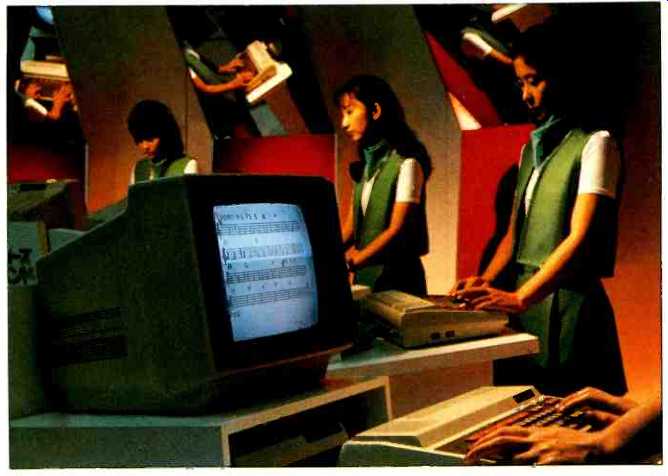
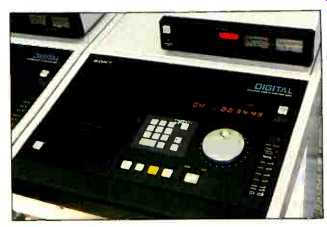
------------ Several computer systems were set up to generate music,
either by reading magnetic stripes or by keyboard commands, as with these
systems from NEC (top). Sony's CDP-5000 Compact Disc Player is intended
for pro use and can locate by track, time or frame (above).
Perhaps more significantly for the United Stales, CBS Records will market Compact Discs imported from their CBS/Sony subsidiary in Japan. In deed, you may already have seen these discs, as the program was to begin, says the press release, "during the first quarter of 1983." In addition, there is to be a pressing facility established by CBS Records in the U.S. by the end of 1984. Inasmuch as some 1,200 CBS employees were laid off at the Terre Haute operation, it's to be hoped that location would be near the op of a list of potential sites for the CD plant. I saw M&K's Ken Kreisel at the Fair, and he told me that he is trying to make his the first American firm to re lease a Compact Disc. Indeed, he may have done so by the time you read this.
RCA has plans to release discs it Europe beginning in March; Vanguard has listed 10 titles for CD release and has been doing a good deal of digital recording recently. AudioSource in tends to import some 100 titles which will carry $23.98 to $25.98 prices; 17 titles will be included in the initial release. Thus change.
During a two-hour trip through Akihabara, an area of Tokyo where there are many audio shops, I purchased 12 compact Discs from a store with a display holding about double that number. As I was about to pay for my initial collection, which ranged in price from 3,500 to 3,900 yen, a sales assistant brought out from a back room about 20 additional discs, most y from Polygram. (Yen/dollar exchange is presently about 245 yen to the dollar.) While I was reselecting discs for purchase, a Japanese man carrying a Sony machine came into the store and made straight for the display. I am told that only the Sony was available during the Fair period, though many other brands were to begin sale as of December 1st.
While I had expected the Compact Disc to be the big news of the Japan Audio Fair, I was not fully prepared for the crowds which congregated around the booths showing players. I spoke with representatives of several firms, each of whom expressed satisfaction at the reception of the CD player.
Aiwa's Mr. Kohjimoto told me that their player would be shown at the Winter CES in Las Vegas, but as with most other firms, plans for marketing in the U.S. were not at all clear. Several makers thought that they would have demonstrations at selected dealerships or at hi-fi shows, but none had any specific dates to offer.
Aiwa was giving away tapes of mu sic by Gimmi and the Pinks, a punk rock group, made at the Fair using Aiwa's WX-11 dual-well cassette deck, which features a four-gap record head and double-speed dubbing for a resulting dub efficiency four times nor mal. Recording a live group is a fairly usual promotion device at the Fair, and apparently there is somewhat greater opportunity for live recording in Japanese clubs, theaters, and concerts than in the U.S.
Aiwa's DX-1000 CD player was priced at 168,000 yen, which is a hot price point and the same as Sony's.
The top price I saw at the Fair was 248,000 yen for the Mitsubishi. Mr. Kohjimoto said he felt that 300 discs were not enough to make the CD sys tem popular; at least 2,000 would be needed. He did, however, point out one interesting use for the CD player, in clubs "because of the disc's durability and the ease of access to songs via programming." Club use brings to mind karaoke, a sort of evening sport endemic to Japan, where a group of fellows go out to a bar and have as their primary entertainment songs sung by one or another of the group. CBS/Sony has already released several Compact Discs for karaoke use, which consist of back ground vocals and music, and there were products from about a dozen makers at the Fair aimed at this market. One such item is a digital vocalizer, that is, a black box which can change both the pitch and the beat of the accompanying music, making the karaoke-san sound like a superstar.
Yamaha's Music Printer combines an electronic keyboard with a melody and chord printout and the expected variations of pitch and beat. And here I thought listening to records was a passive sport.
Besides the CD players, several Pulse Code Modulation (PCM) processors and decks were shown. Of particular interest were the decks extending the technology away from VCR-based recorders. For example, Technics showed both standard and microcassette PCM decks, JVC displayed a prototype deck using a standard cassette, Alpine had a stand-alone processor and a deck using a standard cassette for 1983 introduction with prices of 200,000 to 250,000 yen, and Sansui's Tricode processor has special error-correction circuitry to make possible recording at the slower VCR speeds with no loss of fidelity.
In the Electronics Show section there was one portion devoted almost entirely to combinations of video and computer, which the Japanese apparently see as working hand in hand. National's HA Home Automation system, for example, combines an image synthesizer, system command via an outside telephone, security/home protection, and finger-to-screen image processing/computing, among other things.
Sanyo had in operation a voice-con trolled videodisc search system, while for me the most impressive display was Aniputer's. Controlled by three pushbuttons and a joystick, the Aniputer's action on the screen is like a combination of watercolor brush and finely chiseled variable-size rubber stamp. NEC's exhibit had a quartet of young ladies playing computers (key boards?) from music displayed on their monitors.
Other interesting items at the Fair included the Micro Ridge stylus from Namiki, which sup plied many of Japan's cartridge makers with the Shibata-cut diamonds when CD-4 was in vogue. The Micro Ridge appears, from engineering drawings, to start out much like a line-contact stylus, then it has two V shaped cuts made on it, one going from front towards the back and the second from back to front. This extra cutting results in a sort of lip which works the groove; frequency response is claimed as being absolutely flat from 20 Hz to beyond 30 kHz at a 138-mm groove radius.
Aside from their CD player demonstration, Sony had two eye-catchers.
The Studiolab personal playing room is a soundproof booth, which comes in three sizes from 2.25 up to 3.5 square yards. Prices range from $1,900 to $2,700. I spent about five minutes in one to get away from the noise of the Fair; almost as good as shiatsu massage. Sony's Heliplayer PS-Q7 turntable exposes fully three-quarters of the disc it sandwiches, as its top surface measures only 8 1/2 by 9 1/4 inches. The unit is priced at 35,000 yen, and we will see a near relative from Audio-Technica in their Mister Disc, at $169.95, for the C-cell powered unit which has a headphone output.
An interesting departure from Lux was the Basic A522 belt-drive turntable, a kit (!) with a price tag that translates to about $90, less tonearm. If I read the Japanese flyer correctly, the wow and flutter spec is 0 04% and rumble is-70 dB, DIN-B. Even at double the price, this would seem to be a natural base for one of the quality separate tonearms such as are available from Souther, Sumiko, Signet, or Stax.
High-end car stereo units were displayed by Hitachi and Sansui, while Nakamichi also plans to introduce their TD-1200 mobile tuner/cassette deck early in 1983. Both Hitachi and Sansui have rows of fairly large LEDs for power output levels; sexy.
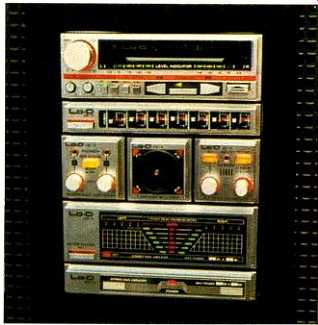
-------- A flashy car stereo system carrying Hitachi's Lo-D brand name.
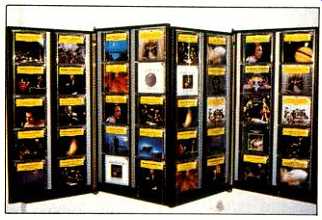
--------- Part of Polygram's display, which included some 270 CD album
covers.
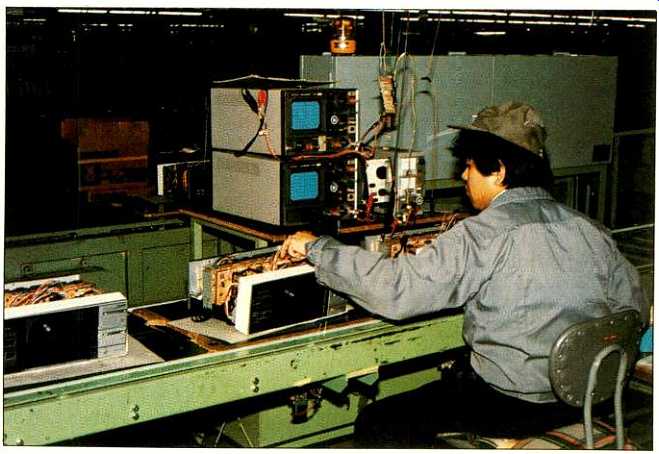
An adjustment stage on Hitachi's CD player line.
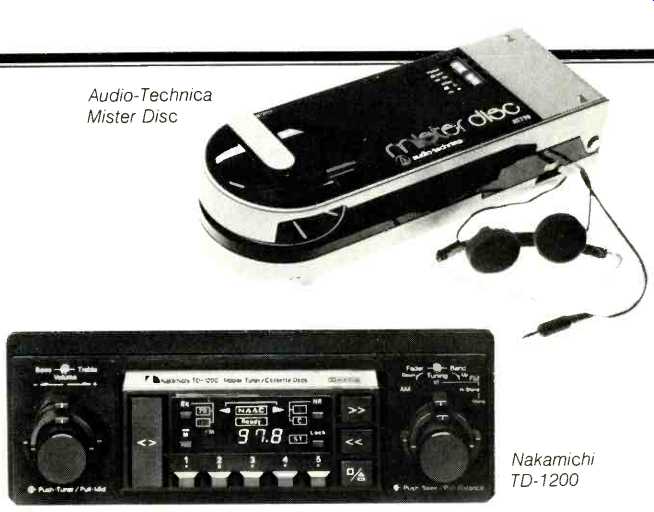
------- Audio-Technica Mister Disc; Nakamichi TD-1200
Truly massive amplifiers were again seen at the Fair, and some idea of what I mean by "massive" can be gained by consideration of not one but two power cords, both of them polarized for 220 volts! As my daddy used to say, it would have taken two men, four mules, three dogs and a long lever. . . .
During my visit in the company of some dealers and reps to the Denon facility, where they have been engaged in digital recording since 1972, Mr. Anazawa told me that they have produced some five generations of pro-grade digital recorders; the DN-035ED is their latest. They have some 600 digital recordings in the can and expect that 30% to 40% will find their way to release as Compact Discs. I received a copy of their sampler at a demonstration of their CD player, where Mr. Anazawa discussed the CD standard and production techniques at some length. Mastering of the disc is the most difficult part right now, and only one or two masters can be made per day. Times of up to 75 minutes can be gotten on the disc, which is single- sided according to the Sony/Philips standard. Yields, as might be expected, are low relative to analog disc rates, but they are going up. One interesting aspect of the mastering is that the music portion of the signal is on U Matic tape, while the timing or address codes are on floppy disc. Mr. Anazawa stressed the need for clean air for plating and pressing; normal air has approximately 1 1/2 million particles per cubic foot, while the CD facility re quires fewer than 100 per cubic foot.
We later went to NHK's FM station JOAU, where we found professional CD players from both Denon and from Sony. Aside from a keypad for calling up exact sections of a disc, I felt that the most impressive feature of these pro CD players was their speed of access; slow access by some of the consumer players has been annoying to me. Other features are a bigger motor and built-in speaker.
I also paid a visit to Mr. A. Suzuki, Sony's digital maven, at the company's Tokyo headquarters in Shinagawa-ku.
He feels that the Compact Disc is the Fourth Source of signal for the music system. I mentioned that we had detected small but consistent differences between the different players, and he said that this could well be so. However, he stressed that it is the final analog section which determines the overall "sound" of the player, rather than the D/A section. It is important, too, he said, that the error correction be adequate. Sonic differences, he felt, were in the frequency response.
(In my own listening tests, I find the differences to be at the level of the differences between two good preamps or amps. What is most striking, after the total absence of surface noise, is the ease with which one discovers what the recording engineer has been doing-or not doing.) Asked what might be expected in the way of future developments for the CD system, Mr. Suzuki said that the main two things Sony was working on were reducing the price and simplifying the operation. "Timing is a key factor, especially with high-grade equipment," he told me, "but there are possibilities in LSI research." Sony is actively investigating a recordable disc but they are very concerned about keeping the power (and therefore danger) of the laser diode low. As a practical matter, this means a lot of research into materials, not to mention determining the proper layering of the disc.
I was fortunate to be able to arrange a visit to Hitachi's Toyokawa-shiplant, where they make CD players. While the firm is very well-known for its semiconductor operation, it has also been involved with the various technologies required for CD players for some years. I was therefore very pleased to see their CD player facility and, thus, special thanks to Keita Kawahara, who made many arrangements for me, and to Messrs. Hayakawa, Hiroayma, Minobe, Sato, Takahashi, Takeda, Yamamoto, and Yoshida, for their hospitality.
As it turned out, Hitachi's CD player line is still fairly new, since it was start ed up only last September 10th; there are roughly 50 to 60 people on this line, many of whom are on temporary loan from the engineering department.
Each section of the laser servo is adjusted in two steps, first onto the disc and back and forth, and then each trim screw is locked with glue. The disc motor is brushless, much like the turn table types from which the design was adapted.
After touring several areas of the plant besides the CD line, I spent the best part of an hour listening to Hitachi's player in head-to-head A/B comparisons, using the same disc, with another player. I preferred the sound of the Hitachi in this audition, though I must point out that it was not run under blind conditions and that the ancillary equipment was not familiar to me. In any case, either CD player's specific sound would not have been recognizable after, say, an hour's lapse; the differences were that small.
One of the most interesting conversations I had during the trip was with Mr. Hiroshi Kanai, who is coordinating Compact Disc operations for CBS/ Sony. His background has been with CBS/Sony's Family Club, a Japanese version of Columbia House. Events are proceeding at such a rapid pace for him, both in the European and Japanese markets, that he has had little time to plan for the American introduction. In addition to a soft market for standard discs, Japanese record firms have also had to deal with stores which rent discs, virtually all of which are copied onto tape. Over 1,000 rental operations have sprung up during the last year, and some of them even pro vide rental gear for on-premises re cording.
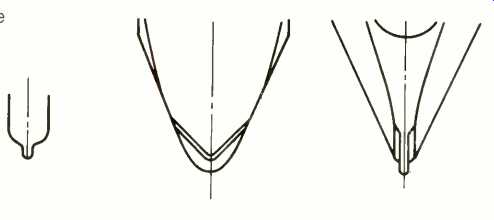
-------- Namiki Micro Ridge stylus, which will be sold on Signet's TK10ML cartridge.
Mr. Kanai feels that basically this is a poor introduction time for the CD sys tem, as he is not at all certain that the market can expand to include the Compact Disc, and he finds that many software people are pessimistic. Playing the "what if" game, he notes that an average-good sale is 10,000 al bums and 5,000 cassettes; adding 3,000 Compact Discs will, in the opinion of many software people, simply squeeze current sales, not generate new ones. If this scenario is true, then there will simply be a further slowdown at standard record and tape producing facilities, which will still be required.
I asked Mr. Kanai about his reaction to statements by some in the hi-fi field that slumping record sales are largely because of poor quality discs and mu sic. Mr. Kanai replied that while such arguments might seem reasonable to the consumer, the pressing-quality argument doesn't really apply since higher quality records would simply improve the quality of home-brew recordings. Judgment of the quality of music being made these days is pretty much an individual thing, he feels.
However, Mr. Kanai stressed that making a compilation from one's own records is quite different in character from copying from a friend's record or from FM. The difference basically is that one supports the musician, while the other does not. He points out that even professional compilations of "greatest hits" never quite have the character of the originals and that they never sell very well. This leads him to feel that the art of the producer and engineer in sequencing, fade downs, etc. is not truly appreciated.
Perhaps the most interesting point Mr. Kanai made was that there has been a fairly obvious change in the public's attitude towards music since the introduction of the cassette-and it is not for the better. He pointed out that he has seen literally hundreds of cassettes out on the street, trashed, and that one never sees LPs treated in such a fashion. I was forced to reply that there is always a market for LPs in second-hand stores or at yard sales, but I have rarely, if ever, seen cassettes sold in such a manner. It appears that the disposable society has descended on the music field.
Some interesting details: CBS/Sony began CD production in July 1982.
They presently have four machines and are planning more eventually. The pressing cycle is 17 seconds versus 25 for a standard analog disc. While there presently is a shortage of capacity during start-up, by the end of 1983 there is an anticipated annual capacity of 2,000,000 Compact Discs.
I also had dinner with Han Tendeloo, who is Director of the Group Technical Staff Bureau for Polygram. Such a title makes one diffident, but you will never meet a more charming or gracious man-or a better source of information about the Compact Disc. Turns out that CBS/Sony and Polygram are using different pressing methods. Injection pressing, used by CBS/Sony, has dust particles as its main problem, while the injection/compression combination method used by Polygram has air bubble inclusion as its toughest. Not that either problem is insurmountable, mind you, but it is interesting that two different problems were encountered in achieving acceptable production rates. Insofar as player difficulties go, Tendeloo felt that proper tracking was the toughest, particularly for the single-beam systems. He also told me that the Philips design, which will be marketed in this country by Magnavox, uses a sampling frequency four times that required by the Standard. This technique makes error correction and filter design much simpler, I surmise, resulting in a very stable output signal.
They have a dozen presses but output is a different story, what with European working conditions.
And now to answer the inevitable question: What was the best sound at the Fair? To my ears, that from the Fostex GX-2020 Regular Phase speaker system, which was playing jazz. This satellite and subwoofer system has 6 x 12 inch ES tweeter panels, 12 x 24 inch midrange ES panels, and 10-inch cone woofers, all in a pair of mirror-image units, together with an FW-800 30-inch cone in a monster subwoofer.
The approximate size of this subwoofer was 5 x 3 1/2 x 3 1/2 feet. The source was a Sony CD player. Very clean! Best sound away from the Fair was at the apartment of Mr. Hiyashi, the genial head of Stax Kogyo, where I auditioned the firm's new and quite spectacular ESTA4U. Unlike conventional electrostatic speakers, this one doesn't require extra polarizing power to operate; further, its relatively small size (15.7 x 17.7 x 3.5 inches) makes it easy to place. While such a small size obviously requires a subwoofer for realistic bass, the ESTA4U's clarity, definition, openness and accurate resolution were exemplary. Sensitivity is fairly low at 80 dB SPL (1 watt/meter), but maximum power handling is 100 watts so that fairly decent peak SPLs can be achieved. Listen if you have a chance.
The Best Badge Award goes to Aurex (Toshiba) for a 3-inch round number which flashed two messages by means of a lenticular screen. Best Tee Shirt to Shonan for C-MOS, making It into an acronym for Contact of Mountain, Ocean, and Sky.
In the place where I now live, there is a new and very good television component system, purchased in the week since I began this article, and a small computer, given me in the same period by one of the Contributing Editors who has graduated to a larger system and who, I believe and hope, will continue to expand his mind as he has expanded mine during the years we have worked together on this idea called Audio Magazine. I had a chance to purchase at very large discount one of the leading makes of CD players. Had I not been intent on replacing the 16-year-old black/white set, which buzzed loudly and intermittently and apparently without cause, and on paying an insurance premium, I would have bought that CD player. In any case, such a player will be the next addition of any magnitude to my audio system.
Thus change.
(Adapted from Audio magazine, Mar. 1983)
========
Vintage magazine ADs:
Achieve Mitsubishi in Cordia.
The contemporary sports coupe.
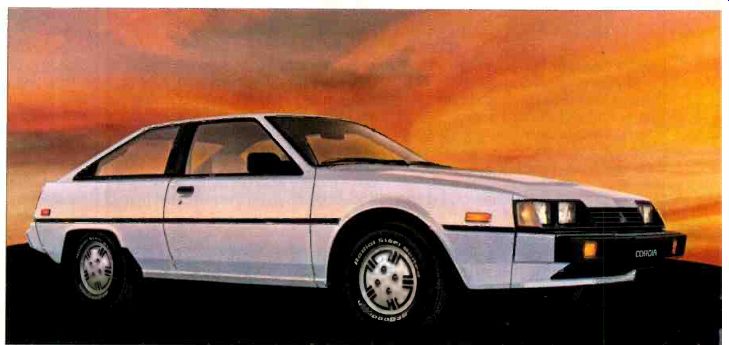

If style can be defined as looking right, then Cordia is an “11” Not only is it sleek, it's slippery. Smooth design has created an arrow -front that produces a minimal drag coefficient of only 0.34.
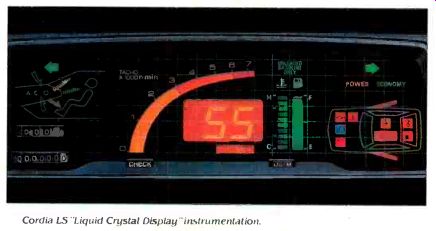
Inside, the Cordia LS features a Liquid Crystal Display that gives you a graphic readout of speed, temperature, tachometer, and fuel levels.
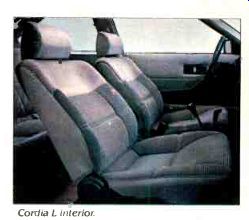
And, Cordia offers plenty of interior space.
There's room to move around.
Plus all Cordias come with standard features that include bi level heating and ventilation system, electric rear window defogger, fully reclining front seats, split fold-down rear seats, remote trunk lid and fuel lid inside releases, and more.
Cordia offers front-wheel drive. A fully independent suspension with MacPherson
Shown with Cordia LS. Liquid Crystal Display instrumentation struts-for agile road handling-lets you know you're driving a sporty car. And Cordia's 4+4 Transmission, on L & LS, gives you your choice of two driving modes.
Cordia also comes with Mitsubishi's advanced ELC (Electronic Control) automatic transmission available on both the L and LS models.
Under the hood, Cordia's engine is a single overhead cam MCA -Jet engine that produces a minimum of engine vibration thanks to Mitsubishi Motors' patented Dual Engine Stabilizers that damp out the noise and vibrations usually found in smaller engines. It makes 4 cylinders feel almost as smooth as a six.
The Cordia gives you three models to choose from: The Cordia, the Cordia L, and the Cordia LS. You start off with luxury and optional things get better after that.
The Cordia. Contemporary beauty. Innovative engineering. And advanced technology. All from Mitsubishi Motors.
To see and test drive Cordia, call (800) 447-4700 for the Mitsubishi Motors Dealer nearest you. In Illinois, call (800) 322-4400.
$7,849* CORDIA L
Manuf's suggested retail price for Cordia L. Actual prices set at dealers. Taxes, license, freight. options arid other dealer charges extra. Prices may change without notice. Availability at dealers of vehicles with specific features may vary.
Under its 1983 Limited Warranty Mitsubishi Motors will replace or repair most components of the Power Train, which prove to be defective, for 24 months or 24,000 miles, whichever comes first. See your Mitsubishi Motors Dealer tor details.
24/24 WARRANTY Mitsubishi takes you where you've never been before.
MITSUBISHI
========
Also see:
A Visit to the JAPAN Audio Fair (Feb. 1978)