I would like to make some comments for those readers who are considering adding a subwoofer to their loudspeaker systems.
The August 1983 Audio featured a project, "New Lows in Home-Built Sub-woofers," to construct a subwoofer sonically identical to the JBL line of subwoofers. I went ahead with the 41/2-cubic-foot project, using the JBL 2235H driver, as suggested, since the box was tuned specifically for this driver. I might point out that building the enclosure not only gave me a great deal of satisfaction, but turned out to be one-third the cost of the factory unit.
(For those interested in the 8-cubic-foot box with the 18-inch driver, the cost would be less than one-quarter of the factory unit.) There are two things, however, to be careful of. The most important is the crossover used; the other is the equalization of the low-frequency response.
After building the subwoofer, I used the crossover/equalizer I already had in my system. There is a trend now to use asymmetrical crossovers to re duce the possible phase shifts which may cancel out portions of the bass response; this is especially true in active crossovers. The crossover in my system gave me an 18-dB/octave slope on the high side and a 6-dB/ octave slope on the low side.
This crossover would be great if you were biamping a three-way speaker and the crossover was around 800 Hz to 1 kHz. The low driver would have components of the midrange driver, which would not hurt its distortion characteristics. The mid/high driver would be sharply cut off, removing the unwanted low information which would cause distortion.
This arrangement is not, however, the optimum for a subwoofer application. The suggested crossover in the project article also has an asymmetrical crossover, but the slopes are re-versed. The high-pass section in this crossover is passive, and the low-pass section, which also contains the needed equalization for the subwoofer, is active. I might also point out that the manufacturer uses a 63-Hz crossover point instead of the more usual 100 Hz.
So, what happens when you use the first-mentioned crossover in the system? You get way too much mid-bass, and the system becomes very boomy.
You end up with three woofers in the range of 100 to 300 Hz.
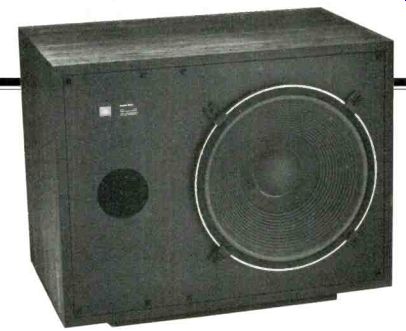
--------p32 The JBL-designed, 41-cubic-foot subwoofer system
Fig. 1--The author's asymmetric crossover has an 18-dB/octave slope on the high side and 6-dB/ octave (modified to 12-dB/octave) slope on the low.
Fig. 2--The asymmetric crossover suggested in the subwoofer construction project has slopes reversed from the author's crossover.
Fortunately, I was able to modify the 6-dB/octave roll-off to a sharper 12-dB/ octave slope. This removed much of the boomy, 100to 300-Hz range from the subwoofer.
The point I'm trying to make is that you must be careful in choosing a crossover for subwoofer applications.
If your speakers are of high quality, and already provide relatively good bass response, you should choose a crossover that gives you a sharp cutoff on the subwoofer side. If you are biamping existing speakers at a higher crossover, then the sharp cut-off should occur on the high-pass side to protect the mid/high drivers.
The other area to watch is equalization of the subwoofer response. Almost all subwoofers have to be equalized, unless you're using the 12-cubic-foot box described in the aforementioned issue. Most of us of moderate means cannot afford the monster enclosures and drivers necessary for an unequalized, flat-response subwoofer. The 4 1/2-cubic-foot enclosure fits nicely in my decor, and I do not need the extra 4-dB gain in efficiency provided by the "big" enclosure/driver. I am driving my "small" subwoofer with a bridged Hafler DH220 (350-watt) amplifier, and believe me, I can get bass levels that will make your ears bleed. In any event, my subwoofer requires equalization for a flat response to 26 Hz.
There are really two ways to equalize your subwoofer, and it depends on your taste as to which way is best for you. If you are a purist, you'll get out your real-time analyzer (RTA) and adjust your half-octave bass equalizer for a flat response. You may or may not, however, get the great improvements you expect, for a couple of reasons.
First, bass is very susceptible to room acoustics (standing waves, resonance, etc.), and if your RTA mike was not precisely at your listening position, you probably won't hear the flat response you just cranked in. Most of us cannot invest in an acoustically perfect listening room. Your subwoofer is probably sitting in your living room (preferably between the two full-range speakers), and you're probably fighting with your spouse because you're rearranging all the furniture to fit your new toy in the sonically optimum position. That's pretty much what you have to do. Moving the subwoofer even 6 inches will affect its room acoustics, so keep shifting it around to find the best position (and take your spouse out to dinner). After you've found the best spot for your subwoofer, you still may or may not hear that smooth, deep bass you're looking for. If not, the problem may be that your ears are not calibratec precisely to the overall weighted response curve (RIAA). Very few of us have perfect hearing. This brings us to the second method of equalization: Using your ears. I know the purist will cringe in horror at the thought of depending on something so imperfect, but that's where personal preference comes to bear. There are a number of records available that provide octave-by-octave pink noise; try using one to equalize that subwoofer to match your own imperfect ears.
An interesting experiment is to use both methods of equalization and note the difference in settings on your equalizer. You may notice rather large differences between the curves.
What further complicates the integration of a subwoofer to your audio system is that the problems I've described occur all at the same time. This requires a great deal of experimentation to determine where the problems lie. If you're like me, though, you'll have great fun in trying dozens of subwoofer positions, equalization curves, crossovers, etc. to find the setup that best suits you. Although your spouse will be a "subwoofer widow" for a few days, it will be well worth it when you're done.
And you'll wonder how you could have done without a subwoofer all this time.
-Gregory R. Jones
(adapted from Audio magazine, Apr 1985 )
= = = =