by John P. Wolkonowicz
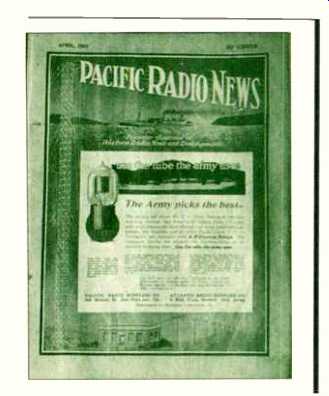
January 1917. With most of the world engulfed in war and only three months left of U.S. neutrality, a new magazine was quietly born at the San Francisco Radio Club. Entitled Pacific Radio News and edited by H. W. Dickow and Paul R. Fenner, the new magazine was launched amid some pretty stiff competition. Although interest in wireless and radio had not yet developed much past the "amateur" stage, several magazines devoted almost exclusively to radio/wireless were already in existence. Wireless Age, published by American Marconi, dated back to 1913, while the first official issue of the Amateur Radio Relay League's QST was published in December 1915. Scores of useful articles about wireless could also be found in Hugo Gernsback's Electrical Experimenter, as well as in Popular Science Monthly, Popular Mechanics and the Scientific American. None of these magazines, however, featured West Coast wireless activities, and because of this Pacific Radio News found a ready audience.
Before Pacific Radio News had much of a chance to grow, however, the United States plunged into the First World War in April 1917. Upon entering the war, the U.S. government sus pended amateur wireless activities for the duration. Thus, publication of Pacific Radio News was temporarily halted with the May 1917 issue. When publication resumed with the January 1920 issue, a completely new radio industry had come into existence. The World War had demonstrated to the U.S. the strategic importance of wireless communication in wartime. As servicemen returned home, "bitten by the radio bug," interest in amateur radio surged. Countless new companies were formed to supply the almost endless demand for "wireless gear," and the new radio industry was off to a flying start.
Pacific Radio News grew steadily during 1920, catering strictly to the amateur wireless enthusiast. The original 6 x 9 inch format was increased to 9 x 12 inches in August 1920 (and was continued through 1935). With the advent of programmatic broadcasting by stations WWJ and KDKA in late 1920, Pacific Radio News gained a new audience: The 'B.C.L." or "broadcast listener." October 1921 saw a change in management and a new editor, Arthur H. Halloran. Halloran's first move was to change the name of the magazine in November 1921 to Radio. The new name signified the magazine's emergence as a national publication aimed at both the amateur and the B.C.L. The broadcasting boom of 1922 ensured Radio's success. By May 1922, circulation had reached 40,000 issues per month and was still climbing.
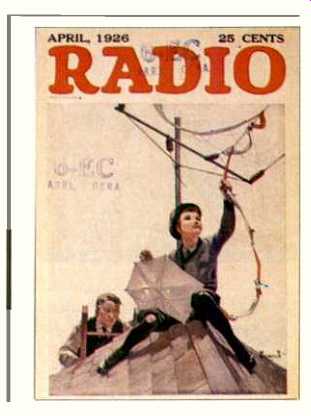
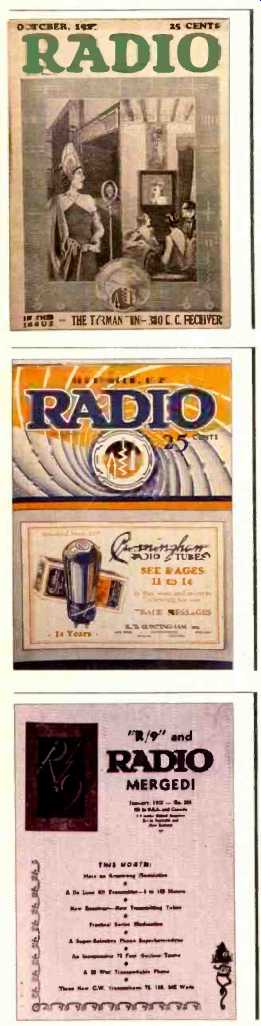
By 1923, a conflict had developed between the amateur and the B.C.L. Radio clearly stated its position on the cover of the April 1923 issue: "An Independent Magazine Serving the Needs of the Radio Amateur and Commercial Operator." The editorial page of the November 1923 issue entitled "Radiotorial Comment" explained the purpose even more clearly: "Radio is primarily the amateur's magazine. It contains information whereby any 'B.C.L.' can so perfect himself as to be advanced to the 'ham' degree." Despite its statements, however, Radio ensured a wide audience by publishing articles of interest to both the broadcast listener and the amateur.
Technical editor Gerald M. Best's articles were always of great interest.
"The Best 45 kc Superheterodyne" became one of the "hot" circuits of the mid-'20s. Nearly every issue of Radio contained an article on either a new and improved version of the "Best Superhet" or plans to improve upon existing models.
By 1928, however, the amateur radio boom began to fade. February 1928 saw the near-demise of Hugo Gernsback's once-giant Radio News, while by March 1928 Radio had been trimmed down to a scant 48 pages.
Competitor Popular Radio, published since 1922, succumbed in May. Clearly a change was necessary.
Nineteen twenty-nine saw the slow but steady transformation of Radio into a trade magazine for the radio industry. The transformation was complete by September 1929, when the "new" Radio emerged as "The National Trade Magazine" complete with advertising on the front cover. The idea looked promising, and the magazine grew quickly in size-a sure sign of success. This growth was short-lived, however, since the stock market crash of October 29, 1929, and the ensuing Depression quickly put a stop to all expansion in the radio industry. Radio Broadcast, once a formidable competitor published by Doubleday-Page, went under in April 1930. Radio somehow managed to survive under the leadership of its new editors, P. S. Lucas and K. N. Ford, but the magazine became progressively thinner as the months passed. Publication was erratic in early 1933 and finally ceased with a combined February/March 1933 issue-the last of Radio as a trade magazine.
After merging with Modern Radio, publication resumed under new management with the June 1933 issue, and Radio became, once again, an amateur radio enthusiast's magazine with considerable emphasis on short-wave radio. The shortwave craze did much to spark a recovery in the radio industry. Unfortunately, Radio didn't find itself a part of this recovery. By mid-1935, a lack of advertising caused Radio's size to drop to 40 pages.
Rescue came in the form of a merger with another amateur radio enthusiast's magazine, R/9, which had been published under that title since September 1932. Under the guidance of technical editor R. S. Kruse, R/9 had gained a steady following among ham operators. With the January 1936 issue, R/9 and Radio were combined to form the single publication, Radio. The magazine now had over 100 pages per month, was 7 x 10 inches in size and printed on glossy paper. Its appearance and content were much like its competitor QST. During this period, Radio was published 10 times per year; the summer months were "slow" among hams, so the August and September issues were skipped each year between 1936 and 1941.
The new format proved quite successful, but once again outside circumstances caused a decline in readership-this time in the form of World War II. Due to the enlistment of many of its readers, Radio again found it necessary to change its format. The transformation to a radio broadcast and design engineer's magazine began slowly with the rather thin February 1942 issue. The April 1942 issue was skipped, and by May the editorial offices had been moved to the East Coast. Radio had become a 9 x 12 inch magazine devoted to "Radio, Sound, and Electronics." After a squabble with Electronics magazine, this became, in September 1942, "Design, Research, Production, Operation." In April 1944, John H. Potts became editor of "RADIO-the Journal for Radio-Electronic Engineers." Slowly, emphasis shifted towards the interests of the broadcast engineer. During this period, Radio was not sold on the newsstands as no price appears on the cover. Once again, due to a decline in advertising, the magazine grew progressively thinner-dropping to 32 pages by late 1946. Another change was necessary.
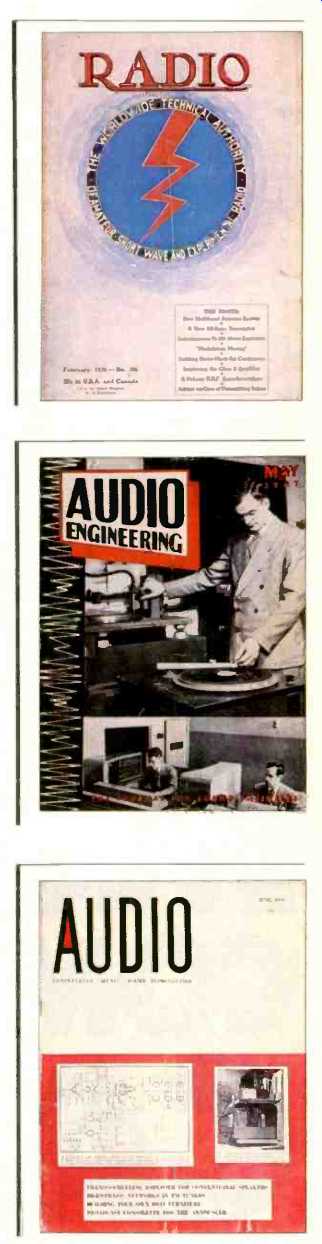
A letter to subscribers from Editor John Potts in the combined February/ March 1947 issue announced the change: Beginning with the May 1947 issue, Radio would be known as Audio Engineering. In Mr. Potts' words, the change was made "Because there has been no technical magazine devoted solely to this field. All engineers interested in audio engineering had to gather piecemeal, from a large number of sources, such information on the subject as is published. To render greater service to our readers and to the industry we have decided to devote our magazine exclusively to the audio engineering field." And so, three years before the emergence of the audio industry, its first booster, Audio Engineering, was born. The first issue, May 1947, featured Norman Pickering on the cover. The appearance was completely new, page count was up to 56, and under the guidance of John H. Potts and C. G. McProud, Audio Engineering was on its way. Early issues were devoted entirely to the audio and broadcast engineer, but with the emergence of the audio enthusiast, the magazine soon contained hobbyist-related articles as well.
After the death of Mr. Potts in March 1949, C. G. McProud assumed editor's duties. One of the co-founders of Audio Engineering, Mr. McProud would head the magazine for the next 18 years! After the founding of the Audio Engineering Society in 1948 and its excellent publication in /952, AE's emphasis shifted slowly towards the audio hobbyist. By 1954, the change was complete enough to drop "Engineering" from the title, leaving simply Audio. Since 1954, Audio has modernized its format several times but still maintains the successful blend of technical and construction articles, product reviews, and record reviews pioneered by Mr. McProud in the early '50s. Audio's readers have become accustomed to looking first to Audio for the latest: The loudness control, Williamson amplifier, and FM-multiplex stereo are only a few of the innovations reported first in the pages of Audio.
Thus, over 65 sometimes stormy but always interesting years, Pacific Radio News, Radio, Audio Engineering, and Audio have reported the birth and growth of both radio and audio. A (Note: Readers desiring a more detailed history of Audio since 1947 should refer to Audio's 10th, 15th, 20th, 25th and 30th anniversary issues of May 1957, 1962, 1967, 1972 and 1977.)
======
MTV -- Music Comes to Cable
JON & SALLY TIVEN
"MTV was a result of examining why music on television did not work," explains Bob Pittman, who designed--or better yet, invented--the format of the cable TV program for Warner Amex Satellite Entertainment Co. (WASEC), a joint venture of Warner Communications and American Express. "It's hard for someone who really loves music to get excited about just an hour of music a week. People don't think 'It's eight o'clock-time for music.' " Pittman's idea was that music on TV had to be accessible 24 hours a day, always at the viewer-listener's beck and call. So Pittman, a Senior VP for Programming, set about finding ways to break the fixed time-frame mold into which music had traditionally been fitted on TV. Drawing on his previous experience as a radio programmer, Pittman put together a group of short video tapes which irregularly rotate through the broadcast schedule at the call of the video jockey, or VJ. Interspersed between the song segments are music oriented movies, concerts or specials.
The second major innovation of the WASEC folks was getting a true hi-fi stereo signal available right from the cable. Andy Setos, the Vice President of Engineering and Operations for WASEC, explains: "What we wanted to do with MTV was essentially to create a radio station with pictures, to be able to play any tune in any order. This meant we had to put it together like a radio station, but the equipment itself had to be TV gear. Since it was going to be a radio station, with every hour fresh rather than prerecorded, there was no way we could edit it together like a conventional program. To do that, we would have been editing in several video tape editing rooms for 24 hours a day just to come up with 24 hours' worth of program. In order to play any tune at any time, we selected an Ampex cartridge machine, but it was mono because regular TV sound is monaural." Ironically, Setos had been involved with New York WNET's simulcasts when fresh out of college in 1971. At that time he had approached Ampex about making NET's AVR-1 machines stereo, and they had turned him down.
Simulcasts then were very difficult to do, what with trying to keep audio tape machines in sync with video tape machines and not having a computer or time base to check on things. However, in 1976 Ampex did modify the WNET machines, essentially by taking the single monaural channel and splitting it into two channels. Normally, such a splitting would have reduced the signal-to-noise ratio, but through use of Dolby A-type professional noise reduction, they actually gained back more than they lost. This was one of the first applications of Dolby noise reduction technique to television.
For MTV, Setos found himself again calling on Ampex, this time to modify the ACR-25, a two-inch quadraplex machine, which is also mono in its normal configuration. They obliged, and Warner-Amex now owns the only three ACR-25s in the U.S. that are stereo capable. Setos believes that there is one in Japan which handles stereo, and points out that TV in Japan is already stereo. Commenting on the results of the modification, he says: "We were very pleased, as it's not easy to modify a machine designed in 1970 to do something today. We ended up with a signal-to-noise ratio of about 68 dB, and that's rather respectable when you consider that the original material we're getting is not up to that level. The cart machines are not the narrowest funnel in the pipe, and the power they give us to program any tune at any time and play all this back-to-back, together with our animations and IDs, is used to good advantage.
All those things come off the cart in real time, actually being selected and played as you see them."
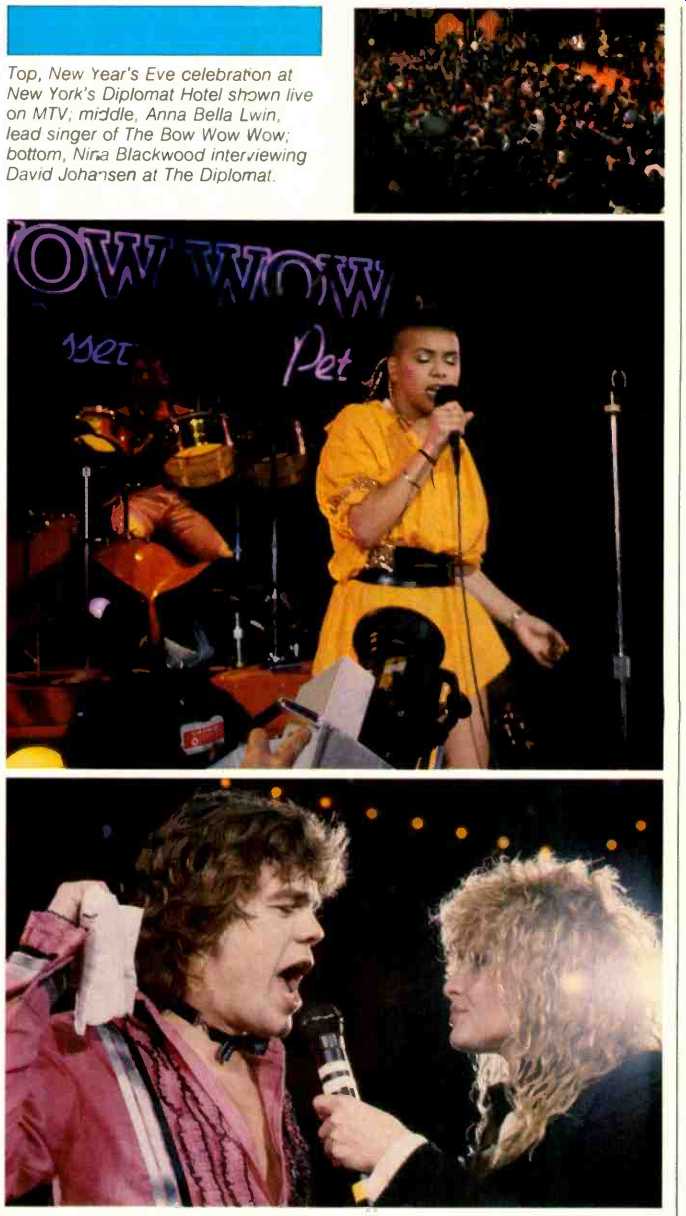
-------- Top, New Year's Eve celebration at New York's Diplomat Hotel shown live on MTV; middle, Anna Bella Lwin, lead singer of The Bow Wow Wow; bottom, Nina Blackwood interviewing David Johansen at The Diplomat.
Most of MTV's programming comes from promotional video tapes supplied by various record companies, and a somewhat wider variety of artists appears than the usually tightly programmed FM station would play. Pittman feels that playing older video promo material from a record company's catalog is not bad, even in the case of a group that didn't make it big.
He says, "I always contended that you really couldn't tell what the consumer wants unless you put it out to them and gave them a chance to decide. If, after a month, nothing happens, then it's reasonable to take it off." Certain video clips, however, do get a heavier rotation, such as those from top acts like The Rolling Stones.
Putting the tapes into the properformat for MN carts and play is Setos' area. He explains that "Many clips are produced for promotional reasons, to be shown in record stores, used as advertising or as fillers on Home Box Office. But they exist in mono, so I have to marry the stereo release to the picture. And we want to make the picture as good as possible. First we convince the record companies to make copies of the master tapes, which is done at 150 ips on the highest quality tape we can get our hands on, usually Ampex Grand Master. All this is done at our expense, about $400 a clip.
"Then we take the picture, whether it be on film or on 3-inch, one-inch, or two-inch video tape, and we send it and the audio tapes out to Image Transform, a Los Angeles company that specializes in making high-quality pictures out of whatever you have, using a lot of proprietary techniques they developed in their own labs. In New York, at Regent Sound, the sound is mixed using a computer synchronized to match the sound."
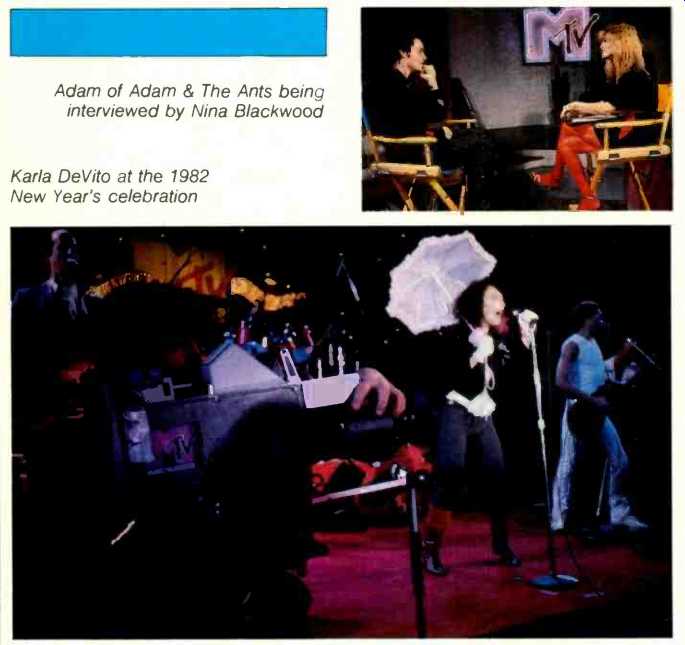
-------- Adam of Adam & The Ants being interviewed by Nina Blackwood. Karla DeVito at the 1982 New Year's celebration Photos: John Bellissimo/Retna Ltd. (top) and Gary Gershoft (bottom)
The stereo signal is piped down the cable in the same fashion as an FM radio signal so that the listener-viewer needs to have his FM tuner or receiver hooked up to the cable in addition to having a connection for his N set. Is this the marriage of audio and video that industry analysts have predicted for so long? Perhaps there has been a secret marriage all along, for Setos points out that WASEC's national research indicates that nearly two-thirds of their audience has their stereo in the same room as the television set. MN uses one of the vacant spots in the FM band for their programming, so the viewer-listener effectively bypasses the poor quality of most TV set audio sections.
To distribute the MN programming, WASEC uses satellite feed, but the stereo signal requires cable companies to buy a $1,500 black box, which is inserted between the satellite antenna dish and the feed link to the cable.
WASEC's Director of Engineering, Dom Stasi, was able to find two sources for the down-link box, Wegner Communications and Learning Industries. The signal-to-noise ratio on the link is about 70 dB, according to Setos, so there is no degradation in that portion of the chain. However, the FM transmission is Dolby B encoded, which provides a relatively compatible form of noise reduction, and a justifiably proud Setos thinks this is the first TV broadcast or TV network distribution done with Dolby B NR. MTV is not all promo films of artists connected by the VJ, as they have taken to showing rock-oriented movies and filmed concerts, as well as doing some live broadcasts. The filmed concert has been the main staple of MTV's special fare, but this has traditionally proved to be a difficult format since few directors and producers appear to understand quite why the rock audience is at a concert. Rarely has the excitement or anything beyond the superficial theatrics of a musical performance been captured on film/tape without the man in charge interjecting an editorial subjectivism which interferes with the art of the performer. Pittman is intent on proper coverage of concerts, saying "We're trying to do something that's never been done on TV before, trying not to take a concert and package it as a TV show, but rather run it as coverage of an event that's worth covering." Pittman and colleagues will have to be very creative to pull this off, and whether he-and indeed MTV-will succeed or will be forced to develop a new format is best left to future pundits. For the present, it's enough to note that there is an element of creative spontaneity to the relatively freeform format that's both interesting to watch and hear.
======
( Audio magazine, May. 1982)
Also see:
Bozak Sonora Loudspeaker System (Jul. 1973)
The Audio Interview: Willi Studer (April 1981)
= = = =