Schubert: "Wanderer" Fantasy. Schumann: Sonata No. 2 in G Minor, Op. 22. Bruno -Leonardo Gelber, piano. Connoisseur Pathé Marconi, EMI CS 2085, stereo, $6.98.
Connoisseur Society is supplementing its own extensive series of home based recordings via some big -name licensing, as witness the above, Pathé Marconi being an illustrious French Italian combine and EMI being, well, EMI. All neatly tied together with international strings. The base, in this case, seems to be Paris.
Without any question this version of the famed "Wanderer" Fantasy of Schubert, a piece that stands in all its horrendously demanding length as a challenge to every classical pianist, is the most communicative performance I have ever heard. I did it the timeless honor of playing it straight through twice, resetting the stylus just as fast as I could at the triumphant ending of the piece.
Schubert is tough to play, first, because of the vast mass of somewhat cluttery and un-pianistic accompaniment notes that always surround the big ideas and, secondly, because of his extraordinarily profound harmonic sense, the strange, moving changes of key-often going quite unheard even by some of the famous pianists.
Third, in this and other big works the last Sonatas-there is a huge time span and an architectural drama to keep going, to sustain, behind all the Romantic details. Not easy! Many otherwise good pianists fail on one or all of these counts.
To use an old phrase, this Gelber makes it all sound ever so easy. He manages even to give the "Wanderer" a light, airy touch, in the right places; and the heavy spots are never merely heavy, always muscular and full of musical spring. He scores 100 on every count, and there never was a more superbly listenable Schubert recording.
The Schumann Sonata, out of his early-ish piano exuberance (Schumann went through phases of composing all in one fashion), is equally well done.
Perhaps I note the Schubert more positively because "Wanderer" is so often recorded and played, and so often bogs down into pianistic bombast or plain impotence. Not here! Wagner: Wesendonk Lieder; Vorspiel/Liebestod (Love/Death Music) from "Tristan." Jessye Norman, London Symphony, Davis. Philips 9500 031, stereo, $7.98.
The five songs, originally with piano (here orchestrated), which Wagner wrote for his passion of the moment, Mathilde Wesendonk, to words of her own writing, were actually studies for the coming opera Tristan, as is instantly apparent to anyone who knows the high points of the big opera. In this rather nicely planned recording, the five songs are preceded on side 1 by the familiar love music from the opera, going on in the long familiar concert fashion directly into Isolde's death music at the opera's end (many hours later); but here there is a new twist; she sings. Most such concert juxtapositions are purely instrumental. So we have Isolde herself as a prelude to the pre -Isolde Wesendonk songs. Nice idea.
I could not say what Wagner might think were he to perceive a black Isolde but here we have one and she puts forth in the grand tradition, a moving if maybe not a great Wagnerian performance. She is a bit quavery in her emotion, does not produce that infallible long line that the great Flagstad could control, even into her old age, and yet she does know and understand the musical expression. The songs, on a smaller scale, are perhaps better than the Isolde segment. Colin Davis provides a solid Wagner orchestra though, again, without quite the long line of tension that the great Wagnerian leaders can command.
American Songs for A Cappella Choir. The King Chorale, Gordon King. Orion ORS 75205, stereo, $6.98.
Fifteen very pro singers with big, operatic voices make up this typical American virtuoso choral group and their music is all-American here, contemporary, more or less, "classical" in approach. If you enjoy this type of ensemble sound, you will find its best virtues here-good, opera -style diction and "acting" of the music, a vast dynamic range from very soft to impressively loud, an unerring exuberance of the sort that all our trained singers learn first of all, and with it that heightened sense of projection, from stage to audience, that opera in particular requires, minus microphones. (Well, we don't count broad casts and recordings; they simulate or are live performances.) Opera? None of this music is opera and there is no orchestra, no instruments; the Chorale is church -based via its organist -choirmaster conductor. Yet the standard American professional choral sound is opera and that is what you will find here in the choral sonics-the good and the bad of it. The unfocused, unblended sound of each part, an aggregation of audible soloists, and the poorly defined harmonies-the singers hear them OK, but we listeners don't. Too fast, too sprightly, too energetic, to the point of habitual inaccuracy of pitch.
Too bad. Because this group has a lot to say in musical terms, if it would just blend better and tune up more accurately.
Not easy to tell you what music is being sung. I won't even try, except to mention Barber, Mennin, Pinkham.
(1) Texts, with authors, are on the jacket reverse-with no composers attached. The composers are duly listed, to one side-in alphabetical order. (2) The composers are on the record label, but in such jumbled fashion that it's almost impossible to figure out who composed what. (3) Not surprisingly, there are outright mistakes--wrong composer--one on each side. A letter came along from the conductor himself (not the record company) noting the corrections.
Since I couldn't tell what was being sung except by stopping the turntable after each piece, every minute or so, and mostly not even then, I just listened anonymously. That'll work fine for you, too. Orion-for goodness' sake, after all these years in the record business...! Hermann Goetz-Complete Chamber Works. A. Veritch, T. King, G. Dicterow, G. Robbins, D. Trembly.
Genesis GS 1037/38, 2 discs, stereo, $13.95.
And WHO is Hermann Goetz? Good question; for you won't find him in Music Appreciation. Listen, here, for four whole sides, and you will find that he was a good man, a German composer after Schumann and early Brahms, yet with a distinct French style of melody, very easy to digest; technically he ranks as a conservative merely because, from our distance, he sounds a bit further back than he actually was. He was around 12 or 13 when Schumann himself wrote his last big works, early 1850s.
Goetz was harried all his short life by TB, which finally got him in his early thirties. That's one reason you haven't heard much about him. He's best known, over there, for a comic opera in German called Der Widerspenstigen Zahmung, which is enough of a name to keep it off the Met stage for another 100 years.
A group of five young pro musicians from the West Coast, who remain collectively nameless (and no room, above, to write them all out in detail), plays Goetz with a fine sense of style and intent, full of fire, notably the solo violin and the piano, very clearly expressing a certain intensity that we can ascribe to the dread weight of that ever -threatening TB that first showed up when Goetz was only 17. It is really lovely music, all fresh early Romanticism, even unto a certain Mendelssohnian flavor. I particularly enjoyed the filler items, Three Easy Pieces for violin and piano; you might try them first. Nicely recorded, though the strings are a bit too loud and close for the piano.
--------
AD:
PART TWO: THE END OF THE DOUBLE STANDARD.
In the frequency range where you find most music, our least expensive speaker offers virtually the same flat frequency response and freedom from distortion as our most expensive speaker.
Until recently, you could consider the selection of speakers an act of faith.
Because of the lack of industry standards and the resulting confusion in the marketplace, the speaker buyer had to depend almost totally on personal taste and subjective evaluation.
But no longer.
At Yamaha, before we designed a new line of speakers that would equal the revolutionary standard of our electronic components, we first defined our goal: High accuracy across the musical spectrum. One of the few objective criteria for rating speaker performance.
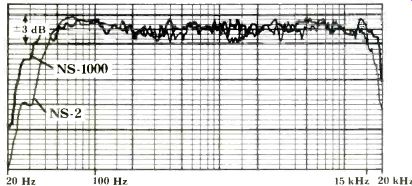
Then we proceeded to make all Yamaha speakers to a single revolutionary standard of accuracy: A frequency response curve that varies by no more than ±3dB from 100 Hz to 15,000 Hz.
With typically no more than 1% harmonic distortion.
But since the frequency range of all our speakers extends well below 60 Hz to beyond 15,000 Hz, why do we even bother mentioning this figure? Because, with the exception of the very deepest rumblings of a pipe organ, all music is produced within this range.
In fact, few if any commercially available stereo pressings have frequencies below 100 Hz and above 15,000 Hz.
Yamaha's success in achieving a single standard of accuracy in all our speakers is confirmed in the chart above.
Unlike the frequency response curves of other speaker manufacturers which indicate unnatural booming in the bass, added sparkle in the treble, and extreme loudness level variations of as much as 10 dB, Yamaha's frequency response curves show a relatively straight line, which indicates uncolored, natural sound.
Yamaha's musical heritage.
Yet, in spite of Yamaha's objectivity in design, the perception of sound remains subjective.
That's why Yamaha speakers aren't designed to meet objective standards alone, but to meet a higher standard: the ears of the people who make Yamaha's world-famous musical instruments.
Since 1887, Yamaha has been making some of the finest musical instruments in the world.
Pianos, organs, woodwinds, guitars, and brass.
With our musical instruments, we've defined the standard in the production of fine sound. And now, with our entire line of speakers and electronic components, we've utilized not only our studio engineers, but also our musical instrument designers to define the standard of music reproduction.
It's called Natural Sound.
And it's totally unique to Yamaha.
Five different speakers, built to one standard.
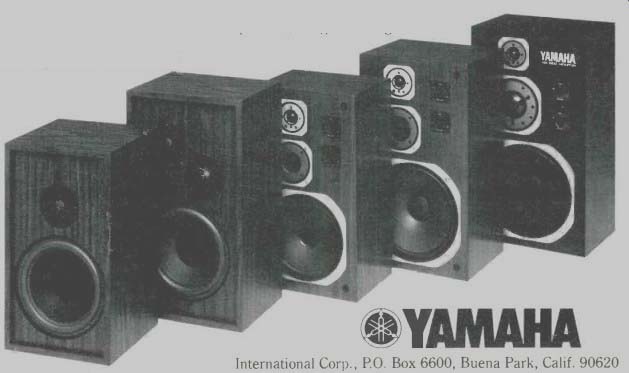
Yamaha offers five different speaker models, ranging in price from $1,350 a pair down to $200 a pair.
At the top, the revolutionary beryllium dome NS-1000 Series, offering the ultimate in state-of-the-art performance.
Following the NS-1000 are our other three-way types: the NS-690,NS-670, and NS-3. Our least expensive, but still highly accurate, is the two-way NS-2.
Since each is built to the same high quality standard, you're probably wondering what those extra dollars are buying.
It's very simple.
To satisfy the most demanding audiophiles, those extra dollars buy extended response at the frequency extremes.
Higher sound levels with equal or lower distortion. More power handling capacity. More tone controls to contour the tonal balance of the speakers with the characteristics of the room.
More specifically, on our model NS-670 and above, Yamaha offers die-cast speaker frame baskets to eliminate potential resonance. Luxurious wood enclosures (even rare ebony wood!). Tangential-edge suspension for midrange and tweeter domes to provide smooth response. Acoustic equalizers on tweeters to flatten frequency response and enhance dispersion. Diagonally edge-wound voice coils for greater diaphragm control and increased transient response. Plus thick felt lining inside the cabinetry to isolate rear sound waves for distortion-free bass response.
But regardless of how much you pay, every Yamaha speaker is built to the same essential construction criteria and tonal accuracy.
Proven acoustic suspension design. Dome drivers for better high frequency dispersion.
Carefully matched crossover networks. And heavily reinforced, extremely rigid enclosures.
The End of the Double Standard.
The single standard of performance found throughout the entire line of Yamaha speakers is a demonstration of product integrity that no other manufacturer can claim.
But in the final analysis, only your ears can be the judge.
That's why we invite you to visit your Yamaha audio dealer soon. His knowledgeable salesmen and extensive demonstration facilities can save you time and trouble in selecting the speaker that's right for your budget. And right for your ears.
--------
While many manufacturers offer accurate reproduction only in their top-end speakers, Yamaha brings you an extremely high degree of accuracy in all models throughout the line.
The above curves. comparing the NS-1000 with the NS-2, were recorded under the following conditions:
1. Equipment used--Bruell & Kjaer [B&K] 4133 microphone. 1022 oscillator, 2113 spectrometer. and 2305 recorder.
2. Input--A "pink" noise source was used with an input level of 3 watts (significantly higher, more rigorous, and more closely corresponding to actual home listening levels than the commonly used industry standard of 1 watt).
3. Measurement--Each loudspeaker was placed in "free field" loft the floor and no closer than 5 feet to any wall boundary in an average size listening room). A multiplicity of curves were taken at various points in the listening room and averaged. to produce the total energy curves pictured.
-----------
(Audio magazine, 1976)
Also see:
Equipment Profiles: E88 "Eclipse" Model 2240 Electronic Crossover/Leonard Feldman; Garrard Model 86SB Turntable/George W. Tillett
= = = =