Equipment Profiles:
E88 "Eclipse" Model 2240 Electronic Crossover/Leonard Feldman; Garrard Model 86SB Turntable/George W. Tillett
--------------------
ESS "Eclipse" Model 2240 Electronic Crossover
MANUFACTURER'S SPECIFICATIONS: Available Frequencies: 100, 150, 200, 250, 500, 800, & 1250 Hz, or (via multiplier button) 1.0,1.5, 2.0, 2.5, 8.0 & 12.5 kHz per channel. Frequency Response: Low Pass: Within 0.25 dB 20 Hz to-3dB at selected crossover; High Pass:-3 dB at crossover to within 0.25 dB up to 20 kHz. Crossover Slopes: 12 dB per octave. Gain: 0 dB in pass bands. Dimensions: 19 in. W x 1 3/4 in. H x 9 in. D (48.3 x 4.4 x 23 cm.) Weight: 5 lbs. (2.3 kg.) Price: $300.00.

The advantages of using electronic crossovers in a bi-amp or tri-amp sound reproducing system, as opposed to passive crossover networks built into multi-driver speaker systems, have been described in audio literature over the last several years in great detail. To summarize the advantages here, biamping or tri-amping of audio systems is said to require less power per individual amplifier for a given level of composite complex signals, elimination of passive components between amplifier and speaker driver, more accurate reproduction of frequencies in the vicinity of crossover points, and retention of high damping factors as seen by the speaker drivers themselves.
The ESS 2240 Electronic Crossover is basically a stereo device with bi-amping capabilities when used with a pair of stereo power amplifiers and a preamplifier or with a stereo receiver with preamp-main amp interruption facilities plus a second stereo power amp. Alternatively, the 2240 may be used monophonically to create a tri-amplification system, as shown in the hook-up diagram of Fig. 1, in which case two Model 2240s would be required for stereo.
The crossover network is intended for standard rack mounting and utilizes just one standard rack space (13/4 inches) in height. The brushed aluminum front panel has 4 rotary controls, a pair of overall channel gain controls for left and right channels and two "frequency balance" controls (one for each channel) which adjust relative gain between low and high frequency output bands. A tiny red pilot lamp indicates that power has been applied as there is no on/off switch on the unit (a fact which poses no real problem since the unit would probably be connected to one of the switched convenience outlets on associated preamplifier equipment or to a switched outlet expander in a pro installation). Actual crossover frequency selection is made via fourteen buttons (seven per channel) plus two "times ten" multiplier buttons, all located on the rear panel as shown in Fig. 2. A total of 14 crossover frequencies may be selected for each channel (see manufacturer's published specifications above). [Editor's Note: For this photo we have removed the metal shield which keeps inquisitive fingers from randomly selecting crossover points.] There are two standard phono-tip input jacks which accept signals from preamplifier outputs and four output jacks (two for low-pass and high-pass bands of each channel). The device is line fused on the rear-panel with a 1 ampere fuse.
The view of the internal construction of the crossover network (Fig. 3) discloses that active filter circuits are employed throughout. No inductive components are used, and three identical integrated circuits take care of all lowand highpass filtering plus gain circuitry. The single large circuit board is made of glass epoxy and high-quality, tight-tolerance capacitors are used in critical frequency-determining circuits. The preliminary owner's manual supplied with our test sample did not contain a schematic diagram of the circuit, so we can only comment on end results attained in our measurements.
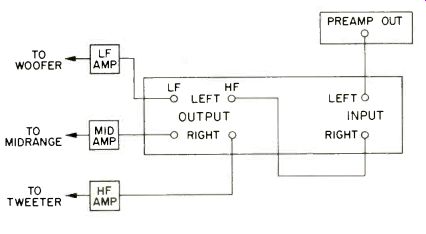
Fig. 1--Wiring required to use the ESS 2240 as a mono three way crossover.
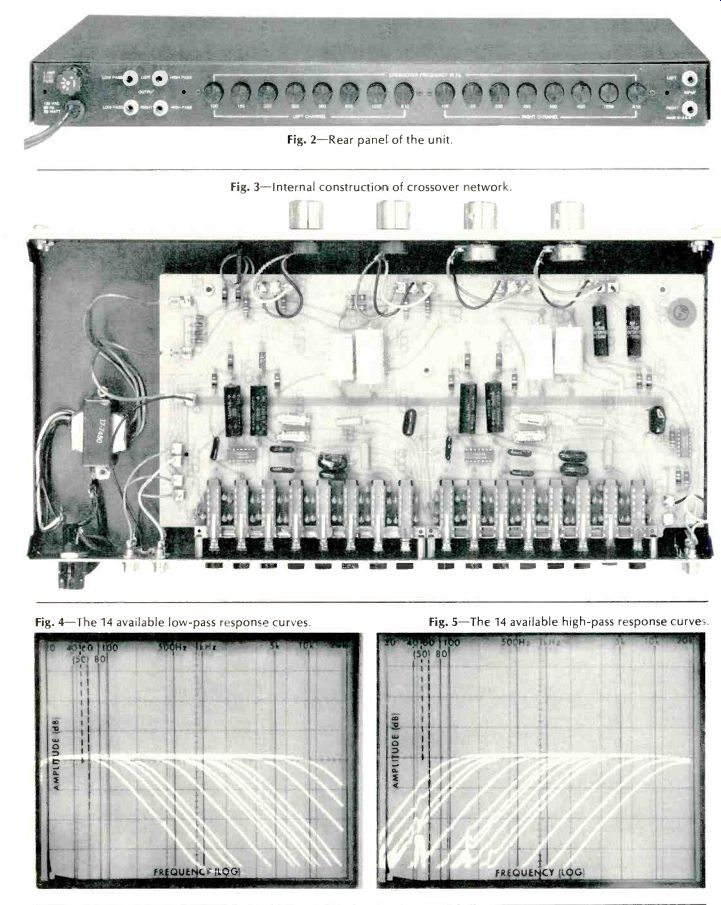
Fig. 2--Rear panel of the unit.
Fig. 3--Internal construction of crossover network.
Fig. 4--The 14 available low-pass response curves.
Fig. 5--The available high-pass response curves.
With some 28 individual response curves available in the 2240, we really appreciated having our Tektronix spectrum analyzer even more than we had up to now. Without it, we would still be plotting point-by-point responses, and this report might not have appeared until several months later! Be that as it may, Fig. 4 is a storage 'scope display of all 14 lowpass filter response curves available, while Fig. 5 shows the 14 complementary high-pass response curves. Since the frequency calibration of our analyzer is extremely precise and frequencies are swept logarithmically, verification of the-3dB points for each curve can be made right from these scope photos and were found to be very precise, with variations (from-3 dB at the specified frequencies) never off by more than 0.5 dB in the worst case and generally much closer than that.
The display in Fig. 6 resulted from two separate frequency sweeps. During the first sweep (with crossover frequency set to 1 kHz) the input to our analyzer was connected to the "low pass" output jack of one channel of the 2240 to obtain the left-hand trace. After first reconnecting the analyzer's input to the high pass output jack of the same channel of the 2240, the sweep of frequencies was made once more, yielding the "text-book perfect" composite crossover characteristic which was photographed directly from the storage scope face.
"The three-way crossover arrangement pictures in Fig. 7 was achieved by connecting the 2240 as suggested earlier in Fig. 1, and low-to-mid crossover of 500 Hz was chosen while mid-to-high crossover selected was 12,500 Hz.
The "frequency balance controls" described earlier are particularly useful if you plan to use power amplifiers which are not equipped with input level controls. Set to one extreme, these controls provide a low-pass output which is 10 dB lower than the high-pass output, while when set to the other extreme, the reverse situation is obtained. To illustrate the action, we rotated the control counterclockwise and obtained separate low-pass and high-pass output traces corresponding to sweeps of frequency as before. The results are shown in the photo of Fig. 8. Each vertical division in this ('and every other) scope photo represents a level change of exactly 10 dB and the difference between the low-pass output level and the high-pass output level in Fig. 8 is very nearly 1 division, or the expected 10 dB.
Other Lab Measurements
With reference to an output level of 0.4 volts rms, hum was-75 dB and random noise under the same output level conditions measured better than-85 dB. All slopes beyond cut-off points were precisely the specified 12-dB per octave rate, and response within the pass bands was well within the 0.25 dB specified.
Measurement of total harmonic distortion really put our Sound Technology 1700A through its paces. At 3 volts in/out (the 2240 is a unity gain device), THD varied from 0.002% to
0.004% depending on frequency and the precise crossover point selected. These figures are very near the bottom limit of the Sound Tech unit.
Fig. 6--Typical low and high-pass response curves at the selected 1 kHz crossover point.
Fig. 7--Three-way electronic crossover on a single audio channel.
Fig. 8--The frequency balance control permits varying levels of lowand high-pass outputs to compensate for different driver efficiencies or amplifier gains.
Conclusions
Devotees of bi-amping and tri-amping may have already noted that the ESS 2240 provides only one rate of slope at any of the crossover frequencies selected-12 dB. Some tri-amping enthusiasts prefer a more gentle 6 dB/octave slope for certain driver combinations, while still others insist that in other cases 18 dB per octave is what's called for. Several leading authorities are, however, recommending 12-dB per octave slope rates, saying that they provide the best combination of performance factors. So if you want the flexibility of being able to try out several crossover frequency combinations (substitute frequencies can be incorporated fairly simply by ESS service personnel is none of the ones supplied suits your taste or that of your speaker elements), then the ESS Series Eclipse Model 2240 Electronic Crossover may well be just what you have been looking for.
Leonard Feldman
--------------------
Garrard Model 86SB Turntable
MANUFACTURER'S SPECIIFICATIONS
Speeds: 33 and 45 rpm.
Motor: Synchronous type.
Drive: Belt to turntable.
Wow & Flutter: 0.06%.
Rumble: -64 dB.
Dimensions: 17 3/4 in. W x 15 1/2 in. D x 7 in. H (45.1 x 39.4 x 17.8 cm). Weight: 25 lbs. (11.34 kg). Price: $159.95.
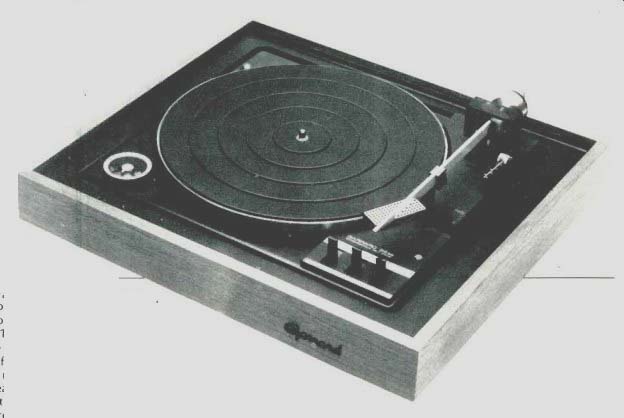
The Garrard Model 86SB is a two-speed automatic turntable costing only $159.95, complete with base and dustcover.
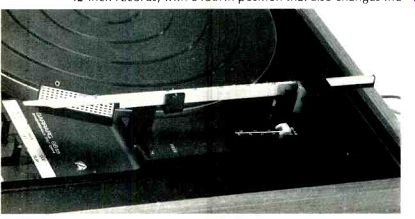
Like the Z-100-SB, it uses a belt drive mechanism with no variable speed. But as far as the basic performance is concerned, differences seem very slight. Styling is typically Garrard with a restrained black and silver finish contrasting with the light teak base. On the left, at the front, is a rotary dial, which controls the arm set-down positions for 7-, 10-, and 12-inch records, with a fourth position that also changes the speed for 7-inch, 45-rpm records. On the right-hand side are three levers for Start-Autostop, On/Off, and Cue-the last named lever operating a narrow platform which raises or lowers the arm. Behind these controls is the knob which locks the arm on its rest, and at the base of the arm is the anti-skating device. This last consists of a plastic bar with a sliding weight attached to the arm pivot. It is calibrated for both conical and elliptical styli with tracking weights up to 4 grams. The arm itself is tubular aluminum with an almost triangular cross-section, and the necessary offset is obtained by mounting the cartridge holder at an angle. A threaded counter weight is mounted at the rear, and the tracking force is adjusted by a small weight which can be moved over a portion of the arm in front of the pivot. This section, about 3 1/2 inches long, is calibrated from 0-4 grams.
The turntable platter is dynamically balanced and weighs about 5 1/2 pounds. As mentioned earlier, a belt drive is used instead of the idler wheel system generally employed by less expensive turntables. The motor is a standard Garrard Synchro-Lab type used on several other models, and the speed change is effected by a fork which moves the belt drive up or down the dual-dimensioned motor spindle. Adjustment screws are provided for set-down positions as well as arm heights in the automatic and manual modes, and the unit comes complete with a 45-rpm adaptor, a plastic gauge for correct cartridge mounting, and a small bottle of oil to be applied to the turntable bearing. The attractive smoky plastic cover fits into a slot at the back of the base and is held in position by a spring loaded arm. The unit itself is spring mounted to the wooden base which has four small mounting feet.
===========
More Complete Information Dept.
In our May article "Record Cleaners Revisited," a poorly edited paragraph could easily have lead to the inference that the Zerostat gun is the only product which is truly effective in removing static from records. This is untrue, as a rereading of our March, 1975 article "Do Record Cleaners Really Work?" will show that we found the Nuclear Products' Static Master "was highly effective in removing static charges ..." and "after treatment ... there was no measurable charge on the records." We stand behind those tests of a year ago and commend the Static Master to our readers' attention. We also apologize to our readers, as well as to Nuclear Products, for this unintended misdirection.
================
Measurements
As the cables supplied were low-capacity types, a CD-4 cartridge was used for the preliminary tests, changing over to a stereo model later. The two selected cartridges were an Audio-technica AT-20 and a Shure V-15 MkIII; neither presented any difficulties in mounting. A standard Garrard cartridge carrier is used, and after mounting the cartridge (using the gauge), it is simply plugged into the arm. The first tests were for wow and flutter, and the combined figure measured was 0.07% using the DIN standard. Rumble came out at-60 dB, also very commendable for a machine in this price range. No doubt about it, a well-designed belt drive is hard to beat! Tracking error was within the normal 0.5 degrees per inch, and the lateral arm friction was assessed at 0.1 gram--a bit higher than I would have liked. On the other hand, vertical friction was too low to measure-so was the arm resonance. This is due to the construction of the counterweight which has a flexible insert tending to de-couple the mass from the arm and spreading the inherent resonance. Arms having a high-Q resonance will often misbehave on warped records, as well as causing other problems! The anti-skating dial seems to be calibrated differently than the tracking force dial, since the optimum setting of the anti-skating mechanism was about 0.5 grams when set up for the 1 1/2 grams preferred by the Shure cartridge. Calibration of the tracking force "slide rule" was extremely accurate-one advantage of this type of adjustment. The force required to operate the automatic arm return mechanism is quite small and not likely to bother the most fragile and compliant cartridge. Speed accuracy was exceptionally good, being right on the nose at both speeds and not affected by reasonable voltage variations.
Listening Tests
No adjustments were found necessary-either for arm height or correct stylus-landing positions. In the automatic mode, the arm is returned to its rest position at the end of the record, and the motor is then switched off. If the auto control lever is moved to Start when a record is playing, the pickup will return to the beginning of the record, and complete manual operation is achieved by simply using the manual starting switch. The cue control is well-damped with a slow downwards movement and a fast retract, and the mechanism is quite positive with no annoying side-play.
The instruction book is written in four languages, but no mention is made of the low-capacity cables actually supplied, the illustrations showing a DIN-type connection. The supplied leads terminate in standard RCA-type plugs with the grey wire for the left channel and brown to the right. A green wire is provided for the ground connection.
Summing up: The Garrard 86SB offers rather good performance for its modest price and should prove an ideal unit for a budget system where a top-quality phono cartridge is to be used.
-George W. Tillett
---------------
ADs:
The Garrard 990B. And the argument ends.
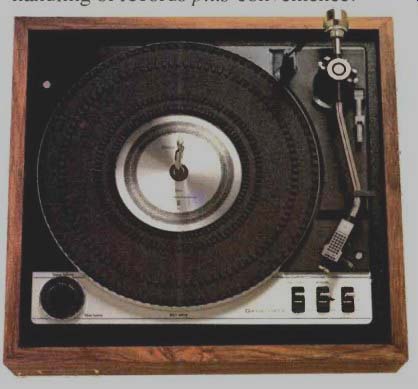
There are almost no limits to what you can spend for a turntable. Nor to the refinements that can be built in.
The argument has been whether you can find a turntable at a sensible price, that really performs-giving away nothing important. Now with the belt-driven 990B, the argument is over. The 990B gives nothing away in any vital area, yet is priced to make it eminently accessible.
We believe the 990B is the best value Garrard has ever offered in its quarter century of designing and manufacturing high fidelity turntables.
The 990B is a single-play/multiple-play turntable and is fully automatic in both modes. That is, its arm indexes, returns to its rest and shuts off automatically.
All of which is more dependable than a hand ... that can be shaky or careless. And the mechanism that does all of this is disengaged during play. You get the gentlest handling of records plus convenience.
But more. In the multiple-play mode, your records rest on a two point support.
You don't have to balance them on a single center support. And pray.
And still more. A precision anti-skating device eliminates distortion and record wear caused when the stylus is forced against the inner wall of the groove by rotation of a record. Even cueing is viscous damped in both directions.
All well and good. But what about performance? A glimpse at some specifications tells the story. Rumble: -64dB. Wow: 0.06%. Flutter: 0.04%. These are possible because your records are cushioned on a full size, 5 lb., die-cast, dynamically balanced platter-belt driven by a motor that combines an induction rotor for starting power and a synchronous section for constant speed.
You can even solve the problem of off-pitch recordings with the variable speed control monitored by a strobe disc.
One final word. The S-shaped, lightweight, aluminum tonearm boasts low mass and low friction. But here's the thing. The 990B's tonearm can track as lightly as 0.5 gram. Protection and performance indeed.
There are other turntables in the price range of the 990B that offer some of these features and specifications. The 990B has them all and at a price that's sensible under $170!
Which clinches the argument.
For a copy of the Garrard Guide, write: Garrard, Div. of Plessey Consumer Products, Dept. C, 100 Commercial St., Plainview, New York 11803.
'The Automatic Choice
------------
Technics
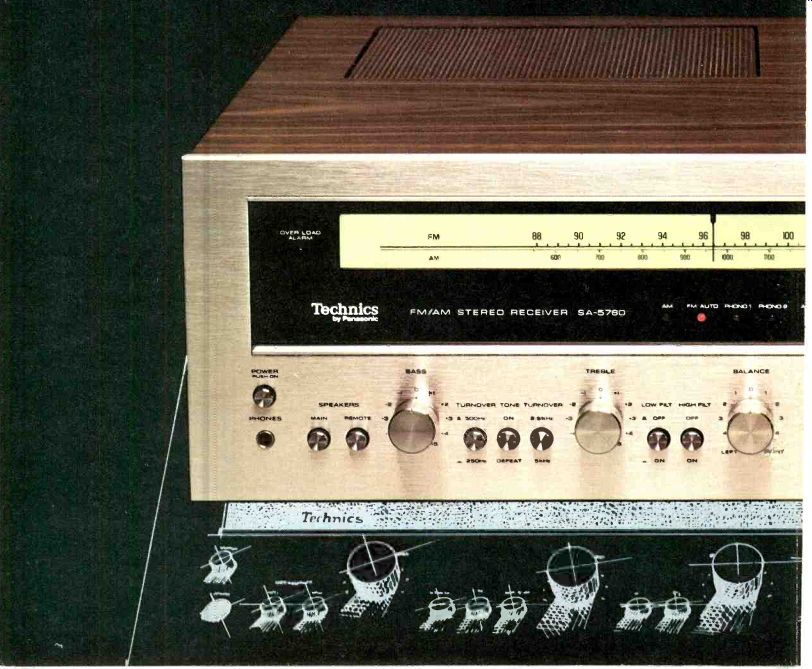
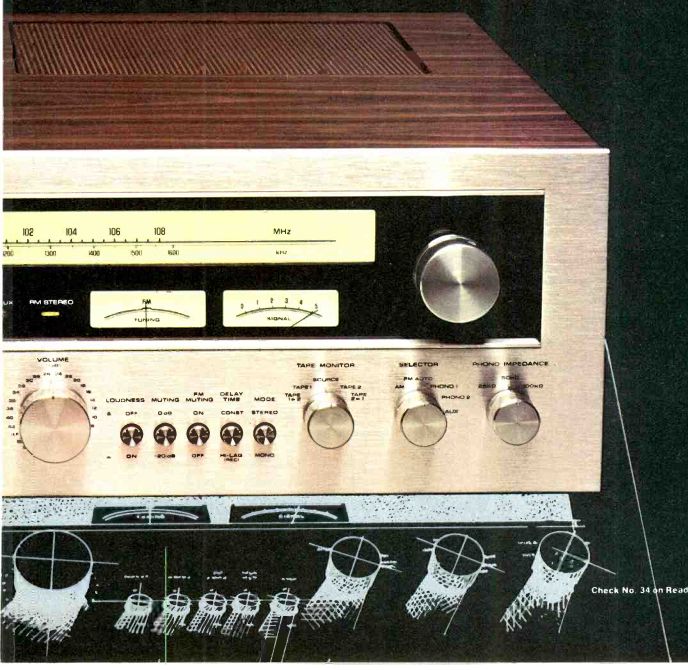
Introducing the world's most powerful receiver. 165 watts per channel With the world's least distortion. Only 0.08% THD.
The Technics SA-5760. 165 watts RMS per channel. That's more power than any other receiver in the world. And an even more important specification, 0.08% THD (Max.) . That's less distortion than any other receiver in the world at rated power.
To achieve this unequaled power and uncompromising performance, we used single-packaged dual transistors in the differential amplifier stage of each channel. As well as high capacitance filtering and a bridged rectifier with high current reserve. And the amplifier is also direct coupled, with no transformers or capacitors from input to output.
There's also heavy power supply regulation. So transient bursts in one channel remain isolated from the other.
And you'll hear your records precisely the way they were recorded. Thanks to "current mirror loading"--a radically new circuit found in the phono equalizer section of the SA-5760's pre-amp. The results are impressive. Double the amplifier gain. An unsurpassed S/N ratio of 78dB. A frequency response that's accurate to within ±0.2dB of the ideal RIAA equalization curve. And an overload-resistant input that will sail through high-level signal inputs without a trace of distortion.
For FM performance, we didn't just settle for outstanding specifications in selectivity, sensitivity and interference rejection. We also use flat group delay filters in the IF section so that the time delay is constant for all frequencies. That means the signal being broadcast is the signal' pull receive and without phase distortion.
And there's a Phase Locked Loop IC which improves tuner performance even more. Like a well-defined 38dB of stereo separation at 10kHz and much higher at mid-band.
Inaudible distortion. A frequency response that actually exceeds the response of FM broadcasts (0.2dB-0.8dB from 22Hz. to 18kHz with the exclusive delay time switch in the CONST position). As well as a S/N ratio of 85dB for super-quiet FM broadcasts.
The SA-5760's controls are as sophisticated as its circuitry. A 26-step true attenuator click-stop volume control. Calibrated from -60 to 0 dB. Low distortion negative feedback tone controls with turnover selectors for both the low end and high end frequencies. A linear FM/AM dial scale.
A zero-center tuning meter for FM as well as a truly linear signal-strength meter for AM and FM that works the way other meters don't: accurately.
There are also multiple speaker and amplifier protection circuits, with a front, panel overload indicator. Two-way tape-to-tape dubbing. Two phono inputs with variable impedance selectors for each. And all the inputs and outputs you'd expect from the world's most powerful receiver.
And to complement the SA-5760, Technics has five other receivers. Each with excellent power. Outstanding performance. Sophisticated circuitry. And at a good price. The concept is simple. The execution is precise. The performance is outstanding. The name is Technics. *165 watts per channel, minimum RMS, into 8 ohms from 20Hz to 20kHz with no more than 0.002 THD (total harmonic. distortion). Technics by Panasonic
---------------
SONY 8B0-2
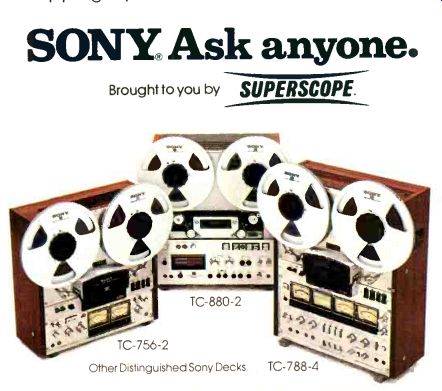
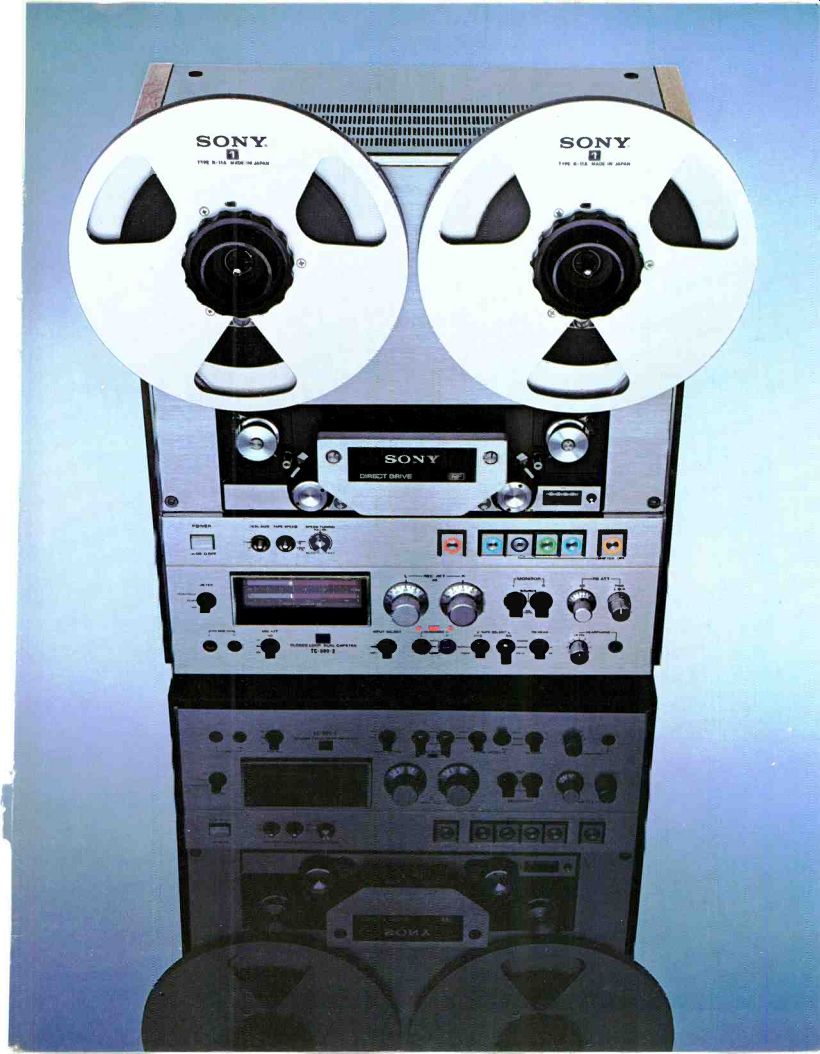
THE WORLD'S BEST.
DIRECT DRIVE SERVOCONTROL SYSTEM. The name may be long-Close-Loop Dual Capstan Tape Drive-but the concept is simple: one capstan is just an extension of the motor shaft itself (the other connects through a belt-drive inertia fly-wheel). Gone are the intervening gears that can often impair optimum operating reliability as well as speed accuracy. The result-almost nonexistent wow and flutter--a mere 0.02% @ 15 ips.
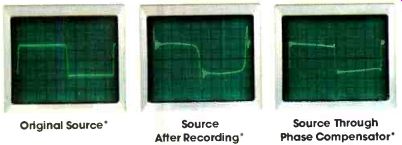
PHASE COMPENSATOR CIRCUIT.
Original Source; Source After Recording; Source Through Phase Compensator
Ideally, what you want on recorded tape is a "mirror image” of the original signal. No more. No less. Problem: the very nature of the recording process causes phase distortion.
Solution: during playback, Sony's exclusive Phase Compensator Circuit compensates for phase distortion. Result: sound quality that's virtually identical to the original source. (REFER TO OSCILLOSCOPE READINGS.)
SYMPHASE RECORDING.
Thanks to the durability of Sony's Ferrite and Ferrite Heads and incredible precision fabrication and alignment of the head gap, you can record any matrix 4-channel signal (like SQ** or FM), play it back through a 4-channel decoder/amplifier, and retain the exact positioning of signal throughout the 360° 4-channel field. What started out in right front channel stays there. What began in left rear doesn't wander over to right rear. There's no phase shift whatsoever.
PEAK READING VU METERS. They're versatile. Accurate. And incredibly informative. 1. You can set for standard VU operation to determine recording level. 2. Set to display transient peaks only (up to +15 dB).
3. A third display, Peak Hold, retains transient reading, letting you accurately measure audio input and adjusts accordingly with 2dB Stepped Record Level Attenuators.
SYNCRO-TRAK. This means you can lay down two individually recorded tracks in perfect synchronization with each other. Record head has playback-monitor function in record mode.
This eliminates time lag that occurs when monitoring through playback head. Thus both tracks can be first generation, keeping noise levels at minimum. Flashing Standby Signal alerts you that the unrecorded channel is record-ready. And Punch-In Record puts you into record mode instantly, without stopping tape.
SONY-- Ask anyone. Brought to you by SUPERSCOPE.
TC-880-2, TC-756-2, TC-788-4. Other Distinguished Sony Decks. 1000 Hz @ 0 dB. 15 ips.- CBS, Inc. (Side panels of these units are constructed of plywood, finished In genuine walnut veneer.) 01976 Superscope. Inc. 20525 Nordtrott St. Chatsworth, CA 91311.
Prices and models subject to change without notice. Consult the Yellow Pages for your nearest Superscope dealer
------------
Sansui
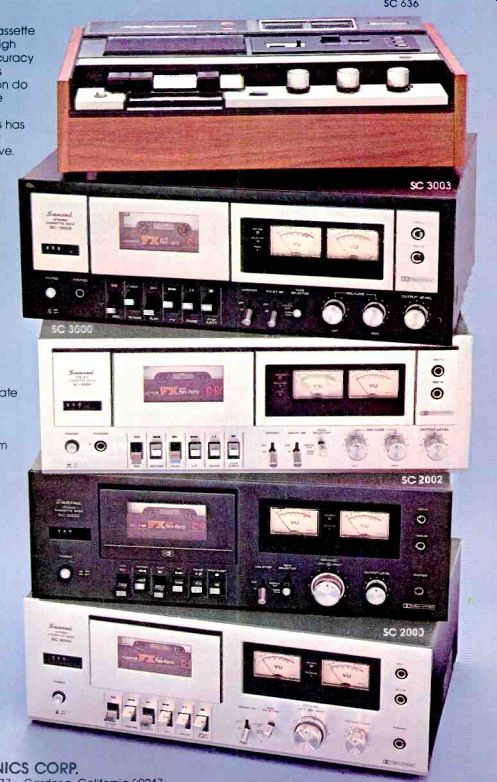
With the development of the Sansui cassette decks, the cassette can truly be called a high fidelity medium. Only with the technical accuracy and near perfection of these Sansui models can the musical recording and reproduction do full justice to the capabilities of the cassette being used.
The new Sansui vertical front-load series has achieved extremely low wow and flutter by isolating the capstan drive from the reel drive.
This is accomplished by a slip-free drive belt coupled to a mirror finish extra large flywheel. Our new decks incorporate the newest Dolby IC chip technology to give you a full 10 dB improvement in signal-to-noise ratio. All mechanical controls are inter-locked so you can go directly from any mode to any other without going through stop, to prevent damaging valuable tape.
The SC-3000 and SC-3003, top-of-the-line models with 0.09% (WRMSI wow and flutter are stacked with attractive features: front-access tape compartment positioned right-side up, fully automatic stop-shut/off, a reliable and easy-to-read 3-digit tape index counter with a very useful Memory Rewind Section, highly accurate VU meters, peak level indicator, extremely hard Permalloy record /playback head for long life and outstanding performance.
All four models in this Sansui series, from under $290.00** to under $370.00** share many of the same outstanding features for true high fidelity performance at attractive prices.
The Sansui SC-6361at under $280.00 a leading all-around deck, delivers fine quality sound without costly frills. As with the higher priced models ,the SC-636 offers fully automatic shut/oft, illuminated VU meters, built-in Dolby'` Type B Noise Reduction System, low wow and flutter and an excellent signal-to-noise ratio.
Sansui has stacked its decks. Stop in at your nearest franchised Sansui dealer today and buy one of these outstanding new Sansui series to stack yours.
* Dolby is a trademark of Dolby Laboratories Inc.
**The value shown is for informational purposes only.
The actual resale price will be set by the individual Sansui dealer at his option.
Simulated walnut grain
--------------
Maxell



THE TAPE THAT'S TOO GOOD FOR MOST EQUIPMENT.
Maxell tapes are not cheap.
In fact, a single reel of our most expensive tape costs more than many inexpensive tape recorders.
Our tape is expensive because it's designed specifically to get the most out of good high fidelity components. And unfortunately, there's not much to get out of most inexpensive tape recorders.
So it makes no sense to invest in Maxell unless you have equipment that can put it to good use.
No other tape sounds as good as ours because no other tape is made as carefully as ours.
It's not difficult to make tape.
What is difficult is making great tape. Tape that's absolutely quiet has no dropouts, is free of distortion and covers the entire audio spectrum flawlessly.
We've found the only way to make that kind of tape.
First we only use the best quality materials.
(Not only the best polyester, but even the best screws, hubs and pressure pads.)
Second, we're very careful.
Nothing gets into our tape until it's been tested out.
For example, every batch of magnetic oxide we use gets run through an electron microscope before we use it. This reveals the exact size and proportions of individual particles of oxide.
Because if they're not perfect, the tape won't sound perfect.
And since even a little speck of dust can put a dropout in tape, no one gets into our manufacturing area until he's been washed, dressed in a special dust-free uniform and vacuumed. (Yes, vacuumed. From the top of his head to the soles of his shoes.) Unlike most tape-makers, we don't test our tape every now and then.
We test every inch of every Maxell tape for magnetic characteristics, frequency response, noise, dropouts, sensitivity.
---------We know how good our tape will sound because we've listened to it
Then we listen to it: totally.
No other tape starts off by c blank, unrecorded tape.
(And if we hear anything, you never get to hear the tape.) Which is why every Maxell tape you buy sounds exactly the same.
From end to end. From tape to tape. From year to year. Wherever you buy it.
It's also the reason why you can't buy three Maxell tapes in a plastic bag for a dollar.
We clean off the crud other tapes leave behind.
After all the work we put into our tape, we're not about to let it go to waste on a dirty tape recorder head. So we put non-abrasive head cleaning leader on all our cassettes and reel-to-reel tapes. Which is something no other tape company bothers to do.
Our cassettes are put together as carefully as our tape.
Many people don't realize it, but a cassette is actually a part of a tape recorders drive mechanism.
So we make our cassettes better than we have to.
So they'll take years of abuse, we put more polystyrene in our shells than other companies.
For precision, we finish them to tolerances as much as 60% higher than the standards call for.
And we spot-check over 200 separate spots on our cassette shells before we release them.
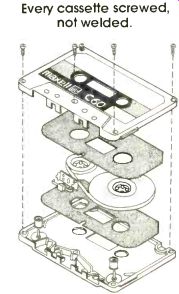
--------Every cassette screwed, not welded.
Other companies are willing to use wax paper and plastic rollers in their cassettes. We're not.
We use carbon-impregnated material. And Delrin rollers. Because nothing sticks to them.
A lot of companies weld their cassettes together. We use screws.
Screws are more expensive. But they also make for a stronger cassette.
They act like steel reinforcing rods. (They also give you a way to get inside in the event that you ever need to.) And before any cassette gets a Maxell label, it gets hit with a heat and humidity test that you couldn't tolerate. This is to make sure you'll never get stuck with a Maxell cassette that sticks.
Our $7.50 tape comes with a better take-up reel than most 5400 tape recorders.
There are those who buy their first reel of Maxell tape just to get their recorder a better take-up reel.
--------There's no way dust is going to get in here.
--------A quick way to upgrade your 8-track player.
That's because we've put more time, effort and polystyrene into our reels than other companies.
Which has made our reel stronger, more rigid and less likely to warp than others.
Also, unlike other take-up reels, ours has no holes in it. This not only keeps dust from getting on our tape, it keeps the tape more accurately centered on the reel.
Our 8-track tape can get more performance out of any 8-track player.
We've found that many of our 8-track tapes end up in underpowered 8-track automobile players. So our top-of-the-line 8-track cartridges come with high-output tape. It has a bigger signal, and a better high end than any other 8-track tape. Which means any 8-track player you put it in will put out a higher sound level, at a lower volume setting.
Our tape comes with a better guarantee than your tape recorder.
Nothing is guaranteed to last forever.
Nothing we know of, except our tape.
We figure, if you've invested in the kind of equipment that can properly use our tape, you're not apt to misuse it.
So anytime you ever have a problem with any Maxell cassette, 8-track or reel-to-reel tape, you can send it back and get a new one.
Give our tape a fair hearing.
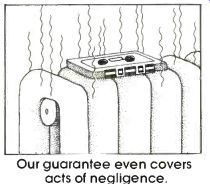
------------Our guarantee even covers acts of negligence.
You can hear just how good Maxell tape sounds at your nearby audio dealer. (Chances are, it's what he uses to demonstrate his best tape decks.) You may be surprised to hear how much more music good equipment can produce when it's equipped with good tape.
-----------------
Stanton
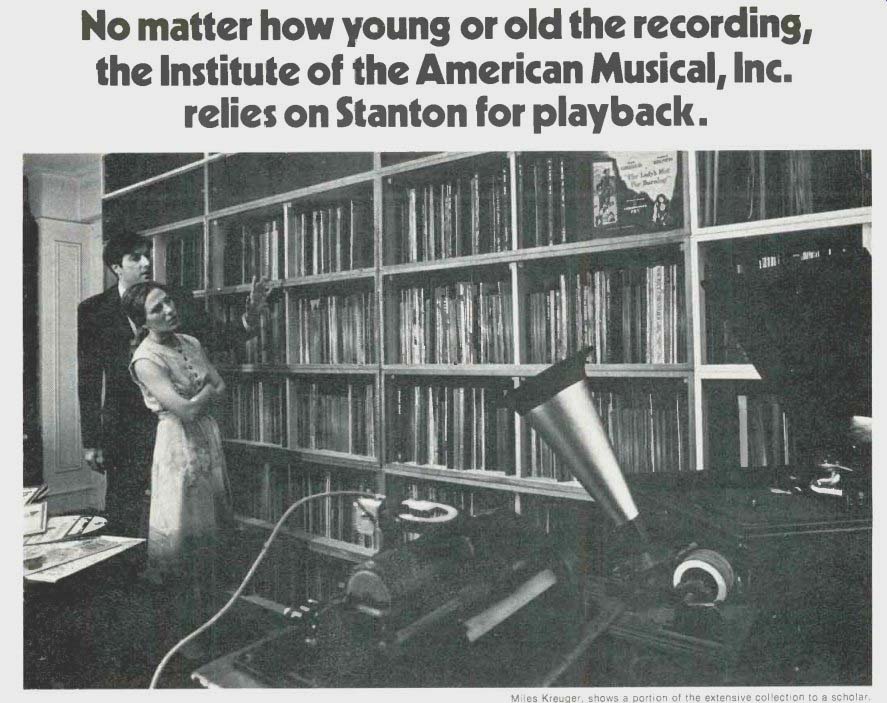
No matter how young or old the recording, the Institute of the American Musical, Inc.
relies on Stanton for playback.
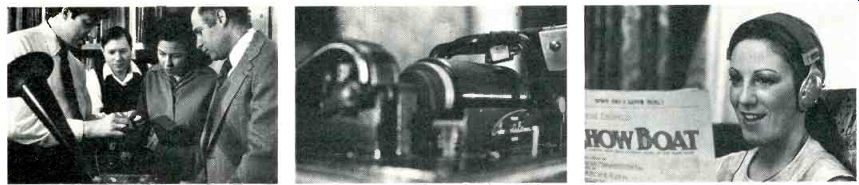
Mr. Kreuger and Mr. Albert Husted, Vice President, show visitors how a Stanton 681 is installed on an original Edison Standard phonograph.
Close-up of the Stanton 681 with special stylus in position on the original Edison Standard phonograph.
Music scholar following the score of Show Boat while listening to original cast performances.
Speaking of problems, how would you like to be faced with the need to accurately reproduce the sound from Edison Diamond Discs, Pathés and Aeolian-Vocalions? That's just what the Institute is faced with-and that's precisely why they turned to Stanton cartridges.
The Institute collection consists of approximately 35,000 recordings, from just about every American theatre or film musical since the Berliners of the 1890's through to the latest stereo and quadraphonic recordings. The collection (not counting hundreds of cylinders) is roughly evenly divided between 78's and 33 rpm's.
They have original, historic machines to play these accurately, but the arms are heavy and the old styli insensitive and somewhat worn. Furthermore, the acoustic playback does not permit them to filter the surface noise or tape these rare records.
Miles Kreuger, President of the Institute, discussed his problem with other famed and experienced archivists. They all agreed that the Stanton calibrated 681 Series was the answer. Naturally, it is the 681 Triple-E for critical listening and taping with more recent discs; the special 681 stylus for LP's; and, for the old ones, a 681 cartridge, especially wired for vertical response (with a 1 mil stylus). Today, thanks to Stanton, the scholars, authors and researchers, who are dependent on the Institute's materials to pursue their projects, can get perfect to adequate reproduction of any of the material in the collection. The Institute, which is crowded into small quarters, is open by appointment only to qualified people. For the future, it looks forward to the day when it will have the space in its own building to make its collection more readily available.
The work of the Institute is important work. Stanton is proud to be an integral part of it.
Whether your usage involves archives, recording, broadcasting or home entertainment, your choice should be the choice of the professionals ...the Stanton 681 Triple-E. Write today for further information to:
Stanton Magnetics, Terminal Drive, Plainview, N. Y. 11803.
--------------------
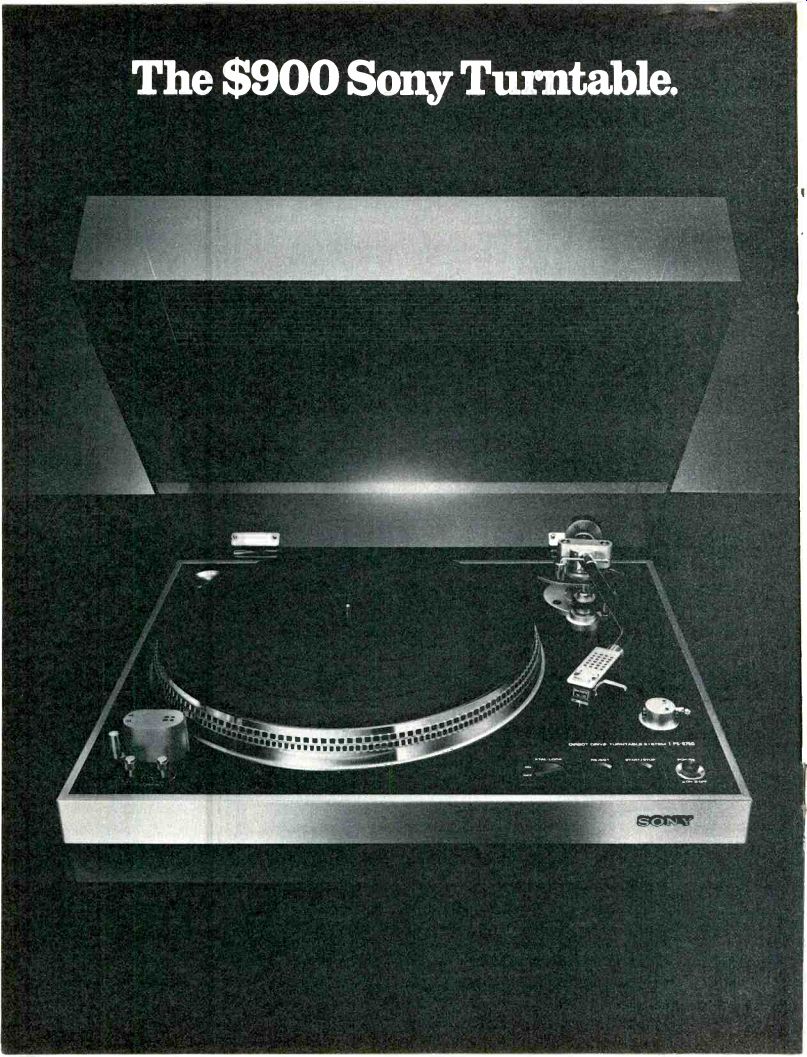
The $900 Sony Turntable
Study this page, because we don't want the price to suck you in.
It would be a shame.
People responding to something because it costs $900*. Not because it's worth $900. People captivated by price, not performance.
We at Sony don't want anyone spending good money for a great turntable for a bad reason like an impressive price tag.
Especially because there's so much technology in the PS-8750 for you to fall back on. After you spring for the $900. So before you spend a lot of money on us, spend at least a little time with us.
Total speed accuracy is our speed.
Speed accuracy can be a problem for turntables because the stylus continually puts pressure on the record (and, in turn, on our engineers.) In fact, as little as one gram of stylus pressure can cause a slowdown in record speed. A slow-down that is particularly noticeable in loud passages.
Up till now, most good turntables achieved accuracy with a direct drive motor and a servo-system to control speed variations.
It was fine for most people. And it still is.
But for those with more elegantly attuned hearing, it's just not good enough.
That's because the servo-system will not serve when it comes to small, low-frequency speed variations. It is not sensitive enough, and the result is there to be heard-if you have the discernment to hear it.
To get around this, Sony took the conventional servo-system and revolutionized it by adding a quartz reference and a phase lock circuitry.
That mouthful is really easy to digest. The stable quartz generator emits a constant frequency. Any variations in speed monitored by the magnetic head are converted to changes in the phase of the signal.
This is then compared against the quartz generator's phase signal. If they do not match, ourXtal-Lock corrects the speed variation instantly.
A conventional servo-system has to wait for the error to appear as a change in frequency, and then it takes time to correct it.
Sony can make the corrections 10 times faster. And within one cycle. All because Sony uses the phase difference as a source of information on speed error, rather than using the angular velocity.
Chart A dramatically illustrates the dramatic difference.
Why our tone-arm costs an arm and a leg.
After conquering the drive system, Sony sped along to the tone-arm. The problem: constructing a light, strong tone-arm that has a low resonance quality.
A high resonance quality means the tonearm vibrates--performing a duet with whatever record is playing.
Sony wrestled with the arm problem and came up with a different material: a carbon fiber of enormous strength and equally enormous lightness. Moreover, it has a much smaller resonance peak than the aluminum alloy commonly used. (See Chart B, where the difference is demonstrated.) The carbon fiber worked so well that it was even incorporated into the head shell of the PS-8750. But Sony didn't stop at the tone-arm's construction. Next came the actual operation of it.
Most turntables have one motor, operating both the drive system and the return mechanism. Meaning that the turntable is linked to the tone-arm. And very often, this linkage produces a drag on the arm.
The PS-8750, however, proves that two motors are better than one. The motor that runs the tone-arm is totally isolated from the other motor that runs the turntable.
This eliminates the drag, particularly the drag at the very end of the record.
This drag is really a drag, because the return mechanism is preparing to activate itself, and the friction is therefore increased.
Sony further innovates by designing pick-up and return cues that are optically activated. Like the doors in a supermarket, if you will.
With the PS-8750, you get the best of the direct drive manual and the best of the semi-automatic. With none of the worst of either.
Does your turntable give you bad vibrations? The same sound waves that travel from your speakers to your ears also travel to your turntable.
This transference excites the equipment. Becoming acoustic feedback, or IM distortion. And the louder you play your record, the more of it you get. There's cabinet resonance. Caused by sound waves.
And there's something called record resonance. Caused by the friction of the stylus in the groove of a warped record.
Sony, however, deals resonance a resounding blow.
We have built the PS-8750's turntable base of an inorganic material that is acoustically dead.
We have also undercoated the platter with an absorbing material that prevents it from transferring any bad vibrations to the good vibrations on the record.
And we cut down on record resonance by pumping a silicone damping material into the record mat itself. By having contact with the entire record surface, it offers more support.
Not for people who want the latest.
But the greatest.
The PS-8750 represents a tonnage of innovation and a couple of real breakthroughs.
It is not for those who want to spend
$900 so they can say they spent it.
It is for those who want to spend $900 so they can hear they spent it.
SONY 1976 Sony Corp. of America. Sony. 9W 575t. NY 10019
SONY is a trademark of Sony Corp.
---------------
Introducing the Phase Linear System Z00
A complete home stereo system built around a Phase Linear amplifier is now within the reach of eve -y serious listener. The development of the new Phase Linear 200 power amplifier Hakes it possible. In combination with tie advanced 2000 preamplifier, the
00 provides the nucleLs of a fine, medium-powered stereo system with lower distortion, wider dynamic range, faster transient response_ and greater flexibility than a comparable receive' eased system at a surprisingly reasonable cost. With a pair of quality tookshe f speakers and a good turntatle, a Phase Linear 200 ;ystem can be assembled by your deae for around 11,000 -a fraction of the iivestment of nany ve -eran audiophiles with sophisticated systems amplified by Phase Linear. You might as well start near tie top.
The new Phase Linear 200 power amplifier is a handcrafted, reliable amplifier with outstanding sonic performance in the tradition of the famous 700B and 403 models. Power output is 105 watts per channel, minimum R.M.S. at 8 ohms from 20 Hz to 20 kHz, with no more than .25% total harmonic distortion. Light emitting diode displays give instantaneous display of power for each channel. Hum and noise: 100 dB below rated power.
The Phase Linear 2000 preamplifier is one of the quietest preamps ever made.
Signal to noise ratio of 74 dB below 10 mV and total harmonic distortion of 0.1 %. Variable ambience injection circuit recovers music lost with most preamps.
The Powerful Difference
------------
++++++++++
--------------
(Audio magazine, 1976)
Also see:
Record Cleaners Revisited/B.V. Pisha
= = = =