by ROBERT ANGUS
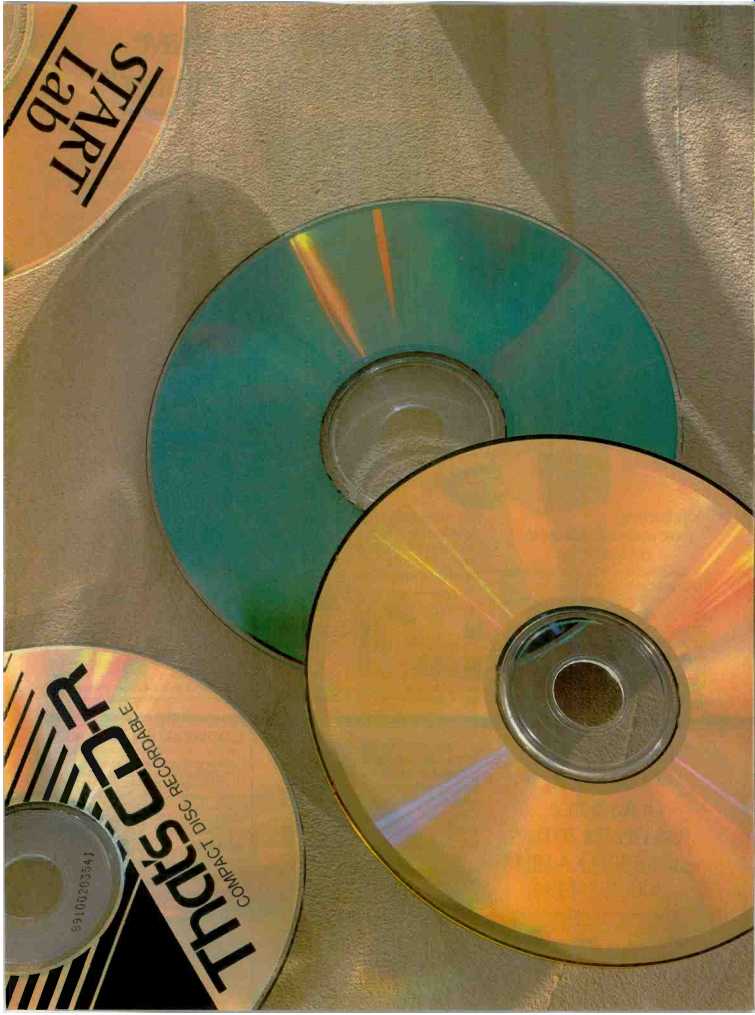
The phone rings. It's Uncle Marvin, calling from California. He's finally managing to get his youngest daughter-you know, the one who sees through the bottoms of Coke bottles and wore braces on her teeth until she was 30-married off. The wedding is a month off and, because I'm the family audiophile, he's calling to find out if I'll record the ceremony. "Oh, by the way," he adds, "we want to do something a little different, to provide the guests with a memento they won't forget. Money is no object. Any ideas?" Well, yes. Since I'm going to use my DAT portable to make the recording, why not, I suggest, present the members of the immediate family with a copy of the recording-on Compact Disc, in a box with a color photo of the wedding ceremony? "Can you do that?" he virtually shrieks. "I know I said money is no object, but can I afford that?" I assured him that not only can it be done, but that the cost is not outrageous. In fact, for less than $35 apiece, Uncle Marvin can present each of 50 guests not only with a CD recording of the wedding ceremony in a jewel box with a color photo cover, but a personalized label including the names of the principals and the date-and deliver it to each guest within 30 days of the event.
One company that offers this incredible service is tucked away in a nondescript office building in downtown Tokyo. The company, Sony Taiyo Advanced Research Technology (START Lab), is a joint venture between Sony and Taiyo Yuden (manufacturer of That's tape), set up to produce custom Compact Discs on a very limited basis and eventually to market blank discs and recording equipment. In the United States, Gotham Audio offers anyone with $50,000 to spare his own CDR 90 optical recording system.
But before you write the check, you should know that discs for the Gotham system cost about $65 each, and there is a shortage. For a custom recording, Gotham recommends a charge of $350 for the first copy and $300 for each extra copy made at the same time. By contrast, START expects its hardware to cost $3 to $4 million initially, with blank discs priced around $10 apiece in Japan. Neither company is predicting how long these disc prices will hold. Both systems start with a Sony PCM-1630 CD mastering processor and DMR-4000 U-Matic digital mastering recorder (included in START's price but not in Gotham's).
The Gotham system uses an encoder which was developed by Yamaha to convert the PCM-1630's PCM digital signal to EFM (eight-to-fourteen modulation). A CD time encoder inserts data into the 0-channel area.
All signals feed to an optical drive with special tracking servos and a high-power recording laser. Gotham's P0 Junior subcode editor/generator was developed by Dr. Benjamin Bernfeld of Harmonia Mundi Acustica and Bennett Smith, a computer scientist.
Through a keyboard, the user enters such data about the master tape as SMPTE timings, song titles, catalog numbers, engineer's name, and comments on sonic quality and the like. The PO Junior automatically formats the data, records the cue track to the PCM machine, and prints detailed master sheets. Data thus recorded on the tape can be read and processed by any existing editor. Completing the system is the LS-101 optical recording unit, a front-loader whose optical head achieves a scanning speed of 1.3 m/S, for high-density digital recording on Fuji Film's YPD-101 write-once optical discs.
The recording laser's lifetime is specified as approximately 6,000 hours of actual recording time. The recorder employs an extremely reliable, high-precision spindle motor, says Gotham, for fast access time and accurate rotational velocity. The drive signal from the encoding unit is precisely cued by the synchronizer to achieve a real-time recording capability of approximately 60 minutes. The gallium-arsenide laser diodes operate over wavelengths of 765 to 795 nm, with an output power of approximately 0.5 watt.
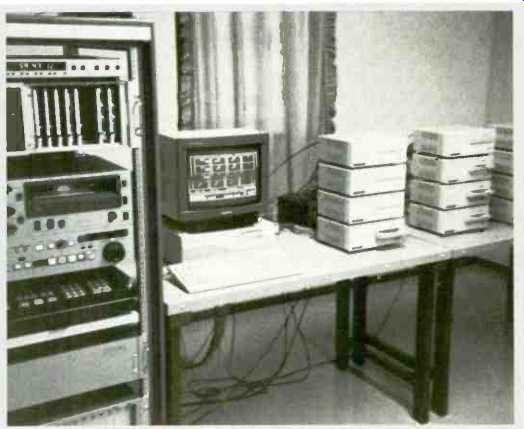
The START package also includes a PCM-to-EFM encoder and a CD code processor, as well as a personal computer (with monitor) which controls the entire system. Linked to it are 12 "writers" (soon to be expanded to 30), which are actually CD recorders, each about the size of a big-city phone book and lacking any controls. All the equipment is Sony-made.
There is some confusion about whether the lower priced START discs, made by Taiyo Yuden, will work on Gotham's more reasonably priced .recorder. Both discs meet the Philips Red Book CD Standards, which means that both will play on any existing CD player. When asked, Gotham president Russ Hamm and START president Dr. Heitaro Nakajima claimed no knowledge of each other's process, although each system looks remarkably like the other in practice (and, as I later learned, Gotham's discs are made by Fuji under license from Taiyo Yuden). During a recent visit to Tokyo, I was invited to visit START. About a month before the visit, however, Taiyo Yuden general manager Alex lida asked me to supply a DAT demo cassette, insisting that it be copyright-clear.
By the time I got to Tokyo, START had transferred it to a U-matic master, complete with digital indexing and coding.
I got off the elevator and stepped into an office which could just as easily have been that of an insurance company branch. Perhaps two dozen people were busily working at their desks. Near this large office, like that of a branch manager, was the office of Dr. Nakajima, president of START and former president of Aiwa. I must have seemed surprised, having expected to find a noisy (and dirty) world of hydraulic presses like those in an LP factory or, alternately, the ghostly quiet of clean rooms peopled by technicians in white work suits. No doubt I would discover one or the other, perhaps both, on another floor of the building.
Instead, after a few preliminaries, Dr. Nakajima led me through the outer office to what obviously had been a storeroom. There on a tabletop was the complete system. As I watched, Masahiro Hotori, the general man ager of START's technical division who was dressed in a dark business suit, inserted a 3/4-inch copy of my digital tape into the PCM1630 and a gold disc into one of the gray writer boxes. He tapped out a program on the PC keyboard and suggested we retire to Dr. Nakajima's office to continue our chat.
Hotori explained that every START CD begins with a U-Matic master, complete with index coding and timing for each track, just like a commercial CD. If the recording comes in some other form, as mine did, START sends it out to a commercial recording studio for transfer to the U-Matic format. Open-reel, DAT, Compact Cassette, LP, or even 78-rpm originals all are acceptable-provided the customer meets START's rigid requirement of certification that there are no copyright restrictions on the material to be copied. The client pays for the studio time involved in making the U-Matic master, which in Tokyo amounts to about $180 per hour. I asked how long it took to transfer my 35-minute DAT demo. "Two hours worth of studio time," Hotori replied. "If it had been in some other [analog] format, it would have taken longer." He said that when Uncle Marvin sends in his wedding tape, he'll have to allow one week for the studio work, "unless we get it in U-Matic form to begin with, in which case all we have to do is add the PQ encoding."
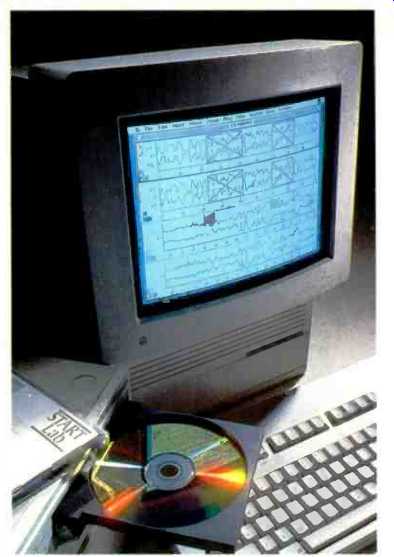
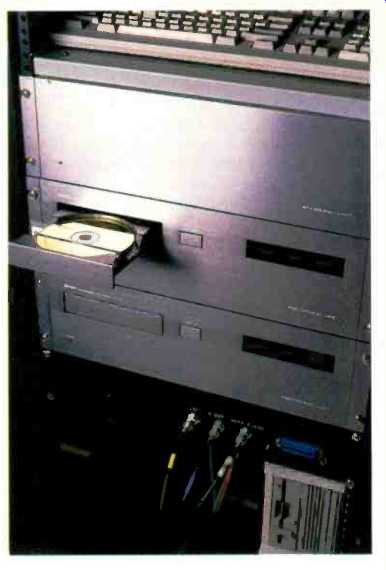
--- A Gotham CDR 90 system, installed at Sterling Sound in New York City.
-----
This desktop CO "factory" in START tab's Tokyo office includes a Sony DMR-4000 U-Matic digital audio mastering recorder, PCM-1630 PCM encoder, PQ subcode generator, and CD code processor (all in rack at left), a personal computer whose display shows system status, and 12 writers (right). Closed drawers on some writers indicate that they are in use.
Both the START and Gotham CDs have a maximum playing time of 60 minutes (roughly the playing time of two U-Matic cassettes).
Gotham's Hamm says that longer playing times are possible with his disc-68 minutes, soon-and Hotori says that additional time is possible on a START disc, but at an increase in cost. Once it has the U-Matic master, START boasts that it can return the finished product to the client within a week, much faster than a CD pressing plant can promise.
For a single disc, such as my demo, the charge would be $215. If I had purchased 10 copies, the price would have been $32.15 for each unit. START can provide a label printed directly on the disc, by silk-screening, at a charge of $72.55 for the first copy and 700 for each additional copy. My disc came with the standard START label.
At the end of 35 minutes, my CD had been duplicated, but Hotori wasn't about to hand it over. "We play each disc through in real time to check for flaws or defects," he explained.
While I waited, we talked about the copyright and standardization questions recordable CDs have stirred up. Will the Serial Copy Management System proposed to limit digital copies of DAT recordings work equally well with CD-R? "Yes." What signal would START need to begin consumer marketing of its recorders? "Legislation in Europe and North America which would mandate the use of SCMS or something like it. Six months later," Hotori said, "we could be on the market with a consumer product." Hotori predicts a price of $1,500 for the first consumer recorder/player. And if the marketplace and the keepers of the Compact Disc specifications will agree to homemade discs which lack indexing and timing, it should be possible for the home recordist to make CDs directly off the air or from his own discs or tapes. What then would prevent amateur copying of friends' discs? "The cost of blanks," Dr. Nakajima said. "The trend in commercial CD pricing has been downward, and I would expect that to continue. It will always be more expensive to make a copy than to go out into the marketplace and buy the original, and the packaging won't be as nice."
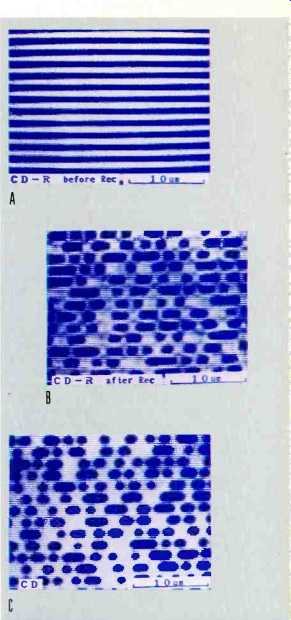
----- Seen through the microscope, an unrecorded START disc (A) shows
only the laser-guiding groove:. A recorded disc (B). still shows faint traces
of these grooves, together with data pits that are virtually indistinguishable
from those of a conventional CD (C).
As soon as my CD had been inspected by the system's PC and found satisfactory, Hotori presented it to me, a golden wafer with a shimmering coppery green underbelly. "We use gold for the reflective layer because we find it produces better results, and because we believe it will last longer than aluminum," Hotori explained. "Gold is not subject to oxidation, as aluminum is." Just under the gold layer is a very thin layer of green dye. Under this is a layer of clear polycarbonate with a fine spiral groove pressed into it to guide the recording laser optically along a track with a pitch of 1.6 micrometers, to match the standard for commercially recorded CDs. A beam from a solid-state recording laser with 6 to 9 mW of power passes through the polycarbonate but is absorbed by the dye, heating it to more than 480° F. The heat decomposes the dye and reshapes the poly carbonate resin, causing it to expand and mix with the melted dye, forming a tiny pit similar in its decreased reflectivity to those molded into a commercially pressed CD. When the disc is played back on a conventional CD player, the player's low-powered laser reads the pits as if they were those on a conventional disc.
As I settled back into my seat for the long flight home, I donned a pair of stereo headphones, plugged them into my portable CD player, and inserted the START disc. What I heard was an extremely accurate re-creation of the original, with better bass response than I remembered-and, of course, with selection timing and indexing, which didn't exist on the original. I was impressed.
How long will the discs last? Nobody knows for sure, of course, but Gotham says its unrecorded discs have a shelf life of at least one year, and its recordings are good for at least five years of archival use-10 years on newer discs. Tests by START indicate that its discs can be played more than 20,000 times without degradation under normal handling conditions. However, warns Hotori, it's always a good idea to store discs away from heat and sunlight, lest they affect the dye.
Dr. Nakajima and Russ Hamm aren't counting on Uncle Marvin to keep them in business. Hamm see the primary market for his system among recording studios, who use it to provide clients like Barbra Streisand and Billy Joel with instant CD versions of their sessions. "The CD reference disc will quickly replace the LP for producers and artists," he said recently. "With CD now the dominant quality format, R-DAT simply isn't acceptable as a reference; it's a different medium. You can send a CD ref to an artist anywhere in the world and say, 'check this out on your player.' " The purposes of the START partnership include working technical bugs out of the system and the discs, ascertaining what controls and features users need, and determining costs and marketing strategies for the START system. According to Hotori, initial uses have included prerelease promotion for new record albums, music demos for performers, private CD publishing, voice tracks for computer-aided instruction, sound effects and music for movie post-production work, an alternative to signal generators in audio manufacturing, replacing endless-loop tapes in public-address systems, sound and beep tone tracks for slide-projector synchronization, a prototype in-flight audio system, radio jingles and commercials, background music, psychoacoustic studies, and limited-run CDROM discs.
Both START and Gotham say their systems can replicate not only CD-ROM but CD + Graphics and CD-I (nteractive) discs--everything, in fact, but CDV, and that may be only a matter of time. "Whatever can be put on the master tape will appear on the disc," Nakajima says.
Editor's Update: Just as this article went to press, START Lab named Sonic Solutions, of San Francisco, as its exclusive U.S. distributor. Sonic Solutions, best known for their NoNoise digital restoration system (Audio, March 1989), will market the START system together with their digital editing system. The price of the total system, including the digital editor, will be about $48,000; the START encoder and one recorder can be purchased for $25,000, and additional recorders for $15,000 each. Blank discs will be priced at $40 each in this country.
-I.B.
==========
(adapted from Audio magazine, Jul. 1990)
Also see:
Greatest Cassette Test Ever--88 Tapes Tested (March 1990)
By the Numbers: Statistics in A/B testing (Feb. 1990)
Sound from Space--Digital Broadcasts, Digital Components (Feb. 1990)
= = = =