By E. T. CANBY
It's always fascinating to me that in both our arts and our engineering-music and hi-fi, for instance-we thrive so well on adversity, even in this age of abundance. We're always forging ahead against limitations that by rights should have us crying "uncle" every other minute. Instead, we just get obstinate and push on even harder. It's a way of life and it goes way beyond any differences between artists and engineers.
Whether it's in music or in engineering, we do our best in the face of limitations--we call them challenges-and very seldom when things are shoved at us on a platter.
We get our kicks, and our successes, by setting up millions of little Mt. Everests and climbing them; because there they are, staring us in the face. We work out compromises, so that somehow or other 2 plus two adds to 5. Are we proud! They said it couldn't be done. Perhaps it's only a couple of dB of signal-to-noise that we've picked up against all reason. Or a successful pop tune when they said all the good tunes had already been written (and copyrighted). Sometimes we do big things, but it's the little ones that really add up.
Parsimony is best. We never start from scratch-that's just rhetoric. We start with whatever we have, what's in front of us--tools, materials-and we build on what has already been built, solving a few more problems that couldn't be solved. Music is that way. So is engineering. Improved tape recorders grow out of earlier improved tape recorders. New music comes out of the old, even if it's all-electronic.
A "totally new" tape recorder? A "totally new" musical language? Hogwash. We each add our parsimonious bit. And all because we insist on denying the commonsense verdict that enough is enough and there isn't any more to be done. Not on your life! Hope of financial reward, by the way, is merely an excellent excuse.
How, then, do young composers come to write their music? The same way young engineers come to designing a tape recorder. Don't think that you can walk up to a burgeoning musician with a couple of Moogs and say, look! Compose anything you want! It doesn't work out that way. Instead, the good young composers go around listening, learning, observing; and then they try their hand at whatever music happens to be around-whether it's for a Moog or a mouth organ. Might be either. Limitations? Of course. The mouth organ plays only two chords. The Moog has great tangles of patch cords, to confuse the budding muse. (Mr. Moog is probably doing something about that. ) Some synthesizers, remember, synthesize only one note at a time, after vast settings of dials and feeds and sliders and switches. ( Whereas any old harpsichord can play you dozens of complex wave forms in seconds.) Music comes out, you see, the way it goes in. You start from where you are and with what you have. Tape recorders are the same. And tone arms. You set out to improve the un-improvable--otherwise why bother? To get down to cases ( and this is how I got started here ... ), I'm interested in a new recording of piano music by a youth of 25, who wrote the stuff a few years back, when he was 20. Funny-it sounds straight out of the pre-war days, say, 1925-1935. He wasn't even born then.
Andrew Zatman. Then there's music by a Prince Consort, composed at the same age though some 130 years ago. Prince Albert.
Good musician. And there's Moondog, a statuesque creature with a vast white beard and hair, dressed in a Viking-style costume. He writes European-type classical, though he comes from Hurley, Mo.
and also Kansas, Wyoming, and points West. It's what he heard. What he likes, where he started.
Then, too, there's Paul McCartney of the Beatles, who might have been Schubert if he'd been around at the right place and time. He wasn't. So, perforce, he's Paul, an absolute master of melody. What melody? The kind he heard in Liverpool, out of America. He, too, manages to improve on earlier models. And with no more than those same seven familiar notes of the ordinary scale plus a few extras on the side. Economical, yes?
Finally, I'm interested in the new KLH Model Forty-One tape recorder ( their hyphen), the one with the built-in Dolby "B" circuit. If ever a "totally new" machine proved my point, this one does.
Namely, that if you start where everybody else is you can always squeeze some more out of a configuration already squeezed a million times. KLH does, with Dolby's cooperation. Yep, they do the "impossible." Andrew Zatman's 24 Preludes for piano, composed at age 20, are very much influenced by Shostakovich, Stravinsky, and Poulenc, as the composer himself admits.
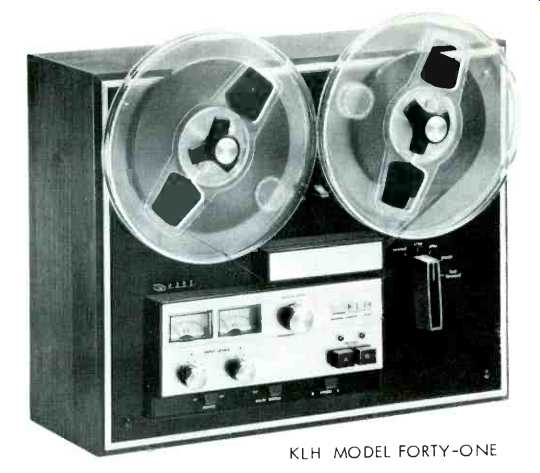
-- KLH MODEL FORTY-ONE
I'd add a few more, to his credit, including Prokofiev, Bartok, Hindemith. OK! So that's what he's been hearing, back in Washington, D.C. If it had been Gershwin, I suppose he'd now be composing a new-model Rhapsody in Blue. If so, it would be good, for this boy has marvelous talent. His little Preludes ( and a Sonata ) are on an Orion disk (Contemporary Music for Piano, ORS 6909 stereo) and they are astonishingly well written and entertaining. He even plays them in the typically dry, brittle piano style of the 1930sbefore he was born. Why not? As I say, one starts where one starts, with good models. Frankly, I prefer Zatman to Shostakovich, who gets long-winded at the drop of a note.
Prince Albert, Queen Victoria's husband and a mainlander German, was a brain and--who knew it?--a first-rate trained musician if technically an amateur, since his business was helping run the Queen's empire. He wrote mostly songs. Again, the kind of songs he heard around him circa 1840. They are often Schubert-like, or Mendelssohnian (M. was a musical lion in England at the time), more expressive than Mendelssohn, yet not as personal in tone as Schumann, who was having his "song year" at about this same date. The Prince's songs are altogether pleasing and beautifully written, to German text mostly, in the German Lied tradition. A "find" for those of us who thought Prince Albert was a kind of tobacco or a cutaway tailcoat, or that the Prince did nothing but beget royal children ( including Edward VII) and open the Great Exhibition of 1851. His music is gracefully recorded by five different voices, out of the Purcell Consort, to the fluent piano of Jennifer Partridge. Argo ZRF 597 stereo.
As for Moondog, he is an anomaly, a self-taught blind musician who goes for the classical sound to the tune of plenty big symphony orchestras. He has a plenty big one on his current Columbia LP (Moondog. Columbia MS 7335 stereo). Fifty-odd performers--wow! Somebody must pay. His scores are curiously folk like, as though he might belong with such as Blind Lemon Jefferson and the sort, but they come out a sort of untutored Brahms or maybe Rheinberger or Weinberger or Castelnuovo-Tedesco-who knows? He, too, has been listening. His orchestra is weird, a handful of strings and a battery of brass and' wind, from flugelhorn to flutes, bass trumpet to baritone sax. I didn't find much cohesion in the Moondog sound in spite of fugues and canons and themes galore but the sonic experience is, to say the least, unique.
By the way-isn't there a personage remarkably like Moondog who stands motionless, year after year, on a busy New York corner just outside Columbia Records, dressed in a Viking outfit that could come straight from the Met costume department? That might have a bit to do with this recording.
McCartney? Go listen to any Beatle record including the new ones, pirated or legit. Only trouble is, you can't always tell McCartney from Lennon. They're like Fletcher and Munson, or Glaser-Steers, or KLH. Or Bach-Stokowsky.
Oh yes--that Model Forty-One from KLH. It's wholly new in the KLH line, which means of course that it isn't new but in basic respects takes off properly from earlier machines of its sort. What distinguishes this model is its unique built-in Dolby "B" circuitry, for noise reduction.
Dolby "A" is the now-familiar professional noise reducing system widely used for the tape masters from which our current LP disks are derived. The "B" circuitry is a much simplified version designed for consumer uses including tape recorders. It's supposed to do the very same job-reduce the accretion of background noise in the record/playback process-without affecting the signal itself. A big order.
Best news I have is that it works. Noise does go down, as compared with a non Dolby recording and playback. Signal, as far as I can hear, is wholly unaltered. No swishings, pulsings, volume changes, just music and a super-quiet background. I wouldn't have believed it possible. But Ray Dolby is a very clever engineering mind working in a familiar area, compression-expansion, where others have fallen flat on their faces. All it takes is the right circuit parameters. Dolby has 'em. Columbus and the egg.
The KLH Forty-One was long in gestation and seems to have offered some problems en route; all I can say is my current model works just fine and my only objection is to the somewhat clumsy controls, stiff and angularly sharp, and to the difficulty in editing-you must go through "play" to get to the manual-tape-rocking "pause" position, and hence you lose your cue point. The Dolby circuit boost tends to overload some hissy sibilants and piano type percussives at the slow 3 3/4 ips speed, but at 7% they are entirely clean. (Could have been the tape I used, I should add.) Dolby "B" will soon be appearing in other areas. Advent has separate "B" units for existing tape recorders; there could be Dolby-ized LP disks some day, for noise reduced playback through the "B" circuitry.
What you should do, I expect, is to go right out and get all of this music I've described, apply it to the KLH Forty-One, and as you play back the tapes ( without a trace of added noise), think hard about improving the un-improvable and the desirability of starting off with what you have, the better to climb Mt. Everest. Whether you're a musician or an engineer, that's the proper procedure.
=============
(Audio magazine, Aug. 1970)
Also see:
Computer-Aided Audio Calculations (Nov. 1983)