Company Address: 6801 Shingle Creek Pkwy., Minneapolis, Minn. 55430.
William Z. Johnson and Audio Research, the company he heads, have helped define the state of the art in high-end audio for as long as I can remember. Johnson, perhaps more than any other single man, has been responsible for creating the renaissance in tube electronics. His preamplifiers and amplifiers have long ranked as some of the best equipment available, and virtually every experienced high-end audiophile has owned or coveted at least a single piece of Audio Research gear over the years.
Johnson's new SP-11 preamp is both Audio Research's latest attempt to maintain their pre-eminence and an effort to redefine the state of the art. A no -holds -barred product which costs $4,900, the SP-11 is a departure for Audio Research in that it is not a pure tube design but a hybrid which uses both tube and FET transistor technology. Johnson feels that this hybrid provides more linearity, higher gain, and a better signal-to-noise ratio than he has been able to achieve in pure tube designs, and still allows him to preserve the transparency and sweetness of the best tube circuits. Judging from the sound, Johnson achieves these objectives. Further, the hybrid technology gives the SP-11 freedom from most of the problems rising from tube wear and sensitivity to microphonics.
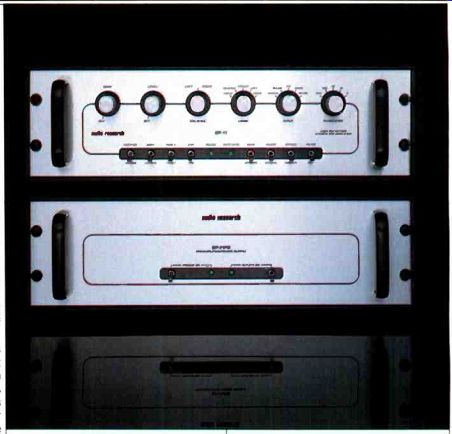
The SP-11 is well styled and physically impressive. It consists of two identically sized, rack-mountable units, available in silver gray with black lettering or in black with white lettering. One unit contains the power supply and has a.c. power switching for the preamp, for the power amp, and for other electronics in the system. The power-supply unit uses a high-grade toroidal power transformer to minimize its hum field and solid-state components. It is fused, and, like the rest of the SP-11, looks more like an expensive piece of defense electronics than a piece of consumer gear where cosmetics was the designer's primary concern.
The power unit is connected by a heavy plug-in power cable to the preamp unit, which has virtually every feature the most demanding high-end audiophile could desire. The SP-11 has exceptionally high -quality gain, level, and balance controls; among its switching features are a mode switch with a full range of options (including mono and stereo reverse) and an input switch with one phono and four high-level inputs. There is also a switch to vary loading of phono cartridges (47,000, 100, 30, 10, and 3 ohms), a phase-reversal switch, a mute control, full facilities for two tape recorders, and a subsonic phono filter switch.
Unlike most equipment, the SP-11 even has an interesting rear panel. For all audio inputs and outputs, it uses Tiffany phono jacks that make their "ground" connections before the "hot" connections are made. This feature, a potential system -saver, eliminates the risk that destructive bangs will occur if you pull a cable out by accident. The range of inputs is well thought out and should meet virtually every system need. The unique range of outputs includes two main outputs (for systems with multiple amplifiers), a phase -inverted output (which is useful for some biamped systems), and a direct output which comes directly from the line buffer and bypasses the toggle switches.
This direct output is part of a whole series of options, including a complex mix of gain controls and bypass facilities, which allows the user to decide how many-or how few-controls are in the signal path. The SP-11 is the first preamp to be designed to let the user make all the choices, either striving for perfect transparency at the cost of convenience, or opting for all the controls he needs for the very most complex system.
As always, it is the sound that counts, and the SP-11 is an outstanding performer in every respect. This is a preamp that takes a full day of warm-up to reach its best, and should be left on at all times. Once it is warmed up and left on, the SP-11 performs so well that there is very little sound character to describe. As is the case with each major step forward in audio electronics, one is not aware of coloration but rather the fact that the SP-11 consistently reveals more musical information than virtually all of its competitors.
The SP-11's specifications are impressive ±0.2 dB RIAA phono equalization accuracy, distortion levels ranging from 0.001% to 0.005%, bandwidth from 0.2 Hz to greater than 250 kHz-but these tell only part of the story. The SP -11 also meets every subjective test for which reviewers have adjectives: Transparency; imaging, depth, and soundstage height and width; treble, midrange and bass transient response, and sweetness. The only way to say something meaningful about the sound of the SP-11 is to make comparisons, and only two other preamplifiers I have yet heard are rivals. One is the Krell KRS and the other is the Cello.
Perhaps the best test of the SP-11's outstanding performance is of its high-level stage. The rise of the CD player is gradually redefining the role of the preamp. For years, all that most high end audiophiles really cared about was the performance from phono input to preamp output. The use of CD players has revealed, however, that many very expensive and much -praised preamplifiers introduce sufficient coloration in their high-level stages so as to sound noticeably worse than when CD players are used to drive a power amplifier directly. To attack this problem, a few CD players--notably the new Discrete Technology--provide gain controls that allow you to eliminate the preamp entirely.
The SP-11 is the only preamplifier--at any price-that I have yet heard with an active high-level stage that does not add audible coloration to the audio chain, compared to the use of a passive stage or the use of no preamplifier at all. In many cases, it will do even better. The SP-11's superb ability to handle gain and balance so as to match the CD player's dynamics to the amplifier's often yields even better subjective sound performance than could be obtained if one bypassed the preamp.
This level of performance is likely to be the new standard for preamplifiers regardless of whether it is CD or DAT that wins the world's sweepstakes as the premier post-analog signal source.
At the same time, the SP-11 also defines the state of the art as a phono preamplifier. With the exception of the Krell KRS and the Cello, it clearly outperforms any other preamplifier I have heard in two important ways. First, it reveals more detail and information through its phono inputs than competing preamps do. Second, over very extended listening, it is consistently more musically convincing, in many small ways, with a wide range of material. The SP-11 consistently reveals more of what is actually on the record-good, bad, or indifferent.
This superiority may not show up in casual listening in a dealer's showroom or when the SP-11 is used with other than the best high -end gear. It will show up, however, if you take the time to really listen to the differences between components with several favorite records, using electronics and speakers as revealing as the state of the art allows. In fact, the SP -11 tells the listener more about the components used with it than about its own sound. It is more a reviewer's preamplifier than a preamplifier to be reviewed. Put extremely simply, the SP-11 is accurate.
There are, however, some caveats that I must apply to this praise. First, the SP-11 is a hybrid system, and it does not have sufficient phono gain to get the best out of the lowest output moving-coil cartridges. It works perfectly with most top moving -coil contenders, including those from Clearaudio, Monster Cable, Koetsu, Kiseki, etc., but it lacks the gain to provide a properly open and dynamic sound with the lower output Ortofon, van den Hul, and Audionote cartridges. You do need to match your cartridge to this preamplifier.
Second, you cannot simply plug the SP-11 into your system and expect to hear it at its best. It does need several days of initial warm-up and break-in, and then should be left on continuously. Fortunately, its design makes tube performance noncritical and allows long tube life, so this should not be a problem. You will need to pay attention to fine details, such as your choice in interconnects; you will also have to experiment with the gain and level controls, to get the best mix of settings for your system and to find out how many control features you want to bypass.
My advice is to try to set the level control so your usual gain setting is between 10:00 and 2:00. I also would caution you about too much purism in bypassing the SP-11's control features. High-end audiophiles sometimes fall so much in love with detail and transparency that they forget about dynamic realism and the sound stage. Very few systems and very few recordings are so well balanced that you do not need to make at least slight adjustments to the balance control to lock in the sound stage and get a truly natural mix of imaging and dynamic contrasts from right to left.
Phase controls serve a purpose, and some material-although not very much-benefits significantly from reversing absolute phase. Sacrificing signal-to-noise ratio in order to get added purity at medium and high levels is a trade-off that should not always be made. The SP-11 exists so you can enjoy music, not sound. Ignore your tweakier friends and use this preamp accordingly.
-Anthony H. Cordesman
= = = =
Also see: