by BERT WHYTE
SHOWPOURRI
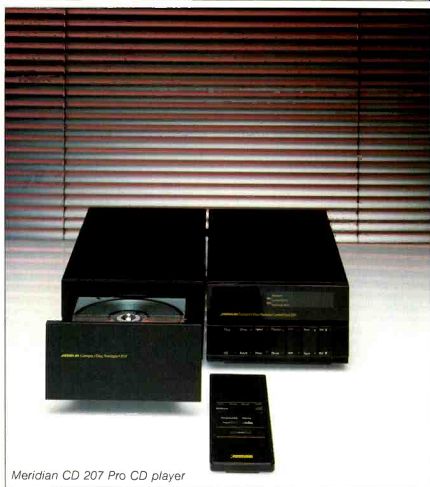
-------Meridian CD 207 Pro CD player
Last month, I reported on several of the more unusual products introduced at the SCES in Chicago. The sheer number of introductions dictates that I be highly selective in this second part of my product round-up.
Without further ado, herewith my report on items which I found interesting and innovative.
As you would expect, there were CD players all over the show, legions of them. The vast majority were garden variety units of no particular distinction, most being cosmetic variations of the basic CD players made by a handful of giant OEM manufacturers. Fortunately, there were several notable advances.
Bob Stuart of Meridian was proudly demonstrating his new CD 207 Pro CD player, which comes in two separate cabinets. The first cabinet contains a newly designed CD transport mechanism and a massive power sup ply. The motor-driven, front-loading disc drawer has a very heavy front plate and when the drawer is retracted into the player, special mechanical and acoustic isolation systems are activated, virtually sealing the CD off from internal and external vibrations. The second section of the 207 contains all of the decoding electronics, D/A converters, and analog processors and controls. There are also inputs and switching for tuner and tape recorder; these are operated via a remote control, which also operates a new electronic gain control for volume adjustment. This makes possible direct connection of the CD player to Meridian's active powered loudspeakers. The dual D/A converters and analog sections are new, advanced types developed for the Model 207.
Unlike Meridian's original MCD and Pro MCD players, which were highly modified Philips units, the 207 is de signed and manufactured by Meridian--although, of course, it still uses the Philips quadruple oversampling system and its associated parts. Bob Stuart was playing the 207 through his newly redesigned M-100 active loud speakers, and it was providing superbly clean reproduction from both classical and pop CDs. The Meridian CD player is available at a cost of $1,550, including remote control.
Nakamichi advanced the CD art with Mark II versions of its OMS-7A and OMS-5A CD players, which incorporate some rather innovative circuitry.
Most CD players employ sample-and-hold circuits after the D/A converters. It is thought that the FET switches used in these circuits, and the memory and dielectric effects in their storage capacitors, cause digital "noise spikes" and loss of resolution at the -80 to -90 dB level. Nakamichi apparently has developed a special new D/A converter which enables them to completely eliminate the sample-and-hold circuit. This permits direct connection from the output of the converter, through the analog low-pass filter, to the output terminals. Nakamichi claims this approach eliminates the offending noise spikes without a loss of low-level resolution.
Among other improvements in the OMS-7AII1 and OMS-5AII is the use of six optical photo-couplers to bring dig ital data to the converter, thus ensuring complete isolation of all digital ground lines from the analog grounding system. Independent power and ground lines are used for display, digital, and servo circuits, as well as for the motor drive and for the conversion and analog sections. All digital circuits are synchronized to a single master clock.
Interestingly, Nakamichi uses quadruple oversampling with high-order, 16-bit digital filtering and dual, 16-bit D/A converters. Apparently, that puts these players among the first to employ the new 16-bit configuration. (As is generally known, Philips has been having problems making the 16-bit version of its quadruple oversampling system, and most other CD-player manufacturers are still using Philips' original 14-bit system.) Nakamichi is also using new discrete, two-stage, third-order Bessel filters following the D/A converters.
These new Nakamichi CD players will be available as you read this, the OMS-7AII (with remote control) priced at $1,650 and the OMS-5All at $1,375.
In terms of exotic, specialized CD players, attention must be given to the new Spectral SDR-2000 Studio Reference CD player, another two-piece model. One cabinet houses the Philips Broadcast Professional CD transport.
The other cabinet is a card cage holding the electronics, all of which is on standard-sized Eurocards; this permits modular upgrade of digital and analog sections to keep pace with technological advances. Spectral claims to use an improved digital process, with linearizing circuits that give precise number-to-number conversion accuracy and very quick recovery time after transients. Aperture-correction circuits essentially, phase-compensated equalizers-correct the high-frequency losses that are incurred as audio frequencies approach the sampling frequency. Spectral also emphasizes the very low transient intermodulation levels, and the high isolation between digital and analog sections that is inherent in its design. The SDR-2000 uses a 16-bit version of the Philips quadruple oversampling system.
Spectral claims their SCR-2000 meets or exceeds the usual CD performance parameters, and they also specify several parameters not usually found on CD-player spec sheets, such as resolution, transient overshoot and settling time, and sideband suppression. Resolution is listed as 85 RV or less-compared, Spectral says, to 100 or more in other top CD players.
Transient overshoot, rated at 8% or less in the SDR-2000, is 15% or more in competing players, says the company. Spectral rated their player's transient settling time at 100 I.LS or less, versus a claimed 500 RS or more in other players. Sidebands were specified as typically 64 dB down, a figure claimed to be 13 dB better than in other players. Needless to say. including so much exotic circuitry in the SDR-2000 makes it a most expensive CD player; it's priced at $5,495.
While there usually is a fair assortment of new preamplifiers and power amplifiers introduced at any CES, this 20th-anniversary show was particularly notable for the number and diversity of new designs. As always, the cutting edge of the art was most evident at the high end.

---------Nakamichi OMS-7AII CD player
---------Spectral SDR-2000 Studio Reference CD player
A relative newcomer, Rowland Re search of Colorado Springs, has been establishing quite a reputation with its Model 7 monaural power amplifier, a 115-pound behemoth. This handsomely styled unit is a direct-coupled design wit no capacitors or inductors in the signal path. FETs are used in all volt age amplification stages, and the driving stage, always powered, drives 28 high-speed bipolar transistors. The Model 7 operates in Class-NAB output mode. The design is totally free of negative feedback, and utilizes a massive 3.0-kVA toroidal power transformer with 126,000 uF of capacity. Current output is in excess of 60 amperes. The Model 7 can provide 350 watts rms continuous into 8 ohms, 700 watts into 4 ohms, and a whopping 1,200 watts into 2 ohms! All this power comes with less than 0.25% rated IM and THD.
I have been using a prototype pair of Model 7s and consider them to be the best of the ultra-high powered amplifiers currently available. Usually, amplifiers with such high power output do not have particularly smooth high-end response, nor are they very transparent, nor do they exhibit much dimensionality This does not hold true for the Model 7. where the elimination of negative feedback gives the amplifier an almost tube-like warmth and musicality while maintaining fine detailing and [...]
(adapted from Audio magazine, Oct. 1986; Bert Whyte)
= = = =
Also see: