by IVAN BERGER
AMPLIFIED STATISTICS
Turning Our Tables
Specification tables like those in our annual directories are actually just two-dimensional views of multi dimensional data sets. This is easier to see when you run the information through a good computer data-base program which can organize it along any desired data dimension. Nelson Pass of Threshold did that with a selection of the audiophile amplifiers listed in last year's Directory, and came up with the following new slants. With a computer database, and patience enough to enter all the data, you could do the same with the information listed in this year's Directory.
The 152 amplifiers Pass entered in his data base ranged in price from $298 for the NAD 2155 to $11,000 for the Esoteric Audio Research 529. The median price was $1,495; as it happened, this was one of the more popular price points, shared by five amplifiers in his listing. But the most popular price point was $995 (nine models), with $6,000 (six models) in second place and the median price running third. Fifteen of the amplifiers Pass listed were priced at $500 or less, 43 between that price and $1,000, 38 between there and $2,000, 40 more in the $2,001 to $5,000 price range, and 16 amplifiers priced higher still. In reality, the price spread is even greater than the 37:1 ratio indicated, since virtually all amplifiers below $4,000 are stereo, while virtually all those above that price are mono. You'd therefore need pairs of the more expensive amps for stereo, making the true spread from $298 to $22,000, a ratio of nearly 74 to 1.
Price per watt per channel, however, showed an even greater spread, 80:1, from $1.10 per watt (tor the Soundcraftsmen PCR800) to $88.48 per watt for the Levinson ML-2.
Two amplifiers, the Bryston 2B-LP and the Audire Otez, fell exactly at the median of $5.50 per watt; but they were very different in other respects the Audire has five times the Bryston's power, at five times the price. Nearly half the amplifiers cost $5.00 per watt or less, and 111 (73% of the total) were $10 per watt or less.
Only 13 amplifiers cost more than $20 per watt, and only four (the Audio Research D79, Classe DR-2A and DR-3, and the Levinson ML-2) were above $30 per watt.
Price per pound covered a comparatively narrow range, a 5.75:1 spread bounded by the Adcom GFA-2, at $12.93 per pound, and the Levinson ML-2, at $74.40; the median fell at about $34 per pound, right between the Classe DR-2A ($33.77) and the Strelioff SC1 800 ($34.48). As you'd expect from the small spread, there was a fairly tight correlation between weight and price, with five of the ten lightest models being among the ten lowest priced, and nine of the ten heaviest models also among the ten most expensive.
The lightest amp was a Carver, of course (the nine-pound M-400t) and the heaviest was New York Audio Laboratories' Megamoscode 1000 (300 pounds). Median weight was 45 pounds, a weight shared by seven different models: the most common weight, however, was 25 pounds (11 models) followed by 55 pounds (eight models).
Not too surprisingly, the lightest amplifiers also tended to offer the most power per pound. Carver and Soundcraftsmen were the clear winners here, with Carver's four amplifiers offering anywhere from 22.82 to 44.67 watts per pound and Soundcraftsmen's both coming in at 17.83 watts per pound. But there was no such correlation at the other end of the scale, where the Classe DR-3 and DR-2A, at 0.71 and 0.77 watts per pound, respectively, were far from the heaviest. The median value fell between the McIntosh MC2255 (6.10 watts per pound) and the Robertson Sixty Ten (6.15).
The lowest powered amplifier in Pass's sample was the Naim NAIT, a 20-watter, while the highest powered was the Strelioff SC1 800, rated at one kilowatt. The median value was 120 watts (a rating common to five amplifiers), while the most popular ratings were 100 watts (28 models!), 200 watts (16 models), 250 watts (12 models) and 50 watts (12 models).
Timing Tricks
My college roommates and I once did an A/B comparison of the Furtwangler and Toscanini recordings of Beethoven's Ninth Symphony. To do it, we had to dub one recording onto tape, so we could run the two in parallel and switch between them. (As expected, the Furtwangler version, on four disc sides, took longer than the Toscanini, on three. What we did not expect was that Furtwangler ran ahead of Toscanini in some places.) If we'd had a stopwatch, we might have quantified the timing differences between those recordings.
Had the Compact Disc system been around back then, we could have read comparative timings for each movement off the player's display. Music reviewers are already discovering this trick, and a growing number of reviews spell out the timing differences when comparing renditions of a work. It's another small instance of the ways in which technology influences art. (Editor's Note: It has been widely recognized that proponents of the theory that criticism is an art are all critics. -E.P.)
Relative Remotes
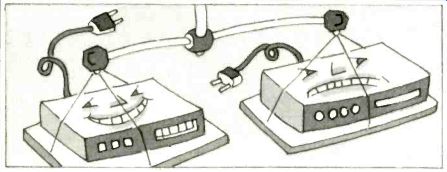
A package arrived for one of our staff members. "Oh, that's a remote control I got for my uncle," she explained. That got us wondering wouldn't it be nice to have remotely controllable relatives? How about a "Play" button for when they get too serious? Fast forward to speed the parting of the ones we don't like, and rewind to bring back the ones we do? "Stop" for rambunctious nieces and nephews? The system would also take care of relatives who aren't quite on the same channel as the rest of us. The most important control of all, however, would probably be "Mute." (Editor's Note: Readers should take the above with a grain of salt; Mr. Berger was married only a few months ago.-E.P) Button, Button I have an equalizer, but I rarely use it. My preamp has buttons galore, to switch in tone controls, a delay system, a spatial enhancer, and a mild expander; I rarely use them, either. Yet I delight in having them not so much because the fearsome array of controls impresses people (if anything, it scares them off), but rather because all of these things are worth using .. once in a while, on recordings or in situations that require them. I don't think I'd want a preamp that didn't have a tone-control bypass (I'm by no means certain, however, that I can hear the difference between the "bypassed" and "flat" settings), but I wouldn't want a preamp without tone controls, either.
Changing Times
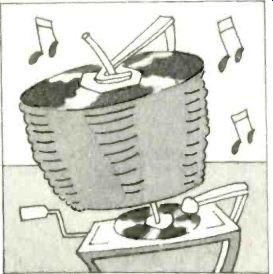
The record changer is moribund; long live the changer. There are still a few turntables that can play a stack of records. Dual and Technics had some multi-play models, last I looked, and there were a few cheapies available from other companies. But the heyday of the multi-play table passed years ago; now, even department-store rack systems include single-play turntables as a matter of course. Audiophiles originally spurned the changer for the drag the early automatic linkages imposed on tonearms; with the advent of the Dual 1009, the changer grew respectable again. Then, as the art of record playing advanced, its problems-some real, some imaginary, and some curable-made it anathema again.
But while the record changer is disappearing, its convenience is coming back, in multiple-play CD and cassette decks. For home use, Sony makes a multi-play cassette deck (sold in the U.S. by Benjamin) and Aiwa and Mitsubishi offer some in pre-matched audio systems. For the car, you can get an Alpine, wish the probability of a Kraco soon and at least one other waiting in the wings across the Pacific.
The concept may flourish even more in Compact Disc players. Sony has matching changers for home and car, and Pioneer, Mitsubishi. and Nikko have them for the home (see article in the June '86 issue). Alpine and Denon have models in Japan, while another, announced by Technics a while back, is only now reaching the market. And Seeburg has announced a jukebox based on a 60-disc changer mechanism made by Sony.
The CD is such a natural for automatic changing that you can expect more. The discs are less delicate than LPs, and the nature of the playback system should forestall the record changer's problem of a stylus angle that changed as the height of the record stack grew. And since CDs are recorded only on one side, there's no need to flip them.
This, plus the CD's longer playing time, means fewer interruptions in the music: A three-LP album, which would be interrupted five times for changing and flipping, would be interrupted only once if it fit on two CDs, and twice if it occupied three.
Not only that. but CD permits some conveniences that LP wasn't as amenable to. Random track access, for example, is built into the system.
And then there are those extra data bits, not yet firmly assigned, which could be used for graphics, song lyrics, selection titles, or what have you. Conceivably, standards will be developed to embrace all those uses and more-equivalent bits in the disc index section, for example, could be used to tell the player which way the subcode bits in a given disc should be used. If the extra bits were used for titling a change could scan through and memorize the titles of each selection on the disc, displaying the entire list on your video screen so you could punch in the selections you wanted without looking at the jacket.
The ultimate automation for the music lover might be something a bit harder to realize. I'd like a system which indexes themes as well as tracks, so I could hum a few bars of something into a mike and have my system tell me what it is, then play it for me. This would be more useful for classical than for pop listeners, because classical themes are usually heard without lyrics to tie them to their titles. Jazz is largely without lyrics too, but is often based on themes that originated as pop songs. Still, some jazz variations are so far from their original theme that a computer like HAL from 2001: A Space Odyssey would be needed to trace them back to their originals.
Something Gained, Something Lost
A lot has happened in the consumer audio business over the last few years. The introduction of new playback formats, including PCM, Compact Disc and hi-fi video, have, unquestionably, improved the quality of the sound available to the home listener. There is, however, a somewhat different perspective to the situation that I think is worth examining. During these times of frantic technical activity, it is all too easy to ignore the way that new developments relate to the artistic and creative work that is the true foundation of our "home entertainment" systems.
Back when I was in college, particularly in grad school, I hung around with a group of people who fancied long, involved philosophical debates about media. We, as artists and engineers, were all actively involved with electronic communications, technically and creatively. Our debates ran the spectrum from pretentious to profound, dealing with such diverse subjects as the influence of television on contemporary art, or the optimum sampling rate for a then-hypothetical digital audio recorder.
Much of the trendiness related to such dialectic was pioneered by the Canadian media guru Marshall McLuhan ("The medium is the message") more than a decade earlier. In the nature of such matters, McLuhan had gradually slipped from the front-line avant-garde into the media-theory "establishment." He was out of fashion. After all, here we were all caught up in the promise on the digital horizon: Limitless bandwidth, infinite dynamic range, pure response truly realistic reproduction. How could we possibly embrace a man who spoke of the value of distortion? McLuhan talked about how the subconscious process of mentally completing the raster television image was an involving and, possibly, a creative activity, as if a certain amount of non-realism in the perceived image actually facilitated fantasy and imagination. I readily dismissed this notion as I worked at increasing the accuracy of audio reproduction, and dreamed of the artistic potential of what was developing. I was fueled by the idealistic but, alas, naive notion that improving the means of human communication would somehow improve the quality of human communication.
I reacted to the commercial introduction of the audio Compact Disc with a fair amount of skepticism.
This skepticism, mind you, was not of a technical nature, since I fully believe the digital format to be audibly excellent. Rather, it focused on two nontechnical issues. First, it seemed to me that a lot of time and money had been expended to solve relatively uninteresting audio reproduction problems-noise, distortion, etc. I had hoped that the next major audio improvement would be in the area of imaging and ambience encoding. My second reservation related to the long-term availability of work with insufficient commercial potential to warrant digital release. In any case, CD was an important advance, and I eventually purchased a player.
Much to my chagrin, I caught the bug. I began to play my few CDs over and over. Virtually all of my most treasured recordings existed only on phonograph records, but treasured recordings were apparently no match for a laser. The first time I saw a digital re-release of a much-loved album I was ecstatic. I couldn't wait to hear it. And it was good indeed, without a doubt, lows to highs. Sure, I could hear the limitations of the analog master, but so what? As good as the audio quality of this CD was, I began to notice that something subtle was bugging me. I didn't quite hear the record I remembered. It took a while to understand what it was. Different EQ? Less compression? Pure sentimentality? No, the reproduction was simply too good.
The recording, rock music, had changed from an entity in and of itself into a reproduction of something else.
I could hear words that I never heard before, studio sounds, background tracks, bad tape erasing-fascinating, but definitely different. Like the difference between a photograph and a painting. I'll never know which version the artist would have preferred, but it's clear that the choice of medium had a significant effect on the artistic results.
I had a related experience when attending a high-definition television demonstration a year or so ago. The image was truly extraordinary, and that made it much harder to accept the intruding borders of the picture tube. My mind seemed to say, "Hey, there is a real thing in the box, please let it out." I've been re-reading McLuhan lately, and I think he may have had a point.
Lest I am accused of being anti digital or a reactionary, I do believe in progress. I will always want ever-better sound. It's just that I happen to enjoy the works of artists who struggled with a certain medium and produced works for that medium. I guess I'm destined to keep buying CDs. But I'll keep my turntable too.
-Kenneth L. Kantor
= = = =
Also see: