Rotel
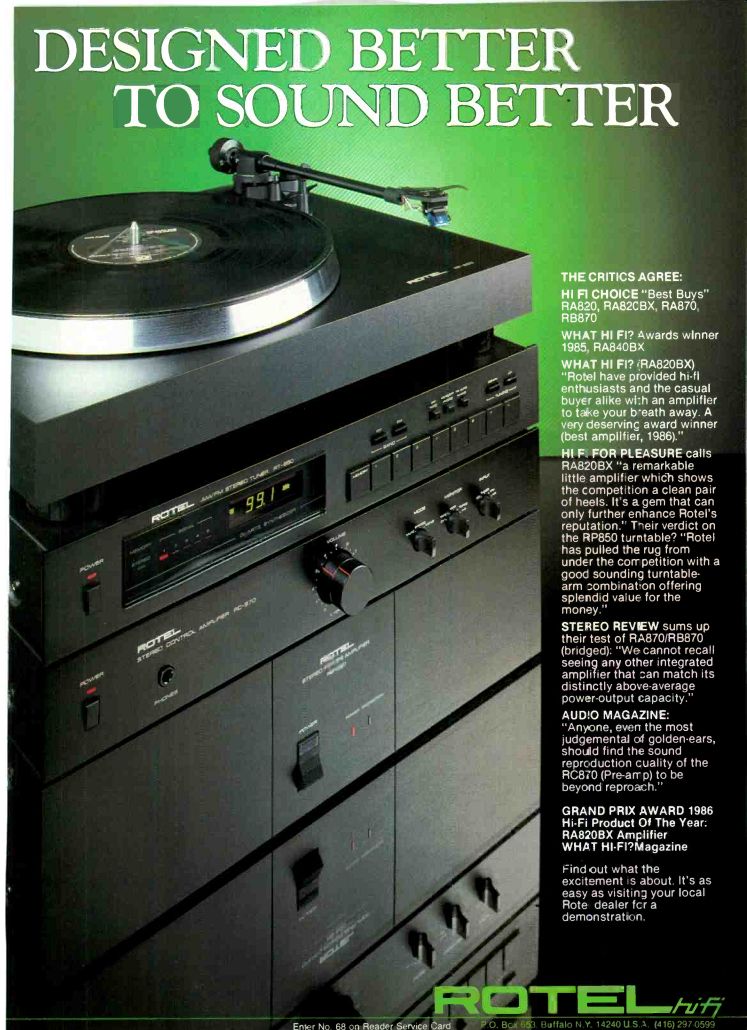
THE CRITICS AGREE:
HI Fl CHOICE "Best Buys" RA820, RA82CBX, RA870, RB870 WHAT HI Fl? Awards winner 1985, RA840BX WHAT HI Fl? .RA820BX) "Rotel have provided hi-fi enthusiasts and the casual buyer alike wish an amplifier to take your breath away. A very deserving award winner (best amplifier, 1986)." HI F: FOR PLEASURE calls RA820BX ''a remarkable little amplifier which shows the competition a clean pair of heels. It's a gem that can only further enhance Rotel's reputation.' Their verdict on the RP850 turntable? "Rotel has pulled the rug from under the competition with a good sounding turntable arm combination offering splendid value for the money." STEREO REVIEW sums up their test of RA870/RB870 (bridged): "We cannot recall seeing any other integrated amplifier that can match its distinctly above-average power-output capacity."
AUDIO MAGAZINE:
"Anyone, even the most Judgmental of golden-ears, should find the sound reproduction quality of the RC870 (Pre-amp) to be beyond reproach."
GRAND PRIX AWARD 1986 HiFi Product Of The Year: RA820BX Amplifier
WHAT HI-Fl? Magazine Find out what the excitement is about. It's as easy as visiting your local Rote dealer for a demonstration.
The Smart Choice in High-Performance High Fidelity Rotel hi-fi is an overnight success which was twenty five years in the making. Founded in 1961 as an OEM manufacturer building hi-fi equipment for many of the big names of the day, Rotel has today taken its rightful place among those respected brand names with a top-quality line of high-performance audio components designed for the serious audio enthusiast.
"After our experience with the RB880, we can better appreciate why Rotel products enjoy favor among demanding high-end audiophiles. If the RB880 is a typical example of the company's products, the reputation is well deserved." Stereo Review April, 1986
Twenty-five years' experience manufacturing audio components shows: since its introduction, the Rotel hi-fi line has won an overwhelming number of awards and accolades from the international audio press, culminating in the selection of the RA820BX amplifier as Hi-Fi Product of the Year (1986) in the prestigious What Hi-Fi Awards.
Such immediate acclaim and impact on the marketplace is virtually unheard-of. It is an indication that Rotel's performance-oriented design philosophy is precisely right for today's discerning audio enthusiast.
The Rotel line is designed in Britain to suit that very demanding, purist market. The United Kingdom has spawned some of the audio industry's most famous names--product lines which have led the way in advancing the state of the audio engineering art and science. Today Rotel hi-fi is one of the most successful, sought-after and valued names in the British audio market, and has earned the respect of knowledgeable audio enthusiasts in Europe and America as well.
Critically-Acclaimed Amplifiers
The first components designed to Rotel's very high performance standards were the superb amplifiers. Rotel amplifiers are available in a variety of configurations: power amplifiers (bridgeable for triple the power in monaural mode), pre-amps of the highest quality and refined performance, and integrated amplifiers combining the technology of the separates onto a single chassis for great cost-efficiency.
Each model has since come to be regarded as a performance leader in its price range, easily out-performing even amplifiers costing considerably more Technically Speaking At the heart of each Rotel amplifier is the high-voltage high-current design. In simplest possible terms, this means Rotel amplifiers will sound much more powerful when driving real loudspeakers than conventional amplifiers of comparable rated power.
Amplifier power ratings are measured under strictly-controlled laboratory conditions, with the amplifier driving a steady-state 8-ohm resistor at a continuous power level.
Once connected to loudspeakers and reproducing music, however, the amplifier faces a completely different set of performance conditions:
All loudspeakers are reactive, presenting the amplifier with an impedance which fluctuates as frequency changes, requiring up to twice the power for the same volume level.
Similarly, musical transients (short-term "peaks" such as a kick-drum note) may double or triple the power demand for a short period of time. High-voltage and high-current capability are required to cope with these conditions.
Rotel amplifiers are designed to easily handle, these real world demands. Such technical refinements as large power supplies and doubled or tripled output devices give Rotel amplifiers huge power reserves, great control on complex musical passages, and the ability to drive even difficult loudspeaker loads. The difference in performance quality will be truly appreciated with today's advanced digital recordings whose extended dynamic range puts tremendous demand on the amplifier.
Specially-Selected Components
Early in the design process it was determined that design and manufacturing dollars would be spent on those components which directly affect sound quality. For that reason, all electrical components such as resistors, capacitors and transistors are sourced from Europe's finest suppliers and hand-selected to a 1% tolerance for critical circuits (20% tolerances- that is, deviations from stated electrical values- are not uncommon in audio components manufacture) Such attention to close tolerances ensures that all circuits will perform precisely as intended by the design engineer. In addition, components are selected for the lowest possible noise levels, ensuring extremely quiet operation.
Straight-Line Design
Even the world's finest components are necessarily imperfect conductors. As a result, all Rotel amplifiers, tuners and receivers typify a straight-line design approach, eliminating all components from the signal path which are not strictly necessary for performance. This straight-line design is seen most graphically in the removal of "features" and controls which make no contribution to sound quality.
It is also evident in direct loudspeaker connections and the absence of conventional protection circuits.
In strictly technical terms, this straight-line design eliminates the potential for phase shift, distortion and signal-loss. In terms of your listening enjoyment, it means a very low noise threshold, improved resolution of low-level details and the most natural, accurate sound reproduction.
System-Building with Rotel hi-fi
-------
Rotel hi-fi is a complete line, including tuners, receivers compact disc players, cassette decks and turntables, all designed and manufactured to the very
high standards set by the Rotel amplifiers. The emphasis on pure, performance-oriented engineering has been the guiding principle in the design of every component in the line. Whether you choose to build a complete Rotel system or upgrade your current system with one or two Rotel components, you are assured of truly outstanding sound reproduction quality.
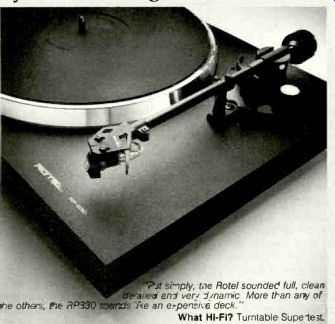
Rotel's quiet, accurate and supremely musical turntables, for example, illustrate the exhaustive attention to detail which is an integral part of every Rotel design: details like an arm-mount pillar precision machined from a solid piece of aluminum refined specifically to Rotel's high standards; details like a platter mat made of energy-absorbing Norselex, and details like silicone-filled feet to isolate the turntable from external vibrations.
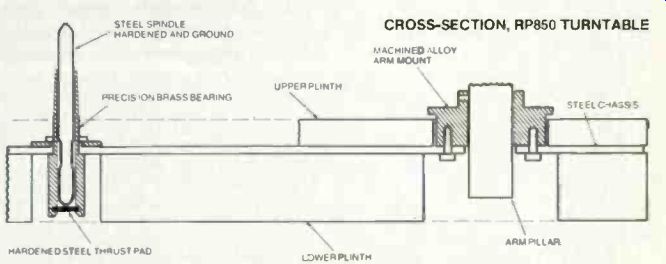
---p91 CROSS-SECTION, RPM TURNTABLE
The Balanced Design Concept
In the design of a high fidelity component, as in the selection of a high fidelity sound system, it is ultimately the weakest link in the chain, not the strongest, which sets the limit to the performance achieved.
In recognition of this fact, no single aspect of a Rotel component's design is considered paramount. Instead, each model is engineered for performance quality which is consistently high in all its aspects.
Similarly, all Rotel components are designed to complement each other in terms of sound quality and performance. This consistency has been repeatedly recognized in the selection of complete Rotel systems as top performers in their field by the British audio press.
With Rotel hi-fi, the weak links simply do not exist.
Bringing You Back to What It's All About: MUSIC
In the final analysis, of course, the only criterion which truly matters in the design and selection of any audio component is its ability to reproduce music naturally, accurately and convincingly. While some "hi-fi" companies appear to have lost sight of this fact, we remember that you purchase audio components to enjoy your music to the fullest, not to read specifications. This is why the listening room remains our most important laboratory.
We invite you to put Rotel high fidelity components to the test. Visit your local Rotel authorized retailer with your favorite records or compact discs and listen to the music. A simple listening test is the best way to find out why Rotel hi-fi is the smart choice in high performance high fidelity.
Designed in Britain, Enjoyed World-Wide
Kyocera ad
This tiny sensor from Kyocera puts high-end audio in any room.
The finer your audio system, the more you should enjoy it. So why confine your listening pleasure to just one room? Imagine having beautiful music throughout your house. In the bedroom as you get dressed. In the family room as you relax. In the living room as you entertain. Now imagine all this music coming from a single audio system of consummate fidelity.
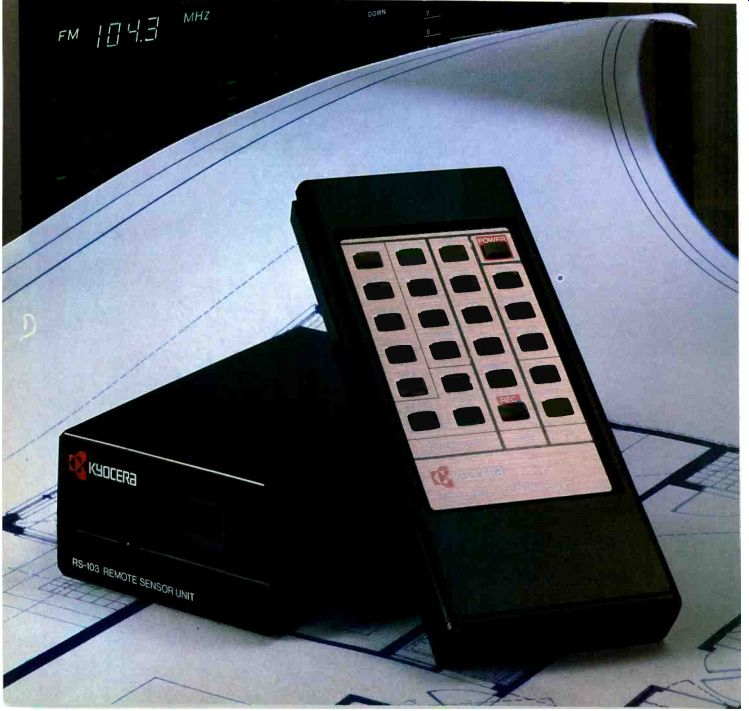


Not long ago, this kind of flexibility was just a dream. It would have taken several separate hi-fi systems to accomplish this feat-with tremendous expense and duplication of components. But the tiny remote sensor of Kyocera's new Full System Remote Control network has changed all that. For the cost of separate systems of marginal quality, you can assemble a single Kyocera system of audiophile quality and enjoy that system in several rooms.
THIS IS HOW IT'S DONE.
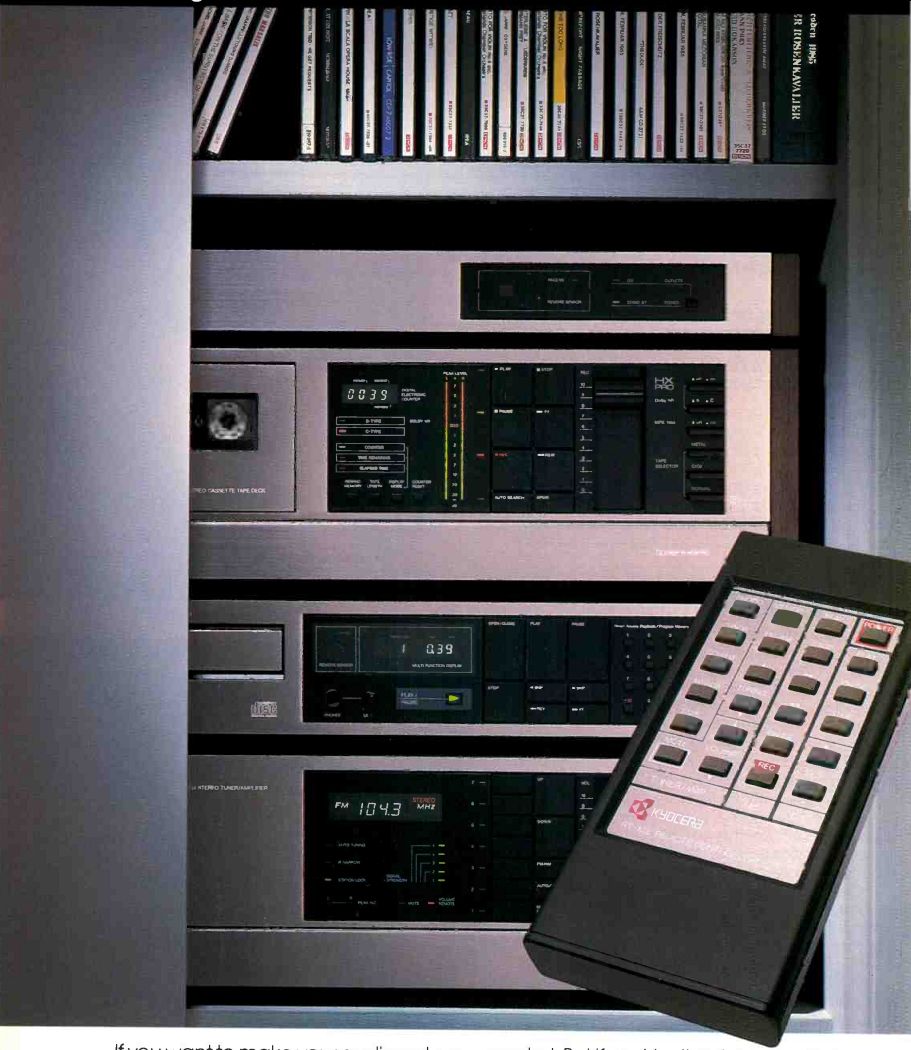
The heart of Kyocera Full System Remote Control is the RC-101 Infrared Remote Control Center. It receives commands from the RT-102 Infrared Hand-Held Remote Controller. And it sends remote commands to the Receiver, Cassette Deck and Compact Disc Player. Just take a look at what you can do by remote control:
RECEIVER: Volume Up/Down; input selection-Phono, Tuner, and CD/Aux; Tape Monitor; FM/AM selection; Memory Preset stations; and Tuning Up/Down plus a special Audio Mute function.
CASSETTE DECK: Play, Stop, Fast Forward, Rewind, Pause and Record.
COMPACT DISC PLAYER: Play, Stop, Pause, Skip Forward and Skip Back.
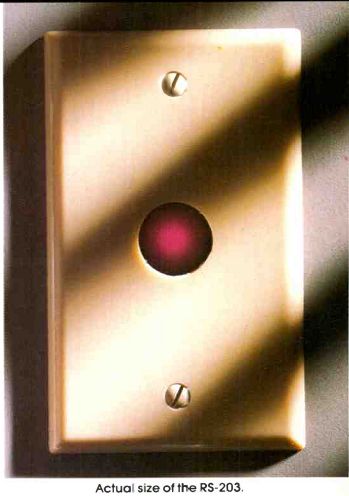
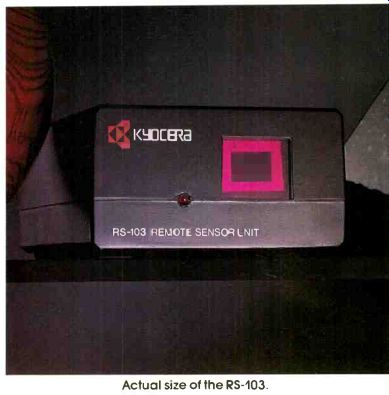
Perhaps more important, the Control Center features inputs for Kyocera's tiny RS-103 Table Top Sensor and inconspicuous RS-203 Wall-Mount Sensor.
They enable you to control the system from the bedroom, from upstairs, from anywhere in the house. By adding speakers, you can bring music into several rooms. While most remote systems operate in only one room, Kyocera's multi-room network is far more advanced.
THE FIRST REMOTE CONTROL SYSTEM WITH AUDIOPHILE CREDENTIALS.
If you've been around, you know that remote control audio is nothing new. Almost all the major audio companies have at least some remote components. And total-remote systems are gaining in popularity. But even as the field gets crowded, Kyocera stands apart with three critical advantages: 1) This Kyocera system is the world's first remote-controlled audio system with performance to please even the most ardent audiophile. Because it's built on the Receivers, Cassette Decks, and Compact Disc Players that have earned Kyocera high praise from audio critics all over the world. No other offering of remote components can match Kyocera in terms of sheer performance.
2) Kyocera uses a building-block approach so you're not locked into buying a completely new system all at once. All the Kyocera components in this brochure form interchangeable, compatible parts of the Kyocera Full System Remote Control network.
3) Unlike other systems, the Kyocera network can be operated and enjoyed in multiple rooms throughout the house. For the first time, you can carry a 100 Watt' MOS FET Receiver, a Dolby HX Pro Cassette Deck, and an anti-resonant Compact Disc player with you when you go from room to room!
Actual size of the RS-203.
Actual size of the RS-103.
---
If you want to make your audio system the centerpiece of your living room, you'll be happy to know that Kyocera components are as beautiful as any on the market. But if you'd rather tuck your Kyocera components discreetly away you can still enjoy them- and operate them via wireless remote control.
RECEIVERS:
We take them seriously.
If receivers have something of a bad reputation among serious audiophiles, there's a good reason. In Japan, where everybody owns component high fidelity, nobody owns one-piece receivers. In fact, North America may be the only place where receivers represent a majority of the market.
For most Japanese audio engineers, receivers are strictly for export. They're not serious components at all. So receivers are designed by the second-string engineers. This explains why even companies with decent separates tend to load their receivers up with meaningless knobs, buttons, and displays.
The irony here is that there's no reason why receivers must be second-class components. There's nothing to prevent a company from using the same common sense and judgment in receiver design as they exercise with separates. This is the guiding philosophy behind Kyocera receivers.
MOS FETS IN THE DRIVER STAGE.
A rarity in receivers, Metal-Oxide-Semiconductor Field Effect Transistors (MOS FETS) are used in the driver stages of all Kyocera receivers for their superior transient response and isolation characteristics.
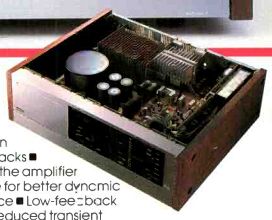
PRE-OUT/MAIN-IN JACKS.
While it is hard to find a receiver with preamp output/main amp input jacks nowadays, all Kyocera receivers have them. So you can connect outboard signal processors, use higher-powered amps, or use your receiver as part of an elaborate multi-amp system. That's particularly important considering the multi-room capability of the Kyocera Full-System Remote Control network.
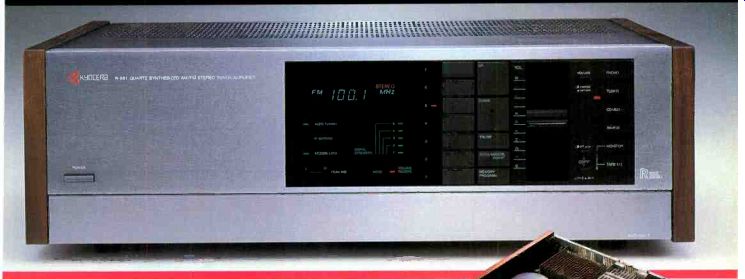
THE KYOCERA R-461.
50 Watts per channel (continuous RMS, both channels driven into 8 Ohms from 20 Hz to 20 kHz with no more than 0.02% THD
Compatible with Kyocera Full System Remote Control network
Manual/ electronic volume control
Subsonic filter at 20 Hz with 12 dB/octave slope
High filter
Two tape monitors with dubbing
Preamp Output/Main Amp Input jacks
MOS FETS in the amplifier driver stage for better dynamic performance
Low-feedback design for reduced transient intermodulation distortion
Female banana jacks bypass speaker switching for straight-wire-with-gain circuit
Quartz frequency synthesis tuning
FM front end with MOS FETS and High-Q varicaps for minimum interference
Ceramic IF filters for high selectivity, low distortion
6 AM + 6 FM station presets.
THE KYOCERA R-661.
70 Watts per channel (continuous RMS, both channels driven into 8 Ohms from 20 Hz to 20 kHz with no more than 0.02% THD
ALL THE FEATURES OF THE R-461, PLUS:
Toroidal transformer
Oxygen-Free Copper (OFC) wiring for reduced noise
Moving Magnet/Moving Coil phono input stage
Parametric bass and treble controls with continuously variable turnover frequency for sensitive and precise tonal adjustment Wide/Narrow .F bandwidth switch adapts to your reception conditions
High-frequency FM comparator for reduced noise
FM quadrature detector for low distortion
Chopper-type FM stereo demodulator for improved stereo separation
High blend switch for better sound on weak FM stations
7 AM + 7 FM station presets.
THE KYOCERA R-861.
100 Watts per channel (continuous RMS, both channels driven into 8 Ohms from 20 Hz to 20 kHz with no more than 0.02% THD.
ALL THE FEATURES OF THE R-661, PLUS: Parametric bass, midrange, and treble controls Automated IF bandwidth switching (Wide/Narrow) adapts to your reception conditions
Switchable de-emphasis for Dolby FM broadcasts.
CASSETTE DECKS:
Two heads can be better than three.
For years, cassette deck manufacturers have touted the three-head feature. Again and again, we are told that three heads are the only way to achieve frequency response to 20 kHz. So many brands have devoted so much attention to this argument that it seems heretical to suggest there's a better way. In fact, doing three heads properly is an extremely expensive proposition. And doing it poorly is a sure way to sacrifice performance.
Proponents of three-head design like to gloss over the fact that any three-head deck with pretentions to high performance must come to grips with the problem of azimuth error.
Azimuth error occurs when the playback head gap does not line up precisely with the signals laid down by the record head gap. This kind of error can never occur on two-head decks, where the record and playback gaps are exactly the same. Less than one degree of azimuth error can cause significant loss of response above 15 kHz. And that's ironic, because extended highs were supposed to be the strength of the three-head design in the first place.
Some manufacturers try to reduce azimuth error by placing the record and playback heads close together-often squeezing them through the cassette's central window. Others try to conquer azimuth error through elaborate mechanics and electronics. To be fair, the more elaborate systems do work, but only at incredible cost to the consumer. And the simpler systems? If the response falls short of 20 kHz on Type II tape, then the azimuth error correction is not completely successful.
Kyocera has a fresh approach. We maintain that a properly designed two-head deck can give you exemplary frequency response. And our decks prove it. Instead of spending money on elaborate azimuth error correction, we consciously spent the money on reducing wow & flutter.
A TRANSPORT OF DELIGHT.
The most audible shortcoming of today's decks is wow & flutter.
That's why Kyocera concentrated on improving the transport. On the D-811, we used two capstans, isolated by a closed-loop belt, for minimum modulation noise. We gave the take up capstan direct drive. We supplied a separate high-torque motor to drive the reel hubs. And we even used a third motor to insert the heads into the cassette gently and precisely. The result is sound without the veil of modulation noise, wow & flutter that plagues lesser cassette decks.
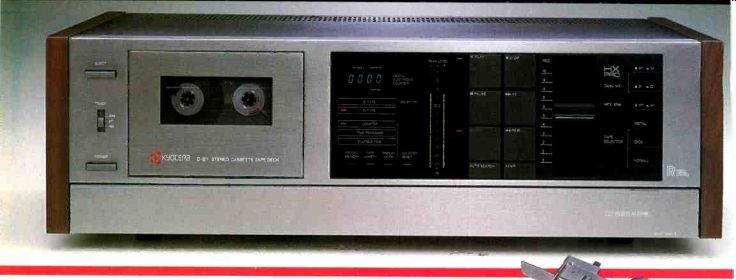
THE KYOCERA D-611.
Compatible with the Kyocera Full System Remote Control network
Three-motor transport
Direct-drive FG servo motor turns the capstan without gears or pulleys-wow & flutter only 0.035% (WRMS)
High-torque motor drives reel hubs
Third motor gently inserts heads into cassette
Sendust-core record/ play head achieves response to 20 kHz with Type I and Type II tape, to 22 kHz with metal tape
Dolby' B and C noise reduction
Switchable MPX filter
Fine Bias control
Timer recording and play
Automatic Program Mute Recording adds four-second blanks between songs
Auto Play and Repeat
Memory Stop and Memory Play.
THE KYOCERA D-811.
ALL THE FEATURES OF THE D-611, PLUS: Dolby HX Pro Bias Compensation for extended recording range
400 Hz calibration tone for record balance
Closed-loop dual-capstan tape drive minimizes modulation noise
Wow & flutter reduced to only 0.02% (WRMS)
Fluorescent readout of tape time in minutes and seconds
LED peak level indicators with peak-hold.
CD PLAYERS:
Solving the problem of resonance.
The role of air-borne vibration in degrading turntable sound is long-recognized and well understood. What is only now coming to light is the effect of vibration on Compact Disc players. Because the CD's track of pits is microscopically narrow, vibration can cause mistracking and its consequent data errors. In fact, controlled tests performed for Kyocera by an independent research laboratory confirm that a non-resonant Fine Ceramics chassis incurred significantly fewer data errors than a conventional chassis of similar design. Thanks to the CD format's error-detection and error-correction systems, these data errors are not heard directly.
However, the very process of error concealment introduces distortion which can be heard.
Kyocera was the first to design and construct anti-resonant CD players. Kyocera's top-of-the-line DA-910 uses massive chassis parts, mechanical isolation of the laser transport, and a cast Fine Ceramics base to minimize vibration-induced mistracking. Now, with the new DA-710CX and DA 610CX, Kyocera provides similar sophistication to a broader audience of music lovers.
These new CD players feature four Fine Ceramics spacers strategically located in the chassis to isolate the laser transport and printed circuit boards from external vibration. In addition, dual zirconia-ceramic guide shafts, newly developed by the Kyocera Gamou Works, assure smoother travel of the laser transport for superior tracking stability. Compared to molded aluminum or stainless steel, the zirconia ceramic shafts can be machined to much tighter tolerances. In addition, the shafts will stay within tolerance for more than ten times the service life of stainless steel, molded aluminum or plastic.
TOP-QUALITY ANALOG CIRCUITRY.
The ultimate quality of a CD player depends on the attention that has gone into its non-digital circuitry as well as its digital circuitry. That's why Kyocera uses DC amplification, resulting in response that extends from a low of 5 Hz to 20 kHz within a tolerance of ± 0.5 dB. Separate power transformer secondary windings and separate voltage-regulated supplies are used for the analog and digital circuits. This precaution prevents digital noise from leaking through the power supply and contaminating analog signals.
Carefully selected capacitors and expensive Linear-Crystal Oxygen-Free Copper (LC-OFC) wiring assure the lowest possible signal loss. As an additional assurance of low noise, the line output jacks are plated with gold. And one more note: the line output level at these jacks is completely isolated and undisturbed by adjustments to the headphone volume control on the front panel.
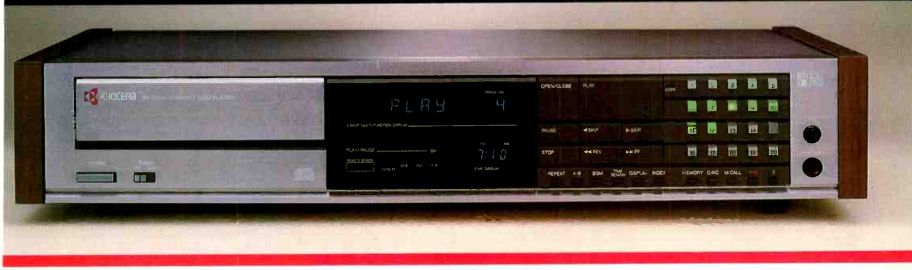
THE KYOCERA DA-610CX.
Compatible with the Kyocera Full System Remote Control network
Anti-resonant construction with Fine Ceramics chassis spacers for fewer data errors, lower distortion
Zirconia-ceramic guide shafts for smoother laser travel, longer life
Three-beam laser tracking for superior Tracking stability
16-bit linear digital-to-analog conversion extracts the full resolution from Compact Discs
DC analog section
Ninth-order low-pass filters
Separate power supplies for digital and analog circuitry
Low-noise LC-OFC internal wiring
Gold-plated output jacks
"Dedicated"24-function wireless remote control
16-selection programmability
Skip Forward and Back
Three-Way Repeat (Track, Disc, and Program)
Multi-function fluorescent display.
THE KYOCERA DA-710CX.
ALL THE FEATURES OF THE DA-610CX, PLUS: Optically coupled digital signal routing to eliminate internal interference
Digital filtering with four-times oversampling at 176.4 kHz To minimize aliasing noise
Dual digital-to-analog converters eliminate interchannel phase delay
Digital Subcode Output Port for use with future digital components
Third-order Bessel-derived analog filtering for minimum high-frequency phase shift
Background Music function plays songs on the disc in random sequence.
Built right from the ground up.
For your nearest Kyocera dealer call:
1-800-633-2252 Ext. 224
Kyocera International, Inc., 100 Randolph Road, CN 6700, Somerset, NJ 08873-1284, (201) 560-0060
Kyocera Canada, Inc., 7470 Bath Road, Mississauga, Ontario, L4T 1L2, Canada, (416) 671-4300
BRYSTON continues to define the state of the art . . . .
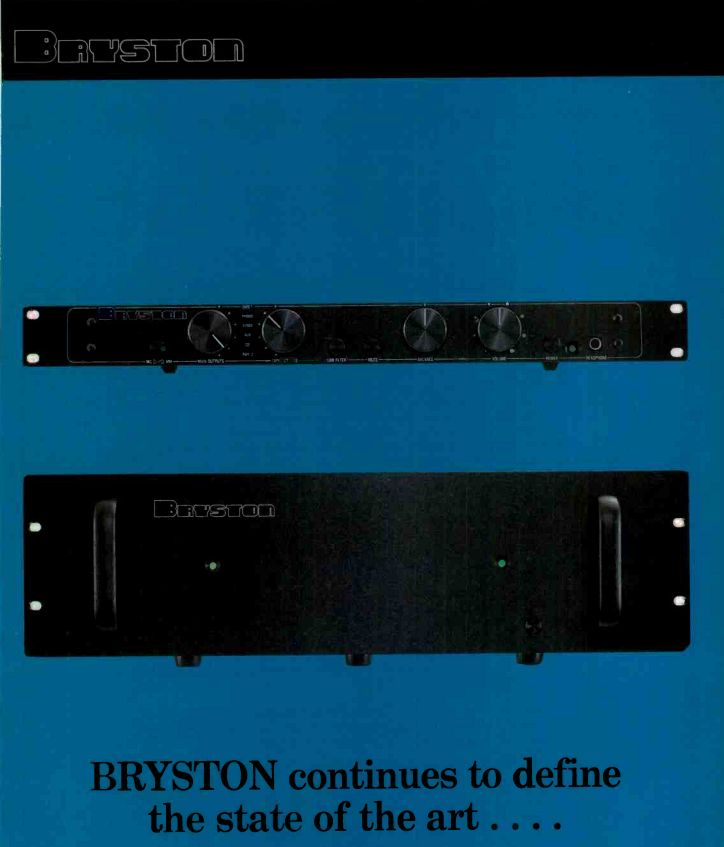



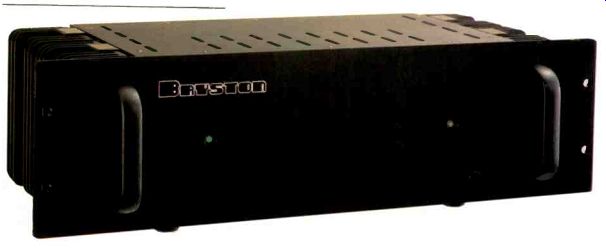
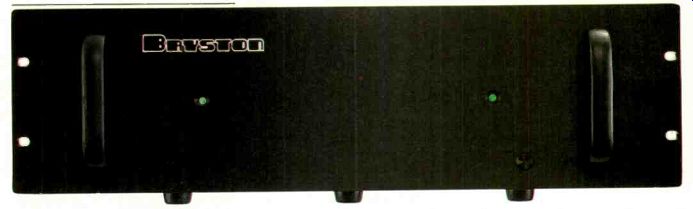
A LETTER FROM THE PRESIDENT Bryston was incorporated in February 1962. Our original concept was the manufacture of specialty electronics with emphasis on quality of components and with extreme care in assembly.. In other words, we wanted to be the best. This "ultimate-quality" commitment has only strengthened with time. Our policy is constantly to improve our products, our service, and our accessibility. Our warranty coverage, a full Five Years, reflects the excellent reliability record our products have shown, and our confidence in them.
In the field of sound reproduction, Bryston maintains as its goal the achievement of complete musical accuracy. Since music is a very complex process, the technology required in its reproduction is often very involved and rich with challenge. Our continuous research into the art and science of electronic amplification of musical signals has yielded many original solutions to what seemed insurmountable obstacles.
We are proud to have been among the first "Audiophile" companies, and even more proud to remain at the forefront of excellence in audio. This book will provide some insight into the techniques and philosophies we employ.
At Bryston, the term "best" applies to the way we conduct our business as well as to the performance of our products. Bryston's integrity is and will remain uppermost in our business dealings. You will find us courteous, helpful, and fully interested in your satisfaction indefinitely.
Time has proven our original concept a valid one. Our reputation and our market strength have continuously improved. Your Bryston system will retain its musical accuracy and its value for many years to come.
sincerely, Brian W. Russell, President.
PRE AMPS
MODEL 12B
Bryston preamplifiers, as with all Bryston components, are designed with one purpose:
absolute musical accuracy. This means that distortion of the original wave form must be held to the minimum possible with presently available technology. The noise is as low as you have ever experienced from a preamp.
The distortion, of any type, is so close to non-existant as to be nearly immeasurable. The equalization accuracy is not measured in decibels (1/10 Bel) but in milli-bels (1/1000 Bel). Bryston preamplifiers cannot be overloaded by any input signal available from any commercial material. They do not add "euphonic" colorations, nor do they alter the clarity of even the most beautifully lucid recordings.
The Model 12B and the Model .5B are full-function preamplifiers.
They are intended as control centers for the finest sound systems. They do not, however, contain controls which are not useful, such as "bass" and "treble". (The systems in which they will be used will hardly require such broadband tailoring.) The controls are all useful and convenient; switching among various sources, low filter for record warps, tape monitoring facilities, mute, balance and volume.
The Bryston 12B is an elaborate and flexible center for the most complete sound systems. It features two phono inputs, one of which is equipped with Bryston's superb moving-coil step-up stage. It allows for the connection of two tape decks, with full dubbing facilities in either direction. There is a dedicated C/D input, as well as tuner, and auxiliary inputs, for a total of seven separate sources. (All sources are available at any time from the tape outputs, regardless of what is being fed to the amplifier). In addition, the 12B contains a headphone jack for private listening, (with automatic speaker disconnect), and a special line-level output for the connection of other amplifiers allowing independent volume control at remote locations.
The 12B preamplifier is equipped for the true audio enthusiast, with enough flexibility and expansion potential to adapt to the most complex sound systems.
The Bryston .5B is a preamplifier for the simpler sound system, with 4 inputs, including one phono. The tape monitoring facility is less elaborate, consisting of a single push button, but like the 12B, the Point-Five-B is intended to be used with the finest signal sources.
Regardless of which Bryston pre amplifier you choose, they all employ the same electronics, (including Bryston's novel and fundamentally correct phono section). Thus they all enjoy the same superb specifications, and the same exceedingly musical sound quality. They all employ ultra quality components, including precision volume controls with 1/4dB tracking, metal film resistors, poly styrene capacitors and heavily gold plated connectors. They use the most careful and exacting assembly and test procedures, with transistors hand-selected and matched to better than 1%. Whatever the size and complexity of your sound system, a Bryston preamplifier is a "final purchase'', with performance that establishes a standard which is un likely to be improved upon in the near future.
MODEL .5B
POWER AMPS
MODEL 2B LP
Bryston's first exploration into audio, over a decade ago, was a power amplifier intended to prove our theory that amplification which was free of cost-cutting com promises, which displayed excellent open-loop linearity, would be audibly superior to amplification which obtained good numerical specifications from a compromised circuit by virtue of large amounts of feedback.
This was, at that time, an almost heretical idea. Long term comparison tests were run at a large recording studio, using the biggest and best known amplifiers of the day. The result was that the studio ordered Bryston amplifiers for its monitor systems, although they were hardly more than breadboard prototypes at the time. Even in this rough form, Bryston's linearity proved audibly cleaner and more musical than the most respected products on the market. Clearly here was the beginning of a trend. Bryston has expanded on this theme ever since.
Included in our original theory were a number of design factors; independent power-supplies, very high output current capability, voltage gain in the output section, and several other approaches intended specifically to linearize the open-loop gain, including complementary output circuitry. (Complementary means employing opposite polarities of transistor on opposing halves of the waveform. Quasi-complementary employs the same polarity of output device on each half, and requires a signal phase reversal to drive one side, compromising linearity). These advances are still in use in all Bryston amplifiers. In addition, we have expanded our concept of full complementarity to include all stages, and have adopted a novel output section which is actually quad-complementary.
This new output section, which employs both polarities of transistor on each half of the output drive circuit, yields a dramatic improvement in linearity and musical accuracy.
This is reflected in extremely low distortion figures, obtained without massive amounts of feedback.
I.M. distortion, which we feel is an excellent indicator of an amplifier's steady-state accuracy, is so low as to be nearly impossible to measure.
Further solidifying Bryston's low-open-loop distortion philosophy, we select and match all input transistors to less than 1% tolerance, employ only metal-film resistors, use poly styrene capacitors in signal-path circuitry. Finally, we hand adjust each and every amplifier to the absolute optimum performance.
MODEL 3B
POWER AMPS
MODEL 6B
Of course, the proof is in the listening. Bryston sells over half of its production to professionals. We find that professionals are first attracted to Bryston by its reputation for re liability, but they are convinced by its sonic quality. The recording and broadcast industries, motivated by recent developments in low-distortion, wide range source material, have become very sophisticated. even audiophile-oriented. Bryston products have become so popular among these groups that there is an excellent chance that your favorite recording was monitored on Bryston equipment at the studio and later transmitted from stations using the same Bryston components on their monitors. Our reliability is so well-known that many touring bands use Brystons on the road as well. In fact, you could be listening to a Bryston chain all the way back to the amplified instruments themselves.
The reliability to which we referred above is not a matter of luck.
It is our scientific application of proven methods. We use statistical mean-time-before-failure analysis, studies of stress on component longevity, vibration-resistance in attachment methods, even the metallurgy of, and oxygen-exclusion in, electrical connections. We know how to make a product fool-proof, and we know how to test for potential problems. Every amplifier Bryston makes is connected to a very high-
stress combination of load and signal, which engages the protection mechanisms continuously. They are "burned-in" this way for more than 4 days: 100 hours. Although nearly all pass this test without incident, the point is, we don't want you to receive the one which might not have.
MODEL 4B
DUAL POWER SUPPLIES
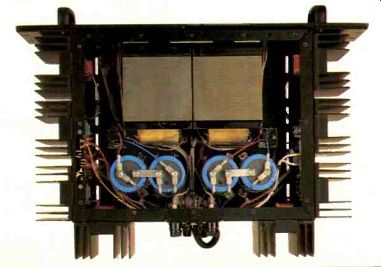
All Bryston amplifiers, from our 50-watt per channel 2B, to the block buster 6B at 800 watts into 1 or 4 ohms, employ separate power supplies for each channel. Each supply could be capable of powering both channels to their full 8 ohm specifications.
Keeping the power separate, however, yields a worthwhile, even dramatic improvement in image firmness and overall clarity. This is because the channels cannot develop any cross-talk or intermodulation through the power-supply.
ACCESSORIES
Bryston believes that equipment which sounds cleaner will measure better, and vice versa. That's why we build all our components with the best materials and the most performance-effective technology. We feel it is important to retain this level of quality in all aspects of the signal chain. Bryston accessories maintain this link without compromise.
Moving coil cartridges display several sonic advantages over moving magnet type cartridges. The primary reason is that the magnet structure is many times larger, since the magnet is stationary, not a part of the tiny cantilever which traces the groove. A larger magnet allows more signal power to be generated, at lower electrical distortion, but since the coil is on the cantilever, and thus tiny, the voltage is lower. (The current, of course, is much higher). Since current can be transformed into voltage, a transformer is the ideal way to capture the improved signal-to-noise ratio this high signal-power allows.
The Bryston TF-1 transformer will deliver a signal from your moving coil cartridge to your phono pre amplifier with lower noise and lower overall distortion at these small signal levels, than any active step-up device.
The TF-1 is available in two gain configurations, (16.5 or 22.5dB), and is internally re-strappable. It is identical to the internal moving-coil stage in the Bryston 12B, and is an ideal match to the .5B, or to any preamp which requires a flawless moving-coil interface.
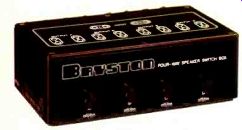
The Bryston line of speaker switchboxes uses massive switch assemblies, which stand up to the high current capabilities of Bryston amplifiers. High pressure contacts maintain ultimately low contact resistance, and gold-plated input and output connectors assure a distortion-free interface between amplifier and loudspeaker. Separate grounds between channels allow the use of bridged amplifiers. Models are available for 2 speakers plus head phone, 3 speakers plus headphone, and 4 speakers. If you require speaker switching, don't use just "any" switch-box; use a Bryston to maintain the clarity and musical accuracy of your system.
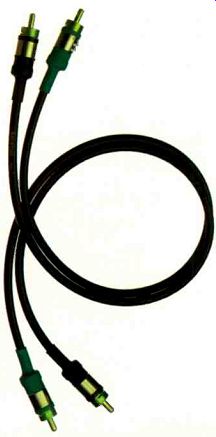
In cable interconnects there are 4 basic parameters which can affect waveform accuracy; contact linearity, cable resistance, capacitance, and inductance. Contact linearity is a function of corrosion in the connection, which can be completely pre vented by the heavy gold plating used in all Bryston connectors, since gold is an inert metal.
The cable resistance and inductance of normal interconnect wires are negligibly low in relation to the source and input resistances they contact, but capacitance can affect performance since it acts as an increasing load at high frequencies. Bryston cables have extremely low capacitance (about 15pf per foot), and in addition, the dielectric is a foamed polymer, which is largely air, (the only "perfect" dielectric). A Bryston preamplifier can feed up to a quarter mile of Bryston cable without changing its bandwidth or distortion specifications. Using Bryston cables will assure you of maintaining all the performance built into your Bryston system.
Specifications:
2B-LP, 3B, 4B and 6B power amplifiers
DISTORTION:
Harmonic:
Less than 0.01% (for 6B 0.02%) from 20 to 20kHz at rated power.
IM:
Less than 0.01% from 10 milli-watts to full rated power.
Noise:
100 db below full output.
Crosstalk:
Below noise 20 to 20kHz.
SLEWING RATE:
Greater than 60 volts per microsecond.
POWER BANDWIDTH:
Less than 1 Hz to over 100kHz.
DAMPING FACTOR:
Over 500 at 20 Hz, ref. 8 ohms.
INPUT SENSITIVITY AND IMPEDANCE FOR 2B-LP, 3B, 4B RESPECTIVELY: 0.75 volt in for full output 50 k ohms.
1 volt in for full output, 50k ohms.
1.25 volts in for full output, 50 k ohms.
FEATURES:
1. Bridging switch.
2. Regulated power supplies.
3. Each channel separated back to the linecord.
4. Dual-colour LED pilot lights and clipping indicators; green changing to red at clipping.
5. Will deliver full output to any phase angle at 4 ohms or higher.
6. Warranty: 5 years parts and labor, shipping one way.
BRYSTON 2B-LP Basic Stereo Power Amplifier 50 watts per channel, 8 ohms.
100 watts per channel, 4 ohms.
200 watts, bridged, 8 ohms.
Over 1600 cm2 of heat-sinking; (over 3200 cm^2 with chassis).
19" x 1.75" x 10", wt. 18 lbs.
48.25 cm x 4.44 cm x 25.4 cm, wt. 8 kg.
BRYSTON 3B Basic Stereo Power Amplifier 100 watts per channel, 8 ohms.
200 watts per channel, 4 ohms.
400 watts, bridged, 8 ohms.
Over 3200 cm2 of heat-sinking; (over 6400 cm^2 with chassis).
19" x 5.25" x 9", wt. 35 lbs.
48.25 cm x 13.33 cm x 22.85 cm, wt. 16 kg.
BRYSTON 4B Basic Stereo Power Amplifier 250 watts per channel, 8 ohms.
400 watts per channel, 4 ohms.
800 watts, bridged, 8 ohms.
(More than 1 horsepower).
Over 6400 cm^2 of heat-sinking; (over 9600 cm^2 with chassis).
19" x 5.25" x 13.5", wt. 50 lbs.
48.25 cm x 13.33 cm x 34.3 cm, wt. 23 kg.
BRYSTON 6B Basic Mono Power Amplifier
Rated Distortion: Less than .02% I.M.
or THD from 20-20 KHz at rated power or below.
Rated Power: 500 watts 8 ohms 800 watts 4 ohms 500 watts 2 ohms 800 watts 1 ohm 6400 cm2 of heat sinking, etc.
19" x 5.25" x 13,5", wt. 50 lbs.
48.25 cm x 13.33 cm x 34.3 cm, 23 kg.
Specifications:
.5B, 11B* and 12B preamplifiers
DISTORTION:
(Any Input, to any Output); Less than .005%, IM or THD, any Frequency from 20-20KHz, at rated output or below.
Rated Output:
10 volts RMS minimum, from Tape or Main Output. (Typically 14 volts RMS available).
Rated Noise: (input shorted) Phono;-80 dBA Referred to an input of 5 millivolts RMS @ 1KHz.
High Level inputs;-95 dBA referred to an input level of 500 my at 1 KHz.
RIAA Accuracy:
Within less than ± 50 mB (.05 dB) from 20-20KHz inclusive.
Frequency Response:
High Level Section; within less than ± 50 mB from 20-20 KHz inclusive.
*without MC 11-ansformer.
12B MC transformer Section
DISTORTION:
Less than .005% 20-20 kHz with preamplifier driven to full rated output.
Noise:
Equivalent to approximately 1000 ohm metal film resistor (Thermal noise greater than-85 dB below 0.6 my input, unweighted).
Gain: 16.5 or 22.5 dB (internally re-strappable).
Frequency Response:
Below 5 Hz to above 30 kHz, within less than ± 0.5 dB.
The best sound you can hear next to Carnegie Hall.
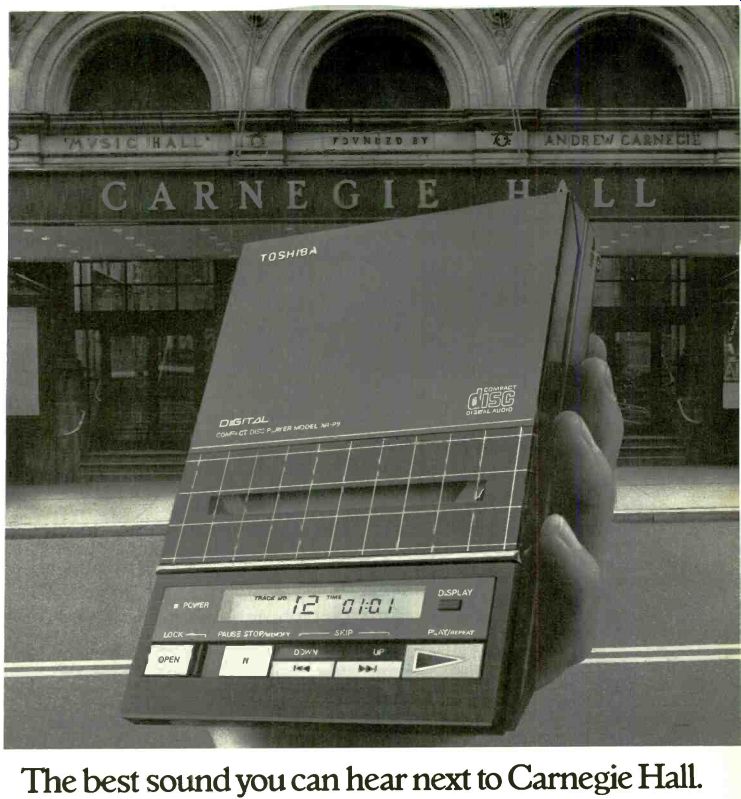
Listen to Toshiba's Portable CD player outdoors and something remarkable happens. It sounds like you're inside a concert hall. There's no distortion. No wow. No flutter. Only pure, concert quality sound.
Yet, when you take home this portable, it's a top of the line CD player. Hooked up to your stereo system through its AC adaptor, it offers features you won't find in other portables: 16 program random memory, 3-beam laser pick-up to guard against mistracking, plus a full function display that monitors the track, lap and remaining time. There's even a 15 function wireless remote control. And, of course, incomparable sound.
Toshiba's portable CD player. Out side of a con cert hall nothing sounds better.
In Touch with Tomorrow
Wingate-- Not for beginners.
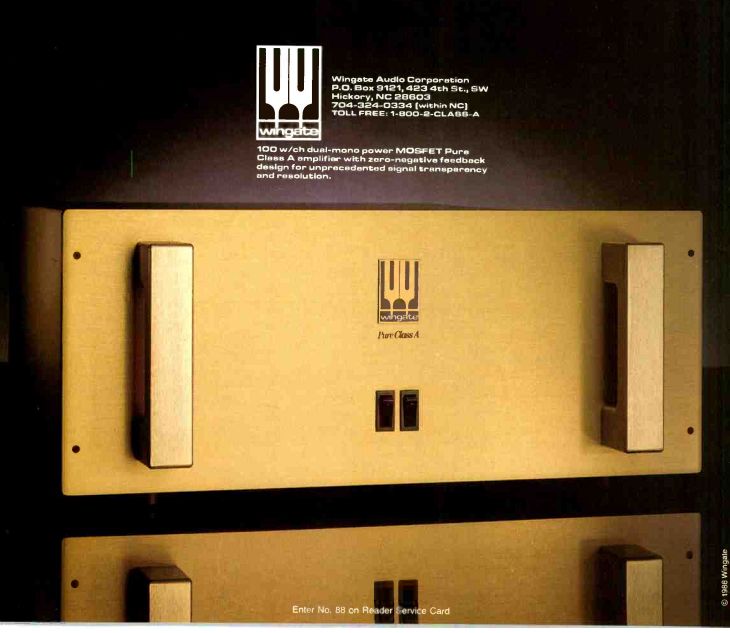
The discriminating sensibilities of the true audiophile are developed gradually as an acquired taste. Naturally, then, we realize that the Wingate 2000A is an extraordinary feat of engineering that far exceeds the understanding or appreciation of the novice. Instead we suggest this incomparable Pure Class A amplifier only for the audio connoisseur whose trained ear will recognize absolute purity of sound.
Wingate Audio Corporation
P.O. Box 9121, 42.34th St., SW Hickory, NC 28603
704-324-0334 [within NC] TOLL FREE: 1-800-2-CLABB-A
100 w/ch dual-mono power MOSFET Pure Class A amplifier with zero-negative feedback design for unprecedented signal transparency and resolution.
COMPACT DISCS NEVER SOUNDED THIS GOOD
INTRODUCING THE INCREDIBLE DISCUS COMPACT DISC STABILIZER BY MONSTER CABLE.
It's Not Easy Being Digital.
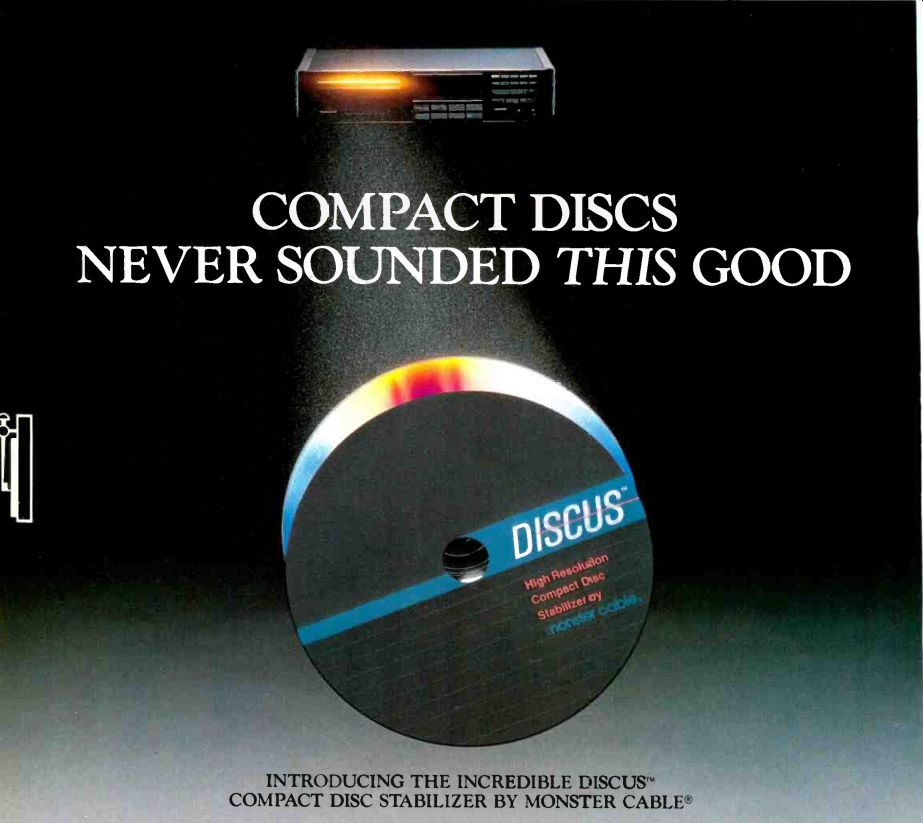
Music from your compact disc, as impressive as it may sometimes sound, is not as good as it could be.
In fact, trying to read digital information from a compact disc with an extremely fine beam of laser light becomes a difficult, if not impossible task considering real world manufacturing techniques. Even the smallest of vibrations, reflections and imperfections can cause data loss and missing musical information.
The Discus Solution.
By simply placing the Discus on top of your compact disc and sliding it into your player, the special materials, manufacturing techniques, and black textured finish are at work effectively damping out compact disc vibrations, minimizing laser diffraction and stabilizing disc rotation. Your player will be able to read more of what's on the disc with fewer percentage of errors.
The music becomes more powerful and dynamic. Bass is deeper, tighter, with more authority. Instrument placement is better defined and exact.
Vocals and surrounding instruments are precisely focused and project out from between your speakers with impressive realism. Transients are quicker and even the harshness of many compact discs is minimized.
What a Pair.
Use the Discus in combination with one of our Interlink interconnect cables and you will experience digital sound the way it was meant to be.
Absolutely awesome.
Give the Discus a listen at your favorite Monster Cable dealer.
You'll be amazed at how much better all of your CD's will sound.
Call or write us for your free cable selection brochure.
Monster Cable Monster Cable Products, Inc.
101 Townsend, San Francisco, CA 94107 Tel: 415 777-1355 Telex: 470584 MCSYUI Enter No 52 on Reader Service Card The Discus is available in 2 models. The Discus+ is an ultra-thin version, yet offer the weight and density necessary for outstanding performance.
The Discus is not compatible with all machines.
Please check with your dealer or the Monster Cable Customer Service before purchase.
"Thanks to Nitty Gritty, every music lover can get the best sound from his records" (and compact discs, too).
So says James Jarvis of the SENSIBLE SOUND. And Bert Whyte of AUDIO, Tony Cordesman of STEREOPHILE, Julian Hirsch of STEREO REVIEW, Enid Lumley of INTER NATIONAL AUDIO REVIEW, Michel Prin of SON HI FI, Al Fasoldt of FANFARE, and Jack Philpot of AUDIO AMATEUR all agree: there is no other record or compact disc cleaning system that is equal to those made by Nitty Gritty Record Care Products of California.
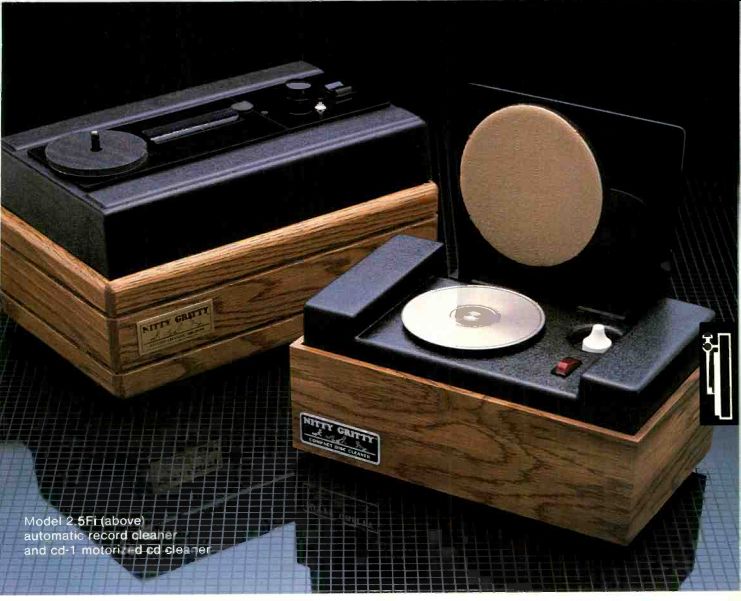
Why do these independent audio critics feel so strongly? Because cleaning systems made by Nitty Gritty get records and compact discs 100% clean. Free of dust, grease and static electricity. Microscopically clean. Perfectly clean.
Have you ever listened to a clean record? Records that have been cleaned by a Nitty Gritty sound more like live music.
They have extended high frequency response, improved imaging, more acoustical space, and less noise.
There is no secret. The effectiveness of the Nitty Gritty record cleaning system is due to its superior design. The record cleaning system employs a powerful vacuum and a pure cleaning fluid. The Nitty Gritty cleaning fluid dissolves dust, and grease, neutralizes static charge, and then is suctioned immediately off, leaving a purified record. Perfectly pre pared for play.
"Any record in one's collection, old or new, audiophile or not, will benefit greatly with a (Nitty Gritty) cleaning." Jarvis says, "I believe that anyone considering up grading his system in any way should first obtain one of these record cleaning machines. Only then will he be aware of what he might be missing in the music, or of what his current system is really capable of in terms of music reproduction." Digital gets a wash, too.
The Nitty Gritty compact disc cleaning system is also regarded as state-of-the art. The CD-1 is the first motorized CD cleaner. It uses bi-directional rotation to safely and surely clean a compact disc.
Bert Whyte said, "Nitty Gritty has come up Enter No. 57 on Reader Service Card with a CD cleaning machine that is un questionably the easiest to use as well as the most efficient and effective method of ensuring pristine CD playing surfaces." The CD-1 also protects the CD with a clear coat that resists scratches. Perfectly protected from the elements.
And now Nitty Gritty has accomplished yet another first: the first motorized cleaner for the 12 inch video laser disc.
The DD3 (not shown) is designed to operate like the CD-1, but on a grander scale.
It also has the ability to clean the other two sizes (10 inch and CD) of the digital discs. Perfectly clean.
Brochures, full reprints of test reports, and a list of dealers are available to you.
Send your name and address for an immediate packet of ear-opening information.
Nitty Gritty Record Care Products 4650 Arrow Highway Unit F4, Info Dept.
Montclair, California 91763 (714) 625-5525
TDK
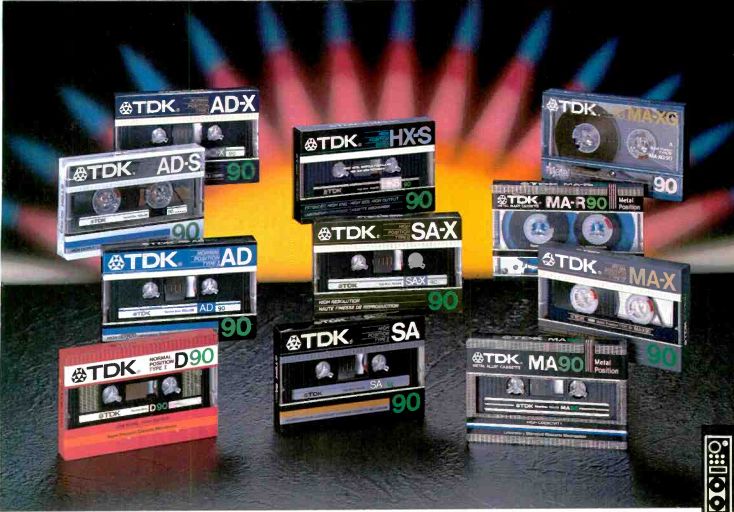

WE'VE DESIGNED A TDK AUDIO CASSETTE THAT'S JUST RIGHT FOR YOUR NEEDS.
BIAS NORMAL POSITION TYPE I, EQ 120 uS
AD-X APPLICATION: For music with extended dynamic range, such as modern jar, chamber, progressive rock or disco recorded live. from FM or LPs. Record on home component systems, integrated systems.
SPECIAL FEATURES: First normal bias Avilyn formulation for a wider dynamic range with superior MOL.
AD-S APPLICATION: For music with a hotter high end; from rock to pop to mellow classical. Especially well suited for car stereos. Record on hone components, integrated systems.
SPECIAL FEATURES: Rigid plastic C-Thru mechanism provides resonance control for sharp, undistorted recording and playback.
AD APPLICATION: For music such as easy listening, pop, contemporary or new wave, older discs. Record on mid-range and economy component systems.
SPECIAL FEATURES: Linear ferric magnetic particles for smooth and natural reproduction.
D APPLICATION: For music recorded from radio or records, voice recorded from speeches, lectures, inter views, or conversation. Record on home tape deck systems or battery powered portable recorders.
SPECIAL FEATURES: The all-purpose premium performance cassette in the widest assortment of lengths.
1986, TDK Electronics Corp.
BIAS HIGH POSITION TYPE II EQ 70 uS
HX-S APPLICATION: For music with consistent dynamic and extended high/low frequencies, such as chamber progressive rock, jazz or disco recorded live, from quality LPs. digitally sourced materials or master tape. Record on home component systems.
SPECIAL FEATURES: First metal formulation for high-bias recording from digitally sourced materials.
SA-X APPLICATION: For music with broad dynamic range such as opera, symphonic, chamber progressive jazz, soul, or rock recorded live, from quality LPs, digitally sourced materials or master tape. Record on high performance component systems.
SPECIAL FEATURES: First high-bias. dual layer Avilyn formulation for improved frequency response. SA-X is the quietest ape in its class.
SA APPLICATION. For music with great dynamic range, LP dubbing. Record on home component systems. It is the world's most popular high-bias cassette.
SPECIAL FEATURES: The ideal high-bias cassette for all recording applications.
BIAS METAL POSITION TYPE IV EQ 70 uS
MA-R; MA-X; MA
TDK. THE ART OF PERFORMANCE.
TDK QUALITY CASSETTES ELIMINATE THE QUESTION OF WHICH BRAND TO BUY.
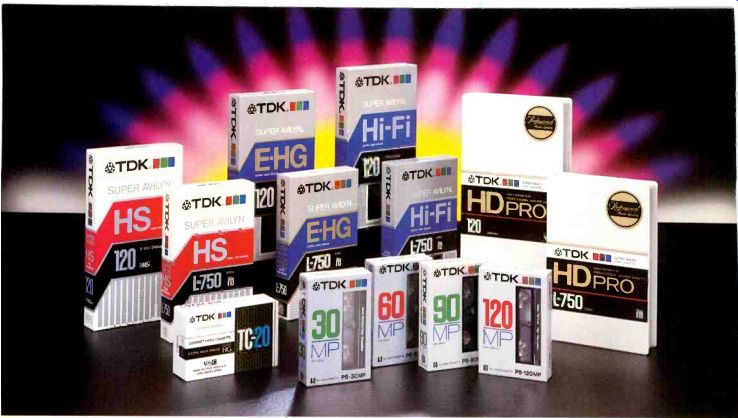
HD-PRO VHS T120 BETA L500 L750 8mm VHS BETA VHS BETA VHS BETA 160 L500 160 L500 130 L500 T120 L750 T120 L750 160 L750 1160 L830 1120 T160 TC-20 MP30 MP60 MP90 MP120 BET Value 45m7/g TDK HD-PRO is a super high definition 1/2" video cassette for the most demanding recording requirements. Perfect for live performance. video cameras. editing, duplicating, and archival use.
SPECIAL FEATURES:
Substantial improvements in luminance and chrominance signal-to-noise ratios, plus a dropout count that is virtually superior to all other 1/2" video cassettes make TDK HD-PRO the ultimate video cassette for your most demanding performance requirements. A precision SO cassette mechanism assures optimum tape transport, tracking, and alignment.
BET Value 35m /g TDK HI-Fl meets the most critical performance requirements of today's most sophisticated HI-Fl Stereo VCRs. It delivers optimum performance for all stereo audio/video applications, including MTS Stereo video-casts. dubbed music videos. and live music.
SPECIAL FEATURES:
Significant advances in audio frequency response from 20 to 20,000Hz and sensitivity ( +1dB) deliver clean. natural, more dynamic sound.
Luminance signal-to noise ratio improvements of +5.0dB assure crystal clear, lifelike reproduction.
WHAT IS BET VALUE? BET value is the measure that indicates the fineness of the magnetic particles contained on a tape expressed in units of square meters per gram (m^2 /g).
BET Value 35m^2/g TDK E-HG is a high resolution video cassette designed to meet the critical demands of today's long-playing VCRs.
Perfect for TV specials, concerts and movies. Ideal for video library applications.
SPECIAL FEATURES:
TDK E-HG delivers brighter, sharper pictures with a luminance signal-to noise ratio improvement of +3.0dB. Plus chrominance signal to-noise ratio improvements of +5.0dB and RF output level improvements of +2.5dB.
TDK's HDD binder system and SO cassette mechanism assure improved performance, reliability and durability, extended tape life and reduced dropout levels.
BET Value 25mqg TDK HS is a new high performance, high standard video cassette specifically designed for today's VCRs. Perfect for time-shifting TV programs and live-
action taping, HS delivers a higher standard of performance with improved picture clarity and color fidelity.
SPECIAL FEATURES:
Ultrafine Super Avilyn particles with denser particle packing deliver greater picture clarity with a luminance signal-to-noise ratio improvement of +3.0dB. TDK's HDD binder system provides improved performance. reliability and durability for extended tape life and reduced dropout levels.
BET Value 35m^2/g
TDK VHS-C is a superb tape formulation designed to deliver optimum video and audio performance in all VHS-C format systems.
Perfect for camcorder taping of vacations and on the spot events like sports and concerts.
SPECIAL FEATURES:
VHS-C features TDK's acclaimed extra high grade (E-HG) formulation which delivers substantial improvements in both audio and video performance compared to standard tapes. Play after play you'll faithfully reproduce the action with vibrant colors and crisp, clear audio to match. And TDK's super precision cassette mechanism assures unsurpassed reliability and dependability.
BET Value 55m^2/g TDK 8mm video cassettes deliver the most impressive picture ever, with four times the magnetic energy of any 1/2" video tape you can buy. Ideal for live-action recording, TDK 8mm video cassettes add a bold, bright new dimension to home movies.
SPECIAL FEATURES:
TDK's 8mm formulation provides superior recording density.
higher magnetic coercivity and higher signal retention to deliver sharper, clearer colors and crisp, clean sound.
Encased in a Super Precision cassette shell mechanism.
TDK THE ART OF PERFORMANCE. 1986 TDK Electronics Corp.
DALI: COMBINING ADVANCED TECHNOLOGY WITH TRADITIONAL EUROPEAN CRAFTSMANSHIP
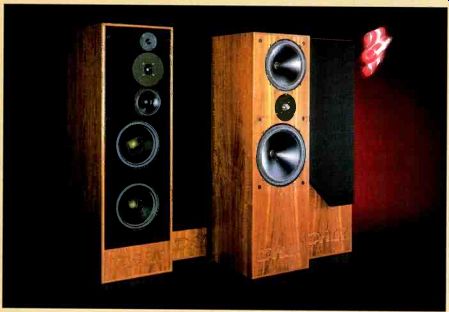
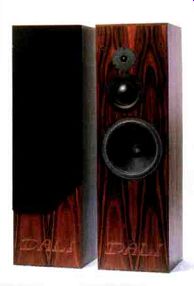

One of the more innovative speaker companies to appear in recent years, DALI--for Danish American Limited Incorporated--has a full line of impressively engineered speaker-systems. The company has recently filed for patents on several unique designs reflecting significant breakthroughs in a number of key performance areas.
INNOVATIVE ENGINEERING
Since the founding of the company, DALI engineers have been investigating the complex acoustic relationship between speaker systems and rooms.
Intensive research has shown that reflected room sound is a frequently ignored, but critical factor in achieving realistic performance. And it is the view of Dali's engineers that intelligent speaker design involves proper control of reflected sound combined with a precisely defined directionality. A psycho-acoustically plausible sound stage is not possible unless the first-arrival sounds and reflected sounds are maintained in proper perspective. As a result of this philosophy, Dali speaker systems are more "room friendly," are easier to place, and have a larger "sweet spot" with a wider and more accurate stereo imaging than conventional designs.
Another proprietary Dali development, dubbed VE2BR (Vibration Elimination 2nd-order Butterworth Reflex), eliminates the usual cabinet panel vibrations caused by conventional woofer mountings. These vibrations are an unappreciated source of a variety of sonic colorations. DALI's configuration was described in the patent abstract: "Two woofers are connected back to back, one on the front plate of the system and the other on an internal baffle board ... the back-to-back arrangement and mutually opposed woofers results in a non-vibrating unit." In addition to ne gating potentially destructive vibrations, the DALI VE2BR design also provides a very low system resonance, excellent transient response and low frequency efficiency, and a significant reduction in harmonic distortion.
A third, more recent DALI patent involves a double magnet, dual voice coil woofer. The design, called DMSLS (Dual Magnet Super Linear Stroke) provides an extended and linear woofer cone excursion which results in very low distortion at substantial low-frequency output levels.
DALI's advanced technology appears in the six models marketed in the United States: the bookshelf models DALI 2 and 3 and the floor standing monitor models DALI 4, 6, 7, and 8. The DALI 7 is the first model to use a patented asymmetrical room-interface crossover technology, and will be available later this year The DALI 40, also due this year, will incorporate the VE2BR Principle in what will be judged a world class speaker design. As befits their Danish origin, Al! DALI speakers are carefully assembled and finished in elegant, hand-rubbed natural walnut veneers.
In the past two years, engineering advances have earned DALI a reputation for being one of the world's most respected and innovative loudspeaker manufacturers. The company is currently represented it virtually every major country and has received a series of excellent reviews in the audio press internationally.
INNOVATIVE MARKETING
DALI's ongoing research has the dual goals of improving the quality of loud speaker reproduction while lowering its cost to the consumer. This dedication to cost-effective quality has resulted in both a superb product line and an innovative marketing and distribution plan.
DALI speakers are not currently avail able at stereo retailers; instead they are sold directly to the public on an individual purchase basis. All DALI speakers are offered on a 10-day "satisfaction guaranteed or money back" basis. If you would like more information about our products and direct marketing policy, we encourage you to write or call:
DALI
20732 Soledad Street Unit J, Canyon Country, CA 91351
Toll-free 1-800-251-DALI In California: 805-252-7203
At EPI we design and build our speakers to one simple precept: speakers should sound not like speakers. but like the instruments and voices of the music being played.
It sounds simple. But today, music lovers can enjoy a wider than ever range of sound, made possible by the current technology of digital recordings. From the most peaceful solo passage to a thunderous full finale the extremely wide dynamic range of modern recordings places very heavy demands on the play back system, especially the speakers.
It takes sophisticated engineering and precise manufacturing to deliver the entire spectrum of available sound to the listener without distortion.
And there are other factors to consider.
The amplifier used to drive the speakers may be a modern, powerful unit or a modest component from before the days of digital sound sources. Personal listening habits vary in extremes of their own: some people are happy with moderate volume levels, while others like to actually feel the sound.
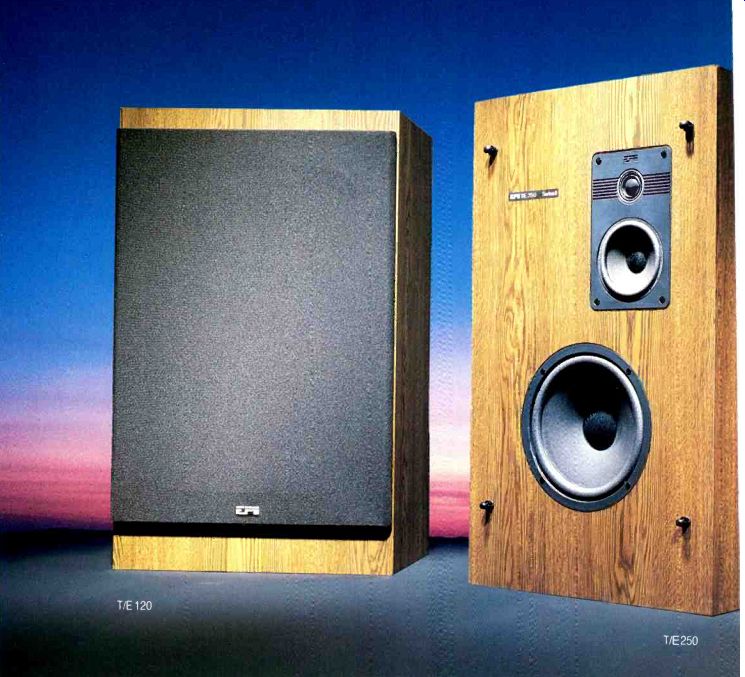
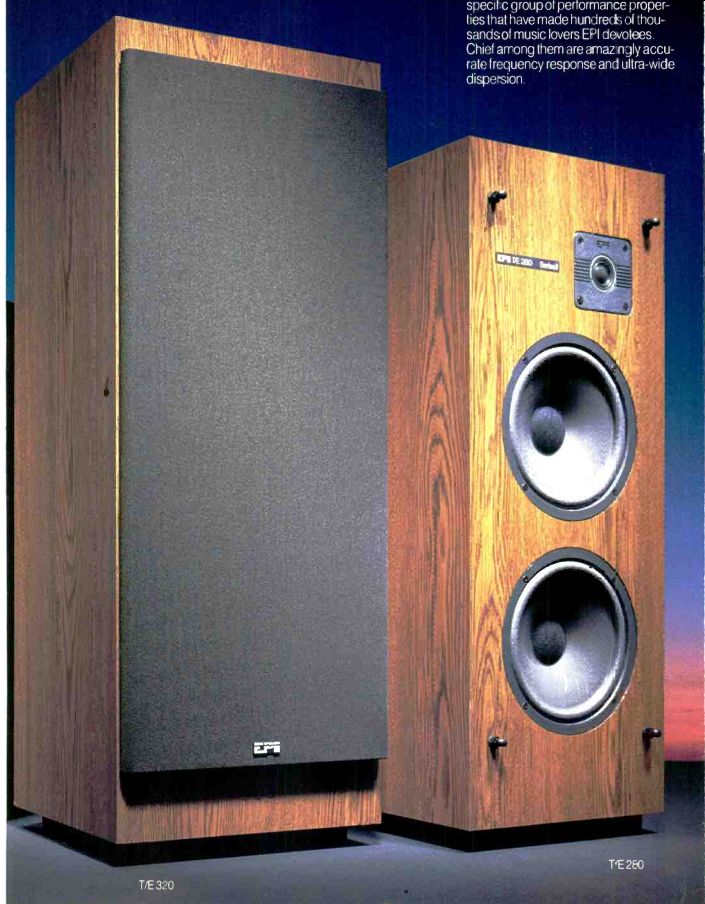
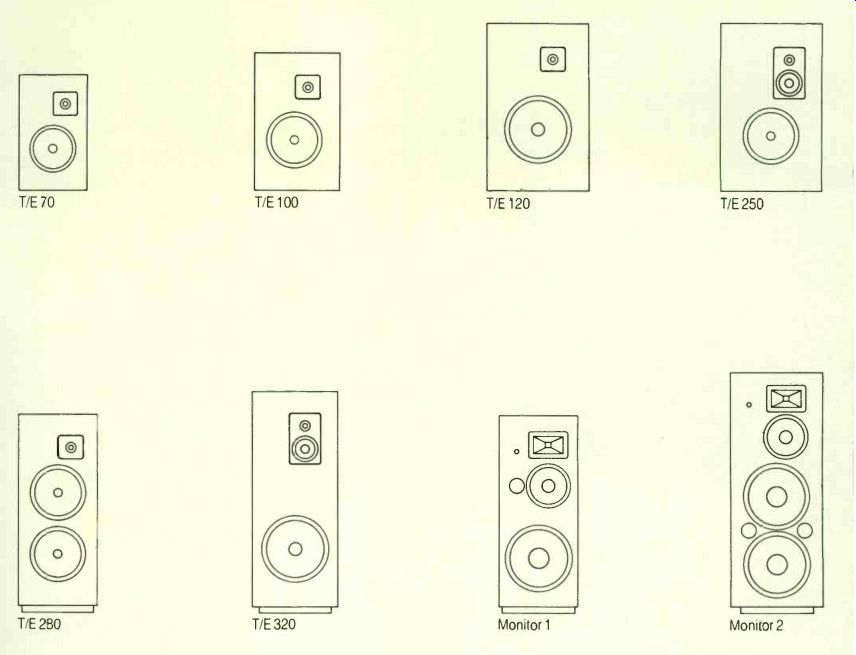
To ensure that all music lovers today can enjoy the performance of modern digital signal sources. EPI has developed the Time/Energy Series of speakers: The Time/Energy Series II and the Time/Energy Monitors. Two distinct groups, each with its own special characteristics, allowing you to choose the performance properties that best suit your individual needs. Both groups enjoy the traditional EPI care and attention to detail which ensures superior sonic performance and reliability for many years to come. With EPI Time/Energy speakers, you can literally listen to the future.
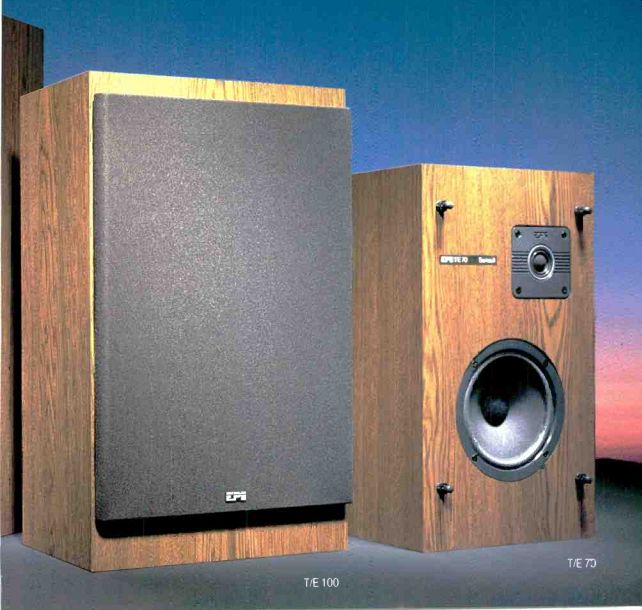
Now, regardless of personal preference. electronics, or music, there is an EPI speaker for you.
--------- This graph shows how the "ringing" DI a conventional cone makes the speaker produce sound alter the signal has ended.
----A speaker with a TIE technology cone slops producing sound almost immediately after the signal e-ids.
A WORD ABOUT TIME/ENERGY TECHNOLOGY: INGENIOUS.
The Time/Energy speaker technology involves making bass and midrange speaker cones, and treble speaker domes, from a layer of light, stiff thermo plastic that is bonded to, or coated with, another material. The thermoplastic layer strengthens the cones and domes so they won't deform while producing sound. The second layer supplies mechanical damping which prevents the cone or dome from "ringing," or producing sound after the signal from the amplifier has ended. […]
The two layer TIE technology cones have the ideal combination of mechanical strength and damping.
Accurate frequency response produces The Linear Sound of EPI."" and lets the speakers reveal all the excitement arid beauty of the music, the subtleties and nuances as well as the power and impact.
EPI's ultra-wide dispersion allows the speakers to project the same accurate frequency response to all areas of he listening room, no matter where the listener is seated. All the music comes through clean, clear and forceful. An additional benefit of the wide dispersion is tie big stereo image it produces. There s no sense of sound coming from a pair of speakers only a seamless wall of sound.
In addition to these well-established EPI performance features, the Time/ Energy Series II speakers boast engineering advances of their own that are of critical importance in modern systems.
Specially engineered suspension systems in the bass speakers in the Time/ Energy Series II units maintain superior cone motion control and prevent cone "bottoming"--even with the dramatic bass energy of modem wide dynamic range recordings.
The new Time/Energy Series II treble speaker has a more substantial, more rugged dome and offers smoother extreme high frequency response.
The three-way Time/Energy Series II speakers feature an integrated midrange/treble speaker module that allows the two speakers-0 be mounted very close to each other :o produce the best sound and stereo image.
The new, wide range design, midrange speaker in the midrange/ treble module reproduces over three octaves of the sound range, allowing the crossover points of the speaker to be placed away from the midrange area where the ear is most sensitive. The midrange speaker's dual chamber isolation structure prevents tie bass speaker from affecting it, lowers its resonant frequency and reduces its electrical "0" to ensure smooth low-midrange response and low distortion.
TIME/ENERGY MONITOR SPEAKERS
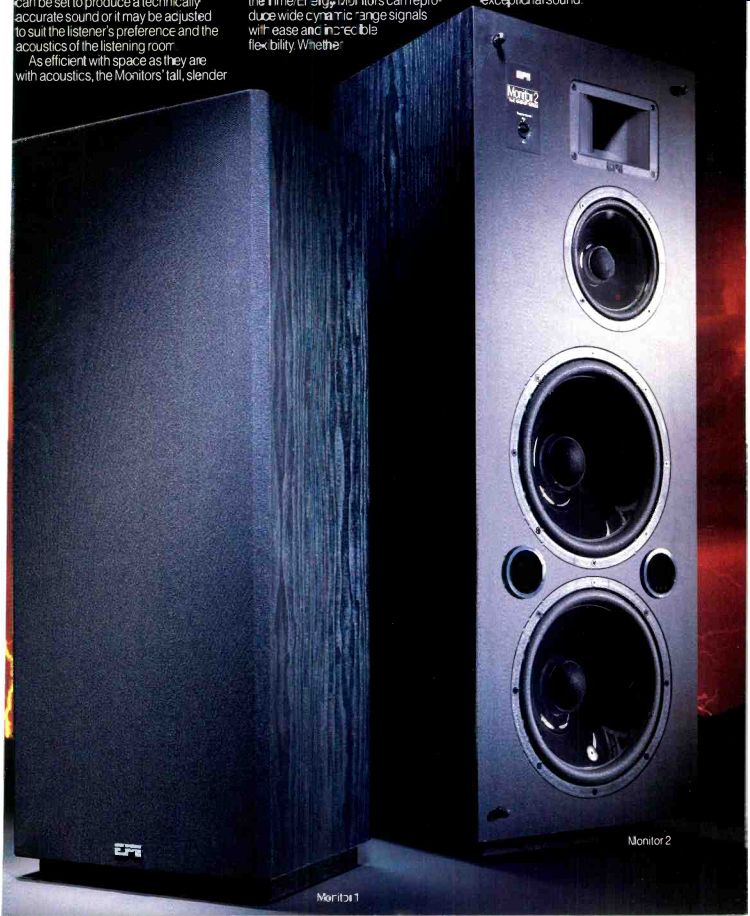
The Time/Energy Monitor 1 and the Time/Energy Monitor 2 represent a new concept in EPI speakers, combining elements of the Time/Energy technology with design features of professional studio monitor speakers.
For people who want to enjoy the impact and wide dynamic range of digital recordings but whose amplifiers deliver only modest amounts of power, or for those who like to listen to music at the volume levels of a live concert, the Time/ Energy Monitors are an ideal choice.
Exceptional efficiency plus an incredible power capacity--the same characteristics exhibited by professional monitor speakers- enable the Time/Energy Monitors to generate sound levels that are nothing short of spectacular.
A revised form of the Time/Energy two-layer speaker cone technology was developed for the Monitor's bass and midrange speakers. Their magnet structures and voice coils were specifically engineered to produce maximum efficiency and shrug off the heat of high power operation. Specially-tuned, vented cabinets augment the bass speaker efficiency and extend its bass response.
Like the Time/Energy Series II, the Monitor's midrange speakers reproduce a large portion of the sound range, allowing the crossover points to be located away from the musically critical midrange area.
A highly advanced horn loaded treble speaker uses the design technology of sound reinforcement speaker systems.
It provides the advantages of high efficiency but with much wider dispersion [...]
From a peaceful solo passage to a thunderous finale Going to the extremes for music
Epicure Products, Incorporated
(Audio magazine, Oct. 1986)
Also see: Audio (misc ADs compilation, Jan. 1986)
= = = =