Editor's Review
Five years ago I wrote "I do not suppose anything has caused so much confusion in the audio world as this question of power output. When highly qualified engineers talk ( and argue) about RMS or sine wave power, peak watts, continuous power, IHF, EIA, music power and so on, it is no wonder that the man in-the-street scratches his head in some bewilderment.
Gertrude Stein could have said 'A Watt is a Watt is a Watt' but she would have been quite wrong!" Well, the situation today is still the same-worse if anything-because we have additional ratings like the misleading ± 1 dB figures to contend with... . The question is, said Alice "whether you can make words mean so many things?"
"The question is," said Humpty Dumpty, "which is to be master-that's all."
Referring to the recent Federal Trade Commission Hearing on Amplifier Power Advertising, Acoustic Research issued a statement saying: "Acoustic Research is firmly opposed to official recognition or sanction of so-called `music power' ratings in advertising. This rating is not relevant to the character of many music signal waveforms, nor is it consistent with accepted physical definitions of power.
Lacking any derivation from the nature of music and power, it is an entirely promotional term, fabricated to inflate the apparent performance of mediocre equipment. The term lends itself to deceptive use; it cannot clearly distinguish one amplifier from another of the same rating; it demeans the integrity of those who use it.
"Acoustic Research favors adoption and enforcement of Rule 1, with minor modifications to make it more complete. The rule would require every claim of power output, bandwidth or:distortion to be accompanied by:
(1) A continuous power rating.
(2) The bandwidth over which this power could be delivered in full.
(3) The maximum distortion at any frequency within this bandwidth.
"FTC pressure can finally bring sanity and order to amplifier power advertising, after nearly twenty years of confusion."
Critics say--with some justification--that amplifiers with identical RMS figures will not necessarily produce the same power output as far as music is concerned.
In other words, an amplifier's power supply regulation might be such that the low-load d.c. voltage is appreciably higher, allowing a larger power output on transient peaks-so increasing the Music Power rating.
The trouble is-there is no agreement as to how long these short-duration peaks shall be. The new EIA Standard speaks airily of measurements made "for a short period of time when measured after the sudden application of a signal." The power peak of some organ works like Bach's Toccata and Fugue in D is maintained for quite long periods, and then how about those tremendous climaxes in Vaughan Williams Sea Symphony? Unfortunately, neither RMS nor Music Power ratings take into account the amplifier's distortion at very low levels, overload recovery characteristic, or indicate the type of distortion at clip point. An amplifier which generates a high percentage of odd harmonics at overload will sound much worse under those conditions than one which produces a higher proportion of second harmonics. ( Some present-day speaker systems are so insensitive that transient overloading occurs more often than supposed.) Then there is the question of output loads: some amplifiers will deliver their maximum output at 6 ohms and others at 8. So it is difficult to come up with a simple set of figures that can accurately indicate what the dynamic power of an amplifier really is. Nevertheless, continuous power rating, bandwidth, and distortion figures are meaningful, repeatable measurements which should always be used in preference to mythical Music Power or dishonest ± 1 dB figures.
--------The 1971 Washington Hi-Fi Show will take place from February 12 to the 15th at the Hotel Washington-near the White House. Show director, Teresa Rogers, believes the attendance will surpass the 1969 figure of 22,000.
--------The New York Hi-Fi Show at Westbury was very successful with an attendance of over 12,000. True, some of the exhibitors were a little dissatisfied with the small rooms and the parking facilities left a lot to be desired (no pun intended) but the results were worthwhile. Walter Goodman, the IHF President, told me that attendance was double that anticipated and that he himself was impressed with enthusiasm of the great number of youngsters who were seriously interested in Hi-Fi.
----------Some additions to the September Products Directory will be found on pages 43 and 44. These include new products, late arrivals and one or two we just plain couldn't find room for.
-GWT
=====================
Dear Editor
I very much appreciated the articles by Don Davis on the use of a computer in planning a Sound installation. Articles of this caliber with the mathematics are rare these days. Keep up the good work!
-J. THOMAS Chicago
The article by Don Davis on Sound installation was far too technical. I could not understand a word of it.
-P. KELLY Indiana What can I say?
-Ed.
Dear Sir:
After reading David Hafler's article in the July issue, I feel prompted to send you my own circuit for a derived center speaker. ( Nothing to do with four-channel stereo.) This circuit solved a problem with my home stereo and does not require that you modify the amplifier as does the Dynaco circuit.
My problem was that my Fisher 500TX would not deliver 60 watts R.M.S. per channel with two 4-ohm AR-3's. With 4-ohm loads the 500TX will deliver only about 37.5 watts R.M.S. per channel. Also, the receiver would overheat at high levels and eventually trip the thermal breaker. I was connecting my center speaker-an 8-ohm AR-5-to the connection provided on the receiver. But this only made a bad situation worse as it caused the load impedance to go still lower. This power was not adequate for two AR-3's in a large room (AR recommends 60 per channel). I have determined that this is normal for a 500TX and my unit is not defective. Most people will assume that the power goes up and not down with 4-ohm loads.
With the circuit shown, my receiver now operates cool at an earsplitting level! About 25 percent of the power is wasted in the resistor with one channel driven. However, note that on monaural no power is wasted since both leads of the resistor are at the same voltage and phase. Whatever is wasted depends on the program material. In my case the result was a very considerable increase in acoustic power. And the receiver now "sees" a much more favorable set of loads.
The purpose of the resistor is to cancel out any cross-channel leakage. I use two 3.7-ohm "fuse" resistors ( designed for TV sets) and they get barely warm at maximum power. The value is not critical as long as it is somewhere near the impedance of the center speaker. The transformer is an Electro-Voice XT-1, which is a large and heavy transformer with a 1:1 ratio. Purists may object to the use of a transformer. Let me point out that this transformer does not carry d.c. and has a 1:1 ratio. It is, therefore, not subject to most of the woes of output transformers. I cannot detect (and neither can anyone else) any distortion introduced by the XT-1.
The sound with the two AR-3a's in two corners and the AR-5 in the middle of the wall is simply superb! The AR-5 is a perfect match for the AR-3's since it has similar midrange and tweeter drivers. The somewhat lesser bass is no worry since the AR-3a's handle most of the bass-and they are in the best location to handle it.
Sincerely, Clyde E. Wade, Jr. , 312 S. Cedar Little Rock, Ark. 72205
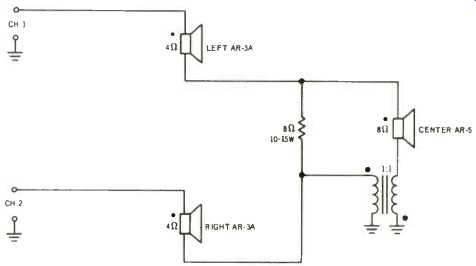
Fig. 1--The transformer must be phased as shown in the diagram or the resistor will not cancel channel leakage.
=======
Sound and Decor
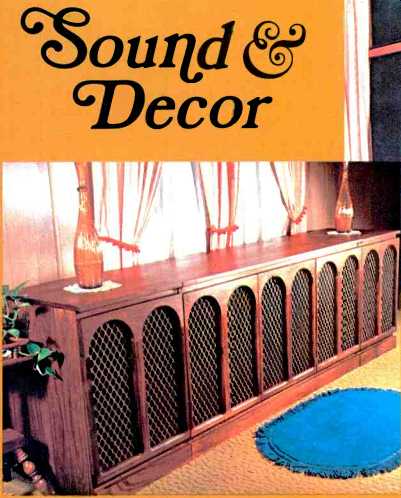
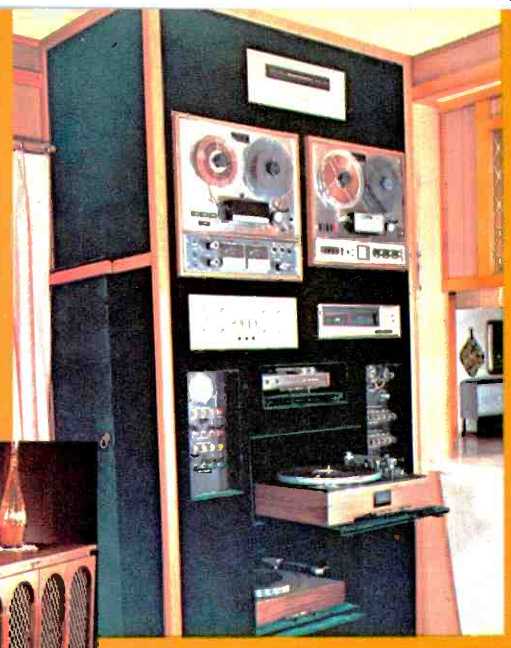
Shown above is a very unusual installation--all the equipment is housed in a mobile home! Proud owner is Don Woodall of Kansas City, and he says he had great difficulty in taking the phonograph as his camera was not fitted with a wide-angle lens. Amplifiers are a Marantz 15 with a 7T, tuner is a Sherwood S2300, and the tape decks are 4010 SU and 1200 Teacs. The turntables are a Miracord 50H and a Thorens TD 150, l:ous sd in a Barzilay 3-piece ensemble. Altec 605 E loudspeakers are used and there are two 755 F units in the bedroom. Other equipment includes a Harman-Kardon cassette player, Sony C-22 condenser microphones plus some very elaborate 'swttchery.' Since the photographs were taken, a Rabco arm has been added, the two tape decks replaced by a Teac 7010 and 6010.
The Marantz tuner is now a model 18 Don is now wondering whether he should add an extension to the trailer so he can put in some more equipment. ( Maybe 4 -channel?)
Jack Simerly, of Pensacola, Florida bought most of his equipment-including the cabinets--in the Orient. He has two tape decks, one a Akai 355 X and the other a 100-D. The amplifier is a Fisher TX-200 and the tuner a Fisher TFM- 200. The turntable is a Lab-80. Pioneer CS-50 speakers are used in the living- room and a pair of Pioneer CS -51's in a bedroom.
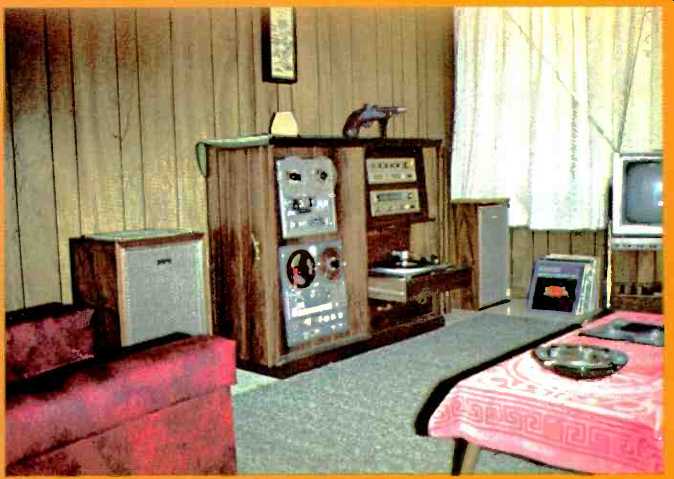
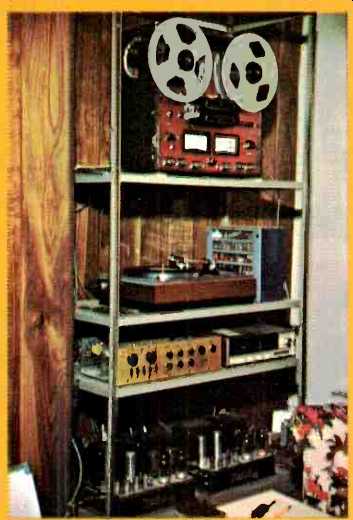
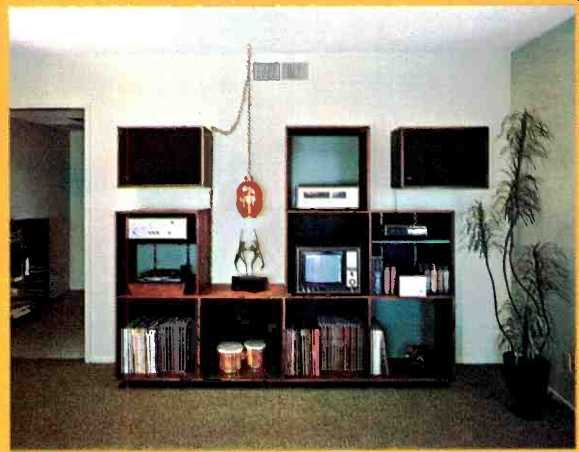

Ron Nelson of South Taylor Oak Park, Ill., says his wife is also an audio fan and she helped to build their installation. The tuner is a Sherwood S 3300, amplifiers McIntosh C-24 and two 60's, and the turntable is a PE 2020 fitted with a Shure V-15 type II. That impressive looking tape deck is a Crown SX 724, and the speaker systems (not shown) are modified Imperial horns using 15 -inch Lansing and Stentorian bass units plus a Wharfedale 12 and a Lansing 8 -inch mid -range speaker. The Nelsons have two children and no doubt they will help out when the next modifications are made .. .
Don Schroeder of South Pasadena, Cal., is very keen on Sony equipment ... amplifier is a TA 1120, tuner a ST 5000 F W--both the TV and clock radio are Sony. The record player is a Dual 1012. Don did not mention the name of the speakers but we think they are JBL SC 99's.
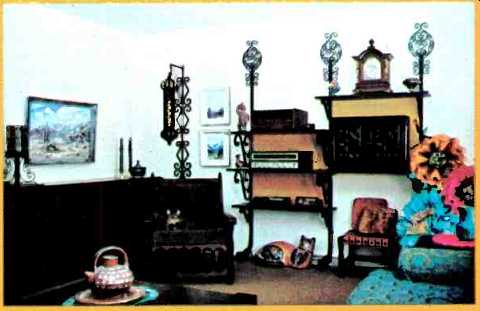
Dr. Harling calls his system "Spanish Style Stereo" and it harmonizes with the decor of their home. Mrs. Harling designed the wrought iron work and some of the cabinetry, which was made in Mexico. Receiver is a Marantz 18, turntable a Dual 1019, and tape deck a Tandberg 6000. The cassette unit is a Sony TC 125 and the installation is completed--appropriately enough-by a pair of Altec "Flamenco" speakers.
=======
Quadraphonic News
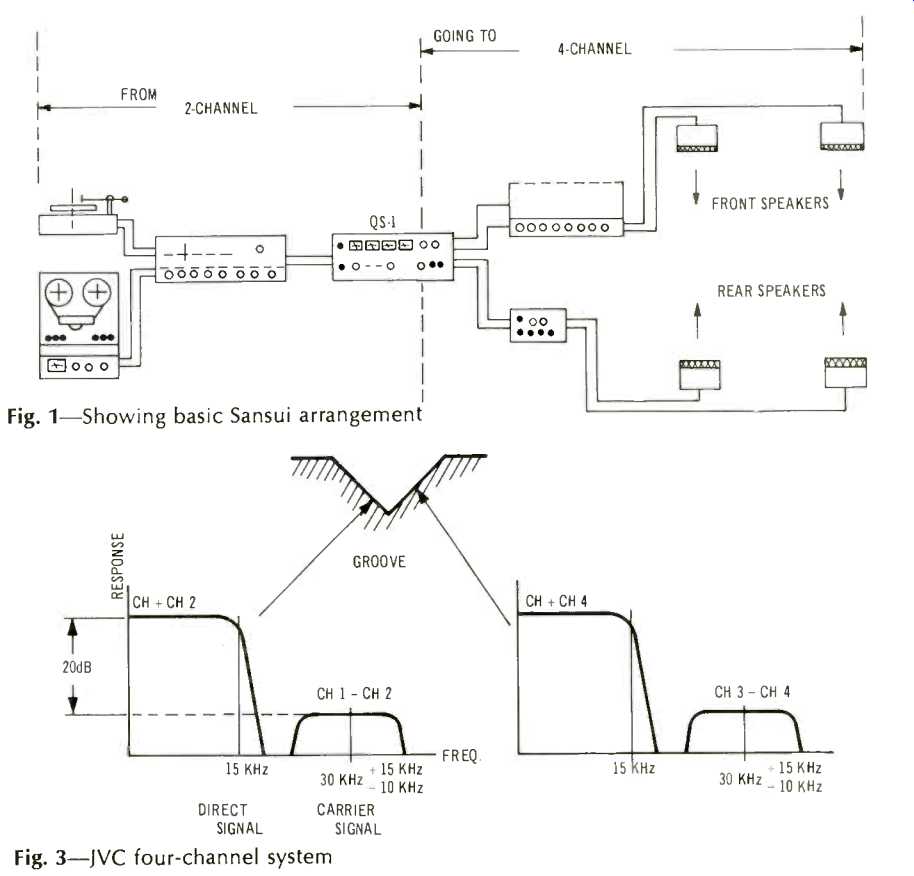
Fig. 1--Showing basic Sansui arrangement
Fig. 2A and B--Speaker positions
Fig. 3--JVC four-channel system
INTEREST IN quadraphonic sound has certainly inspired the inventors, and almost every week sees a new synthetic or psycho-acoustic 4-channel system.
Some of these 'black box' devices can take signals from any 4-channel source, transform them into two channels for broadcasting or recording, and then ‘reconstitute' them with a decoder. All claim to generate four separate channels from any two-channel or even mono source. They include the Harman-Kardon (Orban), Dynaco, JVC, Sansui, Scheiber, IQ, and Feldman-Fixler systems. How do these black box devices work? Well, at the moment the patent situation prevents us from publishing much in the way of detail, but it can be said that amplitude, phase, time delay, and the precedence ( Haas) effect are all used to provide ‘switching' information or location effects.
The Harman-Kardon system also makes use of reverberation. Figure 1 shows the Sansui arrangement. QS-1 is the synthesizer which processes the information into the four channels. According to Sansui, it works by "creating a complex phase interference fringe plus phase-modulation to produce the same phase movements as are present in a live Sound Field." Two speaker arrangements are suggested, one being the more or less `normal' positions shown in Fig. 2A, and the other a variation of the Madsen idea shown in Fig. 2B. A Sansui engineer, listening to the Enoch Light disc "Spaced Out," is quoted as saying, "You feel a fantastic chorus is located in the front center, with a slight echo to be heard from the rear speakers.
Suddenly a trumpet starts playing from the right rear speaker, the exciting beat of the drums from the left front and the carefree sounds of Moog from the left rear. You also hear other Moog sounds from the left front speaker" Another engineer speaks of "The atmosphere of a concert hall and its wide sound field is reproduced in its entirety, you switch to two-channel stereo and you find it provides reproduction on so small a scale, you almost feel like you're listening to a mono rendition." Very enthusiastic, these engineers-but many people have made similar remarks about the Harman-Kardon processor and the new Feldman-Fixier system which was demonstrated at the recent New York Hi Fi Show under the aegis of Electro-Voice.
Here is what Leonard Feldman has to say, "The encoder device has inputs for the four discrete channels from any quadraphonic program source. The four inputs are processed in a manner yet to be disclosed to produce two program channels which are then suitable for disc recording or FM transmission. Since no high frequency switching components are involved, the encoded signals can be broadcast via existing FCC standards with no increase in bandwidth or any other changes in present techniques. The inventors of this system claim that the four program sources so derived exhibit separation characteristics which are extremely close to those of the original. The decoder device can be used with any two-channel material to produce four separate channels. While no claim is made for this with respect to true four-channel synthesis, a feeling of surround sound with different information coming from each of the loudspeakers is said to give new dimensions to almost any existing two channel material." A similar claim is made for the IQ (International Quadraphonic) system but no details are available at present. Another system-which was specifically developed for phono records is the JVC mentioned in the October issue.
It is a carrier system and Fig. 3 shows the arrangement. Frequency modulation is used for low frequencies and phase modulation for frequencies above 800 Hz.
The decoder ( which uses no less than 29 transistors) has an output of 100 millivolts and is expected to cost around $50. The four-channel disc has a channel separation of 20 to 25 dB and is said to be fully compatible. Phono-cartridge response has to extend way out to 45 kHz but JVC has a suitable wide-range cartridge available at a reported cost of $50. CBS are also experimenting with 4 channel discs, but few details have been released. All we can say is (a) they are fully compatible, and (b) a matrix switching system is used.
=======
ADs:
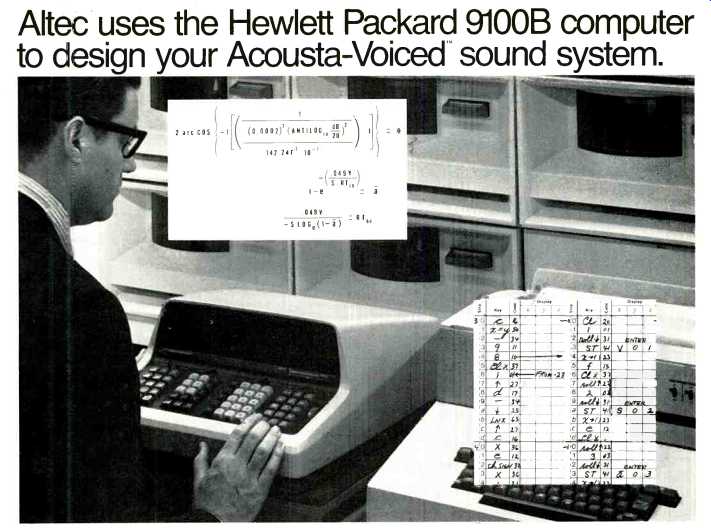
Altec uses the Hewlett Packard 9100B computer to design your Acousta-Voiced sound system.
To properly engineer a sound system, you must consider every detail. The shape of the individual room, the absorption coefficients in the room, the acoustical characteristics of the room. Plus, the efficiency, directivity and uniformity of dispersion of the loudspeakers. And this is where the experience and knowledge of your local Acousta-Voicing sound contractor can really help First, he measures and calculates all the parameters and fills out a computer-designed survey form. This information is telephoned to Altecs' central computer location, and fed to our Hewlett Packard 91008. The answers received by your Altec contractor include the basic design approach to be used, the equipment required, positioning information, everything the Acousta-Voicing sound contractor needs to install the proper sound reinforcement system.
Altec has the only team of sound contractors in the audio industry trained in computer planning and designing of sound systems. They're also the only team equipped with the very latest in Hewlett Packard real time audio frequency spectrum analyzers and using calibrated, adjustable Acousta-Voicing equalization. And they already have more than 1000 Acousta-Voiced installations to their credit.
---------------
TEAC
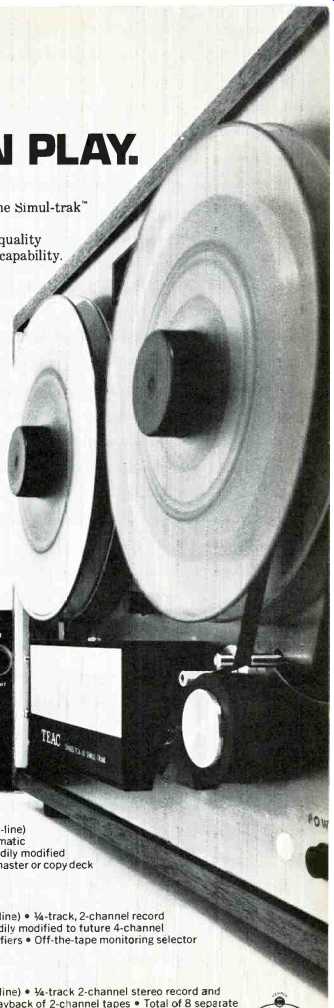
ANY NUMBER CAN PLAY.
The time is tomorrow. The name is TEAC. The machines are the Simul-trak Series TCA-40. And they're here today.
This series of tape decks combines the best features of high-quality quarter-track, two-channel operation with four-channel stereo capability.
It's the best of two worlds, in three versions, four channels.
A.1 three models feature four-channel playback, as well as regular two-channel playback with auto reverse. What's more, Models 40 and 41 can be modified later to the full four-channel capability of Model 42, at moderate cost.
Meanwhile, any one of these machines is compatible with your present equipment; no modifications or reassembly are necessary.
So what are you waiting for? Simul-trak surrounds you with sound and gives you a head start on tomorrow.
TEAC, TEAC Corporation of America 2000 Colorado Ave. Santa Monica, Calif. 90404
General Specifications
Speeds--7 1/2 and 3 3/4 ips Motors-1 hyst. sync., 2 outer rotors
Wow and Flutter--0.12% @ 7 1/2 ips Freq. Response ±3 dB 50-15,000 Hz @ 7 1/2 ips
S/N Ratio--50 dB; Crosstalk--48 dB
TCA-40 1/4-track, 2-channel stereo playback, plus 4-channel stereo playback (in-line)
1/4-track, 2-channel erase and record heads for future "step-up Automatic reverse for uninterrupted playback of conventional 2-channel tapes Readily modified to TCA-41 or42 Built-in solid-state preamplifiers Ideal for duplication master or copy deck TCA-41(illustrated) 1/4-track, 2-channel stereo playback, plus 4-channel stereo playback (in-line) 1/4-track, 2-channel record Automatic reverse for uninterrupted playback of 2-channel tapes Readily modified to future 4-channel recording capability, or TCA-42 Solid-state playback and record preamplifiers Off-the-tape monitoring selector TCA42 1/4-track, 2-channel stereo playback, plus 4-channel stereo playback (in-line) 1/4-track 2-channel stereo record and 4-channel stereo record (in-line) Automatic reverse for uninterrupted playback of 2-channel tapes Total of 8 separate solid-state playback and record preamplifiers Off-the-tape monitor selectors.
-----------------------
DYNACO
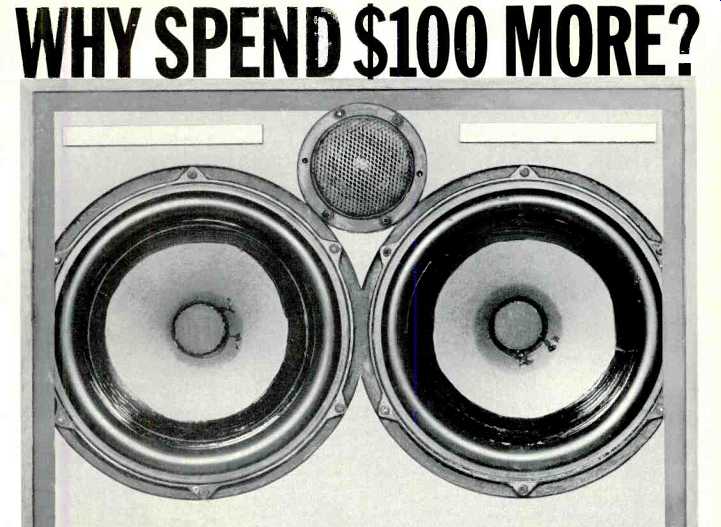
WHY SPEND $100 MORE?
Here is the new Dynaco A-50 Aperiodic loudspeaker which costs $100 more than the popular A-25 loudspeaker.
As thousands of listeners have found, the A-25 gives excellent performance throughout the musical range and satisfies at least 95% of all listening requirements. Many people will not want to spend $100 more for the last 5% that the A-50 provides . . . its lower frequency response, high power handling capabilities, and slightly more linear impedance curve. The A-50's mic range is also slightly smoother because the new do me tweeter's lower resonance permits a 1000 Hz crossover.
For most listeners, these are not substantive differences, but for those striving for perfection, they are worthwhile.
Here is how they are attained in the A-50: The A-50's cabinet consists of two closed chambers, each the size of the A-25, connected through an acoustical resistance consisting of a narrow slot filled with the critical density of fiber glass. The two 10" woofers and high dispersion dome tweeter are mounted in the top half. The top enclosure provides a high degree of acoustical loading in the critical 50-150 Hz spectrum. This damping is responsible for the outstanding transient performance and flat impedance characteristic of the speaker and explains why power transfer between an amplifier and the speaker is so efficient with an aperiodic design.
Below 50 Hz the bottom air volume is added to the top, giving a large air mass which combined with the two 10" woofers extends low frequency performance.
The A-50 and A-25 are acoustically compatible and both can be used in the same four dimensional stereo playback system. Your dealer now has both speakers available for your comparison.
We know you will be satisfied with the A-25. We also know that for those of you who are seeking that last 5% of performance, the A-50 is worth $100 more . .. $179.95.
3060 JEFFERSON ST., PHILA., PA. 19121 IN EUROPE WRITE: DYNACO A S, HUMLUM, STRUER, DENMARK.
------------------
ADC
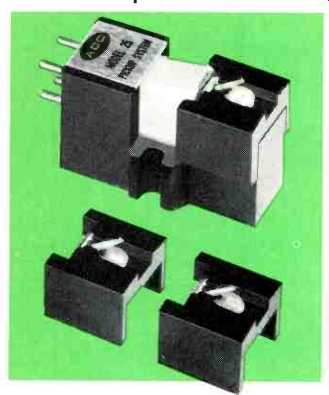
THE LITTLE PERFECTIONIST. ONLY $100. Not all records are created equal. And now Audio Dynamics has done something about it. We've hand-crafted the world's only 3 stylus cartridge. It allows you to custom match the cartridge to each record in your collection, simply by selecting the optimum stylus assembly.
The ADC 25 represents the "state of the art"--the ultimate refinement of Audio Dynamics' induced magnet principle.
With all this, the ADC 25 naturally costs a little more than most other cartridges, but for audiophiles $100.00 is a small price to pay for perfection.
If money is an object, buy the ADC 26.
It is the same cartridge, but with one elliptical stylus. You can always add one or both of the other 2 styli later.
SPECIFICATIONS: ADC 25 STEREO PICKUP SYSTEM with GRAIN ORIENTED DIAMOND STYLUS
Type ... Induced magnet Sensitivity ... 4 my at 5.5 cms/sec. recorded velocity
Tracking force range ... 1/2 gram to 1 1/4 grams
Frequency response ... 10 Hz to 24,000 Hz ± 2 db
Channel separation ... 30 db from 50 Hz to 10 KC
20 db from 12,000 Hz to 24,000 Hz
Compliance ... 40 x 10^-6 cms/dyne
Vertical tracking angle ... 15 degrees
Recommended load impedance ... 47,000 nominal ohms
Price ...$100.00 suggested resale
Replacement Styli .. #251, #252, #253
*For substantially increased stylus life
AUDIO DYNAMICS CORPORATION-- AUDIO FOR AUDIOPHILES
PICKETT DISTRICT ROAD, NEW MILFORD, CONNECTICUT 06776
----------------
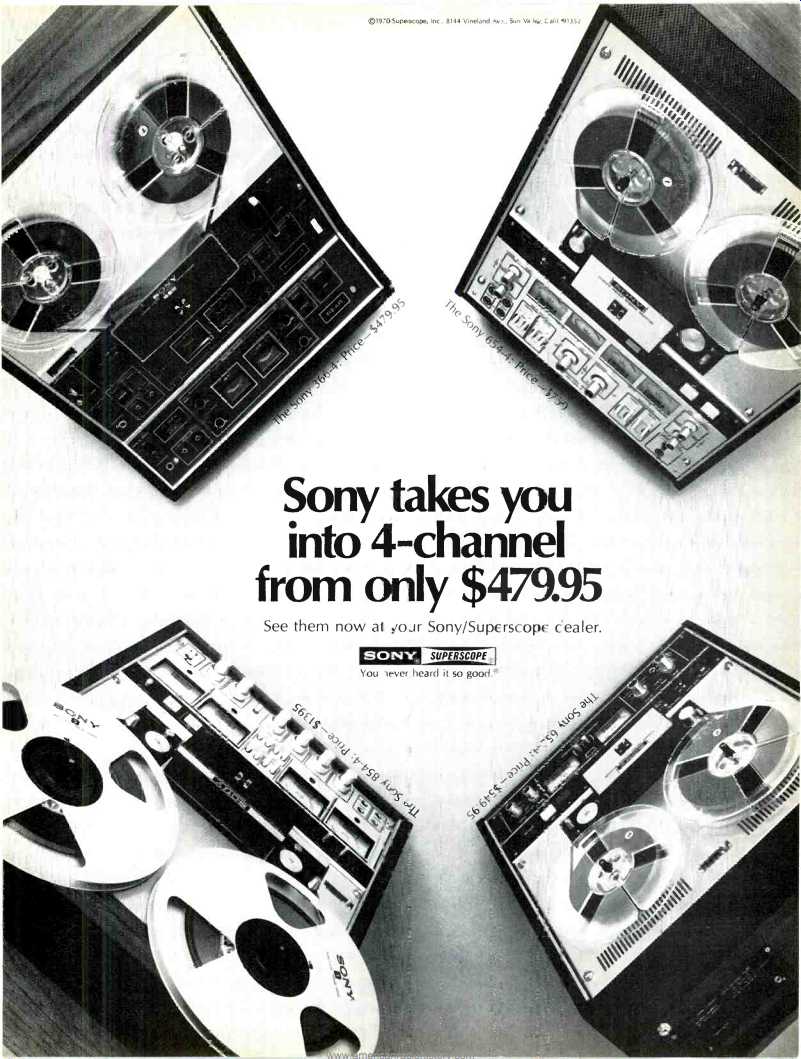
Sony takes you into 4-channel from only $479.95 See them now at your Sony/Superscope dealer. Sony-SUPERSCOPE. You’ve never heard it so good.
---------------
Introducing the Ampex Extended Frequency Cassette

You no longer have to trade quality sound for cassette convenience.
With Ampex Extended Frequency Cassettes you can use the full range, the maximum frequency response of your stereo system. Record anything.
Rock to Pop to Classics. Enjoy better listening with lower noise because of super-smooth Ferrosheen tape. Get higher output with exclusive small particle black oxide formula that produces more magnetic energy per square inch of tape. Capture it all on Ampex Extended Frequency Cassettes...cassettes that look as good as they sound.
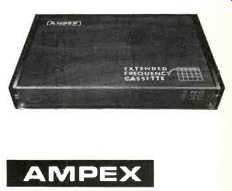
Packaging so handsome it complements any piece of fine equipment. Combined with complete inside indexing and packaged with gold leaf for elegant labeling.
Ask your Ampex dealer to demonstrate the difference.
Ask, too, about the special cassette caddy introductory offer. (Buy 6 C60 Extended Frequency Cassettes and get a handsome walnut grain storage case free.) Your equipment deserves nothing but the best-Ampex Extended Frequency Cassettes.
Ampex Corporation, Magnetic Tape Division 401 Broadway, Redwood City, California 94063
-----------------
Dual
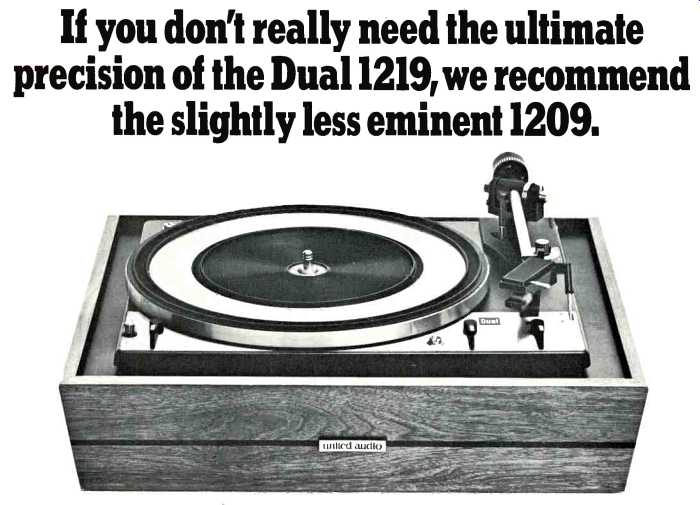
Dual Soon after we introduced the 1219 a year ago, it drew such comments from the test labs as: "a good example of how an already outstanding instrument can be further enhanced by imaginative engineering." (Julian Hirsch in Stereo Review)
One example of that imaginative engineering is the four-point gimbal suspension of the 1219's tonearm. Another is the Mode Selector that shifts the tonearm base up for multiple play, down for single play.
But innovations like these are costly: $175 to be precise.
Which may explain why many budget conscious record lovers, including professionals, feel more at home with the 1209 at $129.50. Especially because its engineering precision and performance offer everything they really need.
The 1209's low-mass tubular tonearm tracks flawlessly at as low as a half gram. Because all tonearm settings must be precise at such low tracking force, the counterbalance clicks at every hundredth gram. Anti-skating is calibrated separately for conical and elliptical styli.
The hi-torque/synchronous motor brings the four pound cast platter to full speed in less than a half turn. And keeps speed dead-constant no matter how much line voltage may vary.
But since the rest of the musical world is not as accurate as the 1209, we added a control to let you match record pitch to less fortunate instruments such as out-of-tune pianos.
The cue control is silicone-damped, and eases the tonearm onto the record more gently than a surgeon's hand.
As you can see, there's nothing middling about our middle-of-the-line turntable.
However, if by this time you feel you don't need even this many features, we suggest the new 1215 at $99.50. But that's another story, and you'll have to write for it.
United Audio Products, Inc.,120 So. Columbus Ave., Mt. Vernon, New York 10553.
Dual. If you don't really need the ultimate precision of the Dual 1219, we recommend the slightly less eminent 1209.
-----------------
Sennheiser HD-414

... make our famous cup test ... and do your ears a favor Take an ordinary cup and place it firmly over your ear. If this sounds like a silly thing to do, you're right. But it's no different than applying the design principle used in most of the quality headphones on the market: totally isolating the ear by means of airtight seals against your head. At the very least, it's uncomfortable. But anything is worth good reproduction ... or is it? By now, if you're still wearing the cup, you may be conscious of an unpleasant pressure on your ears. And that cup is getting heavy.
Just like ordinary headphones do.
But smile. You can still enjoy all the intimacy, the separation, the privacy of headphone sound without discomfort. By using Sennheiser HD 414 "open-aire" headphones-a lightweight (5 oz.) unit whose unique "open acoustics" design conducts full-range sound to your ears in two ways. Directly through the soft, featherweight cushions. And through the air immediately around you. It's the nearest thing yet to concert-hall sound; yet at low levels, you can keep touch with the world around you.(Turn up the volume, and you're effectively alone.) We could tell you much more about the HD-414. Starting with its professional (20-20,000 Hz) response, high sensitivity, low distortion (less than 1% @ 1000 Hz, even at 122 dB sound pressure) and compatibility with high- and low-impedance outputs.
One listen, though, is worth a thousand words. A visit to your nearby Sennheiser dealer will convince you that while cups are fine for drinking, open-aire headphones are best for listening.
For the name of your nearest Sennheiser dealer, write or call us.
The HD 414, by... SENNHEISER Electronic Corporation. 500 Fifth Avenue, New York, N.Y. 10036/Telephone (212) 564-0433
--------------------
Altec
With a new 15-inch Dynamic Force woofer for better reproduction of low frequencies. Both Altec's new Barcelona and Granada speaker systems incorporate this all-new woofer. It features a long voice coil with edge wound, pre flattened copper wire and a magnetic structure of extremely high flux field.
Working together in our infinite baffle enclosure, this speaker is capable of producing a Dynamic Force against the compressed air in the cabinet of up to 16 psi. This greatly improves low frequency transient performance, extends low-end response and reduces distortion while maintaining medium efficiency.
With a large sectoral horn for better controlled angular distribution of mids and highs. This exclusive horn enables the new Barcelona and Granada to keep the off-axis frequency responses of mids and highs almost identical to the on axis responses-even in the critical mid range (above 500 Hz) where most low frequency speakers have a narrow angle of distribution. This large sectoral horn also helps extend the direct field which is where you hear the original acoustics of the recording rather than the acoustics of your listening room.
With more hand-sanding and hand finishing for finer cabinetry. The hand rubbed natural walnut cabinets of Altec's new Barcelona and Granada feature an infinite baffle design inside the enclosure with snap-on fretwork grilles outside. To ensure both quality and beauty, these pieces of fine furniture have been individually hand-sanded probably more than any other speaker cabinets on the market today.
Altec's new Barcelona (873A) sells for $550.00. Altec's new Granada (875A) sells for $450.00. Write for our complete, new catalog. Altec Lansing, 1515 South Manchester Ave., Anaheim, Calif. 92803.
------------------
Thorens TD-125 3-Speed Electronic Transcription Turntable
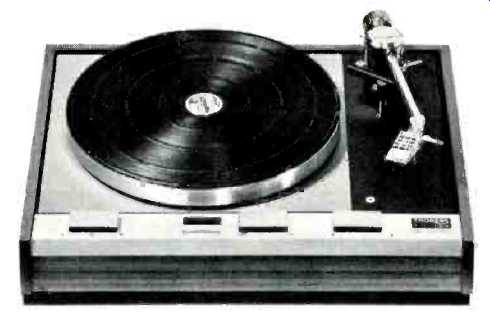
There's no room for compromise when you build the world's finest transcription turntable. And that's exactly what the Thorens TD-125 is. But then, you always expect the finest from Thorens. And you get it.
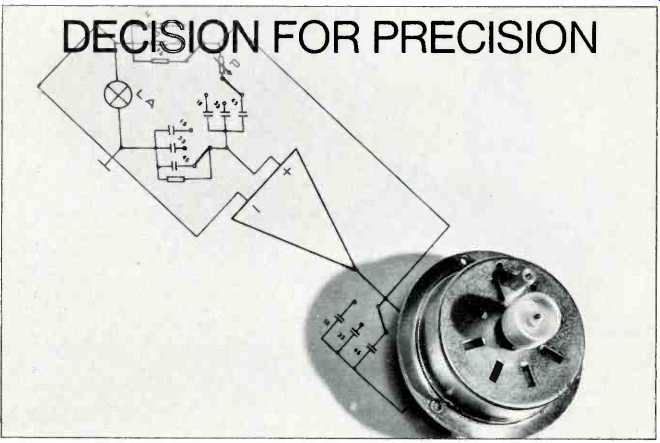
DECISION FOR PRECISION
Decisions ... decisions ... and Thorens has made all the right ones with the TD-125. Take the vital area of motor rotor speed control. It must be precise, or Dance of the Hours can sound like Danse Macabre.
Thorens' solution a Wien bridge transistorized oscillator whose frequency can be varied precisely to change the speed of the rumble reducing 16-pole synchronous motor. And, if you want to correct the speed (or pitch), you can make instant finite adjustments and monitor them on the built-in stroboscope.
Check these additional features: 3 speeds (16 2/3, 33 1/3, 45 rpm)... 16 pole belt-driven synchronous motor... Low (a few hundred rpm) motor rotor speed for rumble-free listening... Tonearm mounting incorporated in shock mounting of platter... Interchangeable tonearm mounting board... Controls independent of shock mounting... Dynamically balanced 7 lb., 12-inch, non-magnetic platter for low wow and flutter... Self-lubricating bearings... The World's Finest Transcription Turntables. Thorens-Franz AG., CH 5430 Wettingen, Switzerland U.S. Distributor: ELPA MARKETING INDUSTRIES, INC., New Hyde Park, N.Y. 11040
-------------------
= = = =
(Source: Audio magazine.)