by Frank Driggs
Throughout its eight years, MosaicRecords has been a two-man (Michael Cuscuna and Charlie Lourie) operation based in Stamford, Conn. This label has continually brought to market the most exciting and consummately produced jazz reissues with a widely catholic taste. This is in marked contrast to the hit-or-miss efforts by the major labels like CBS (Sony), RCA (BMG), and MCA (Universal). Some of the early history of the reissue effort is worth noting.
Jazz reissues began during the depression when RCA, which had taken over the Victor Company in the late-'20s, began releasing cut-out masters by Bennie Moten, Jelly Roll Morton, and countless other jazz, blues, and country artists on their new Bluebird label at less than half the price they had sold for originally.
Another group of bankrupt labels including Okeh, Columbia, and Vocalion had been pulled together under the umbrella called the American Record Corporation (ARC), a by-product of Republic Pictures and Consolidated Film Corporation. They used Vocalion to re-re-release the famous Louis Armstrong Okehs.
In 1938, CBS--the radio network--bought out ARC and reintroduced the Columbia label where both John Hammond and George Avakian were soon to produce three- and four-record 78 rpm albums of Armstrong, Ellington, Fletcher Henderson, Bessie Smith, and others. Soon after, Eugene Williams headed a similar project at Decca, which owned much of the old Brunswick and Vocalion labels.
An important figure during those years was Milt Gabler, whose Commodore Record Shop had been a gathering place for jazz fans of that time. He formed the United Hot Clubs of America, which, in 1936, began leasing rare classic jazz masters from the big three and other bankrupt companies. Two years later he formed Commodore Records, the first of the great jazz independent labels.
The introduction of the LP in 1948 opened up new possibilities and Columbia's George Avakian produced some landmark LP reissues including those of Armstrong, Bix Beiderbecke, and Bessie Smith. Later, Decca would pursue similar LP reissues under Milt Gabler, who had moved to the company in 1944.
As a young record collector and jazz critic, it soon became obvious to me that many of the finest and hardest to find recorded performances might never be reissued by the big three. To counter this, bootlegging began in earnest-but that is a story for another day.
John Hammond returned to Columbia, after stints at Mercury and Vanguard where he produced some stunning recordings, to head up a newly formed reissue program. He immediately became involved with newer artists including Aretha Franklin and Bob Dylan and really did little to move the reissue program into high gear. Hammond was aware of me through my jazz writings. In the summer of '60, I was the lucky one he sought out to take the reissue project in hand. I did so, and for the next six years Columbia pretty much had the field to itself. We pioneered the concept of three- and four-LP sets complete with lavishly illustrated booklets. These sets featured the major works of Billie Holiday, Duke Ellington, Fletcher Henderson, Robert Johnson (single LPs), and others.
In 1964, RCA began its Vintage series, which were single LP releases, under Brad McCuen and later Mike Lipskin. Around 1967, Decca (later as MCA) once again brought in Milt Gabler for its reissue program.
The only major commitment maintained from the early-'50s through the early-'60s was by
Riverside. Orrin Keepnews and Bill Grauer had done some exemplary reissues at Victor's X label in the early '50s before they formed Riverside Records to reissue the '20s Gennett and Paramount recordings they owned.
The reissues business seemed healthy for a time, but the huge success of the Beatles on Capitol Records in the '60s soon brought in new management and new attitudes toward profits, and reissue programs were rarely, if ever, to be the same again.
Columbia (now CBS) soon stopped the boxes. I was out. Chris Albertson did the wonderful two-fers including Bessie Smith, and soon left. Michael Brooks, John Hammond's last protégé, has been handling CBS's efforts in the past years with some degree of success. Blues and country material, including the long-awaited three-LP set by Robert Johnson, will be brought out under Larry Cohn's diligent hands.
MCA's program disappeared and Milt Gabler retired not long after that.
RCA's Vintage series folded, was revived for a moment, and RCA did nothing until a new benevolent management came in the mid-'70s enabling me to once again work that company's superb vaults using the long-dormant Bluebird label as a broad-based effort with jazz, blues, country, pop, and R&B issues, all of which came crashingly to a halt a month before Elvis Presley died in 1977. Several management changes later, Orrin Keepnews is now at Bluebird's helm. He also handles MCA's reissue program-probably the first time in history that one person has simultaneously run two competing record companies' reissue programs.
The most satisfying efforts have been done by DRG and Polygram.
Hugh Fordin's DRG company has brought out some wonderful packages using the old Swing label of France.
Polygram has made intelligent use of the Mercury and Verve vaults and has brought out boxed sets by such artists as Sarah Vaughan and Dinah Washington. Polygram's most impressive effort to date is the massive 21-LP boxed set of the complete works of Harry Lim's Keynote label of the '40s. This was produced in Japan and wisely brought out in the U.S. by them.
There is also the Smithsonian program headed by critic Martin Williams, which has done some good work-as well as some which seems not so good. It has produced a good deal less than one might have expected.
Most of these programs, with the few exceptions already noted, always seemed to have something wrong with them: Incompleteness, lack of information, wrong data, inept editing and programming, occasionally awful mastering and pressings, a lot of terrible artwork, liner notes that ranged from superb to unbelievable, and sometimes headshaking howlers from which even I have not been immune.
Many people, myself included, were probably skeptical when Mosaic announced, as so many had before them, great and wondrous plans to bring forth significant treasures, many long unavailable, to the market in the coming months and years. They have kept their word, delivered the goods, and the goods are the best they could be.
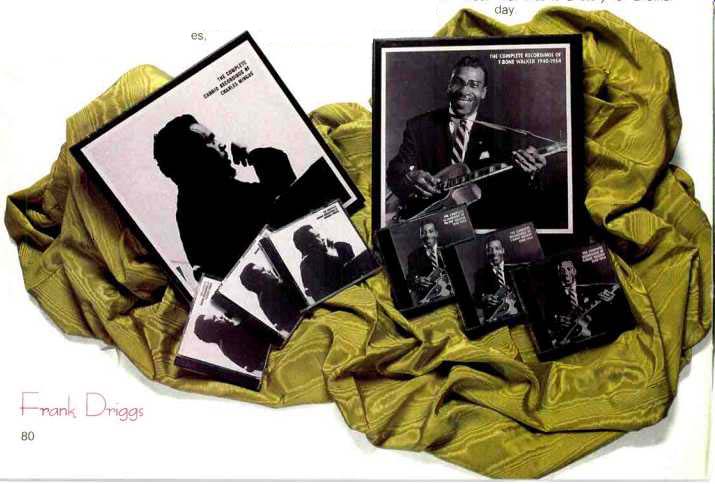
Ranging from single LP compilations like the Port Of Harlem Jazzmen (MR1-108), Benny Morton-Jimmy Hamilton Swingtets (MR1-115), and Pete Johnson/Earl Hines/ Teddy Bunn (MR1-119) to the awesome 23-LP Commodore Collections (two of these 23-LP boxes are now on the market with a third to come) simply boggle the mind. Most of their catalog are three- and four-LP boxes (with superbly illustrated booklets with William Claxton and Francis Wolfe's outstanding photography) of everything from boogie-woogie pianists Albert Ammons and Meade Lux Lewis and New Orleans clarinetist George Lewis, through swing artists like Johnny Hodges, Ike Quebec, and John Hardee. Also included are modernists like Art Pepper, Freddie Redd, Budd 'Powell, Thelonious Monk, (two different boxes, one already sold out), Chet Baker (three different boxes), Herbie Nichols, Shorty Rogers, Art Hodes, Tina Brooks, Paul Desmond with Jim Hall, Buddy DeFranco, and Clifford Brown. Cecil Taylor and Charlie Mingus are here as well. Mosaic's first blues release is a nine-LP and six CD set by the one and only T-Bone Walker.
We have much more to look forward to. Mosaic will be putting together some prime Count Basie sets from the Roulette catalog, a Nat King Cole Trio package is down the road, and in the near future we can expect Mosaic's first non-limited edition, the release of the Dean Benedetti legendary disc recordings of Charlie Parker.

This is all top-grade stuff, the very best that jazz has to offer in every way, presented for the maximum listening (and learning) pleasure. Mosaic's product stands in sharp contrast to almost everything else in the field. Here is a commitment made and a commitment kept, and bodes well for the foreseeable future.
Mosaic Records are only available n limited editions, by mail or phone. Call (203) 327-7111, or write Mosaic Records, 35 Melrose Place, Stamford, Conn., 06902.
(adapted from Audio magazine, Nov. 1990)
===========
AD:
PHILIPS FB1000. THE SPEAKER You CAN'T HEAR.
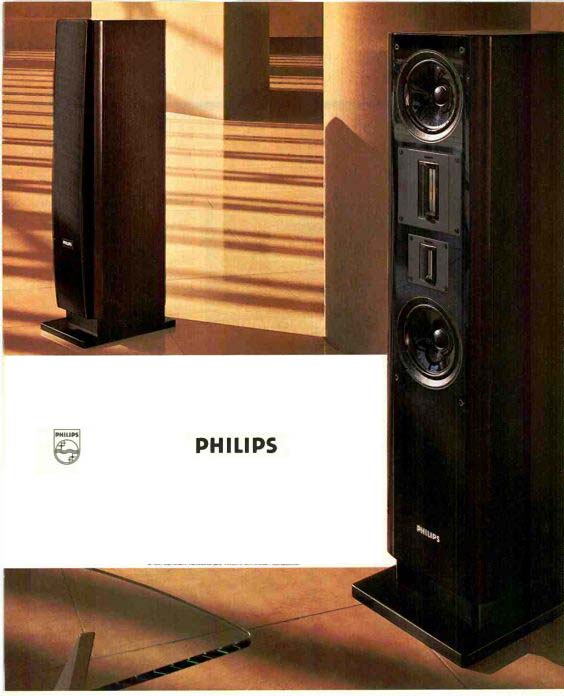
Philips introduces a four-way loudspeaker system designed to achieve the audiophile's ultimate goal --optimum transparency, with virtually no coloration from the speakers themselves. All you hear is the music. Exactly as recorded.
Years of innovation in speaker technology at Philips have made this breakthrough possible. Our patented Isophase planar ribbon drivers provide exceptionally accurate, low -distortion musical reproduction. Philips' approach to speaker design combines the most advanced proprietary computer techniques with expert listening tests io achieve optimum acoustic tuning.
The result is a speaker system that produces what may be the purest, most accurate sound to date.
With the introduction of the FB1000, Philips has created a Reference Series addition to a speaker line destined to set new standards throughout the world. To experience them for yourself, call for your nearest Philips audio dealer at 1-800-223-7772.
Philips --- WORLD-CLASS TECHNOLOGY. EUROPEAN EXCELLENCE. 1990
===========
Also see:
Good Walls Make Good Neighbors (Dec. 1990)
= = = =