"ALL TOGETHER NOW"
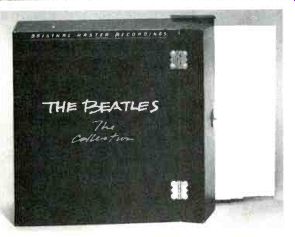
The Beatles: The Collection. Mobile Fidelity Special Edition, 14 discs, $350.00.
Sound: A+
Performance: A+
The Beatles were a recording industry phenomenon in every sense of .the term, and practically every phase of their activity was guided with this in mind. From the first, their records were mastered with a highly subjective ear, and the Mobile Fidelity renderings allow us to hear what we perhaps weren't intended to hear originally: The Beatles' music reproduced accurately, with all the material intact and not quite as much accent on the vocals. A lot is revealed through this process.
The earliest records by The Beatles represented a tremendous task for producer George Martin: He had two excellent writers and singers, but a band with more instrumental exuberance than chops. There were two ways to remedy this problem, and both were used-de-emphasizing the instrumental portion of the material and, when George and Ringo simply couldn't handle the material, bringing in session players. (Drummer Bernard Purdie and various session guitarists, Cornell Dupree for one, it is reported, were brought in from America.) With the rather amazing separation of tracks afforded on these editions, the differences in sound between the John and Paul with Bernard sessions and those with the rest of the group are readily apparent. One can imagine that the decision to let George and Ringo sing, which greatly helped to establish The Beatles as personalities, was a con cession by John and Paul to make up for their exclusion as players. The characteristic background vocal sound that pervades all Beatles records is even easier to hear on these discs, and on songs like "Boys" there's a real party atmosphere. Also, while producer George Martin's original approach put the emphasis on clarity (as compared to contemporary Andrew Loog Oldham, The Rolling Stones' producer, who buried everything in a swirl of reverb), with these even more accurate reproductions one can hear new things. On "Please Please Me," for example, the echo chambers are brought up at the very end of the song and there's a heavy dose of wetness on the harmonica.
By the time of Beatles for Sale (known in America as Beatles '65), the group was finally playing their own instruments on most of the tracks, and Ringo's drumming was being disguised with tambourines, acoustic guitars, and anything else available. What was happening was that rock was being invented-the style of playing, recording, songwriting, the works-and though the two main Beatles and George Martin had a fair bead on what they wanted, George and Ringo were pretty much following the leads of their taskmasters. George plays some pretty rank phrases and sour notes-his technique didn't really cover much beyond Chuck Berry and Carl Perkins at this time-and this present disc doesn't mask them the way they were in the past. However, by the time Rubber Soul came around, George seemed to have gotten his fingers moving a little more fluidly, and he delivers some genuinely incredible solos ("Nowhere Man"). Incidentally, McCartney was also playing guitar on certain Beatles songs around this time, and it is unclear exactly which parts are whose.
Revolver and Sgt. Pepper are often looked upon, respectively, as the bottom and the top of The Beatles' recording career, an unfair characterization which has more to do with sales than musical content. Revolver was ignored because Lennon made some careless remarks regarding the Savior, while Pepper was acknowledged a masterpiece because the great public was starting to catch up to The Beatles' psychedelectation. In truth, Revolver was a very much better album with highly developed recording techniques ("Tomorrow Never Knows," "I'm Only Sleeping"), incredible guitar work ("And Your Bird Can Sing"), and the most consistent songwriting and playing on any record by the group.
But because of the nature of its experimentation and the fact that the American version of the album left off several crucial tracks, Revolver was dismissed and Pepper was embraced.

Play the MFSL box set on an LP12!!
Not to denigrate the latter, but Revolver was truly the apex as far as a group statement; Sgt. Pepper was McCartney's trip (he wrote almost all the songs, played most of the instruments, and dominated the sound). The White Album was a tasty pastiche of solo albums disguised as a group effort. Yellow Submarine and Magical Mystery Tour were basic soundtrack albums where each member did his own track for the film, and Abbey Road featured a side of The Beatles as a rock band and a side of McCartney playing most of the instruments. Only on Let It Be did the group decide that The Beatles was about four people playing together. For all its rough edges it does make a statement about rock 'n' roll, as well as having some fine songs by a group which had pretty much ceased to be a group at least four albums earlier.
The Beatles: The Collection draws the lines more clearly than they've ever been seen before. The ability to distinguish exactly who is doing what is heightened incredibly in this set. There are still times when McCartney's voice sounds like Lennon's and vice versa, but that's because they were aping each other, not the result of the mixdown. This is the whole unadulterated truth, and you can draw your own conclusions.
Mobile Fidelity has, however, made a few decisions that seem a bit imprudent in terms of choice of material.
There are several tracks which are excluded due to the disparity between American and British releases. There were no British equivalents of Something New, Yesterday and Today, and The Beatles' Second Album. Thus, songs like "She Loves You," "Day Tripper" and "We Can Work It Out" are not on this 14-disc set. Perhaps Mobile Fidelity could put together these leftovers with "You Know My Name" and other B sides, call it The Best of the Rest of The Beatles, and put it out as a two-LP set for next Christmas. For now, The Beatles: The Collection is not only a joy to listen to but a fantastic insight into the career of a group that is still a mystery despite all the information in print.
--Jon & Sally Tiven
Also see:
Remasters of Living Stereo (Aug. 1993)
Re-climbing Everest (remastering recordings of the old Everest label) (Jan. 1990)
============
(source: Audio magazine, Sept. 1982)