PRODUCT REVIEW: BUDGET PHONO PREAMPS---Here's a survey of some low-cost phono preamps. Find out which one is right for you. [Apr. 2003]
--------------------
If you wish to archive your vinyl records on CD-Rs, or you have a newer receiver or preamplifier that does not have a phono preamp built into it and wish to connect a turntable, you need an outboard phono preamp. [1,2 ] This is a test of some budget stand-alone moving magnet (MM) phono preamps.
Many of the units in this article won't be found at your high-end audio dealer. Think Best Buy, Circuit City, K-Mart, and The Wiz.
They are available on the Internet (eBay always seems to have several of them) and at catalog companies such as Crutchfield, MCM, Parts Express, and Radio Shack. Two are available from kit suppliers.
So, if you have thought of purchasing one of these preamps, what can you expect in terms of performance?
First, there are very few specifications with some of these preamps. The input resistance--and capacitance (if any)--is fixed in these preamps. I chose seven different units for my testing. Table 1 also includes the specs for the highly regarded discrete phono section of the NAD 304 integrated amplifier.
- Hagerman Bugle $50 (kit, www.hagtech.com)
- MCM Model #40-630 $13.50 (www.mcm.com)
- PAiA 9802K $23.75 (kit, www.paia.com)
- Parts Express Rolls VP29 $77.99 with AC adapter (www.partsexpress.com)
- Radio Shack 970-1018 $24.99 (www.radioshack.com)
- Tech Link TPA2 $55 (www.tracertek.com)
- TCC TC-400 $26.95 with 12V DC adapter (www.tradertrax.com)
In this age of opamps, three of the seven units have discrete transistor circuitry. None have regulated power supplies, just R-C filters. Some run on 9V batteries.
There were also several older Shure phono preamps for sale on eBay, but I wanted to get new, commercial units.
You can explore this used-equipment market yourself, if you like. I also passed on a unit from Terra Tec (with editing software, www.terratec.net) that uses a D-connector to interface with a PC and obtains its power from the PC's sound card game port. That eliminated its use in an audio system.
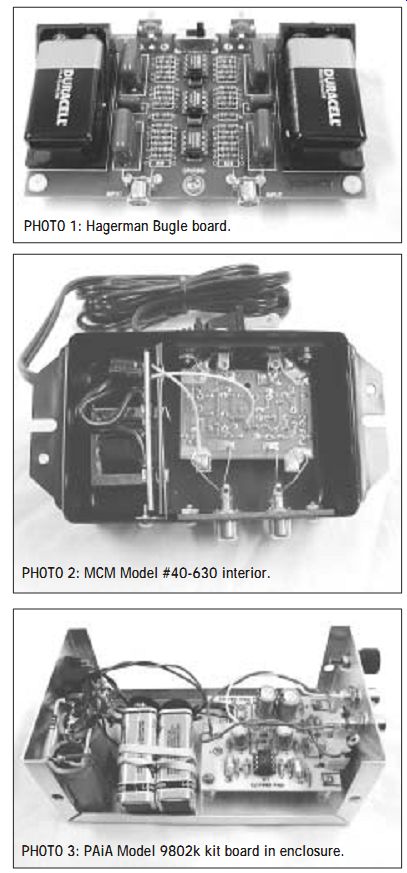
PHOTO 1: Hagerman Bugle board. PHOTO 2: MCM Model #40-630 interior. PHOTO 3: PAiA Model 9802k kit board in enclosure.
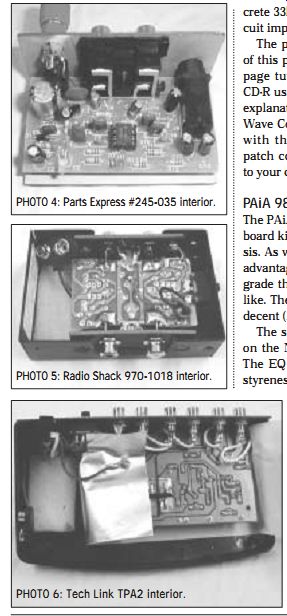
PHOTO 4: Parts Express #245-035 interior. PHOTO 5: Radio Shack 970-1018
interior. PHOTO 6: Tech Link TPA2 interior.
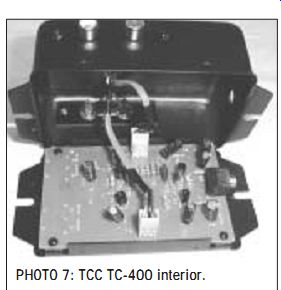
PHOTO 7: TCC TC-400 interior.
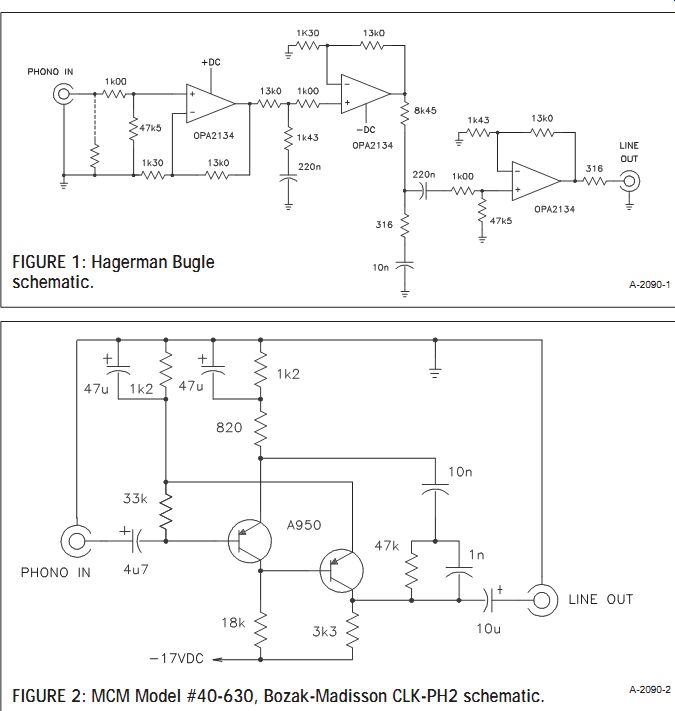
FIGURE 1: Hagerman Bugle schematic. FIGURE 2: MCM Model #40-630, Bozak-Madisson CLK-PH2 schematic.
1. THE BUGLE
The Hagerman Bugle Audiophile Phono Stage is available as a $50 kit, or a $25 "half kit," which includes a bare epoxy PC board and the assembly manual. You can buy the electronic components from DigiKey yourself, or use your own stock of parts. An assembled version will also be available (check the website).
The 13-page man al is detailed and thorough. The finished kit has no chassis and uses two on-board 9V batteries for a power supply (Photo 1). Battery life is estimated for 16 hours. Parts quality is first-rate, with polypropylene caps, 1% metal film resistors, and gold-plated jacks.
A brass screw allows you to connect your turntable to the circuit ground to reduce noise. The kit components provide the standard 40dB RIAA equalization curve, but you can customize the Bugle for any EQ curve you desire, with 40dB to 60dB gain. An on-line component value calculator is available at www.anyeq.com.
The circuit schematic (Fig. 1) uses three OPA2134 dual high-performance audio op-amps. The first stage boosts the magnetic phono cartridge signal by 21dB. An empty resistor position at each input allows you to provide lower resistance loading for moving-coil cartridges. The three-step RIAA curve is implemented in two passive EQ stages (all the other preamps use feedback, or active, EQ). The RC network between U1 and U2 provides the 3180µs and 318µs break points. The RC network after U2 provides the 75µs breakpoint. An addition al series RC before U3 adds a low frequency -3dB rolloff below 15Hz, and removes any DC offset passed from the first two stages.
2. MCM AND BOZAK-MADISSON PREAMPS
The MCM Model #40-630 solid-state and Bozak-Madisson CLK-PH2 stereo phonograph preamplifiers are both available on eBay. These identical made-in-Taiwan units have a discrete circuit, with two 2SA950 PNP transistors per channel. The interior of the unit is shown in Photo 2.
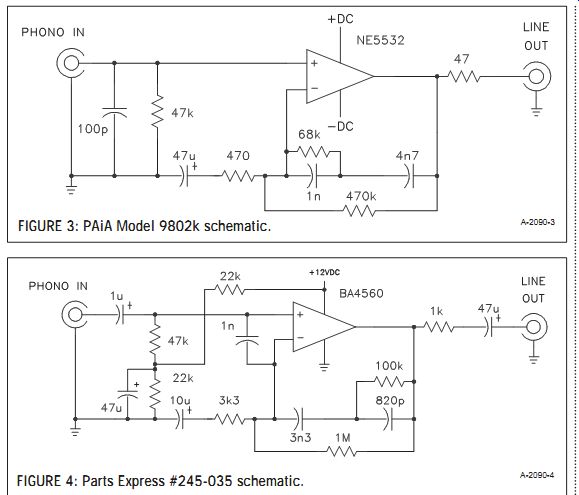
FIGURE 3: PAiA Model 9802k schematic. FIGURE 4: Parts Express #245-035 schematic.
The preamp has a painted steel chassis with a chem-filmed steel bottom plate. A plated steel shield sits between the power transformer and the epoxy circuit board. All four jacks are tin plated. The phono input jacks are connected to the board via bare leads, while the line output jacks are soldered directly to the board.
The basic schematic is shown in Fig. 2. The half-wave rectified power supply uses an R-C pi-filter. The circuit board draws about 5.5mA of quiescent current.
The circuitry is similar to the phono preamps used in 1970s-vintage transistor stereo systems. All resistors are 5% carbon film, and the EQ capacitors are general-purpose (not quality NP0) ceramics. Cartridge loading is by a discrete 33k resistor and the transistor circuit impedance.
-------------------------
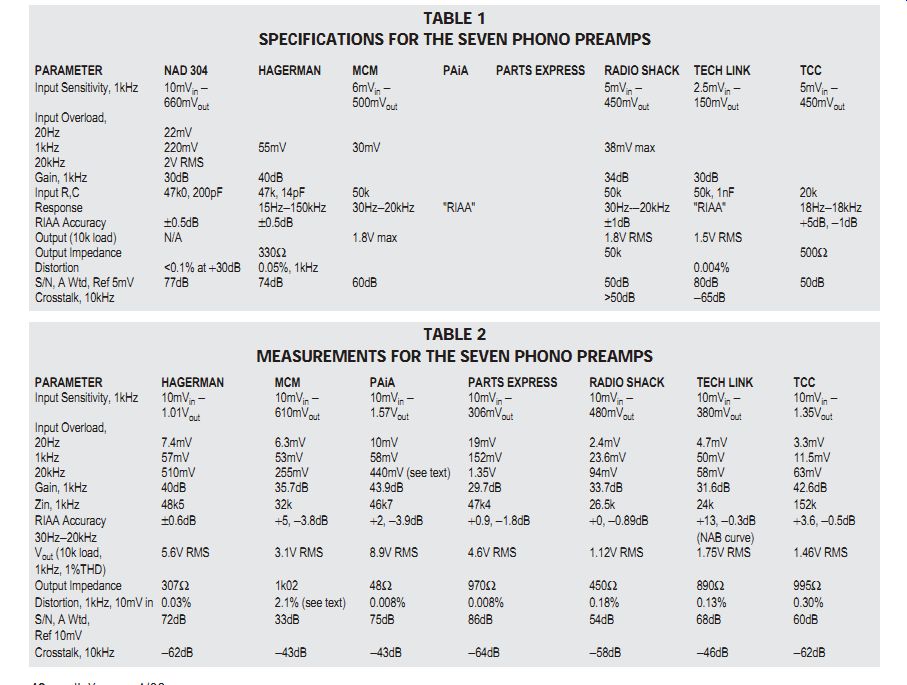
TABLE 1 SPECIFICATIONS FOR THE SEVEN PHONO PREAMPS
PARAMETER NAD 304 HAGERMAN MCM PAiA PARTS EXPRESS RADIO SHACK TECH LINK TCC Input Sensitivity, 1kHz 10mVin - 6mVin - 5mVin - 2.5mVin - 5mVin -
660mVout 500mVout 450mVout 150mVout 450mVout Input Overload, 20Hz 22mV 1kHz 220mV 55mV 30mV 38mV max 20kHz 2V RMS Gain, 1kHz 30dB 40dB 34dB 30dB Input R,C 47k0, 200pF 47k, 14pF 50k 50k
50k, 1nF 20k Response 15Hz-150kHz 30Hz-20kHz "RIAA" 30Hz--20kHz "RIAA" 18Hz-18kHz RIAA Accuracy ±0.5dB ±0.5dB ±1dB +5dB, -1dB Output (10k load) N/A 1.8V max 1.8V RMS 1.5V RMS Output Impedance 33 0 ohm 50k 50 0 ohm Distortion <0.1% at +30dB 0.05%, 1kHz 0.004% S/N, A Wtd, Ref 5mV 77dB 74dB 60dB 50dB 80dB 50dB Crosstalk, 10kHz >50dB -65dB
----------------------
TABLE 2 MEASUREMENTS FOR THE SEVEN PHONO PREAMPS
PARAMETER HAGERMAN MCM PAiA PARTS EXPRESS RADIO SHACK TECH LINK TCC Input Sensitivity, 1kHz 10mVin - 10mVin - 10mVin - 10mVin - 10mVin - 10mVin - 10mVin -
1.01Vout 610mVout 1.57Vout 306mVout 480mVout 380mVout 1.35Vout Input Overload, 20Hz 7.4mV 6.3mV 10mV 19mV 2.4mV 4.7mV 3.3mV 1kHz 57mV 53mV 58mV 152mV 23.6mV 50mV 11.5mV 20kHz 510mV 255mV 440mV (see text) 1.35V 94mV 58mV 63mV Gain, 1kHz 40dB 35.7dB 43.9dB 29.7dB 33.7dB 31.6dB 42.6dB Zin, 1kHz 48k5 32k 46k7 47k4 26.5k 24k 152k RIAA Accuracy ±0.6dB +5, -3.8dB +2, -3.9dB +0.9, -1.8dB +0, -0.89dB +13, -0.3dB +3.6, -0.5dB 30Hz-20kHz (NAB curve) Vout (10k load, 5.6V RMS 3.1V RMS 8.9V RMS 4.6V RMS 1.12V RMS 1.75V RMS 1.46V RMS 1kHz, 1%THD) Output Impedance 307-ohm 1k02 48 ? 97 0 ohm 45 0 ohm 89 0 ohm 995 ? Distortion, 1kHz, 10mV in 0.03% 2.1% (see text) 0.008% 0.008% 0.18% 0.13% 0.30% S/N, A Wtd, 72dB 33dB 75dB 86dB 54dB 68dB 60dB Ref 10mV Crosstalk, 10kHz -62dB -43dB -43dB -64dB -58dB -46dB -62dB
-----------------------------
The pricier Bozak-Madisson version of this preamp comes with a useful 19 page tutorial on transferring vinyl to CD-R using a CD recorder or PC, and an explanation of how to use Ganymede's Wave Corrector software. It also comes with the RCA-to-3.5mm phone jack patch cord you need for connecting it to your computer sound card.
3. PAiA 9802K
The PAiA Model 9802 RIAA is a bare PC board kit without power supply or chassis. As with the Hagerman preamp, the advantages of a kit are that you can up grade the components to whatever you like. The basic circuit topology is fairly decent (Fig. 3). The standard components are based on the NE5532 dual low-noise opamp.
The EQ caps are high-quality 5% polystyrenes, with 5% carbon film resistors used throughout. A 47k resistor and a 100pF X7R ceramic cap supply the cartridge loading. A pad is available on the PC board for a turntable ground connection.
The unit is designed for a power-supply range of ±9 to ±18V DC, and PAiA makes a line of regulated dual sup plies in kit form. They recommend their ±12V DC model 9770R-12. You can also use two 9V DC batteries.
Two tin-plated RCA input jacks are provided for mounting on the single sided phenolic PC board. Two ¼” mono phone jacks are provided for the outputs. The chassis is up to you.
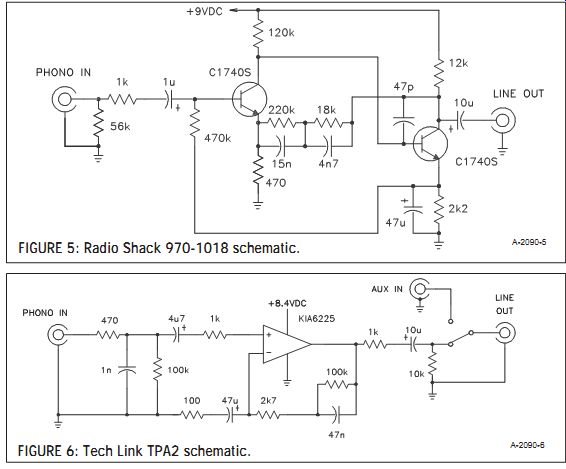
FIGURE 5: Radio Shack 970-1018 schematic.
FIGURE 6: Tech Link TPA2 schematic
I decided to build the kit with a high quality gold-plated 8-pin DIP socket, and I used gold-plated phono jacks (Photo 3). I made an unregulated ±15V DC, dual half-wave rectified and filtered power supply from a 9V AC plug-in power adapter3. I put a 47k bleeder resistor across the 2200µF filter caps. A DPDT-CO switch selects either the power adapter or two 9V batteries.
I used a RS 270-238 mini-box for the chassis, with a binding post to attach the turntable ground wire. Other than that, I used the parts supplied with the kit. The extra parts and the chassis added about $20 to the cost of the preamp.
4. PARTS EXPRESS PREAMP
The Parts Express #245-035 Rolls VP29 Phono Preamp (Photo 4) is made in Salt Lake City, and comes with a 12V DC power adapter. It has the biggest power supply filter cap (1000µF) and a green LED to show the unit is active. The two piece steel chassis is painted crackle finish red. Gold-plating is used on the outer shells of the RCA input and output jacks, with tin center contacts. The preamp also has a gold-plated ¼” stereo phone output jack, and the chassis has a binding post that connects to circuit ground via a 50nF cap, so you can connect your turntable ground lead to the preamp.
The circuitry (Fig. 4) is based on a BA4560 dual low-noise op amp. The op-amp is socketed, so you can easily change it if you like. The EQ caps are Mylar film, with 5% carbon film resistors used throughout. A 47k resistor returned to half the supply voltage (phantom ground) supplies the cartridge loading.
5. RADIO SHACK PREAMP
The Radio Shack 970-1018 magnetic cartridge stereo preamp is another battery-powered preamp, made in Korea. It is not carried in the RS stores; the part number on the RS website was 970 1018, while the box I received was labeled catalog number 42-2111. It has a discrete circuit, with two 2SC1740S NPN transistors per channel (Photo 5). The painted steel chassis has a flip open brushed aluminum cover that is secured by two screws. The on-off switch and the four tin-plated RCA jacks are soldered directly to the PC board.
The schematic is shown in Fig. 5. The data sheet lists the quiescent current as 1mA. All resistors are 5% carbon film, and the two EQ capacitors are Mylar film. An NP0 ceramic is connected b-c at the output transistor. Cartridge loading is by a discrete 56k resistor and the circuit impedance.
6. TECH LINK PREAMP
The Tech Link TPA2 is an aux/phono preamplifier made in China with a plastic enclosure. In order to provide shielding, the epoxy PC board is wrapped in aluminum foil tape that has a paper/plastic insulating layer under it (Photo 6). A jumper lead connects the foil to the power jack ground. The unit can be powered by an internal 9V battery or a 9V DC plug-in adapter that you must supply (with a 2.5mm × 5.5mm plug with +9V on the center pin--nothing in the package tells you this). The internal polarity protection diode drops this to about 8.6V DC, with quiescent power consumption from the 9V battery at about 3mA. Two of the four suction cup feet partially block the battery compartment and must be held out of the way to access it.
While some of the other units have RCA jacks with gold-plated shells and tin center contacts (fool's gold ?), the six RCA jacks in the TL preamp are fully gold-plated. A rocker switch on the cover selects either the AUX (directly switched to the output) or the phono input.
The preamp uses a KIA Electronics KIA 6225S dual preamp IC in a 9-pin SIP package. The schematic (Fig. 6) is taken from the KIA datasheet for an NAB tape preamp circuit (kecorp. com), with a change to the EQ capacitor value, so only one of the three RIAA EQ break points is implemented! All resistors are 5% carbon film, and the lone EQ capacitor is Mylar film. Cartridge loading is the parallel combination of a 100k resistor, the 100k± 50k input impedance of the 6225, and a 1nF X7R ceramic cap.
7. TCC and RECOTON PREAMPS
The TCC TC-400 audio stereo phono preamplifier and the Recoton SP2 stereo phono preamplifier are two more essentially identical phono preamps.
The interior of the made-in-Taiwan TCC unit is shown in Photo 7. The black painted steel enclosure is very similar to that of the MCM and Bozak-Madisson units, except it uses a 12V DC power adapter that is furnished with the unit. They also supply a set of generic tin-plated phono interconnects.
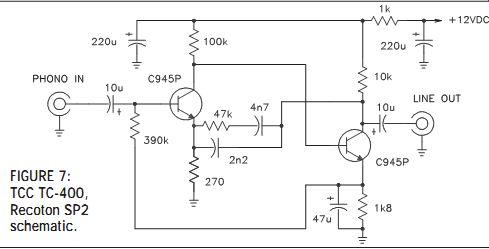
FIGURE 7: TCC TC-400, Recoton SP2 schematic.
The cardboard box, with a Calrad Electronics p/n 80-574 sticker, has an Audio Precision frequency-response graph printed on the top. It shows the low-frequency (LF) response rising to +5dB at 20Hz, and the high-frequency (HF) response dropping to -1dB at 20kHz. According to the box, a version with both RCA and DIN jacks is also available as the TC-400D.
The input and output jacks have gold-plated shells, but tin center contacts. These jacks are connected to the PC board by two-pair shielded wires and Molex-style 3-pin connectors. There is no provision for a turntable ground connection.
The circuitry (Fig. 7) is similar to that of the Radio Shack unit, with a different EQ network topology. Two 2SC945P NPN transistors are used per channel. All resistors are 5% carbon film, and the two EQ capacitors are Mylar film.
----------------
----------------
MEASUREMENTS
For S/N and DC offset measurements, I terminated the preamplifier input jacks with a "cartridge" load consisting of a 499 ohm metal film resistor mounted in a shielded phono plug. The line-level output load for all tests was 10k-o. I used an inverse RIAA network for frequency response and some distortion measurements. I used the distortion test set 80kHz low-pass filter to limit out-of band noise during the distortion tests. I made response and distortion versus frequency measurements with a test signal level into the inverse RIAA net work that produces 10mV at 1kHz at the preamp input jack. This is equivalent to a cartridge with an output of 10mV at 5cm/s recording velocity (2mV/cm/s sensitivity).
Typical vinyl records are recorded at 5cm/s maximum, while the RIAA specification allows a maximum recording velocity of 25cm/s (50mV at 1kHz for my testing). Therefore, any phono pre amp that exceeds 1% THD+N with an input of 50mV at 1kHz would not meet the RIAA specification. You can see from Table 1 that many of these pre amps are specified for inputs of only 2.5mV to 6mV. Yet many of the "DJ" and some standard MM cartridges do indeed have 10mV outputs. This type of phono preamp will likely be employed in a live-music "DJ" setting.
I also measured the gain at 1kHz, for comparison with the RIAA standard of +40dB at 1kHz. The low power-supply voltage of some preamps may require a lower overall gain to prevent clipping at low frequencies where the RIAA gain requirement is highest. You will need to make up this gain shortfall in your line preamp or computer sound card.
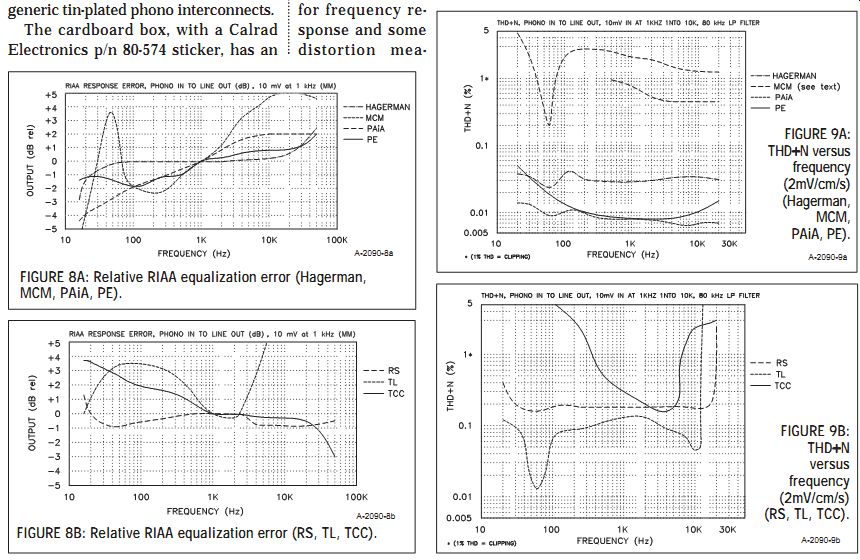
FIGURE 8B: Relative RIAA equalization error (RS, TL, TCC).
FIGURE 8A: Relative RIAA equalization error (Hagerman, MCM, PAiA, PE).
FIGURE 9A: THD+ +N versus frequency (2mV/cm/s) (Hagerman, MCM, PAiA, PE).
FIGURE 9B: THD+ +N versus frequency (2mV/cm/s) (RS, TL, TCC).
My signal-noise and crosstalk 0dB reference level is the output that each card produces at 1kHz with a 10mV input. For distortion versus output at 1kHz, I fed the sine-wave generator directly into the phono preamp without the interposing inverse RIAA network.
Figures 8A and 8B show the relative RIAA equalization error, where 1kHz is the 0dB point. To get the true picture, you must add in the overall gain at 1kHz for each unit, which is listed in Table 2. Any designed--in LF rolloff is acceptable as long as it meets the 7950µs (20Hz) time constant [4] and the rest of the curve is flat.
Figures 9A and 9B show THD+N versus frequency at a reference input level of 2mV/cm/s, while Figs. 10A and 10B show THD+N versus output voltage at 1kHz. Again, the data is presented in two graphs for better clarity.
THE BUGLE
The Hagerman Bugle maintains normal output polarity. Input impedance was 48k5, and output impedance was 307 ohm, all at 1kHz. The output noise was 0.25mV left and right (-72dB). The maximum DC offset voltage was +6mV (left).
Gain at 1kHz, 10mV input was exactly 40dB. The RIAA accuracy, as shown in Fig. 8A, was within ±0.6dB from 30Hz to 20kHz. It continues to rise at higher frequencies. Crosstalk at 10kHz measured a low -62dB in both directions.
The THD+N versus frequency (2mV/ cm/s input level) is shown in Fig. 9A.
Initially, I saw 0.12% THD at 1kHz (in the higher left channel). However, when I connected the inverse RIAA net work chassis to the preamp ground screw, it dropped to 0.03%. The distortion residual showed low-level noise with no discernible harmonics.
The THD+N versus line output level at 1kHz is shown in Fig. 10A, with fresh 9V batteries. The input overload at 1% THD clipping was acceptable for a 10mV cartridge: 7.4mV at 20Hz, 57mV at 1kHz, and 510mV at 20kHz. Clipping was delayed by distributing the gain over three op-amp stages.
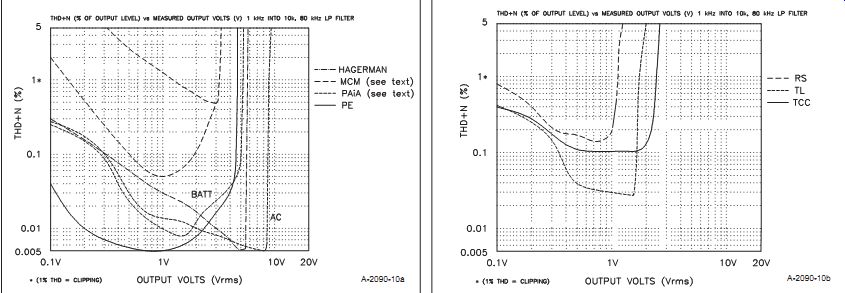
FIGURE 10B: THD+ +N versus output voltage at 1kHz (RS, TL, TCC).
FIGURE 10A: THD+ +N versus output voltage at 1kHz (Hagerman, MCM, PAiA, PE).
MCM PREAMP
The MCM Model #40-630 phono preamp maintains normal output polarity. Input impedance was a low 32k, and output impedance was 1.02k, all at 1kHz.
DC offset voltage was 30mV. The output noise, at 13mV (-33dB), is dominated by 60Hz hum, as is the distortion residual. The transformer inside the module, and a circuit topology that has a lower power-supply rejection capability than the op-amp-based designs, aggravate this problem. Interestingly, the 60Hz output noise dropped to 4mV with the input open-circuited. This suggests a ground-loop problem may also exist.
The instructions for this preamp specifically tell you not to connect the turntable ground lead to the preamp. In my own audio system, the hum was noticeable from my listening position with my preamp volume control at 12 o'clock. The preamp comes with a polarized two-prong AC line plug, so I did not try to reverse it with a "cheater." Gain at 1kHz, 10mV input was 35.7dB. The RIAA accuracy was skewed towards the higher frequencies, with an LF peak at 48Hz as shown in Fig. 8A. I could also see some high-frequency oscillation on the falling sides of the sine wave when the test frequency exceeded 2kHz. Crosstalk at 10kHz measured -43dB in both directions (the test-set bandpass filter rejected the 60Hz hum).
The THD+N versus frequency (2mV/ cm/s input level) is shown in Fig. 9A. I took one reading at exactly 60Hz, where it was 0.2%. This is because the fundamental notch filter removes the 60Hz hum as well as the oscillator signal.
I re-ran the test from 500Hz to 20kHz using the 400Hz high-pass filter in the distortion test set. With the 60Hz hum attenuated, the distortion performance is much better, as represented by the partial HF curve in the MCM data. Here the distortion residual consists mainly of even-order harmonics.
The THD+N versus line output level at 1kHz is shown in Fig. 10A. Again I took the data with and without the 400Hz HP filter. The data with the filter is the lower curve at 1V output. It isn't until the output voltage is almost 3V RMS that the signal is finally great enough to over come the 60Hz hum. The input overload points (I used visible clipping because of the hum level) were 6.3mV at 20Hz, 53mV at 1kHz, and 255mV at 20kHz.
PAiA 9802K
The PAiA preamp maintains normal output polarity. Input impedance was 46k7, and output impedance was a low 48 ohm, all at 1kHz. The output noise was 0.14mV left (-81dB) and 0.28mV right (-75dB). The DC offset voltage was 130mV, probably reflecting the amplified input offset voltage of the 5532 op amp (4mV) in this direct-coupled design.
Gain at 1kHz, 10mV input was 43.9dB. The RIAA accuracy has an over all upward slope, as shown in Fig. 8A.
Crosstalk at 10kHz measured -43dB in both directions. The THD+N versus frequency (2mV/ cm/s input level) is shown in Fig. 9A. Initially, the THD at 1kHz (in the higher right channel) was 0.13%. When I connected the inverse RIAA network chassis to the preamp ground post, it dropped to 0.008% on battery power and 0.012% with the AC adapter.
If I left the AC adapter plugged into the preamp with the transformer block unplugged from the AC outlet, and operated on battery power, the THD was 0.016%. One side of the 9V AC is connected to power-supply ground, so the lead length from the plug-in transformer to the preamp may be picking up noise.
The bottom line is to unplug the AC adapter from the preamp if you use battery power. This would probably not be a problem with the PAiA regulated supply, which sends DC to the preamp.
The distortion residual showed the third harmonic with some very low level noise. The THD+N versus line output level at 1kHz is shown in Fig. 10A. I ran this with the AC adapter, and again with 9V batteries. Both curves are shown in the figure.
The input overload at 1% THD clip ping on battery power was too low for a 10mV cartridge: 5.7mV at 20Hz, 34.1mV at 1kHz, and 260mV at 20kHz. This is because the high gain of this preamp causes output overload, despite the highest power-supply voltage of all the tested units. When I connected the AC adapter (±15V DC supply), overload margin increased to an adequate 10mV at 20Hz, 58mV at 1kHz, and 440mV at 20kHz. This high gain, in conjunction with a high output cartridge, could overload some computer sound cards.
Since the PAiA preamp is a kit, you can easily make some improvements. As you can see from Fig. 8A, the PAiA pre amp error curve is straight, but excessively bright. I recalculated the EQ components, using the Lipshitz formulas [5], leaving R5 and R9 at 470k. The nearest standard component values are listed below, and reduce the nominal error over the audio band to about ±0.25dB.
C4, C9 2n2
C5, C10 6n8
R4, R8 39k
These changes will also reduce the 1kHz gain by about -4dB, improving the input overload margin. You can further reduce the gain by increasing the value of R3 and R7. I would also replace the cartridge loading capacitor with a quality film or NP0 ceramic cap.
Here's one final possibility: The 5532 op amp has a maximum supply voltage rating of ±22V DC. You could use four 9V batteries to produce ±18V DC rails and achieve the highest headroom. If you install an 8-pin DIP socket in order to experiment with different dual op amps, be sure to observe the maximum supply voltage spec. The supply rails for many audio-grade op amps cannot exceed ±18V DC, and should not be operated above ±16V DC for reliability reasons.
PARTS EXPRESS PREAMP
The Parts Express #245-035 Rolls VP29 phono preamp maintains normal output polarity. Input impedance was 47k, and output impedance was 97 0 ohm, all at 1kHz. The output noise was very low at 15µV, or -86dB. When I made the DC offset voltage measurement, I found it wandered at a random ultra-low frequency about ±0.1V, almost like a record warp. At first I thought it might be the phantom ground to which the 47k input resistors are referenced, but the two inputs did not wobble together. Even when I loaded the outputs down to 1k, the wobble did not disappear. Grounding the inverse RIAA housing to the preamp binding post did not improve the situation. It was still there even after I connected the signal generator directly to the input, and may be due to high leakage in one of the aluminum coupling caps.
I don't think this wobble is of any sonic consequence. Most line preamps and power amps will roll off this less than-1Hz component and not pass it on to the speakers. DC coupled amplifiers are another story, where this wobbly DC offset will be multiplied by the amplifier gain.
Gain at 1kHz, 10mV input was 29.7dB.
The RIAA accuracy was reasonably good, with an overall upward slope, as shown in Fig. 8A. Crosstalk at 10kHz measured -64dB in both directions.
The THD+N versus frequency (2mV/ cm/s input level) is shown in Fig. 9A. I had some difficulty measuring distortion because of the randomly changing DC offset. The distortion test set has a fundamental notch filter with a feed forward circuit and automatic frequency tuning that tracks the input signal.
When a wobble occurred, it caused the notch tuning to move slightly off frequency, decreasing the notch depth.
For higher-frequency THD measurements, I again used the 400Hz high pass filter in the test set. The lower frequencies required patience. I needed to wait for a lull in the DC offset wobble and grab the lowest THD reading I could see while the meter settled down.
I think the THD performance of the PE preamp below 500Hz is probably better than that shown on the graph.
The distortion residual was mainly the third harmonic and some very low level noise. The THD+N versus line output level at 1kHz is shown in Fig. 10A.
Again, I took the data with the 400Hz HP filter. The input overload at 1% THD clipping was the best of the bunch: 19mV at 20Hz, 152mV at 1kHz, and 1.35V at 20kHz.
RADIO SHACK PREAMP
The RS 970-1018 phono preamp maintains normal output polarity. Input impedance was a low 26.5k, and output impedance was 45 0 ohm, all at 1kHz.
The output DC offset voltage is negligible. The output noise, at 1mV (-54dB), is equal parts noise and 60Hz hum pick up. Grounding the preamp chassis to the inverse RIAA network housing caused the output noise to increase slightly.
Gain at 1kHz, 10mV input was 33.7dB.
The RIAA accuracy was within the specified ±1dB within the audio band, but increased at lower frequencies, as shown in Fig. 8B. Crosstalk at 10kHz measured -58dB in both directions.
The THD+N versus frequency (2mV/ cm/s input level) is shown in Fig. 9B.
There is a slight dip at 60Hz, where the fundamental notch filter removed the 60Hz hum. The 1kHz distortion residual consists mainly of even-order harmonics, and low-level hum and noise.
The distortion begins to rise rapidly above 16kHz, reaching 2.6% at 20kHz.
While the response is flat, the circuit lacks sufficient HF headroom.
The THD+N versus line output level at 1kHz is shown in Fig. 10B. As the output voltage increases, the waveform becomes more and more triangular.
The input overload points at 1% THD+N were too low: 2.4mV at 20Hz, 23.6mV at 1kHz, and 94mV at 20kHz.
TECH LINK
The Tech Link TPA2 phono preamp maintains normal output polarity. Input impedance was a low 24k, and output impedance was 89 0 ohm, all at 1kHz. On 9V battery power, the output noise was low at 150µV, or -68dB. With the AC adapter, the output noise increased only slightly to 210µV, or -65dB. The DC offset volt age measured +2.7mV left and -0.1mV right. Crosstalk at 10kHz measured -64dB in both directions.
Gain at 1kHz, 10mV input was 31.6dB.
The RIAA accuracy curve, as shown in Fig. 8B, had a LF peak at 75Hz, and then took off like a rocket above what should have been a pole at 2120Hz (75µs). output clipping began at 11kHz. At 20kHz (not shown on the graph), the error is a huge +13.1dB, with 4.5 times more gain than is required. I don't know why the designers used an NAB equalization circuit for this preamp, but it produces a to tally unacceptable equalization error when applied to a phono cartridge pre amp circuit.
The THD+N versus frequency with 9V battery power (2mV/cm/s input level) is shown in Fig. 9B. The data was essentially the same with the AC adapter powering the preamp. I always select the higher channel for THD measurements, to show worst-case data. Usually the two channels are fairly close, but here the 1kHz measurements were 0.045% right and 0.13% left. That's quite a difference for a dual monolithic IC.
When I took the THD+N reading at 63Hz, I could see another hum pickup problem. The THD+N was 0.25% at 1kHz, but only 0.013% at 60Hz, where the test-set notch filter rejected the power-line hum. However, in this case, when I grounded the inverse RIAA net work chassis to an unused phono jack shell on the preamp, the problem mostly disappeared, and I didn't need the 400Hz HP filter. In addition to fixing the EQ circuit, this preamp needs a dedicated ground connection point for the turntable ground lead.
The 1kHz distortion residual consist ed mainly of low-level noise. Above 11kHz, the output began to clip on the lower half-cycles, and was in hard clip ping by 16kHz. This unit will have major problems with a 10mV phono cartridge, and will be screechy and distorted at high frequencies even with lower sensitivity cartridges.
The THD+N versus line output level at 1kHz is shown in Fig. 10B. The head room was unchanged with the AC adapter, even though it provided more voltage (9.9V DC versus 9.1 for a fresh battery).
The input overload at 1% THD below 2120Hz was marginal: 4.7mV at 20Hz and 50mV at 1kHz. The input overload was only 58mV at 20kHz.
The Tracertech website has detailed specifications for this preamp, al though none came with the unit itself (Table 1). The preamp spec for THD is 0.004%, whereas the data sheet for the KIA6225 IC lists it as 0.04% typical and 0.25% maximum. The -65dB spec for preamp channel separation is the spec for the chip alone. Once you add peripheral circuits and interconnections, crosstalk will naturally increase. Compare the specs in Table 1 with the measured data in Table 2.
TCC PREAMP
The TC-400 preamp maintains normal output polarity. According to the box, the input impedance is specified as a low 20k, but I measured 152k at 1kHz.
Unlike the Radio Shack preamp, there is no discrete resistor at the input jack (my DMM read over 1M). I simulated the circuit with SPICE and got the same high input impedance. Output impedance was 995 ohm, again at 1kHz.
The output DC offset voltage was only 3mV. The 1.4mV output noise (-60dB) is equal parts 120Hz hum and noise. Gain at 1kHz, 10mV input was 42.6dB. The RIAA accuracy, with a slope opposite all the other units, pretty much agreed with the Audio Precision graph on the box, as shown in Fig. 8B.
Crosstalk at 10kHz measured -62dB in both directions. The THD+N versus frequency (2mV/ cm/s input level) is shown in Fig. 9B.
The 1kHz distortion residual consists of low-level 120Hz hum and noise. The distortion below 100Hz was very high, in creasing to 17% at 20Hz. Grounding the inverse RIAA network chassis to the preamp chassis made only a slight improvement.
The THD+N versus line output level at 1kHz is shown in Fig. 10B. As the output voltage increases, the waveform becomes more and more triangular.
The input overload points at 1% THD+N were too low: 3.3mV at 20Hz, 11.5mV at 1kHz, and 63mV at 20kHz.
CONCLUSIONS
The discrete transistor circuit measurements were generally inferior to those of the op-amp units (the NAD 304 uses a discrete differential input stage). I would have to rate the Tech Link as unacceptable because of its NAB EQ curve. The two kit units offer great value.
The Hagerman Bugle preamp uses very high quality op amps, and passive EQ. RIAA circuits with passive EQ may clip a bit at the high frequencies be cause of the high gain required from the input stage, coupled with the rising cartridge output with frequency. By distributing the gain over three stages, the Bugle avoids this problem. The PAiA unit is also nice for the audio hobbyist who can easily modify it to improve its basic EQ and gain performance.
The Parts Express preamp measures the best "out of the box" unit, and it appears to have been well designed from the outset for its intended purpose. However, its gain is a bit on the low side. A little tweaking of the EQ parts values would make its RIAA error curve very flat.
---------------
REFERENCES
1. "NAD PP-1 Phono Preamplifier," G. Galo, Audio Electronics 3/00, pp. 38-41.
2. "QED DS-1 Discsaver," M. Fremer, Stereophile 10/00, p. 52.
3. "Budget Wave Analyzer, Part 1," C. Hansen, Audio Electronics 3/99, p. 14, Fig. 7, without the three IC regulators.
4. The fourth RIAA time constant of 7950µs is defined in IEC Publication #98, Amendment 4, dated September 1976.
5. Letter, "PAT-5 Inversion and Equalization," S. Lipshitz, TAA 3/78, p. 48.
------------------
Listening Critique
By John and Sandra Schubel We listened to these seven budget priced phono preamps, and compared them for sound quality, audible distortion, and background noise.
Our first observation is that the units from Hagerman, Tech Link, and Radio Shack are designed to operate off a 9V battery only. Our preference is that the preamplifiers be capable of AC operation, so that you can turn them on and off with the control amplifier.
A second observation is that two of the units--the Hagerman and the PAiA--are not enclosed. The Hagerman unit is neatly constructed and is available completely assembled, but its printed circuit board is exposed on the bottom, requiring care in its use to avoid shorting out the circuits. The PAiA circuit board is provided as a kit, so you must install it in a case such as a GEM box and connect it to Line Out connectors and AC filter prior to use.
The remaining units, the MCM Model #40-630, Parts Express Rolls VP29, Tech Link TPA2, and TCC TC-400, are all enclosed in boxes of various shapes and sizes. The Tech Link TPA2 has an added feature of an "AUX/ PHONO" switch. This could be convenient if it would otherwise be necessary to disconnect some other source from your AUX input in order to connect the phono preamp.
LISTENING TEST
We used a Sony PS-LS520 turntable equipped with a Pickering TL-2S cartridge for the listening tests. We used the control amplifier and power amplifier sections of a Sony STR-DA555-ES, and the Sony's internal phono preamp as a reference. The speakers were a pair of NHT Model 1.3 speakers and NHT Model SW2 subwoofers.
We did the listening tests one audio selection at a time, because of the large number of preamplifier units to be reviewed. Although we used Sony's phono preamplifier as the reference, over time we were so pleased with the Hagerman that it became the benchmark for the others. We used a realistic sound pressure meter to assure that levels were consistent across all preamplifiers.
We did an initial screening of the preamplifiers using a direct-to-disk recording, Lincoln Mayorga & Distinguished Colleagues Volume III, Sheffield Labs SL5/SL6. Two cuts on this record--" America" from West Side Story and "That Certain Feeling"--are clean and offer wide frequency response and percussive sounds.
We performed subsequent tests using these recordings:
"The Sea and Sinbad's Ship" from Scheherazade (Rimsky-Korsakov), Lon don SPC 21005, Leopold Stokowski and the London Symphony Orchestra.
"Surely He Has Borne Our Griefs" and "All We Like Sheep Have Gone Astray" from Messiah (Handel), L'oiseau-Lyre D189D3, Christopher Hogwood and the Academy of Ancient Music and the Choir of Christ Church Cathedral, Oxford.
The Moldau (Smetana), RCA Red Seal LSC-2471, Leopold Stokowski and the RCA Victor Symphony.
HAGERMAN BUGLE
The Hagerman unit had no audible noise or hum at both normal and extended volume levels. The sound with " America" was not as bright as with the Sony, although cymbals and triangles were crisp. Instrument detail was excel lent, and the listener was brought close to the soundstage. Particularly impressive was the detail given to the saxophone on the second track, "That Certain Feeling." The impression is that there is more midrange from the Hagerman than from the Sony.
Scheherazade sounded much cleaner on the Hagerman than on the Sony preamp. The violins were exceptionally sweet and clear, as were the harp, cello, and woodwinds. Complex musical pas sages were handled cleanly. You had the impression of being in the middle of the concert hall.
Handel was very clearly reproduced, with each section and solo voice clearly articulated. The violins and harpsichord were also clearly reproduced.
The effect was as if you were there, singing in the choir loft.
The Moldau was slightly dull on this preamp. The triangles and piccolos were clear, the bass was full, and the violins were clear except in the most complex passages. The sound was more like the back of the concert hall. You had to strain to pick out the clarinet in the opening measures of the piece. The tympani were well reproduced, as were the trumpets, yet the sound remained distant. It was difficult to place instruments on the soundstage.
PAiA (BATTERY)
The PAiA unit had no audible noise or hum at both normal and extended volume levels. The sound with " America" was extremely bright, and sometimes harsh with horns. The guitars seemed out of balance with the other instruments. The first impression was that this preamplifier would tire the listener easily.
Scheherazade sounded brighter on the PAiA than on the Hagerman. The violins and harpsichord stood out from the other instruments. The sound of the harpsichord was very pleasant, but the violins became strident as the score modulated higher and higher. The cello sounded somewhat tinny. The sound became muddied during loud complex passages.
Handel was unpleasantly bright on this preamp. The choir sections were not well defined. The violin and harpsichord were very bright. The treble choir was reproduced with great clarity, but it was "in your face." Although the sound was bright, the listener did not get the sense of being close to the performers.
The flutes and clarinets, and the plucking of the violin at the beginning of The Moldau, made you feel that you were at the front of the audience, as did the striking of the cymbals. The bass was full and rich, and the violins stood out with clarity. It was easy to place the instruments on the soundstage, and there was no muddiness even in loud and complex passages.
Sometimes the sound became too bright, particularly with loud brass pas sages. You believed that you were at the front of the concert hall. John liked listening to this piece with this preamplifier, although perhaps he would have reduced the volume below that which we had established as a reference for this test.
PAiA (AC ADAPTER)
The PAiA unit had no audible noise or hum with the AC adapter at either normal or extended volume levels. The sound was indistinguishable from that experienced under battery power. The sound remained very bright, somewhat masking the percussion. Since there was no discernible difference in sound with the AC adapter, we decided to do the balance of testing with battery power.
MCM
The MCM preamp is powered by 120V AC, with the power supply internal to the preamplifier case. This preamplifier had significant hum. The power plug is polarized, so no attempt was made to reverse the polarity. The turntable was grounded at the Sony control amplifier, as there is no provision on the preamp for grounding the turntable.
The sound on " America" was less bright than the PAiA, and slightly brighter than the reference Sony. This preamp seemed to bring out the attack of the drums, and muddied the harpsichord. The raspiness of the saxophone on "That Certain Feeling" was very muddy.
The first thing we noticed when playing Scheherazade was that as soon as we set the needle down in the groove the hum level grabbed our attention.
The violins screeched as the score modulated upward. The cello sounded raspy and the clarinets had no personality.
In general, it was difficult to clearly identify the various instruments. The sound was muddy on complex pas-sages. One interesting phenomenon when using this preamp was that touching the controls on the amplifier or turntable sometimes produced a "pop," and there was always a loud "pop" when the turntable set the needle down on the record.
Handel was pleasantly reproduced, if you ignored the constant hum and the loud "pop" as the needle set down on the record. The sections were clearly defined and well separated. Soloists stood out well from the chorus. This preamplifier produced a surprisingly clean playback of this selection ... if it were not for that hum.
The listening test with The Moldau was inconclusive as low-level passages were masked by the hum of the preamplifier. John set the flute entrance to 60dB, which yielded a listening level of approximately 80dB for all but the loudest passages. When he attempted to set this level for the MCM, the hum was as loud as the flutes, invalidating his set ting. Giving it our best shot at level set ting, the amplifier otherwise sounded fairly clean, but placed the listener at the back of the hall.
ROLLS VP29
The Rolls preamp is powered by a 12V DC transformer supplied by the manufacturer. This preamp had no audible hum or buzz at normal or elevated listening levels. When the volume was advanced on the Sony's control amplifier, it consistently tripped the unit's protection circuitry, shutting down the amplifier. This happened both with the turntable grounded at the receiver and at the preamplifier.
This preamplifier had a distant sound, and lacked clarity in either the midrange or the high end. We could not attribute it to lack of high-frequency response, although the high end was subdued. In general, the performance of " America" and "That Certain Feeling" sounded distant and unpleasant. Instruments lacked clarity.
We reconnected the preamplifier the next day, intent on setting levels with the realistic sound-level meter, and then playing Scheherazade. Before we could adjust the level, we heard a pulsing buzz from the amplifier, consisting of two buzz pulses one second apart, and then two seconds of silence before the two buzz pulses repeated. We listened to this for about 15 seconds and shut down the preamplifier. We tried no further testing on this unit in deference to the Sony and the speakers.
We contacted the distributor of this preamplifier, and they provided a second sample, which also consistently tripped the Sony's protection circuitry when we advanced the volume. This second sample also produced no buzz or hum until just before the Sony's protection circuit activated. As the volume was advanced, we suddenly heard a buzz, followed al most immediately by the amplifier shutting down and the word "Protection" appearing across the amplifier's display.
We repeated the listening test with " America" and "That Certain Feeling" and again thought the preamplifier had a distant sound. What was really noticeable was the difference in gain between, for example, the Hagerman pre amplifier and the VP29, with the VP29 requiring approximately 11dB more gain from the Sony to produce the same listening level. John took the realistic sound-level meter and noted that we preferred a listening level of, on average, 82dB. To maintain this level with the VP29, we needed to crank up the level to near where the amplifier protection circuit activated.
Curious about how much we could increase the listening level, we risked fate just one more time and cranked up the volume. The protection circuitry activated at approximately 8dB above the reference volume level. We backed the volume down slightly, turned the amplifier back on, and verified that the average listening level was now around 90dB.
We also noted that when we stopped the record, we could now hear a pulsing buzz similar to that which we experienced with the first sample.
We backed the volume down to the reference level and listened to Scheherazade. The violins sounded brittle, lacking the warmth experienced when listening with the Hagerman preamplifier. When the harp entered, we sensed that the recording of harp and violin was made in a room with metal walls. The full orchestra did not fare better, sounding distant and tinny. Loud passages sounded shrill and distorted.
The Moldau also gave the impression that the orchestra was far away. It was difficult to place instruments on the soundstage, and we needed to strain to pick out individual instruments, which at times sounded shrill, yet high-frequency percussive sounds such as triangles did not stand out.
Handel also sounded distant on this preamplifier. The choir fared well, as did soloists. It just sounded as though we were at the back of the church. The instruments were muted to the point where the choir dominated the sound. We knew there was a harpsichord in there, but we had to hunt for it.
TECH LINK
The Tech Link preamplifier sounded very clean and slightly bright when playing " America." It produced no audible hum at normal listening levels, or at extended listening levels. It gave the listener the impression of being very close to the performers, but the sound was sufficiently clean that the bright ness was not objectionable.
Instruments were well defined and separated. The harpsichord was very clean, and the saxophone sound in "That Certain Feeling" was similar to that produced by the Hagerman. Trumpets were very cleanly presented. Cymbals were very crisply presented, bordering on harsh.
Scheherazade on the Tech Link was very bright, and the violin and harpsichord stood out from the other instruments. The violins overpowered the other instruments on loud and complex passages. Most instruments in the orchestra--when they had the chance during quiet passages--were clearly de fined. We thought we were sitting in the violin section. The sound was very clean, but the overemphasis of brass and violins grew tiring.
Handel was very bright, but all sections were cleanly reproduced. Violins and harpsichord stood out clearly. You had the feeling that you were in the front row. Sections were well defined and separated.
The choir tended to overpower the instruments. Sandra thought that the voices tended to morph into instruments and be flat, not dimensional.
John normally loves the front row, but for this performance it was a little too close. Reducing the listening level would have made this as pleasant to listen to as the Hagerman.
The Moldau was also very bright. Sandra found it to be "edgy." This was OK with John on the opening passages, as it made the violins, triangle, and wind instruments stand out with clarity.
Later in the piece, it caused the violins and triangle to become overbearing, out of balance with the remainder of the orchestra. The sound never became cacophonous, just too bright. It was difficult to place the listener in the hall.
RADIO SHACK
The Radio Shack unit produced no audible hum or hiss at normal or elevated listening levels. Playing " America" on this unit produced a more distant sound than the Sony, Tech Link, or Hagerman, and seemed to lack definition. The kick drum did not thump with authority, and the cymbals and triangle did not seem as bright. John rechecked his levels to be sure that this phenomenon was not caused by reduced listening levels, and found them to be correct.
Scheherazade was very listenable on the Radio Shack preamp. When individual instruments played solos, they stood out well. Violins and harpsichord were cleanly reproduced, as was the cello. Woodwinds did not stand out with their distinctive personalities. The instruments were not well defined during loud passages, but the effect was more of being further back in the hall, as opposed to being muddy.
Listening to Handel, the violins and harpsichord were well reproduced, but the organ sounded tinny. The choir sections and soloists were cleanly reproduced. We sensed the reverberations in the hall. As such, individual sections did not stand out, although the sound never became muddy. All and all, it was what you might expect if you were seat ed in the middle of church.
Our initial impression of The Moldau was that the performance was quieter than with other preamps, even though the level was set using the sound-level meter. The plucking of the violins during the opening measures was not crisp, and John believed it was difficult to identify whether the accompanying instruments were flutes or clarinets.
Sandra, on the other hand, particularly liked the sound of the flautist's breath across the mouthpiece.
Once the full orchestra came in, the bass was solid and full, and the general balance of the orchestra was excellent.
The sound seemed brighter than with the Hagerman but less so than with the PAiA. Still, instrument detail was missing. The oboe, for instance, did not have its characteristic overtones.
TCC TC-400
The TCC unit produced no audible hum or hiss at normal listening levels. We could hear a slight hum with the Sony turned to full volume. The turntable was grounded to the Sony, because there was no provision on the preamplifier for local grounding. This unit produced a sound akin to the Hagerman when playing " America." The sound was very clean, and the kick drum was struck with more authority than on other preamplifiers.
The sound was full across the sound spectrum, and instruments were well balanced. The saxophone seemed slightly subdued in "That Certain Feeling." The listener seemed to be placed near the performers, although not as close as with the Tech Link. Out of curiosity, I compared the Hagerman directly against the TCC, and confirmed that the TCC appeared to have more emphasis at the very low bass.
Since this phenomenon had not shown up on other preamps, John did a little experiment with an old Theatre Organ recording. The test vehicle was a recording of "It's Almost Like Being in Love" (Lerner and Loewe) on the Para mount Theatre (New York) organ immediately before the organ was packed up and the building torn down (Command RS 881 SD, Showtime, Ashley Miller, organist). The Sony and Hagerman pre amps sounded very similar on this recording, but the TCC was significantly heavier in the low bass.
Scheherazade had a warmer sound than with the Hagerman. Violins did not sound as sweet, and the cello sounded tinny. Individual instruments did not stand out with clarity in loud, complex passages. The sound placed the listener farther back in the audience. On occasion the sound seemed slightly harsh, and the bass clarinet lost its tone.
Handel seemed to lack clarity. The sections of the choir seemed to blend together and lose their individual personalities. The cello was obtrusively loud, and the harpsichord sometimes became lost behind the chorus. We found ourselves straining to hear the sections with the same clarity that we heard from some of the other preamplifiers, particularly the Hagerman. The reverberation of the hall was muddy.
The performance was unremarkable when played on this preamp.
Listening to The Moldau, this pre amp initially sounded slightly bright, as the triangles and violins seemed to stand out. We could clearly identify the flutes and clarinet. As for the sound stage, we thought we were in the middle of the hall. Once the bass began to play, the spell was broken. The bass was too loud and heavy, which dampened our enthusiasm for an otherwise enjoyable listening experience.
CONCLUSION
The clear winner from this assortment was the Hagerman preamplifier. Its performance was consistent across all recordings. John's second choice in this group was the Tech Link, although he would depend on the control amplifier to tone down the treble. Sandra would go with the Radio Shack unit as her second choice, because she found the Tech Link too bright.
The next two on our list were about on par, each with its own personality. The PAiA is too bright in the treble range, and the TCC accentuates the low bass.
The remaining two units--the MCM and Parts Express--were unacceptable.
The hum on the MCM would make it un usable, especially for copying your record collection to CD. The Parts Ex press units consistently tripped the protection circuitry of the Sony amplifier.
Now the hard question is for which one from this group of seven would we spend our money--- If your use is occasional, the Radio Shack unit is hard to beat as a compromise of performance, price, and availability. If you play your records regularly, the nicely packaged and AC-powered Tech Link is a good choice. If your objective is to copy your prized record collection to CD, and neither the open circuit board nor battery operation is an issue, the Hagerman Bugle is the one.
Manufacturer's Response:
Thank you for the informative and timely article on budget phono stages. Just to make sure there is no confusion on pricing, the Bugle "half-kit" is only $25. A completed unit runs about $50 in total parts.
Regarding RIAA response, that rise in Bugle response above 10kHz is intentional. It is to compensate for the 50kHz turnover which most products ignore. In fact, I believe the particular inverse filter used in testing is incomplete by omission. This is all explained in my Audio Electronics 3/99 article "On Reference RIAA Networks" (filter available at hagtech.com). So as I test the Bugle, RIAA response is ruler-flat across the audio band. I would not hesitate to claim it as the most accurate of any production phono stage, independent of price. Square-wave performance is phenomenal. The 1% resistors and 2% polypropylene capacitors guarantee consistency.
Similarly, I expect the small bumps in the distortion curves are the result of difficult test conditions. The dip at 60Hz is probably due to the analyzer's notch and the peak at 120Hz from a stray instrument hum. The Bugle itself is inherently immune from hum as it is powered from batteries. Nevertheless, strong AC fields in close proximity can couple into the unshielded circuitry.
I am honored by the comments "over time we were so pleased with the Hagerman that it became the benchmark for the others" and "the clear winner from this assortment was the Hagerman preamplifier." I designed the Bugle as a statement piece not to compete with other budget amplifiers, but against far more expensive units.
Many happy customers confirm that it achieves true audiophile quality.
Jim Hagerman
Hagerman Technology LLC
-----
---------------------
SOLVING FOR INSTABILITY
When John Schubel discovered the Parts Express Rolls VP29 caused his amplifier's protection circuit to trip, he requested a second sample. Unfortunately, this second unit had the same malady, so he invited me over to hear for myself. When the preamp volume was advanced to anything above polite dinner party background music level, there was an oscillation at very low frequency just prior to the trip. This correlated with the random ultra-low frequency DC offset wander (about ±0.1V) I noted during measurements, almost like a record warp.
I ran a SPICE simulation of the circuit, extending the AC analysis from 0.1Hz to 10MHz, to look for degraded stability that could trigger oscillation. I fed a SPICE sine wave generator to the preamp through a simulated inverse RIAA network to reflect the rising input signal level with frequency. While the audio from an LP would certainly not rise indefinitely due to the cutting lathe velocity limit, surface noise might.
The VP29 uses a 1nF capacitor across the input terminals of its 4160 opamps. This differential mode capacitor (Cid) forms a response pole in conjunction with the RIAA feed back network. Cid causes additional phase shift, and produces gain peaking by partially shunting the feedback gain setting RC network.
In the SPICE simulation, the input signal continues to rise with frequency while the preamp gain levels off (flat RIAA response) from 10Hz to 30kHz. Above 30kHz the pre amp gain increases again until it meets and tracks the input signal level from 476kHz to 730kHz. At the same time, the input and output signal phase angles are decreasing.
Suddenly, at the pole formed by Cid, the output sees a phase reversal from -180° to +180°, while the gain is still near unity. The phase margin drops to about 50°, setting the stage for oscillation. At this high frequency, the op amp is also trying to drive the very low impedance of the two series RIAA network caps, depriving its internal compensation capacitor of current in the process.
I changed the SPICE Cid from 1nF to 1pF, and the phase margin problem went away.
Although the gain remained near unity above 700kHz, the output also remained essentially in phase with the input. While the trigger appears to be HF instability, the oscillation seems to get started at LF, based on what John and I heard just before his amp protection tripped, and the wandering DC offset I measured. I should also mention that none of the other preamps use a differential input capacitor across their op-amp inputs.
---------------
-------------
PREAMP SALE [expired !]
Six of the preamps reviewed here are for sale through Old Colony Sound Lab ( PO Box 876, Peterborough, NH 03458, 603-924-9464, Fax 603-924-9467, audioXpress.com, e-mail custserv@audioXpress.com), first come, first served, at the following prices, plus postage: MCM Model #40-630 ..... $10 PAiA 9802K ; $20 Parts Express Rolls VP29 ..... $70 (with AC adapter) Radio Shack 970-1018 .$21 Tech Link TPA2 ....$50 TCC TC-400..$21 (with 12V DC adapter)
---------------------
Reviewed by Charles Hansen and John and Sandra Schubel
----
Also see:
A PHONO PRE-PREAMPLIFIER FOR THE CD ERA, PT. 1
CAPACITOR ESR TESTER--THE GOOD, THE BAD, AND THE LEAKY---Build this handy test unit to measure and track down faulty capacitors.
TESTING THE SEAS FROY MK3 -- How does this updated Froy kit, featuring high-quality SEAS drivers, rate? Our audio experts put this design through its paces.