AUDIO NEWS : Audivideo, Russian RFI , and Quadcasting, LARRY KLEIN, RALPH HODGES, CHARLES REPKA
Audio video
Of course it was inevitable, but to have it happen this soon comes as a slight shock: the video disc has gone audio. The companies involved are Mitsubishi, Teac, and an outfit known as Tokyo Denka. The happening was a series of demonstrations in Japan recently of a music reproducer that turns out, upon even casual examination, to be a direct adaptation for audio purposes of the Philips-MCA video player, with its 1,800-rpm speed and its scanning laser. The recorded information takes the form of pulse-code modulation which is converted by electronics within the machine's base to an analog signal that appears at the output at a nominal level of 300 millivolts.
(The demonstrations reportedly involved two-channel material only, but this does not preclude the addition of more channels.) As a system, the optical audio machine provides a frequency response of 10 to 20,000 Hz +0.1,-0.5 dB, total harmonic distortion of under 0.1 percent, no detectible wow, and flutter, and a whopping 98-dB dynamic range. Playing time is 30 minutes per disc. Projected prices are in the neighborhood of $600 for the player and $10 for each disc. A Teac spokes man was hopeful that record companies will be willing to loan master tapes (possibly on a royalty basis) which can be turned into audio-only "video" discs--even though they will fall short of the new medium's technical potential. (Incidentally, Philips and MCA just announced an improved version of the video disc which now has a playing time of at least one hour, utilizing both sides of the disc. This implies that any future audio-video disc will play at least as long as a conventional LP.
Magnavox plans to begin regional marketing of the video players, and MCA's DiscoVision division will be selling the sound-and-sight video disc in the fall of 1978.) We would suggest, however, that readers refrain just now from holding their collective breaths against the day the audio-video disc takes over the market. Reflect: is it likely that record companies will invest in an entirely new recording and playback technology be cause it is "better" when they won't take the (relatively) simple steps necessary to improve their current product? If the record companies believed that a new format-or a better product--would generate substantially increased sales, quality would improve over night. However, the companies will hardly be rushing into an entirely new and expensive re cording format (especially one which would also require new consumer playback equipment) without the assurance of a reasonable (and fairly prompt) return on investment.
When the video-playback disc becomes a mass-market product sometime in the next ten years, then our 1974 prediction of a dual-purpose video/audio disc player should come to pass. Such a machine would, depending upon the kind of "record" placed on its turn table, play either a color program with stereo sound through your TV or an hour or more of multichannel sound through your audio system. The fact that an audio/video disc is now technically feasible has little bearing on its immediate commercial viability.
-Larry Klein and Ralph Hodges
Russian Interference
STEREO REVIEW'S article on radio-frequency interference (RFI) and its cures last May reminded me of a recurring problem I've been having with my hi-fi. One night about a year ago I turned on my equipment (a modest assemblage by purist audiophile standards, worth only about $6,000) to play some new records only to be greeted by a rhythmic ticking sound. At first I thought it was a leaky capacitor charging and discharging, but as I investigated further I found I could not trace it to any piece of my equipment, and so had to conclude that it was some sort of RFI.
Which mystified me all the more, for there were no voices, no one saying, "Breaker, breaker," nor was there any Morse code. The noise was a very distinct ticking at a rate varying from about one to three per second, and it would come and go at random intervals during the day. At first I thought the signal was being generated by some sort of malfunctioning machinery or even a nearby neon sign, but the actual source finally turned out to be a bit farther away-in Russia! While reading the CB/ham column in my lo cal paper I noticed a letter by a ham complaining about interference on certain frequency bands, and what he described was identical to my problem. The editor of the column replied that the RFI (nicknamed "The Woodpecker") is man-made and is being heard all over the world. As far as anyone can determine, it is caused by the Russians' testing of a new "over-the-horizon" radar system! All of the pieces of the puzzle now fell into place. This explained the ticking sound, the change in repetition rate, and the unusual times of day I picked it up.
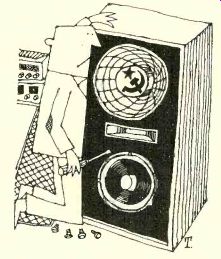
The solution? I have none. The noise is very broadband and so powerful I can hear it in my speakers with my power amps turned off! Let me hasten to explain (before someone accuses me of spending too much time in a John Birch Society Reading Room) that my loudspeakers are of the electrostatic type and have their power supplies on at all times to maintain charge. The wires from the power amps pick up enough signal to generate an audible (though faint) ticking. Fortunately, my listening and the Russians' testing schedule haven't coincided too much recently, but if the problem gets any worse, I'll make a suggestion to Jimmy that the matter be brought up at the next round of the SALT negotiations.
-Charles Repka
Quadcasting
If you act quickly, you may have one last chance to help rescue four-channel sound from its current parlous plight-or, if you prefer, pound another nail into its coffin. The Federal Communications Commission, presently inviting comment from all interested parties on the desirability and feasibility of quadraphonic FM broadcasts, has extended its original September 15 deadline for receipt of comments on the subject to December 16.
The FCC is particularly interested in whether there is sufficient active support for four-channel amongst the general public and broadcasters to justify the creation of a stand ard for "discrete" (or quasi-discrete) quadraphonic FM transmission and, in particular, whether both parties are willing to spend the money necessary (for equipment adaptation or replacement) to make use of such a system.
At the moment, of course, broadcasts of matrixed four-channel material are permitted under existing FCC regulations, and a number of FM stations have availed themselves of this opportunity to provide quadraphonic programming. Whether any rules should be adopted to govern matrix transmissions is another question on the FCC's mind. At least one matrix proponent, CBS, is pressing for adoption of its system (SQ) as a quadraphonic broadcasting standard. If the FCC were to look sympathetically upon the CBS petition, it could make SQ the "official" FM quadraphonic matrix-which is to say that your local station would retain the right to broadcast any matrix recording, however encoded, but when it announced a quadraphonic matrix broadcast, that broadcast would be SQ. Such an announcement could even take the form of a special subcarrier transmitted with the pro gram to turn on a "quadraphonic" light on the front panel of suitably equipped tuners and receivers.
Whether or not you are interested in quadraphonic FM, any FCC decision-for action or inaction-is bound to affect the fortunes of all four-channel formats. It could, for example, spur the production and availability of every type of four-channel equipment, which has been a little scarce recently. And it couldn't help but have a positive influence on software manufacture as well ...
The FCC's inquiry therefore shapes up as an excellent opportunity for you to strike a telling blow, pro or con, for four-channel's fu ture. Comments must be received by the FCC on or before December 16 to be considered. If you wish all responsible members of the FCC staff to see your letter, you should send a total of six copies.
Address-Re: FM Quadraphonic Broadcasting (Docket 21310), Federal Communications Commission, 1919 M Street N.W., Washington, D.C. 20554.
-Ralph Hodges
++++++++++++++
Also see:
CLASSICAL DISCS and TAPES: A Little X-mas Music, WILLIAM KIMMEL, Gustav Leonhardt's Brandenburgs, STODDARD LINCOLN, Jean -Baptiste Lully's Alceste, ERIC SALZMAN, Kreisleriana, GEORGE JELLINEK, Giuseppe Verdi's II Trovatore, GEORGE JELLINEK
AUDIO QUESTIONS and ANSWERS: Advice on readers' technical problems, LARRY KLEIN
Link | A BEGINNER'S GUIDE TO HI-FI---Selecting equipment intelligently is something anyone can do ROBERT N. GREENE
Technical Talk, Julian D. Hirsch
I Remember Mono--An Audiobiography
Source: Stereo Review (USA magazine)