By Larry Klein
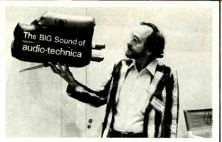
Technical Director Klein inspects a large but low-mass phono cartridge at the Summer CES.
Power Capability
Q. How can Julian Hirsch say, in a recent H-H Labs report, that a speaker system's 500-watt power rating is justified when a 200-watt-per-channel amplifier blows its tweeter fuse?
PHILLIP HARRIS; Woodbridge, Va.
A. Speaker power-handling ratings are not a simple matter. First, note that H-H Labs did not say the speaker in question could handle 500 watts, but rather that it is rated for use with amplifiers delivering up to 500 watts output. The two statements are not at all the same.
A speaker's power rating is a function of both frequency and time. The low-mass higher-frequency drivers can easily be burned out (literally) by a few watts of energy applied for a sustained period. On the other hand, the heavy woofer structure can dissipate a large amount of power for a long time, and modern woofers are in fact more likely to be damaged mechanically (by a torn cone, suspension, or displaced voice coil) than thermally.
Luckily for speaker designers, ordinary music does not contain an even distribution of energy over the audio-frequency range. It is maximum in the range of several hundred hertz, where the woofer is easily able to handle it, and except for brief transients it will rarely exceed its midrange value in the tweeter range. Such factors as the crossover frequencies and slopes as well as the use of such heat-transfer agents as ferrofluid in the voice-coil gaps can have a great effect on the ruggedness of tweeters and midrange units. Most testers have blown out tweeters by feeding in only a few watts of test-tone energy centered in their frequency range even though the woofers in the same systems could easily handle 50 to 100 watts.
The best way to specify power-handling ability is to state, however loosely, the amount of power a speaker can handle in a given frequency range for a given amount of time. Such a specification would read some thing like that of, say, the Allison: Five system: "At least 15 watts continuous or aver age at any frequency. At least 35 watts peak at resonance frequency. Over most of the frequency range, at least 350 watts for 0.1 second; 125 watts for 1 second; 60 watts for 10 seconds." An alternative approach is the equally useful power spec from Acoustic Research: "May be used with amplifiers capable of delivering up to 100 watts continuous power per channel, being driven into clipping no more than 10 percent of the time on normal speech and music source material in non commercial applications."
Phono-brush Force
The instruction manuals for several phono cartridges with built-in brushes (Shure. Stanton, Pickering) say to add extra tracking force to compensate for the brush. That doesn't make sense to me since when it's on the record, the brush supports its own weight--or doesn't it?
PETER BRANDT; Los Angeles, Calif.
A. It does--which is precisely why you must provide additional tracking force for the cartridge.
Obviously, in order to be effective, the brush has to exert adequate downward pressure on the disc surface. This pressure is provided by a deliberate weighting of the brush assembly, usually by a specified extra half gram or so. During play, the weight of the independently pivoted brush assembly does not affect the tracking force of the cartridge. However, when the tone arm is lifted off the record for the "zero balancing" procedure used originally to set stylus tracking force, the weight of the brush assembly is added to the weight of the arm and cartridge. This combined weight is then nullified in the zero-balancing process.
But since the brush assembly is sup ported independently by the record surface during play, a tracking force dialed in after zero balancing will be too low by precisely the weight of the brush assembly. In other words, what you are compensating for by dialing in a higher tracking force is the absence of that amount of weight during play.
I hope that the readers who have written expressing confusion about this matter will be gratified that I have treated it as a properly weighty question instead of giving it a fast brush-off.
Volume Pop
Q. When I play records (not the tuner or a tape) the volume level in one channel pops up and down intermittently. I have had both the amplifier and the phono cartridge checked, but nobody seems to be able to determine where the trouble is. Can you offer any suggestions?
PETER WARNER; Garland, Tex.
A. The "intermittent" is a major head ache for any service technician. The classic symptom is a sudden and apparently unprovoked complete or partial loss of signal; operation will usually return to normal when the amplifier is either physically or electrically disturbed. The technician's problem is that simply connecting his test instruments into the circuits to make diagnostic measurements will frequently restore normal operation, and when the circuit is operating normally there is no easy way to locate the trouble. Most of the battle is won when you can determine the point in the system where the defect is occurring. In your case it has to be in either the phono cartridge, the record-player connections, or the phono-preamplifier stage of your pre-amp or integrated amplifier.
The first connections to check are those in the tone-arm headshell. Using long-nose pliers, tighten the cartridge-pin clips and squeeze the pin terminals where they are crimped around the thin shell wires. Also clean the contact points where the cartridge shell mates with the tone arm by rubbing them carefully with a pencil eraser. If none of this cures the problem, try substituting another cartridge and/or headshell. You might also try to induce the effect by vigorously wiggling the phono leads from your turntable while it is playing. If that makes the volume level "pop" up and down, check out the leads and the jacks they connect to.
The ultimate diagnostic test for this part of your system is to substitute a different turn table temporarily.
If none of the above clears up the problem, the preamp section is probably the culprit. If you feel confident enough to check this out yourself, unplug the amplifier's a.c. power cord and open up its enclosure. Gently wiggle each of the printed-circuit boards, particularly those that plug into some type of edge connector. (Oxidation of internal plug-in connections is a common cause of intermittent operation of some types of audio components.) In any case, it's a good idea to check with the service departments of the manufacturers of your turntable and amplifier. The fault you are experiencing may be more or less typical of one of the products involved, and the manufacturer may be able to suggest an effective quick fix.
Because the number of questions we receive each month is greater than we can reply to individually; only those letters selected for use in this column can be answered. Sorry!
------
Also see:
CAR STEREO--Coming Attractions
CES 1982--The latest hi-fi trends and product introductions.
NEW PRODUCTS--Roundup of the latest audio equipment and accessories
Source: Stereo Review (USA print magazine)