AT THE SUMMER CES
THE Summer Consumer Electronics Show in Chicago clearly showed the dominance of the cassette medium in the hi fi marketplace. No new open-reel decks were in evidence (though a number had been introduced at last winter's CES, including five from Teac), but new component cassette decks were everywhere. Over all the specs are still better in the open-reel format, but cassette machines and tapes have improved dramatically over the past several years. The most recent developments are Dolby-C, which essentially doubles the 10-dB noise reduction of the Dolby-B system, and the low-voltage IC chip from Matsushita (parent company of Technics and Panasonic) that facilitates incorporating the dbx system, which nearly doubles a recorder's dynamic range, into all types of cassette machines. With this and more and more dbx-encoded prerecorded cassettes being released, dbx should be increasingly popular as a cassette-deck feature.
Besides Dolby-C and dbx, many of the new decks in Chicago featured auto-re verse, twin-transport dubbing facilities, and microprocessor controlled functions. And some had real-time electronic tape counters rather than the conventional numerically arbitrary mechanical types. The trend continues away from mechanical record-level meters to multi-segment fluorescent or LED-string displays. Higher-priced models generally have three heads, and metal-tape capability is now a standard feature.
I noted five new models from Aiwa, including two with Dolby-C and built-in head demagnetizers, and two from Akai with Dolby-C, one computer controlled and the other with auto-reverse. Cybernet had no new offerings but dropped prices on its two cassette decks by about $90 each. Fisher seems to have added several new cassette decks to its extensive "Studio Standard" series, and Garrard brought in two low- to medium-priced units. Harman Kardon had a new wide-range (20 to 20,000 Hz ±3 dB) machine for only $250.
Hitachi had four new cassette decks (from $150 to $570), and JVC had direct-drive capstans in three of its eight new models, seven with Dolby-C. Kenwood added a new mid-priced model, and Luxman added to its line with both Dolby-C and dbx equipped units. Marantz added three models, two with Dolby-C. Of the three brand new Nikko decks, one has Dolby-C and one has twin-transport dubbing (prices from $210 to $379).
Pioneer's six new decks all feature Dolby-C, as does the new $2,000 Revox cassette deck. One of Sansui's new offerings has auto-reverse, and two offer three-head operation. Sherwood has Dolby-C in a three-head, microprocessor deck (the S-6100 CP) for only $400.
Sony had seven new cassette decks, from the economical TC-FX33 at $180 to the computerized, three-head TC-FX 1010 at $650.
Tandberg brought its proprietary Dyneq and Actilinear recording systems to the world of cassettes in the $500 Model 3034.
Technics had two new Dolby-C models, several with dbx, one with both Dolby-C and dbx, one with auto-reverse, and one dual-transport-dubbing deck in its eight introductions (at all price levels). Among Toshiba's four new offerings ($160 to $300) were a Dolby-C unit and one with auto-reverse.
The obvious popularity of the Sony Walk man has led to many imitators in the "personal-portable" genre, some with FM/AM radio reception and many with either stereo or mono recording capabilities. Aiwa introduced a unit with auto-reverse recording and playback as well as AM and FM reception. Panasonic introduced two models worth special note: one was claimed to be "the world's smallest" and the other the first to be equipped with dbx noise reduction. Almost all the personal portables still use standard-size cassettes, but it seems to me that the trend in this type of equipment will be increasingly toward microcassettes, although there was not quite as much evidence of this at the show as I had expected.
Only JVC and Fisher offer home microcassette decks.
There was a lot of activity among the tape makers, though in audio tapes much of it consists of minor improvements in packaging and filling out of lines. Fuji now has five audio cassettes (one metal, one premium high-bias, one premium normal-bias, and two less-expensive normal bias). Loran has improved its high-bias formulation, as has TDK, which has also revised its packaging.
PD Magnetics has introduced a metal-bias formulation. Memorex, which was still shattering wine glasses at its demonstration booth, also brought out a microcassette line, as did Scotch, Sony, and JVC. It's safe to predict that we will be seeing rapid progress from this point on in the record-playback capabilities of microcassettes and the machines that use them.
------------
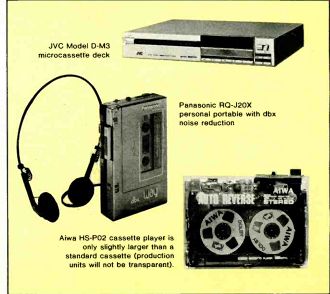
JVC Model D-M3 microcassette deck, Panasonic RO-J20X personal portable with dbx noise reduction, Aiwa HS-P02 cassette player is only slightly larger than a standard cassette (production units will not be transparent).
-------
ADs
Creating great Music has never been simple.
Now recreating it is.

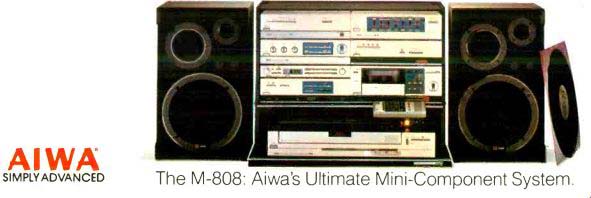
Being good isn't enough to make it to the top. You have to be great. Our top of-the-line M-808 proves the point. With the M-808, un adulterated power is yours. The totally new Plus A Class amplifier has reduced distortion to inconsequence. To reduce operating confusion, each component is ergonomically designed. The back-lit front panel controls assure quick, miss-free operation. Of Dolby is a trademark of Dolby Laboratories Aiwa American Inc 35 Oxford Drive. Moonachie. New Jersey 07074. The M-808: Aiwa's Ultimate Mini-Component System.
AIWA---SIMPLY ADVANCED
AIWA course, the metal capable cassette deck includes Dolby C, while our quartz synthesizer tuner boasts 12 station memory preset. Whether or not you add our front loading turntable, infrared remote control, seven band equalizer or the programmable timer, you'll find the M-808 system is simply amazing. And thanks to Aiwa technology, it's also amazingly simple.
--------------------------
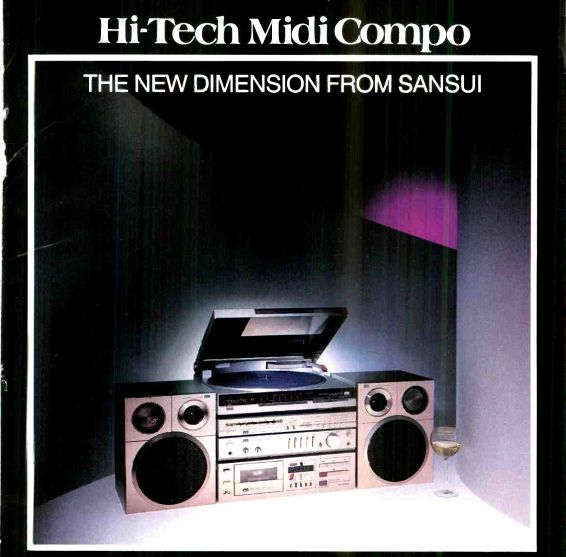

Hi-Tech Midi Compo. THE NEW DIMENSION FROM SANSUI. Good music wherever you want it. What's Midi Compo, one of the new Sansui Hi-Tech Compo series. Great sound and simple operation, ensured by Sansui's know-now in developing and using advanced technology.
Midi Compo is programmable throughout. By presetting up to 10 of you--favorite stations ( 5 AM and 5 FM) you can instantly tt..ne any onE at the touch of a button. Or pick selections on a record, in t4ie order yot. want to hear them on a quartz-locked turntable. The Mid. Compo's cassette deck with exclusive Sansui Compu Edit will then tape them in that order, automatically.
Sansui Midi Compo also includes a powerful amplifier and bass-enhancing speakers to give you the full feel and impact of toll.: music. In any room.
See and hear the new dimension in sound at your authorized Sansui dearer today. SANSUI ELECTRONICS CORPORATION. Landhurst, NJ 07071; Gardena. CA 90248 Sansui Electric Co.; Ltd.. Tokyo. Japan
-------
TDK
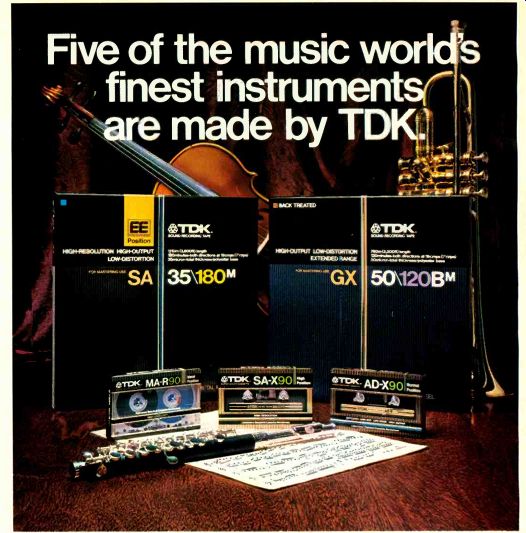
Like any fine musical instrument, TDK Professional Reference audio cassettes and open reel tapes are products of genius. In TDK's case, it's the genius of constantly-advancing audio technology. And now, TDK technology has advanced again in the re-formulation of our MA-R metal, SA-X high bias, and AD-X normal bias cassettes.
MA-R, SA-X and AD-X are formulated to an incredibly strict, new set of audio tape standards based on measurements and values no audio cassette manufacturer has ever attempted to meet. TDK cassettes deliver clarity, fidelity and quality unmatched by any other cassettes on the market today.
MA-R, with its unique unibody metal alloy frame and Reference Standard Mechanism is the first metal reference tape in the industry. SA-X pushes high bias to its limits. AD-X normal bias is extraordinary in its wider dynamic range and its freedom from saturation at high frequency. SA-X and AD-X both feature TDK's specially engineered Laboratory Standard Mechanism. Each cassette comes with a Lifetime Warranty.
TDK's superior technology is just as evident in our SA/EE (Extra Efficiency) and GX open reel tapes.
TDK SA/EE is the first open reel tape to use TDK's famous Super Avilyn particle. This gives SA/EE almost double the coercivity and high frequency MOL of conventional open reel tapes. GX mastering tape offers a wide dynamic range, high MOL and low noise. Both SA/EE and GX feature low distortion and extended frequency response.
MA-R, SA-X, AD-X, SA/EE and GX--they're five of the music world's finest instruments for all of the music and instruments you record. One final note. TDK's new Professional Reference Series of audio cassettes now comes in bold, new packaging. So they stand out in sight just as they stand out in sound.
TDK--- THE MACHINE FOR YOUR MACHINE. 1982 TDK Electronics Corp.
-------
Memorex
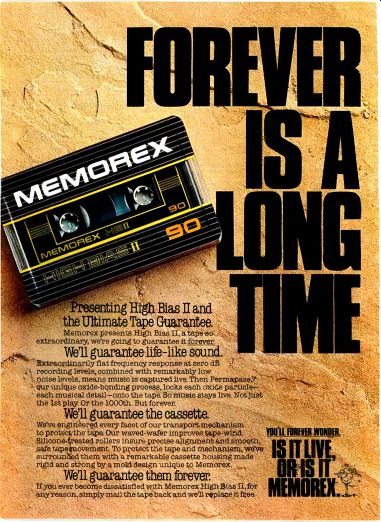
Presenting High Bias II and the Ultimate Tape Guarantee.
Memorex presents High Bias II, a tape so extraordinary; we're going to guarantee it forever.
We'll guarantee life-like sound.
Extraordinarily flat frequency response at zero dB , recording levels, combined with remarkably low noise levels, means music is captured live. Then Permapass, our unique oxide-bonding process, locks each oxide particle each musical detail-onto the tape. So music stays live. Not just the 1st play. Or the 1000th. But forever.
We'll guarantee the cassette.
We've engineered every facet of our transport mechanism to protect the tape. Our waved-wafer improves tape-wind.
Silicone-treated rollers insure precise alignment and smooth, safe tape movement. To protect the tape and mechanism, we've surrounded them with a remarkable cassette housing made rigid and strong by a mold design unique to Memorex.
We'll guarantee them forever.
If you ever become dissatisfied with Memorex High Bias II, for any reason, simply mail the tape back and we'll replace it free.
YOU'LL FOREVER WONDER, IS IT LIVE OR IS MEMOREX.
------
Also see:
AUDIO QUESTIONS and ANSWERS--Power Capability, Phono-brush Force, Volume Pop
CES 1982--The latest hi-fi trends and product introductions.
NEW PRODUCTS--Roundup of the latest audio equipment and accessories
Source: Stereo Review (USA print magazine)