AUDIO Music Reviews: The AUDIO Music and Record Review Section: Classical, Light Listening, Jazz and All That, About Music.
EDWARD TATNALL CANBY, OSCAR E. KRAUT ,MARVIN ROTBARD, LIONEL RUDKO
The Classics
CHORAL MUSIC
Mahler: Symphony No. 8 ("Symphony of a Thousand"). Soloists, Leeds Festival Chorus, London Symphony Orch. Chorus, Orpington Junior Singers, Highgate Boy's Choir, Finchley Children's Music Group, London Symphony Orch., Bernstein. Columbia M2S 751 (2) stereo
There must be a good thousand performers here, though they don't say so, what with so many choruses, children, boys and girls both, eight solo singers, organist, and a battery of extra instrumental players. And managing the whole super planetary, cosmos-shaking get together is our own Leonard Bernstein.
Four LP sides and some of the loudest (and cleanest) disc cutting I ever hope to hear of the sort. Phew! Monster affairs like this can side-track an earnest record reviewer for days at a time, while hundreds of other discs wait.
I remember enthusing over Vanguard's Utah performance of this huge work, some time back. It was unusually fine in the over-all, as are many of Abravanel's productions in the Mormon country. That was a somewhat lean, intense, rather youthful performance (with college choir sound in the chorus). This one is more massive, bigger, more European and, I think, stylistically closer to Mahler's intent. For the endlessly huge climaxes, going on for minutes at a time, the relentlessly top-volume choral parts, often in the very highest registers over and over again, require heasoned, hefty, and mature voices-as do the profoundly felt solo vocal parts.
These massed choruses are exactly right for the physical ordeal of the gigantic sound production, solidly mature, competently professional in sound and volume, yet accurate and-most important
-enthusiastic. Against them the children's voices are exactly in spirit. The orchestra and large organ together sound positively apocalyptic, tremendous in the loud passages; yet in the inevitable quiet stretches the famous Mahler instrumental color comes out beautifully, solo by solo.
"Imagine that the universe bursts into song," wrote Mahler about the work.
"We hear no longer human voices but those of planets and suns circling in their orbits." That sort of super-egoism is not very much to our taste today, quite aside from its astronomical inaccuracy. And much of this interminably loud music will merely make many listeners squirm with uneasiness. It just goes on and on, and the great trance-like state we are supposed to fall into just doesn't happen easily in the living room.
It is mass-hysteria music, for all its splendidly controlled shaping, and only an actual performance can approach this state in terms of audience-performer rapport on a vast scale.
Ah-but the soft parts, the marvelous Mahler songs, for the various soloists! Between the dreaded climaxes, the music is just plain out of this world. That's when my trance begins, I can tell you.
You'll know in five seconds that Bernstein has these thousands right in his hand. It's a splendidly vital big show, whether you like the cosmos-shaking elements or not. E.T.C.
Beethoven: Mass in C, Op. 86. Soloists, Dresden Cathedral Choir and Orch., Kurt Bauer. Baroque 2846 stereo.
Here we are way down at one end of the big Dresden Cathedral, not far from the choir and solo singers. It's a vast place and the music, in stereo, is somewhat overwhelmed by it. This is an East-German performance, not of an international sort but, rather, the kind intended for local listeners, done by the local performing forces. We are, in a way, listening in.
The music is Beethoven's lovely "little" Mass in C of 1807, typically middle Beethoven, small in comparison to the giant Missa Solemnis of later years but full of splendid material, in an expanded traditional style out of the Haydn-type Masses.
It is an earnest, sincere, and veil musical performance but hardly of top competence. The work often goes very slowly and romantically (perhaps the cathedral acoustics demand it), making the piece sound bigger than it really is. No great harm done. The chorus is wobbly in tone but well rehearsed, the soloists, strictly local types, wobble even more earnestly; the orchestra is not particularly audible. And yet-the music is obviously meaningful to these performers; and so it is meaningful for us. I enjoyed it. E.T.C.
Telemann: Two Motets, "Wie ist dein Name so Gross!," "Deus Judicium Tuum Regi Da!". Soloists, Philippe Caillard Chorale, Saar Radio Chamber Orch., Ristenpart. Westminster WST 17109 stereo
Such a flood of instrumental Telemann has been resurrected lately that we are just coming to the vocal works-hundreds of them, once we get started. These two motets (cantatas in effect) will amaze those who expect Telemann to sound just like Bach, as of the same period. He couldn't be more different.
Yes, in truth, Bach was a conservative, narrow in his outward scope though sublime in inner expression. Yes, Telemann was obviously the more progressive of the two by far. In these late works, one of them produced in 1756, six years after Bach's death, we are teetering on the very edge of the Haydn-Mozart period, yet still solidly in Baroque. Haydn's first little symphonies date from only three or four years later. Mozart was born in the very same year.
The two works are full of experiments.
There are many striking instrumental combinations, a rich and big orchestra which, accompanying the Baroque-style arias, has already that busy, bustling quality of activity that is the gallant style about to be born. There are absolutely weird harmonic progressions-so odd that these musicians clearly don't "hear" them, and flounder at the sense. And those who know French Baroque music --Rameau, Couperin, Campra, Delalande and the rest of that now-burgeoning school--will be astonished at how literally Telemann (he is always known as French-influenced) has borrowed into the French style, especially in the second of these works.
Westminster's get-up is annoying, at least to those who want some idea as to what is being talked (or sung) about.
No texts. Not even the titles of the various sections-just "Bass aria," "Chorus," etc. At Westminster's higher price (for music of a sort that is often available on low-cost labels) there is no excuse fo omitting the texts-the cheap labels often include them, complete with translations.
E.T.C.
Zachau: Two Cantatas, "Lobe den Herrn," "Ich will mich mit Dir verloben." Instr. and vocal soloists, Heinrich Schutz Chorale of Heilbronn, Pforzheim Chamber Orch., Werner. Westminster WST 17103 stereo.
A pair of most amiable big Baroque contatas, by a man who has been virtually rediscovered-and well worth it.
Not only is he good of his sort, but for many of us he has a special interest: he was young Handel's teacher for eleven years.
It is very interesting, then, to find in this unknown man's work (the Handel biographies hardly make mention of him) a number of tell-tale Handelian mannerisms of the most familiar sort.
Not much doubt but that the bigger composer originally got them from this very source.
Such Handel tricks as the dramatic dialogue of short phrases between a solo singer and an instrument, the clear, uncomplicated vocal fugue (as compared to Bach's thick, complex structures), indeed a general clarity of texture that is very much like the Messiah sort of writing, even the ultra-Handelian sudden detached slow ending to a rapid piece, all point to the great influence this teacher had on the most imposing figure of the coming generation.
One cantata is very long, a-side -- and a-third; the other is big enough. Both are full of instrumental variety-trumpet solos, bassoons, oboes, lots of chorus and solo singing. Very showy, but rather low in tension, more static display and spectacle than high power religious persuading. The performance is earnest, well prepared and nicely recorded, but on the slow side, even for spectacle music.
E.T.C.
Italienische Chormusik der Gegenwart. (Dallapiccola, Peragallo, Petrassi). Monteverdi-Chor Hamburg, Jurgen Jurgens. Telefunken SLT 43095 stereo via London.
Contemporary Italian choral music, sung by a crack German choir from Hamburg, that's what all the German in this title means. And some of it makes extraordinarily good listening. My particular rave is for two unaccompanied pieces by Dallapiccola, Italy's major big hope, composed before he went into serial music and such-these two are settings of texts by, of all people, Michelangelo, and they are infectiously enthusiastic as well as beautifully written for chorus. I'm trying desperately to get hold of the music, to try them on my own singing group, the Canby Singers.
Other music here, most with modest instrumental accompaniment, is much more serious in mien but it all, interestingly, has a peculiarly Italian flavor, as much out of Caruso and Verdi as out of the older Monteverdi himself (died 1767-this is the "Monteverdi Year"). High colors, flashing drama, tunefulness, passion and, of course, the Italian wit and the Italian mixture of sunshine (technicolor) and tears (saccharin) all at once--these old-fashioned attributes can be found even here, if you listen hard enough.
You might try the Nonsense pieces by Petrassi first. Settings-to Italian words, mind you-of Edward Lear's well known limericks! Crazy, man. (There was a young lady whose nose continually prospers and grows: C'era una signorina ...) E.T.C.
BACH AND TELEMANN
Telemann: Don Quixote Suite; Suite in A Minor. F. Schmidtmann, recorder; Ensemble Benedetto Marcello ( Holland). Odeon SAXH stereo (via London)
Telemann: Don Quixote Suite; Suites for Orch. in G, D; Dance Suite (Concerto a 4). Rouen Chamber Orch., Beauchamp.
World Series PHC 9003 stereo/mono Two imported recordings of Telemann, one Dutch and high priced, the other French and low-priced (though both originate with Dutch record companies). The more expensive disc is decidedly the better one, though price has little to do with it.
Both performing groups are of the new small virtuoso sort. a dozen-odd string players and a keyboardist. (The first to become famous was I Musici.) The Dutch "Marcello" players are good, if not exactly outstanding; but they bring with them an extraordinarily fine recorder player, Friedrich Schmidtmann, who does the well known A minor suite (usually played on a standard flute) with astonishing technique and a warm, knowledgeable musicianship as well. The Odeon disc is worth its price just for this splendid music, on side 2.
As for the Rouen players from France, they have all the hallmarks of a high power musical promotion job: a virtuoso group chosen via a national contest to bring big-time music to a smallish outlying city. They are young and they play with a hard, brilliant ensemble, over-tense and astonishingly unmusical.
They have not even discovered yet that Baroque "French overture" movements are supposed to be playéd at a moderate speed with quick doubledotted rhythms, instead of mathematically and lugubriously, as written. (You may not understand this in words but you would recognize it in the music, I am sure.) Their fast movements are unmercifully hacked, without phrasing and subtlety; their slow movements are unshaped and dull; only the middle-speed movements come over with a good effect. Not beautiful at all, and no great credit to Rouen, if you ask me.
"Don Quixote" is one of the dullest of all the thousands of Telemann works, far beneath his usual rich standard.
There must have been a reason; the stuff is in a kind of "peasant" style, elaborately over-simple and monotonous, a bit like Haydn's "Toy" Symphony or the simpler Mozart Divertimenti for outdoor use. Rouen just makes it duller.
The Dutch do it as well as can be done.
Fortunately, both records include much better music in their supplemental offerings. Rouen's "Dance Suite," a dance like concerto grosso, is worth the price of that disc, and is the best played music on it. E.T.C.
Bach: Lute Music. Walter Gerwig. Nonesuch H 71137 stereo.
Bach on the lute! Yes, he did write for the instrument, or rather, wrote out numerous works for lute which are also well known in other forms. It isn't entirely clear, either, which came firstmaybe the lute did in some case. (Leipsic, Bach's town in later years, was a center for the last remaining school of lute playing in Germany.) Walter Gerwig is excellent. No twangs and buzzes, as so often on amateurish lutes, no hesitations and unclear rhythms, while the fingers hunt for the chords.
All is smooth and straightforward here, everything clear and easy to follow as well as very musical. Just as well Ger wig keeps a rather strict and forthright beat. Helps us to get the music's sense.
Included are a number of works more commonly known in versions for solo violin and solo cello--the entire A major cello suite is on Side 2 and part of the E major solo violin suite on Side 1; also works alternatively known for organ and keyboard. Guitarists with a classical urge and even electric-guitar rock & rhythm men will find the lute's abilities quite astonishing as compared to their own instrument's capabilities in this same sort of music. More strings, a wider pitch range with more low bass.
E.T.C.
J. S. Bach: Four Sonatas. Kenneth Gilbert, harpsicord, Steven Staryk, violin. Baroque BC 2858 stereo.
The Baroque label (Everest), high priced-at least as officially listed-is wildly erratic in both content and quality, most of the material not even Baroque at all. This disc is a fine one, and Baroque at that, made in Canada by two outstanding Canadian artists. Very nicely recorded in stereo, too.
The four Sonatas are not out of the familiar collection of six works (3 sonatas, 3 partitas) usually recorded by this combo of instruments. These are odd works of the recently discovered sort, "undoubtedly authentic" though not specifically provable as real Bach. Listeners will be pretty sure this is Bach. Sounds like Bach. This seems to be a unique recording of all four works.
Two of them, on side 1, are for violin and continuo. The two on side 2 are of a different type, with harpsichord obbligato written-out parts. They are actually trio sonatas, the keyboard playing one upper melody in addition to the bass, the violin taking another. An interesting musical difference and it is very well realized, both in the playing and the recording. The violin stands out as a solo on side 1 but on side 2 it recedes somewhat into the background, as merely one of the two upper melodic lines, the other on the harpsichord.
Staryk's violin playing is sweet, somewhat tense with a slightly nervous fast vibrato, but utterly musical, excellent in both pitch and phrasing. Gilbert's harpsichord is solid and rather forthright, always intelligent and also very musical.
A fine record and the only one of the music. E.T.C.
Bach: The Four Orchestral Suites. Pablo Casals, Marlboro Festival Orch. Columbia M2L 355 (2) stereo Casals: A Living Portrait. Columbia PC-1 mono.
The living portrait (in Casal's own words), with narration by Isaac Stern to connect the segments) comes with the 90th birthday recording of the Bach suites.
Yes, Casals is a great person, a sage, an Elder, whose words of wisdom become wiser and more universal as he grows still older. He is a great musician in his way, as well as a philosopher. But with all of this, he is of his own time, which is not today.
In music that means a style of playing--on his cello, as a conductor here of Bach-that is straight out of the early years of the century, perhaps 50 years ago. Much as I admire him (and these new performances are far more relaxed and much better in ensemble than the hectic Casals Festival performances of some years ago)-I cringe at this Bach.
For it simply ignores all the changes in Bach playing that have occurred in the last couple of decades. All the old falsities are back again-the ultra-slow opening movements, with the wrong rhythms, the fat symphonic sound (even from a small orchestra), the big slowdowns at each ending and so on. And the B Minor Suite, No. 2 with flute, goes right back to the pre-war whirlwind drive that drags the flutist along unmercifully with never a split second to get a breath.
If none of this sounds as though it would bother you in the slightest, then go right ahead-Casals is a fine musician and so are his players (who probably know a lot more about Baroque performing that he does-but what can they do?). It's a splendid recording, of the old-style sort.
The extra record is a montage of many of Casals' words of wisdom, in master classes, orchestra rehearsals and so on, with a good many musical illustrations.
He is, of course, 101 per cent right on all matters of phrasing, on the soul of music-making, on imagination, spirituality-old-fashioned concepts that have now bowed mostly to logic and computer technology. I must say I go along with him in his words, his ideas, if not in his Bach.
I'm getting old. More than half his age already.
E.T.C.
Introducing: OSCAR E. KRAUT Hans Werner Henze: Five Symphonies (No. 1, No. 5). Berlin Philharmonic Orchestra conducted by the composer. DGG DGS 9204 stereo tape.
This is a most provocative 2-reel volume! To be suddenly confronted with not just one, but five full-sized symphonies incorporating almost every conceivable resource of a large modern symphony orchestra, and by a composer whose name is barely known in this country, certainly offers plenty of food for thought.
One thing is settled very quickly and that is that Hans Werner Henze is a first-rate composer with great sensitivity and complete command of his medium.
He writes with a firm, strong hand, leaving no room for doubt that he has something worthwhile to say and knows how to say it. All of his writing is highly dramatic and charged with intense emotion as evidenced by these recordings. He has the gift of being able to command your attention and carry you along to his climaxes, which is characteristic of really great composers. What is most remarkable is that Henze makes this compelling music in a style of writing which is an outgrowth of the complex 12-tone technique developed by Arnold Schoenberg.
This is a little like writing a love letter by means of double acrostics. Yet Henze expresses himself clearly, naturally, and with complete freedom and ease.
Hans Werner Henze is a German composer born in 1926, who received his musical education from disciples of the Schoenberg school in both Germany and France. His Symphony No. 1 was composed in 1947, when he was only 21.
In the liner notes, the composer himself refers to the initial performance of this symphony as an "utter failure." The version performed in this recording is a completely revised and reorganized edition produced in 1963. There are additional indications that the original scores to the 2nd, 3rd and 4th Symphonies were also revised for this recorded performance, so that while these performances represent the final and authentic versions of all five symphonies (even beyond the printed scores available), they are not a valid indication of the composer's growth through the twenty years which elapsed between the original production of the 1st Symphony and these final revisions.
Add to the above that we can hear the composer conduct an excellent orchestra, the Berlin Philharmonic, and wè have full assurance that we are listening to a definitive performance of these symphonies. Come to think of it, this is a pretty wonderful and unique contribution which high fidelity can make to the cause of appreciation and understanding of music, especially new music.
All five symphonies are less than 30 minutes each in length and are fairly concise in structure with well defined movements. Except for the 4th Symphony, which is in one movement, the printed outlines are clear and easy to follow. Henze is very much concerned with structure and form throughout all the symphonies, a characteristic of this school of composition, but as he indicates, his music offers as much to the naive listener as to the technically well informed.
The Symphony No. I in this new version (1963) was scored for a small orchestra, though Henze draws some effects out of this group to rival a full-sized symphony orchestra. It opens quite gracefully and easily with a singing style and before you know it you are on your way.
The movement ends just as it began. The second movement is a slow nocturne featuring some effective writing for solo viola. The symphony closes with rhythmic movement full of fireworks somewhat reminiscent of Stravinsky.
Symphony No. 2 composed in 1948, opens rather mysteriously, setting the mood for the remainder of the movement as well as the symphony. A fast second movement follows, finally giving way to a somewhat more lyrical slow closing movement.
Symphony No. 3, written in 1949, was evidently a great success when first performed. It might be characterized as a dance symphony. It opens with an invocation to Apollo, moves into a more lively rhythmic section, rises to a fury, and then closes. The second movement is a stately dance. The third movement is a dance of incantation that moves through a variety of Stravinsky-like rhythms to finally conclude in a blaze of sound.
Symphony No. 4, dated 1955, is seemingly in one continuous movement. Henze indicates that this work was originally incorporated in his opera Konig Hirsch, and actually consists of five movements in one. Unfortunately, the opening slow statement is marred in the review copy by a rather serious wow. As the 4th Symphony got under way the wow effect became less and less noticeable but in these days of electronic music, it becomes difficult to be certain of anything.
This work seems reminiscent of Alban Berg. It is made up of series of recitative-like passages for solo strings and woodwinds.
The last symphony in this set, the Fifth, was composed in 1962, and is divided into three distinct movements.
The first movement consists of dramatic contrasting material. The following movement is a slow section, giving way to a perpetual motion Finale.
The last two symphonies move much more deliberately than the earlier three and appear to be a great deal more involved. But this is after all one of the great advantages in recording new compositions, namely the unlimited opportunity to become thoroughly familiar with the work and the musical idiom used through repeated playings. There is a definite limit as to how much can be absorbed at a single performance, unless a printed score is available.
Technically, DGG has done well by Henze and his music since the tonal balance is quite smooth, lush and full bodied, with the Berlin Philharmonic coming through crisp and clean and all instruments equally balanced. DGG deserves a vote of thanks for making these symphonies of Hans Werner Henze available. It is to be hoped that some of his other work may become similarly available soon. O.E.K.
Introducing: MARVIN ROTBARD THREE FROM COLUMBIA Tchaikovsky: Capriccio Italien; Waltz from Eugene Onegin. Rimsky-Korsakov: Capriccio Espagnol; Bridal Procession from Le Coq d'Or. The Philadelphia Orchestra, Ormandy cond. Columbia MS 6917 stereo
This combination of the two Capriccios appears coupled on more records than I care to count. Columbia throws in an extra measure, however, by also provided the two extra tidbits to round out each side of this disc.
The Philadelphians under Eugene Ormandy are what they are. That is a fully polished and musically professional group that need take a back seat to no other orchestra. The music at hand here is the big, brassy kind of sound that hi-fi buffs use to show off their rigs. Let me at once say that the engineering here is excellent with widespread but not over-blown stereo.
And the two feature works have great musical value. Thetwo Russians' views of Italy and Spain respectively are models of this sort of expositional writing.
I tend to lean toward the Tchaikovsky for its sheer brilliance of scoring; although I will concede that Rimsky is more colorful. But the real charmer of this disc is the little Waltz. If you want to know why the Philadelphia strings are famous, listen to this work.
Ormandy's conceptions of the major works is perhaps lacking in the kind of fire that is needed to transform these oft heard opuses into a fresh appearance. Still, you simply cannot say that this is bad; Ormandy is far too much the musician to allow that.
So Sound is the real hero here. The Columbia engineering is correctly and usefully lavished-and the surfaces are quiet enough to allow you to hear the tape hiss of the master. M.R. Russian Sailor's Dance: New York Philharmonic, Leonard Bernstein. Columbia MS 6871 stereo
"When you hear this kind of music. you want to get up and dance," quotes the liner notes of Mr. Bernstein. If by that he means that all the music of this album is dance music, then I must agree. Here's the list of what is on the disc: Russian Sailor's Dance, Gliere; Brazilian Dance, Camargo Guarnieri; Norwegian Dance No. 2, Opus 35, Grieg; Slavonic Dance, Opus 46, No. 1, Dvorak; Danzon Cubano, Aaron Copeland; Trepak (from the Nutcracker), Tchaikovsky; Galop, Waltz, and Danzon, Leonard Bernstein; Hungarian Dance No. 6, Brahms; German Dance No. 8 (K.605, No. 3), Mozart; Batuque, Oscar Lorenzo Fernandez; and the Hoe-Down from Rodeo, Copland.
Bernstein has selected eleven charmers here. Many are well-known. Less popular, perhaps are the Guarnieri, Copland Danzon and the Fernandez.
The first named is one of those brassy Latin-American numbers whose origin is almost cliche. Nevertheless, this is a sprightly and attractive dance. The Copland Danzon Cubano is jazz-oriented Copland sound at its best. And the Batuque of Fernandez' presents a heavily scored-for-brass syncopated-beat march.
But Latin sound is not the focal point of this disc. The best number easily is the Hoe-Down which is swung to perfection by Bernstein. In fact Bernstein brings to these numbers an infectious Joie de vivre that is a pleasure to behold. Everyone concerned seems to have enjoyed making this recording.
Certainly, I enjoyed listening to it. What with Bernstein and Columbia's fine stereo sound, this is a highly recommended collection. M.R.
ONE FROM LONDON
George Gershwin: Porgy and Bess, Symphonic Suite. The London Festival Orchestra, Robert Farnum, cond. London SPC 21013 stereo
This is a new one from those responsible for London's Phase-4 stereo. It must be said that this is technically nearly "straight," although there are some strange shifts in perspective as solo percussion comes in closer than the entire orchestra. Still, on the whole, this is a sonically stunning recording.
I wish I could say the same about the performance. Perhaps it is more accurate for me to complain about the arrangement. What we usually hear in concert as a synthesis of this Gershwin operatic masterpiece is an orchestral arrangement made in the 1940's by Robert Russell Bennett. This recording features a new arrangement of the score by conductor Robert Farnum. I'm sure his intentions were good. But the Gershwin flavor seems to fare better in its post depression dress. Mr. Farnum's score is smart and modern. And there is its failing, I think. Gershwin just does not come out right in completely modern dress.
Don't let me prejudice you. There must be a valid case to be made for this re-orchestration. Certainly, it has been done in a musicianly manner. And Farnum the conductor would seem to be faithful to Farnum the arranger. Most important of all is the near indestructability of Gershwin. In the end he still manages to shine through. - M.R.
TWO FAVORITE SUITES Bizet: L'Arlesienne Suite No. 1. Grieg: Peer Gynt Suite. Suite No. 1, Op. 46, The Cleveland Orchestra, George Szell, cond. Columbia MS 6877 stereo
George Szell and his Clevelanders turns in a fine pair of performances here. These two suites are both delivered up crisply and smartly.
Both works are culled from larger efforts written as incidental music for dramatic theater productions. The thirty four year old Georges Bizet was commissioned in 1872 to supply incidental music for Daudet's popular L'Arlesienne.
The play, rarely performed today, is a somber affair involving two brothers. The older brother dominates the play while the younger is clearly a dullard.
To simplify things the emotional older brother ultimately commits suicide over an unhappy love affair involving a girl from Arles. (It is she whose name is lent to the play, though she never actually appears.) The shock of this restores the younger to normalcy and he assumes his rightful place as the new family leader.
Bizet's contributions to the production did not receive critical praise. Nevertheless this suite, extracted from the work (there is also a less well-known second suite) has assumed a permanent place in the concert repertoire.
Grieg, on the other hand, faired well with his score of background music to Henrik Ibsen's great drama Peer Gynt.
The five selections of the Suite No. 1 are culled from twenty-two pieces written for the play in 1867. Ibsen's drama tells the tragic story of Peer Gynt's search for the perpetual youth of an adventurous life. He is, in fact, a character not altogether unlike another rogue, Till Eulenspiegel.
The sections of the suite are not in the order in which they appear in the play. Rather, Grieg arranged them in a logical way so the suite could stand independently. And it does.
If anything can be criticized in this recording it is a return to the practice of allowing the first strings to take the melody line in Solvejg's Song. It is interesting to note that this number is usually included in performances even though it rightfully belongs to a second suite Grieg extracted from the score.
In any case, wherever it goes, I do prefer to hear a soprano rightfully take her place here, rather than the violins.
Columbia turns in its usually fine engineering to accompany George Szell's equally fine readings. M.R. Introducing: LIONEL RUDKO Wagner: Die Walkure. James King, Regine Crespin, Gottlob Frick, Hans Hotter, Birgit Nilsson, Christa Ludwig. Vienna Philharmonic. Georg Solti. London Loy 90122 stereo
This recording of Die Walkure completes for London Records the unique project of committing to disc the entire Ring cycle. This is a monumental achievement and London is to be commended for the huge effort it must have been.
Wagner was, and the Ring epitomizes, theater composition.
He thought not in terms of music primarily, but in terms of music drama.
The previous concept of opera as a vehicle for the exploitation of the prima donna of the day, was completely foreign to him. His concept was a wedding of the arts, in which the music, libretto, sets and staging, were woven together into a tapestry of human emotion and experience. Condemned and revered in turn, he left a legacy to the opera theatre that opened new vistas in the evolution of this art form.
The opening bars of Act 1 portend good things to come, for the listener that is, not for Siegmund and Sieglinde.
The sound is excellent, bass response is solid and transient. Individual definition of instruments is excellent and every detail reproduces with utmost clarity.
There isn't too great an opportunity to evaluate the principals vocally until the later part of Act I. No sooner has Sieglinde drugged Hunding when the sparks begin to fly. From then until the end of the act, can be heard the best singing of the entire opera. Siegmund and Sieglinde are an aural delight. What a pleasure to hear singers perform with the bel canto ease and freedom so seldom heard in German opera.
Bouquets to James King and Regine Crespin. Gottlob Frick, in the role of Hunding, is adequate vocally. His high notes are rather forced and intonation not too secure. Sound addicts such as myself, will revel in the luscious lows, the thundering tympani and the brash, brilliant brass. I must say, in reference to both conductor and orchestra, that I have seldom heard brass choirs with such precision of attack and excellent balance. The Vienna Philharmonic is one of the great orchestras of the world and they sound it.
If fault must be found, I would say a little more prominence in the wind section would have been desirable. I have always had an aversion to the
thin and reedy oboe sound in central European orchestras. The recording technicians have created the feeling of stage movement by shifting voices from speaker to speaker and fading in an out to enhance the impression of depth. I found this created a pleasant illusion, although it remains for each listener to reach his own conclusion in this regard.
Just as our hopes have been bouyed in Act I, that here might be the performance with as ideal a cast as could be mustered, along comes Wotan (Hans Hotter) and plunges us to the depths.
It is particularly saddening to witness the decline of an artist who through the years has been enjoyed and respected.
Yet what artist can be expected to retain full command of his vocal powers indefinitely? The question this proposes is, when should an artist face this realization? Mr. Hotter has a tremolo of at least a minor third which is in evidence throughout his lengthy monologue in this act. The most appropriate critique is provided by Mr. Hotter himself when, early in the act, Wotan bemoans, O Heilege Schtnact (O Divine Disgrace). The perfectly cast opera is still an elusive goal.
It is inconceivable to me that whoever was responsible for casting this recording would jeopardize its excellence in this manner. Christa Ludwig as Fricka is not brilliant but is in good voice and performs her task ably. Birgit Nilsson is assured and professional as is to be expected. She is one of the world's outstanding singers and a welcome member of any cast. She sings intelligently and her rendition, subsequently, of the famous Hoyotoho is devoid of any scooping of the last "ho" as is so often the case.
We have been alternately raised to the heights and plunged to the depths in Acts I and II. Act III maintains this pattern of inconsistency. Some of the most inspired passages of the entire opera are heard here. The vocal interplay of the Valkyries as they bear the dead heroes across their steeds, is an awesome stereo experience as their cries appear from all sides. The orchestra rises to its height, the sound is overwhelming and joy reigns once again.
However, it is short lived as Wotan returns, and from then to the end of the opera, even the excellent strivings of Brunnhilde are insufficient to offset the monotonous repetitions of our lamentable Wotan.
We have been witness in this recording, to potential brilliance reduced to mediocrity through a major error in casting. In a work of such importance and magnitude, as is Die Walküre, no stone should be left unturned to assemble a cast of at lei st equal accomplishment. L.R.
+++++++++++
Light Listening
Mr. Music . . . Mantovani London PS 474 One of the occupational hazards of reviewing records is a fairly subtle one.
It's a small trap that many reviewers of popular music fall into at some time or other. I would describe this particular hazard as the Process of Taking the Artist for Granted. For some reason (years of unshakeable success?) Mantovani seems to be the artist most frequently dismissed in this fashion in the field of popular records. When record reviewers for audio industry magazines leave their monastic cells and gather once a year at the New York High Fidelity show, their shop talk usually finds the name of Mantovani cropping up most frequently when the discussion turns to "What can one say today about So and So's records?" I've had my problems of staring blankly at a typewriter with each new release of a Mantovani-a-month on the London Records schedule. I'm sure London's treasurer doesn't share my feelings and we'll never know how many of the label's projects in other fields of music have been launched on earnings provided by Mantovani's popularity. As for the artist's standing with the record retailer, I still remember the day in the late 50's when the New York office of London Records demonstrated its first batch of stereo discs. While members of the audio press were wondering aloud why the loudspeakers for the right and left channels were about 12 yards apart (we found the answer later when we played the same discs with only six or eight feet separating the speakers), most of the record dealers present were interested solely in the first appearance of a Montovani album in the new medium.
RICHARD L. LERNER CHESTER SANTON ROBERT SHERMAN
In recent months, review copies of his albums have been coming to me in tape form. Album number 474 is the first Mantovani disc release I've heard in some time. Here, as they say in confessional booths, was an opportunity to Turn Over a New Leaf and listen to Mantovani without taking his music for granted. A fresh exposure to his sound on records is not a dull or thankless task--if you've been hearing him solely on tape. A good deal of the past year's technical improvement in London classical discs is evident in this album. The wider frequency range of the disc, as opposed to commercial tapes, brings out more instrumental color and identity in stereo sound that is superior to tape in depth and easily its equal in separation.
Over the years there has been a gradual change in the Mantovani style, most of it in the direction of a more logical tonal balance. The strings no longer cascade over the rest of the orchestra as well as themselves. In this collection of old and new favorites, the woodwinds and other segments of the large ensemble are given a full opportunity to shine and the album is all the better for it. if you can discipline yourself into thinking you've never heard Mantovani's music in the past, a fresh appraisal of the orchestra's current sound on discs is well worth trying-if only as an exercise in keeping your musical reflexes flexible. C.S. Stanley Black: Broadway Blockbusters London SP 44088 A recent sampling of the London Phase 4 Stereo process shows that it, like the label's conventional recordings, sounds better on disc than on 4-track, reel-to-reel tape at.7.5 ips. Following an interval during which I've reviewed Phase 4 in tape form only, a return to discs affords quite a different perspective on the special London process used in this series of releases. On this particular record of show songs for chorus and orchestra, the channels of sound cohere well enough so that the ear is almost lured into imagining an unbroken curtain of sound between the speakers. Considering the amount of echo introduced in the processing, this is not an easy trick to pull. There may be a trade secret involved in London's use of echo in this series. The sound is far cleaner than most I've heard where echo was applied with a liberal hand. In some of the heartiest songs the Broadway stage has provided in recent decades, the reverb is all on the plus side in ultra-close pickup of chorus and orchestra. The only glaring giveaway of the presence of echo in the processing occurs in the rare moments when one voice is heard in a line of a song. As for the performance by Black's chorus and orchestra, it seems to be a hard fact that distance lends some sort of enchantment in show business even as it does in other matters.
I've rarely heard a chorus throw itself into its job with such gusto on this side of the Atlantic-where gusto was sup posed to have been invented. If, like me, you believe in the use of an ample bunch of woofers in each channel of a playback system, you'll probably go along with my conjecture that the drummer in Black's orchestra went through several sets of skins in the course of this recording.
C. S. I Do! I Do! (Original Broadway Cast) RCA Victor LSO 1128
A word of caution about the words "Broadway Cast" in the title above. "I Do" is a musical without the usual principals, chorus, and lengthy roster of supporting players. The "cast" is Mary Martin and Robert Preston. This latest David Merrick production is a musical version of the famous play of 1951, "The Fourposter" by Jan de Hartog. Millions of playgoers over the years found diversion and entertainment in its slender story of a marriage unfolded by the two participants. The fact that a tale such as this now makes its appearance as a two person musical offers some clue to the shortage of plots currently facing Broadway producers. David Merrick has been fortunate in securing the services of Harvey Schmidt (music) and Tom Jones (lyrics) who created off-Broadway's "The Fantasticks" and the on-Broadway "110 in the Shade." Their pleasant songs for "I Do, I Do" give Mary Martin and Robert Preston a surprisingly stable platform from which to launch an evening of virtuoso sleight-of-hand. Heard on records, the absence of a musical's usual trappings is not a handicap. C.S. Baja Marimba Band: Watch Out A and M Tape 118 Unwind this tape past a well-designed playback head to learn what can be done today on commercial releases using 3.75-ips speed. As this speed, once almost unthinkable for music in high fidelity circles, is subjected to more development and refinement it becomes increasingly difficult to dismiss it as a bona fide medium for the reproduction of music.
The more albums I hear at this speed, the more apparent becomes a basic fact of life in the transfer of sound from master tape to the final reel playing at 3.75. You've got to start out with a master tape that is several notches above the quality of master that most labels are willing to settle for at a recording session. Every extra effort the Herb Alpert A & M label exerts in the making of a tape master plays some part in the sound they are able to market at 3.75 tape speed. In the latest album by the nine-man Baja Marimba Band, there is a crispness in the sound that any disc maker would be proud to call his own.
It's a crispness that certainly comes in handy in the versatile Latin stylings that any Alpert-groomed outfit is bound to feature. Since versatility is one of the first attributes Herb Alpert is apt to look for in any group he sponsors, the Baja band delivers a program varied enough for anyone. "Gay Ranchero" and "Ghost Riders in the Sky" are the best examples the album offers of their carefree side. "Sabor a Mi" and "Tomorrow Will Be Better" prove that the band can make pretty music with the best of them.
The slower arrangements even offer an attraction you seldom hear in a pop aggregation-a flute player with good tone and adequate breath control.
C.S. Living Marimbas: Latin Soul RCA Camden CAS 2105
If you're in the mood for some puzzlement, put this low-price RCA release on your turntable. You may end up agreeing with me that it sounds better through a good home system than does a typical RCA popular release in the higher-priced Dynagroove series. The difference doesn't make sense but there it is, underlining once more the weird state of affairs in the record business today. If the almost anonymous artists in this release of Latin music with a marimba foundation had happened to be household names, they would in all probability have ended up on Dynagroove with sound tailored for the indifferent machines found in the majority of homes.
Instead, they have been left to shift for themselves in one of the large studios of RCA's Webster Hall, where, without the dubious benefits of Dynagroove, their sound reaches home speakers with a minimum of fancy processing. The result, in terms of audio-buff listening pleasure, is more than the customer is entitled to in view of the price he paid for the disc. Quite apart from the advantage this record enjoys through absence of Dynagroove's limited sound range, there has been a definite improvement in the quality RCA is putting into its latest Camden pressings. In point of time on the market, Camden is one of the oldest labels in the low-price field.
Until recent months, the raw materials going into the actual disc simply weren't good enough to put Camden in the same league with expensive discs. The appearance of Elektra's Nonesuch label offering good stereo pressings at a price of $2.50 forced most of the industry, not only RCA, to reexamine its low-price lines and upgrade the sound in order to remain competitive. Here the listener gets all the sonic breaks as Leo Addeo leads his ten musicians in authentic Latin numbers such as "Ella" or "La Ultima Noche" and more familiar pop tunes such as "It Happened in Monterey" and "El Rancho Grande." C.S. More Skitch Tonight Columbia CS 9250 Is there a more versatile orchestra currently before the public than the Skitch Henderson crew? It is the orchestra's good fortune that phonograph records actually give it a chance to demonstrate this versatility. Although only a sidelight to its regular activity on the "Tonight" TV show, the making of records at least gives the band an opportunity to be heard in something more than mere accompaniment or a guest welcoming fanfare. The steady appearance of a stream of Henderson recordings with this fine band would indicate that there still exists an audience for tasteful arrangements of popular music delivered with impeccable musicianship.
As arranger and performer at the piano, Skitch Henderson has always occupied a special niche in my esteem. This respect for the chap as a person dates back to a time in the early Fifties when I chanced upon him discussing component sound equipment in the showroom of a dealer situated in the Radio City area.
Even a totally objective listener will have much to admire in this latest Henderson album. In addition to his own arrangements, there are stylings by such experts as Torrie Zito, Deane Kincaide, Tom Newsom, and Dick Reynolds. There are several delicious items in brisk tempo--"It's Delovely," "Titter Pipes," and "Arriba." "Trumpets Olé" is a great sonic showcase for trumpeters Doc Severinsen, (he's only the best in the business among New York's free lance musicians) Clark Terry, Snooky Young, and Jimmy Maxwell. Anyone who grew up during the era of the big bands will get a special charge out of the Henderson performance of Claude Thornhill's famous signature theme, "Snowfall." Its inclusion in the album is a logical one since Skitch and Thornhill once played as a team when Andre Kostelanetz used two pianos in his large orchestra of former days. The sound produced by the band in this album is the best in the "Tonight" series. Thanks to the intelligent use of today's better mikes, the sound has the warmth of a good close pick-up without any loss of transparency. A neat job by all hands makes this a disc that's very easy to recommend. C.S. Sour Cream and Other Delights RCA Victor LSP 3663 Apparently the wild success of Herb Alpert's Tijuana Brass has rankled the rest of the industry a bit more than we've suspected. Even austere RCA Victor is willing to forget some of its dignity as a corporate giant to poke some uneasy fun at the famous Alpert instrumental style as well as the design of the jacket cover on one of the first best sellers of his A & M label. That, if you recall, was the album called "Whipped Cream and Other Delights," complete with a picture of a girl encased in what looks like whipped cream. Victor's spoofing of the original cover includes the same color scheme and lettering in the artwork, plus a bevy of five similarly encased "beauties" that has to be seen to be believed. The instrumental fun poked at a dozen Alpert-identified tunes by a group called The Frivolous Five doesn't come up to the job done by the art department on the cover but the tenuous neo-Mexican doodling of the band may provide a laugh or two. C.S. Bing and Louis M-G-M MS 591
Not all albums being released these days are recently recorded productions.
Any confusion this fact may cause at the consumer level is not too serious a matter. Some re-issues, despite new modesty in packaging and a lower price, are a distinct improvement, technically, over the original releases they have supplanted in the catalogs. The updating of sound possible with the industry's current cutter heads has been very gratifying to customers aware of the difference.
To date, practically all the re-cutting has been in the field of classical recording, where the music doesn't go out of date too readily and consumers are far more aware of price as such. This re-issue of an older album by Bing Crosby and Louis Armstrong would indicate that the idea could catch on in the popular field. If the stars are important enough and the performance one that could not be easily duplicated today, we may see more such re-issues. This recording of Bing and Louis romping through oldies such as "Dardanella," "Brother Bill," and "Muskrat Ramble" originally appeared in stereo as MGM S-3882. It is one of the quirks of the Schwann LP catalog that this record was not a part of the listing of Armstrong discs when it was released early in 1961. Then, as now, it is to be found only in the Crosby column. Next time you have occasion to look up a collaboration by two highly rated vocal luminaries, the first name listed on the cover seems to take precedence. If that doesn't work, apparently one tries the listing of the second artist. C.S.
Introducing: RICHARD L. LERNER Continental Airlines Playhouse, Volume 1 Caedmon CVF 501 Music Hall, Volume 1 Verve and MGM CFM 401 Golden Moods Music, Volume 4 Verve and MGM CPK 104 Classical Concert Hall, Volume 4 DGG Archive CCK 204 Continental A' Go Go Verve and MGM CKG 301
These are all recorded tape releases made under the auspices of Ampex. The first two listed are mono recordings; the rest are stereo. All are 33/4-ips recordings offering about 80 to 90 minutes of total play. As may be guessed from the titles, these are recordings of the program music featured on Continental Airlines. They are all sets of program material designed to entertain you (more or less) while you jet your way wherever Continental's yellow-tailed birds fly. This is the kind of programming that is uniquely suited to recorded tape. On these releases there is only one interruption. In fact, machines equipped with reversing triggers activated by a twenty hertz pulse (as are the Ampex units) will reverse automatically giving you the entire program without interruption. Try that with disc.
Now comes the question of the programs. Clearly these are not tapes designed primarily for attentive listening.
At least, I don't think so. They are background tapes-sound to be played as atmosphere behind a more engrossing activity. This is true of the music tapes; it may be less true of the talk performances. But make up your own mind.
CVF 501 has eight dramatic selections and each is excellent. Lorelei's Diary from Gentlemen Prefer Blondes is read by Carol Channing. Blithe Spirit, Act II, Scene 1 is read by Noel Coward and Margaret Leighton. Julie Harris, Hal Holbrook, Kevin McCarthy, and Edward Woodward devote time to something called the White House Saga. Ogden Nash reads (as only he can) three of his poems. The Celebrated Jumping Frog of Calaveras County is delivered by Walter Brennan (who is good, but I wish it had been Hal Holbrook). From Act 1, Scene 1 of Ceasar and Cleopatra by G. B. Shaw, we are treated to Claire Bloom, Max Adrian, and Judith Anderson. Finally, there is a beautiful excerpt from Dorothy Parker's The Waltz, recited ably by Shirley Booth.
This is a formidable pack of talent reading first-rate literature. I would pick out the Blithe Spirit selections as the high point of this fine collection of dramatic snippets.
CMF 401 is a mixture of personalities and situations that are supposed to be part of the atmosphere of a music hall.
Jimmy Durante, Will Holt and Martha Schlamme, Stanley Holloway, Yves Montand. Jackie Mason, and Martyn Greene are the stars. Each is on his own, doing a selection he does best. Best of the lot is the closing number-a generous section of the original cast album of The Fan tasticks.
Next comes CPK 104 with Russell
Garcia, Julius LaRosa, David Rose and arch., Lena Horne doing The Lady is a Tramp, Manuel and his Strings, the perennial Bing Crosby, Andre Previn, Fran Jeffries, Ella Fitzgerald, Ray Charles, Margaret Whiting, the George Shearing Quintet, and I'm sure I left someone out.
CCK 204 has orchestras and artists of the DGG stable in performances of Sinbad the Sailor from Scheherazade by Rimsky-Korsakov, a portion of Act III of Verdi's II Trovatore, the Overture to The Marriage of Figaro-Mozart, the popular last movement from the Dvorak New World Symphony, Sarasate's Gypsy Airs, some snippets from Orff's Carmina Burana, the first movement of the Concerto for Piano in G Major by Ravel, the Suite from the 17th Century-J. H. Schein, excerpts from the Miraculous Mandarin by Bela Bartok, the Prize Song from Wagner's Die Meistersinger, the Coppelia Ballet Suite Delibes, and Johann Strauss' Radetzky March. Beautiful recordings all and reasonably generous portions.
And then there is CGK 301. This is a solid ninety minutes of teen-type dance music by name (to them) artists and groups. Although there are selections by Count Basie, Billie Holiday, Pete Seeger, Louis Armstrong, and so on, so I'm not sure just for whom this tape was designed.
This group of tapes represents an interesting phenomenon. The music tapes are clearly designed, in these presentations at least, as background music. It is not within the scope of this report to engage in the question of a world that has soft music behind it. Rather I must report that all of these tapes represent well-chosen programs that have been recorded with some variability traceable to the original recordings. But at their best they are good indeed. It is quite impressive to hear just how good a tape can sound at this slower speed. R.L.L.
American Airlines Astrovision Classical Program No. 3 Vanguard CW3 Popular Program No. 23 Kapp W23
Here are two more tape recordings that are copies of what airlines offer to willing passengers. This time it is American Airlines. I won't begin to list the selections offered; these seem to be ample samples of the recent catalogs of the respective recording companies. Let me instead comment on these 33/4-ips four-track tapes. No wide-hub reels here.
These tapes each offer over three hours of music. Recording from so many sources offer the risks and rewards that must accrue. For the most part the technical quality is excellent; it is never bad.
There are over twenty selections on the classical tape and half again as many on the pop album. Either way, if you divide into the 190-odd minutes you can see that the excerpts are generous. For the most part they are complete selections that can stand on their own merits (as much as a complete movement can ever stand apart from its symphony). I do wish that the proofreader of the classical program was a bit more careful. There is a concerto by Vivaldo and an opera called Eugene Onegrin. And then, there is so much in the way of titles to list, that there is absolutely no room to offer any information but the title and artist of each one.
Still, if it is good background music you seek, you will find your needs well served by these tapes. And, at times, if you have nothing better to do, you might even consider listening to them.
R.L.L.
Introducing: ROBERT SHERMAN
Spontaneous Flamenco: Carlos Montoya, guitar, with Virgilio Manuel Blanco, piano, and Juan Vallejo, singer. Paramount ABC 857 (4-track stereo tape)
The title of this colorful release may be a bit redundant (improvisation being so essential an ingredient of flamenco), but it does serve to underscore the impulsive, deeply personal nature of Montoya's playing. The song and dance forms he uses (Cante Jondo, Bulerias, Soleares, and so on.) have been tapped countless times on other recordings, but in the hands of so imaginative an artist, each new performance emerges with its own shape, its own variety of dazzling virtuosity. In three of the eight numbers, Montoya's sizzling guitar patterns blend with the strident, impassioned singing of Juan Vallejo, and the improvisational give-and-take between two kindred flamenco spirits adds yet another vigorous dimension to the music. One more duet doesn't come off nearly so well, but it's worth hearing for the sheer novelty: it's a Fandango, with Montoya on guitar, and Virgilio Manuel Blanco playing the piano! The trouble here may be partly a matter of listening habit (the piano just doesn't sound flamencan-you keep expecting the music to turn into Granados' Spanish Dance #5 or something), but I think it's also that Blanco's keyboard themes and figurations can't begin to keep pace with Montoya's in terms of originality or emotional drama.
The piano, in other words, loses its status as an equal musical partner, and seems out of place as an accompanying instrument. R.S. Album: Peter, Paul, and Mary. Warner Bros. WSTC 1648 (4-track stereo tape)
Peter. Paul, and Mary have sparked so many folk trends that they are quite entitled to sit back and catch their breath. This, essentially, is what they are doing on this attractive tape. Rather than striking out into unexplored territory, PP & M simply offer a sort of compendium of the various musical styles and forms that have intrigued them in the past. Thus we find sharp-edged gospel harmonies (And When 1 Die), gentle, soft-spun love songs (Sometime Lovin'), a peculiar mingling of blues and country music (The Other Side of This Life) and pensive ballads-with-amoral (The Good Times We Had). Paul Stookey indulges his penchant for zany humor by imitating, via multiple recording techniques, all the vocal and instrumental sounds in a spoof rock-'n-roll number, Mary Travers takes a tender solo in a latter-day lullaby For Bobbie, and Peter Yarrow leads the Trio in the poignant Mon Vrai Destin. Best of all, in this day of folk-rock and super-sophisticated folk-pop, PP & M also find nothing amiss in a simple, completely "straight" version of the Weavers' classic Kisses Sweeter Than Wine. This may not be the "in" type of folk music any more, but it still is a joy to hear. R.S. You Were on My Mind: Marti Shannon, with Orchestra conducted by Ben McPeek. RCA Victor LSP 3633 (stereo)
A strong, sultry voice and hard-driving intensity are Marti Shannon's chief musical calling cards, and they account for both the strength and weakness of her debut album. Strength, because individual tracks here explode with genuine excitement: Dick Fariña's Hard Lovin' Losers, for instance, and a compelling Shannon original, War Drums. Weakness, because the unrelenting pace of Ben McPeek's arrangements, along with the constant high-tension level of the singing, gives everything a basic sameness, whether it be a ballad of love, of longing, of protest, of war. The talent is unquestionably there, however, and hopefully Miss Shannon will develop a more pliable approach to go with it. Indeed, the occasional moments when her voice softens, come off so well that pianissimos just might turn out to be her forte, after all. The dozen songs here are about equally divided between fine examples of the current folk-pop style (i.e., Some Day Soon, by Ian Tyson, and Tom Paxton's lovely The Last Thing on My Mind), and run-of-the-ballad items of minimal interest. R.S.
Golden Hits, Volume II: The Smothers Brothers Mercury STX 61089 (4-track stereo tape)
The humor of the Smothers Brothers is an acquired taste, and those who have acquired it will no doubt be pleased to know that Tom and Dick remain true to their irreverent and irrelevant selves.
The title of their latest album is the first clue to their brand of wit (there is no Volume I), and thereafter, it's every folk song for itself, as the Brothers take on such tunes as Pretoria, Michael, Row the Boat Ashore, Hangman, and My Old Man, and leave them down for the count.
In most instances, these are the old stop and-start, play-on-lyrics routines which launched the boys to fame some five years and ten recordings ago, but their acts have been refurbished, spruced up and otherwise improved (it says here), and the disc therefore merits a place in every complete Smothers Brothers library. R.S.
++++++++++++++
Jazz and All That
Bertram Stanleigh
Johnny Hodges, Wild Bill Davis: Blue Pyramid Verve Stereo V6-8635 The awesome magnificence of the Hodges alto is once again made manifest as this veteran demonstrates his mastery of the blues idiom. His long-lined phrasing has the backing of two of his colleagues from the Ellington band: Lawrence Brown, on trombone, and Jimmy Hamilton, on clarinet. Further links with the Duke are provided in such fare as Stormy Weather, The Brown Skin Gal in the Calico Gown, and Pyramid. The eminently serviceable contributions of Wild Bill Davis help to flesh out the contours of a group whose rhythm requirements are met by Billy Butler, guitar, Bob Bushnell, fender bass, Jimmy Jones, piano, and either Herbie Lovelle, Joe Marshall, or Johnny Hodges, Jr., on drums. Everything is done to a turn in a singing, swinging style that gives Hodges lots of elbow room for his solo work but nonetheless provides a very solid group sound. The recording is clean and well balanced with just the right amount of reverb. B.S. Clark Terry & Chico O'Farrill: Spanish Rice Impulse Stereo AS9127 Conductor-arranger Chico O'Farrill has put together a virtuoso group of jazz and Latin musicians for this mad, hectic romp starring the trumpet of Clark Terry. With trumpet and flugelhorn assignments shared with Snooky Young, Joe Newman, and Ernie Royal, Barry Galbraith, and Everett Barksdale, guitars, George Duvivier, bass, Grady Tate, drums, and a quartet of Latin percussion, a bright, swinging collection of trivia is offered in a mood of lightheaded tomfollery. In addition to Peanut Vendor, El Cumbachero, Que Sera, Me.v-ican Hat Dance, and six more south of-the-border items, Terry adds a slapstick version of Happiness Is, about key figures in the music business, and the title tune, Spanish Rice, a wacky bit of high jinks obviously concocted for the occasion by the performers. This may not be a disc to please all jazz fanciers or all Latin-music enthusiasts, but it's plain to hear that it pleased all of the participants. B.S. Gabor Szabo: Spellbinder Impulse Stereo AS 9123 Here's another new Impulse release with more than a modicum of performer deviltry. On a superb rhythmic base supplied by Chico Hamilton, Ron Carter, Victor Pantojo, and Willie Bobo, Szabo improvises with total freedom, and the results range from such foolish nonsense as a version of the Sonny and Cher hit, Bang Bang, complete with vocal, to a glorious duet with Ron Carter of My Foolish Heart that is bound to become one of the classic performances. In between are a number of pleasantries performed in Szabo's crisp sound with just a bit more amplification than I care for.
The resulting quality is frequently closer to the sound of a jazz koto than to that of a guitar. But one can even overlook matters as important as sound quality when one hears such a sure, clean technique. To make that technique as evident as possible, Szabo has been given recording treatment that is almost clinical in its capture of close-up detail and crisp transient sounds. B.S. Sonny Rollins: Tenor Titan Verve Stereo VSPS-32 These are mono recordings made in 1957 and 1958 that have been "electronically enhanced for reproduction in stereo" and repackaged. Of the five tunes, four were recorded at the Music Inn in Lenox, Mass. with members of the Modern Jazz Quartet. I'll Follow My Secret Heart and Limehuose Blues are performed with Percy Heath and Connie Kay, and You Are Too Beautiful and Doxy also include John Lewis. The final band was cut in New York in 1957 with Dizzy Gillespie, Ray Bryant, Tommy Bryant, and Charlie Persip. The pseudo-stereo effect has been realized with a degree of success that makes me wonder if these were not actually true stereo tapings. The sound is fresh and spacious, but the playing is hardly likely to please any of Rollins' current admirers. The most useful function of this reissue is simply to demonstrate how much this leading figure in modern jazz has developed in the last ten years. B.S. Kenyon Hopkins: Mister Budwing Verve Stereo V6-8638 This is music from the original soundtrack of a new MGM film by the composer of movie scores for Baby Doll, The Hustler, and The Property is Condemned. It is a jazz-rooted background not unlike some of the scores of Henry Mancini. Hopkins has a sure way of writing for brass and reed choruses, but his arrangements for rhythm instruments are generally a bit angular, and he has a tendency to tie segments together with the kind of solo bridge passages that are standard film-music clichés. Some rearrangement for disc recording purposes could have made for a more cohesive musical package, but it is clear that as a background to a dramatic presentation this is a highly effective, ably crafted piece of creation. The recording has the typical sound of a big-scale Hollywood production-bright, full, and filled with special reverb effects. B.S. Toots Thielmans: Contrasts Command Stereo RS 906 SD Guitarist, whistler, harmonica player, and the composer of Bluesette, Toots Thielmans is afforded the opportunity to display all of his multi-faceted talents in the ultra high-fi sound of this new Command release. Backed by an orchestra that includes such luminaries as Phil Bodner, on clarinet and flute, Phil Kraus, vibes, Bucky Pizzarelli and Al Casamenti, guitar, George Duvivier, bass, Grady Tate, drums, Eddie Shaughnessy, percussion, four trombones, and a thirteen-man string section, Toots has a field day with such widely varied material as Sweet Georgia Brown, Sweet and Lovely, Spanish Flea, Royal Garden Blues, Cherokee, and seven other numbers, including a new and superior edition of Bluesette. B.S. Roswell Rudd: Everywhere Impulse Stereo A-9126 In a span of eight years, this thirty-one-year-old trombonist has travelled from the ranks of the white traditionalist jazz combos to the forefront of the almost entirely black new-music practitioners. No matter who he plays with, he seems to fit in, and most important, vigor and enthusiasm with which to say he has something to say and lots of it. Heard with Giuseppi Logan, flute and clarinet, Lewis
-in performances that have an easy self-confidence along with a fierce emotional intensity. B.S. TO OUR READERS
A new post office directive requires publishers to pre-sort magazine mailings by 5-digit zip codes. In order to ensure the same prompt delivery of your copy of AUDIO, please check the address label from this issue. If it does not contain the 5-digit zip code, please write it in and mail it back to AUDIO, 134 N. 13th St.. Phila., Pa. 19107.
+++++++++++++++
About Music
HAROLD LAWRENCE
Recording Flamenco in Hollywood
HOLLYWOOD. During the Christmas season Los Angeles is a city desperately trying to stir up Yuletide spirits. Signs everywhere proclaim "Season's Greetings," red and green neon lights flicker in the San Fernando Valley, reindeer teams prance through the air over traffic intersections, and Santa is seen in department store windows, atop "topless" night clubs, and climbing down chimneys of ranch houses. Shuttling back and forth from my hotel to the recording studio, I spotted what I think is the most striking sign in all Hollywood, ranking second only to "We Squeeze Navels"-"Ho, Ho, Ho! Christmas Trees! Painted, Flocked, or Fireproofed!" The flocked pine outnumbered all others here.
In fact, nearly every Christmas decoration in Los Angeles County seemed to be flocked.
Somehow Los Angeles didn't quite make it. The sun was too brilliant, the sky too blue, and the temperatures too high to convince me it was really December. And there were the ubiquitous palm trees.
But to at least one Hollywood family, the Southern California weather did not interfere with Christmas. Guitarists Celedonio Romero and Sons settled here nearly ten years ago after leaving their native city of Málaga in Andalusia.
Since then they have become one of the most popular attractions of the musical circuit, performing almost one hundred concerts a year across the country.
Between Christmas and New Year the Romeros return to their homes in the Hollywood hills to relax and celebrate the season with their friends. There are all-night parties, chamber-music soirées, much cooking of paella, drinking of sherry, and talking. But the Romeros work, too, and the major project of this season has been the final preparation of a two-LP recording of flamenco music for four guitars.
Like all Andalusians, the Romeros grew up with the sounds of flamenco around them. They absorbed the traditional flamenco cantes (songs) with their characteristic harmonies, their compás (set rhythm), and their coplas (stanzas). But only when performers improvise on the raw material of flamenco can the music come to life; as in jazz, improvisation is the lifeblood of this Andalusian art form. Each of the Romeros knows by heart the words of countless flamenco chants still being sung throughout Southern Spain, and their playing reflects this intimate knowledge.
For this recording, the Romeros decided to round up an authentic jaleo to re-create the flavor of a real flamenco evening. Freely translated, jaleo means "hell raising." Its members sing, dance, snap their fingers, clap, shout, and otherwise encourage themselves and their fellow performers. Jaleadors function both as the percussion of the flamenco `orchestra" and its audience. But don't for a moment believe that the noise-making is random, merely the uninhibited expression of a group of peppery Spaniards. The clack of a palm on the wrong beat can throw off an entire piece. Anyone who has heard a fine dancing troupe like the late Carmen Amaya's knows how important the jaleo can be to the over-all impact of the flamenco experience. The exciting rhythmic patterns set up with heels (taconeo), palms (palmas), finger-tips (pitos), and castanets (in the Sevillanas), must be performed with razor-sharp precision to be truly effective.
When the Romeros located their jaleo (a singer from Málaga, a dancer from Seville, and a couple from Madrid), I booked a studio in Hollywood for six sessions and emplaned for Los Angeles to attend rehearsals at the home of the Romeros and meet with the recording engineers.
The combination of four guitars and jaleo poses considerable problems for the recordist. In this case, all the Romeros play guitars made by Miguel Rodriguez of Cordoba, sensitively constructed instruments noted less for volume than for warmth and purity of tone.
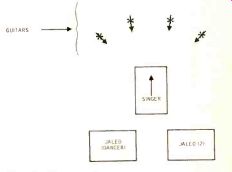
Fig. 1. The studio setup for recording these flamenco performances.
Against this we had to contend with the transient-loaded sound of the jaleo's heels, palms, castanets, fingers, and shouts of exhortation which, in tutti passages, would tend to obliterate the sound of the guitars. In live performance, the spectator can compensate for this by his visual perception: he sees the guitarists playing and therefore imagines he hears them at all times. Because the visual element is missing in a recording, the producer must restore proper aural balance.
There are roughly three ways of dealing with this problem: (1) Isolate the guitars from the jaleo; close-mike the instruments and place the jaleadors in a separate booth with their own microphone pickup. (2) Hold down the overall volume level of the jaleo in performance. (3) Establish the focal point for the basic microphone setup to cover both forces.
The first method is undesirable because it would break up the cuadro flamenco, thus preventing intimate collaboration between jaleo and guitarists.
Such an arrangement would also place the jaleo and guitarists on different planes of perspective and result in an artificial sound. The second method would make the engineer's job easier but only at the price of emasculating the musical results. In true flamenco music, no one can predict exactly when the lightning of intense feeling will strike, and when it does, look out! If the instrumentalists and jaleo have to think about reining in, you're nowhere.
We chose the final alternative as best from the musical and technical standpoints.
The recording sessions took place at United Recording's Studio A on Sunset Boulevard. The dimensions of the room were 18 feet high, 55 feet long, and 40 feet wide. The Romeros sat in a line in the center of the studio, with the outer players (Celin and Celedonio) turned in slightly. Three Neumann U-67s set to an omnidirectional pattern were suspended approximately 7 feet above the guitarists. This provided the basic pickup. The jaleo was placed opposite to and facing the Romeros. (See Fig. 1.) The principal dancer Raul Martín arrived with his own platform, a yard square of braced plywood. After a rehearsal of the Sevillanas it was decided to replace the platform because the hollow sound made the listener aware of its size. Engineer Ben Jordan found a larger platform in the studio that was equally solid and into which fiberglass had been stuffed. The effect was perfect.
We now tackled the palmas, pitos, and castanets of Isabel and Choly Martín (no relation to the dancer) and obtained good presence, except for a piercing, ringing sound on certain claps and on the castanets generally. Moving the Martins back away from the microphones failed to eliminate the ringing and dissipated the stereo effect by excessive "bleeding" into the other inputs.
Acoustical treatment was called for, something that would take the edge off the sharper sounds of the castanets and palms without in any way reducing the total impact. Waist-high panels were placed on either side of the Martins' platform and an absorptive goho rolled up behind. It worked.
The same careful balancing was applied to the Romeros and finally to the singer, whom we placed in the center between the two groups. The basic balance achieved, we prepared to "take" the first of the eighteen pieces to he recorded.
What happened in the next fifteen hours of recording is what every producer and engineer dreams of. Within the first seconds of the joyful Sevillanas, the excitement in the studio soared. Only eight performers were there but it would take a sophisticated ear to realize there weren't more. Although nothing was done to enhance or inflate the basic sound, one got the impression of a throng of participants. Accents were shooting forth from all directions-a guitar rasgueado (vigorous strumming effect), a machine-gun rat-tat-tat of the dancer's heels, an unexpected counter rhythm in the patinas, the low-pitched cries of the female jaleador. After a rousing crescendo, the piece suddenly ended. Pause. Then a torrent of Spanish words as Romeros and jaleo exchanged compliments. For two minutes and thirty keconds the performers seemed to have forgotten about the microphones and the people in the control room behind the glass panel. They were in their native Spain halfway around the globe, playing in some cafe cantante for themselves and for a small but knowing audience.
AE
+++++++++++++++
Also see: