by NEKNNAML HOP
A GREAT SET OF CHEOPS
I write this on the train from Cairo, having only a few hours ago said farewell to "Biff" Lirpa, son of the famous audio genius and tangled-string consultant, Prof. I. Lirpa. After months of negotiations, I finally arranged a meeting with Biff to check out the incredible rumors concerning his latest audio experiments. At last, he invited me to visit his Think Tank, located in a Cairo suburb behind a hummus stand.
Biff's Think Tank was in reality an old army tank purchased from a surplus bakery in Gaza. From outside, only the famous Lirpa banner flying from the radio antenna suggested anything unusual. But as I greeted Biff and climbed down into the tank, it was clear that the fighting vehicle had been highly modified for other purposes.
Glowing electronic displays, rows of switches, a few Ouija boards, and other arcane gear was crammed everywhere in the already crowded space.
My eye could just make out Prof. Lirpa's exotic collection of audio equipment, including a subminiature prototype of the Lirpa Compact Dish player (reviewed in the April 1984 issue). In the interests of secrecy, Biff confiscated my camera, as well as my pastrami on white bread with mayo; however, my notebook and pencil remained in my possession.
I settled down in the gunner's seat and observed the top of Biff's head as his voice echoed up from the driver's seat below. He explained that the fabulous success of his father's audio products had produced billions in excess cash, and that the family had decided o diversify into areas such as communications, satellites, computers, and he franchising of goldfish-grooming boutiques. Biff had assumed a lot of things, including control of research at his mother's audio-communications corporation, Ma Lirpa. Their familiar slogan, "The louder you talk, the better they'll hear," had already caused the price of their stock on the Baghdad Exchange to catapult tenfold, from 0.01 to 0.1 cents per share.
Bill's department had researched several new products, all aimed at sending messages over incredibly vast distances, using acoustic methods to avoid the high cost of wires or audio transmission. Their prototype power amplifier, Big Bertha Lirpa (named after Biff's sister, Gladys), could deliver an acoustic output of 5 million megawatts (rms), thanks to the surplus Three Mile Island nuclear reactor inside The unit comes on 28 flatbed trucks and can be operated anywhere, provided there is a large water source nearby (such as Lake Erie) for cooling purposes. NASA is considering using the amplifier to send acoustic messages to the moon, and Biff demonstrated its awesome output power in Los Angeles last year. In a highly publicized demonstration, he played a concert for folks who had recently died.
Following the success of the amplifier, the research team's direction was suddenly altered when Biff began dating Madame Zelda, a palm reader. His psychotherapist, Dr. Lucky (who was coincidentally Zelda's brother), advised Biff to take her advice seriously.
Thus a new, crash top-secret project, code-named Crash Top-Secret Project, was initiated.
"How much do you know about the pyramidology theory of digital audio?" Biff asked me as he fired up the Think Tank, put it in gear, and headed out of Cairo into the Sahara. I laughed, thinking it was some kind of joke. Instead, he responded with an explanation which grew more incredible by the minute as we rumbled across the desert. A couple of years ago, my father researched the monoliths on Easter Island and discovered that they are, in fact, highly sophisticated hot-dog vending machines, built by an ancient civilization for outdoor rock concerts.
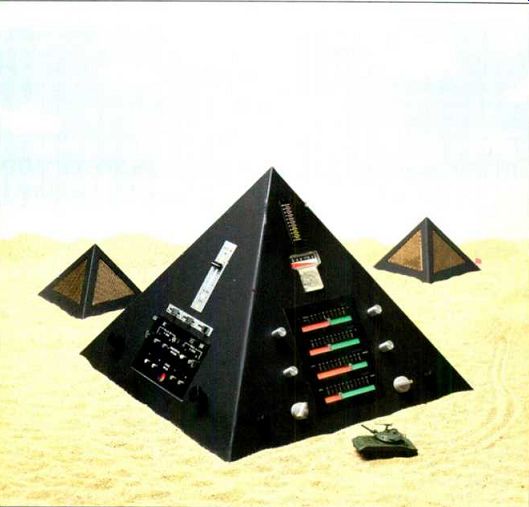
However, he could never uncover the sound system these ancients had used. But one day while watching a Star Trek rerun, the one where Spock has a food fight with the guys with inflatable heads, it suddenly occurred to me that any civilization advanced enough to tell the catsup dispenser from the mustard dispenser without making one red and the other yellow, must have designed a digital sound system. The rest is obvious!" My mystified silence caused Biff to explode with exasperation. "Don't you see? Think about the Great Pyramid of Cheops: It has exactly 2,097,152 building blocks, which is 221; in other words, 21 bits per data word. And the angle of the sides is exactly 51°, which is their sampling rate in kilohertz. Wow, what a system! There are 201 stepped tiers of limestone blocks, with an average weight of 2 1/2 tons each, all rising 485 feet over the plateau. Its base is 13 acres square-about seven midtown blocks in New York City. If you took it all apart, you could build a wall 3 feet wide and 10 feet high around France! Damn, I bet it's loud!" I looked at him blankly, still wondering how the conversation had gotten from Easter Island to Egypt, never mind New York and France. "Don't you see?" Biff asked again. "It's the world's first, and biggest, digital sound system! He pointed excitedly through the driver's slit. I peered through the gunner's periscope and there, coming up over the desert horizon-a mountain blocking the red sunset-was the Great Pyramid itself. "Don't you see? It's a stereo! Each of the 2 million blocks is a quantization interval, and when you resonate it at the sampling frequency, it plays, two channels from each of the little pyramids on the sides.
Wow, think of the bass! Those ancient Egyptians sure loved to dance!" I stared at the man-made mountain towering ever higher before us, my brain frozen with awe and wonder, and then my jaw dropped. Clearly, Biff Lirpa had unlocked the secret of the pyramids.
"Zelda thinks it was probably built by some alien astronauts who couldn't get a permit in their galaxy--I mean, who wants loud music, not to mention all the traffic, in their backyard? So they built it on Earth-got it zoned for recreational use. Easter Island was the concession stand, they probably kept the brewskis cold in Antarctica, and the Middle East here was the stage. Must have been some scene! But anyway, I want to show you just what the Crash Top-Secret Project has developed. My chief engineer Nuke Napoleon and I have replicated all of the electronics necessary to activate the pyramid sound system.
"It's really very simple. We use my Dad's Compact Dish player as a signal source, but we patch the laser beam directly into a special bebop circuit which is powered by a Briggs & Stratton lawn-mower engine modified for fission combustion. Of course, the signal is time-travelled and defrosted before it goes into the spin cycle, and it is filtered through a pair of fuzzy, red dice. The secret of the activation system is the glitter glove which is used to excite the hydraulic angular bremsstrahlung system, provided the time-space continuum isn't ripped apart when the lattice comes unglued. I mean, we are generating the energy equivalent of a head-on collision between two solar systems, which is quite a lot."
"Okay, let's stop here, about a quarter mile from the site," my guide continued, pulling the Think Tank over. "For demonstration purposes, let's activate that small pyramid over there--the Mycerinus Pyramid, which was the speaker system typically used by the warm up band. I just look through my view finder and rotate this knob on the master control panel until the cross-hairs line up on the apex. Got it! Okay, let's try a 1-kHz test tone through the system--I hope it's all still calibrated--I mean, the last concert they played here was during the fourth dynasty o the Old Kingdom, around 2450 B.C. for Pharaoh Chephren's bar mitzvah." I waited, breathlessly, to hear the ancient, digital sound system come alive after a 4,000-year intermission Biff made a final systems check, put a quarter in the slot on the master control panel, and pushed the one-play but ton. A red, beeline laser beam shows through the air and touched the apex of the Mycerinus Pyramid. Instantly the stone monument glowed a resplendent ruby-red against the twilight sky.
heard a deep groan well up from the desert sands, and the 1-kHz test tone sang out into the hot air, growing louder by the second, and then louder and louder still! I clasped my hands to my ears, shaking at the intensity of the sound, my eyes involuntarily blinking against the sonic onslaught, and still i grew louder. I screamed at Biff, but my words didn't even reach my own ears, so great was the voice of the ancient sound system, which grew even louder! Then suddenly the pyramid turned yellow, then blue, then white-and exploded. The Think Tank rocked under the impact as it was pelted with huge chunks of limestone and camel parts. Then it was over. I cautiously peered through the haze to observe a smoking crater where the Mycerinus Pyramid had once been; now it was history, slowly drew my hands from my ears, not knowing if the desert was again still, or if I had lost my hearing. Bill's voice broke the silence.
"Gee, I'm sorry about that. I guess miscalculated the power-handling capacity. You know, I always get squares and roots confused. Well, no matte', it was only a test. But when I try out the Great Pyramid, I'll use the Sphinx as a fuse, just to be safe."
(adapted from Audio magazine, Apr 1985; KEN POHLMANN )
= = = =