Equipment Profiles:
Technics SA -5550 AM -FM Receiver/Len Feldman; Sansui SR -717 Direct -Drive Turntable/George W. Tillett
----------------
Technics SA -5550 AM -FM Receiver/Len Feldman
Technics by Panasonic SA-5550 Stereo Receiver
MANUFACTURER'S SPECIFICATIONS
FM Tuner Section
Sensitivity: 1.8 µV (10.5 dBf). S/N Ratio: Mono, 70 dB. THD: Mono, 0.2%; Stereo, 0.4%. Alternate Channel Selectivity: 70 dB. Capture Ratio: 1.6 dB, Image Rejection: 50 dB. I.F. Rejection: 70 dB. Spurious Rejection: 65 dB. AM Suppression: 50 dB. Frequency Response: 20 Hz to 15 kHz, ±1 dB. Stereo Separation: 1 kHz, 40 dB; 10 kHz, 30 dB. Leak Carrier: 55 dB. AM Tuner Section Sensitivity: 30 µV, external antenna; 230 µV/M, internal antenna. Selectivity: 25 dB. Image Rejection: 45 dB. I.F. Rejection: 40 dB.
Amplifier Section
Power Output: 58 watts per channel, 8-ohm loads, continuous power from 20 Hz to 20 kHz, both channels driven; 72 watts/channel into 4 ohms. Rated THD: 0.3%. IM Distortion: 0.4%. Damping Factor: 40 at 8 ohms. Input Sensitivity: Phono, 2 mV; AUX, tape 1 & 2,180 mV. S/N,A Weighted: Phono. 70 dB; AUX, 90 dB. Frequency Response: Phono, RIAA within 0.5 dB; AUX, 5 Hz to 90 kHz, +1,-3 dB. Tone Control Range: Bass, ±10 dB @ 50 Hz; Treble, ±10 @ 10 kHz.
High Filter: 7 kHz,-6 dB/octave. Low Filter: 150 Hz,-6 dB/octave.. Tape Output Level: 180 mV.
General Specifications
Power Requirements: 120 volts, 60 Hz, 189 watts maximum.
Dimensions: 18-1/6 in. W by 5-1/2 in. H by 15-3/4 in. D. Weight: 28.2 lbs. Retail Price: $479.95.
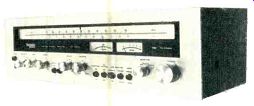
Technics by Panasonic, one of several companies which has, in recent years, concentrated heavily on four-channel receiver design, has now turned its attention towards broadening its stereo receiver product line. The new family of receivers departs from the traditional "black-out" dial styling and offers, instead, a highly visible, light-colored, illuminated dial scale area with extra-long dial pointer travel and accurate calibration marks every half MHz over the linearly calibrated FM frequency scale. The SA-5550 is the top priced receiver of this new line and, unlike the lower powered, lower costs models, features two tuning meters, positioned below the dial scale. The lower priced models employ only a single tuning-strength meter and lack the center-of-channel tuning meter found on the SA-5550. All operating controls, including the large tuning knob, are located along the lower portion of the control panel.
These include rotary controls for bass, treble, volume and balance adjustment, a speaker selector switch (the SA-5550 handles main and remote pairs of speakers singly or together, at any impedance from 4 ohms to 16 ohms, but the manual cautions against using lower than 8-ohm speakers if both pairs are to be operated simultaneously), and a program or input selector switch. Power on/off pushbutton switch and headphone jack are located at the extreme left of the panel.
Pushbutton switches are used to activate low- and high-cut filters, loudness compensation, FM muting, tape 1 or tape 2 monitor circuits, and selection of mono or stereo operation.
Reception of stereo signals is indicated by the usual illuminated inscription located just to the right of the two tuning meters.
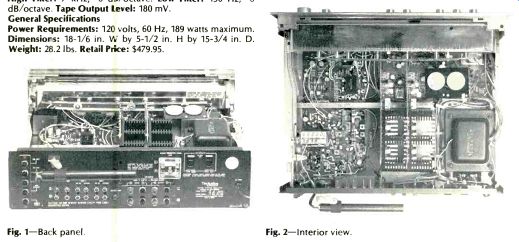
Fig. 1-Back panel.
Fig. 2-Interior view.
The rear panel of the SA-5550, pictured in Fig. 1, contains screw terminals for connection of 75-ohm or 300-ohm balanced FM antenna transmission lines, an external AM antenna, and a ground connection. In addition to the usual phono, AUX and tape input and output jacks, there is a four channel "MPX" output jack intended for future connection of a four-channel FM adaptor. Color-coded speaker terminals are of the screw type, but are widely separated to prevent possible shorts between adjacent exposed speaker wires. Individual speaker-line fuses are accessible from the rear panel by removing a transparent plastic cover which is retained in place by means of a single screw. The back panel also has a pair of convenience a.c. receptacles, one switched, and one unswitched, as well as the usual pivotable AM ferrite bar antenna.
Circuit Highlights An internal view of the chassis of the SA-5550 is pictured in Fig. 2. The front-end features a 4-pole MOS-FET in the r.f. amplifier stage and uses a frequency-linear variable capacitor for both FM and AM tuning. The i.f. section of the receiver features six-stage construction, including three differential amplifier stages and three two-element ceramic filters. A phase-lock-loop circuit is used in the stereo multiplex section. Stereo detection or switching circuitry includes a double differential switching arrangement which is all part of the high density integrated circuitry used in this section.
A ceramic filter is also used in the i.f. section of the AM circuitry of the SA-5550. The preamp-equalizer stages of the receiver take the form of a PNP-NPN, 2-stage, direct coupled circuit with direct-current, negative feedback applied from the emitter of the second stage to the base of the first stage. As for the SA-5550's main amplifier section, it is completely direct coupled with a differential amplifier input stage. The output stages are pure complementary symmetry type which use PNP and NPN transistors in combination.
The power supply of the receiver is filtered by means of a pair (one for each polarity) of 10,000 µF electrolytic capacitors.
FM Performance Measurements
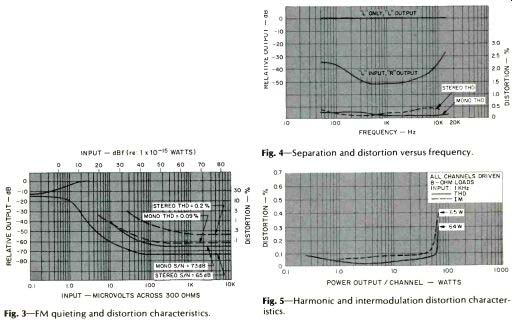
We measured usable sensitivity of 1.7 microvolts (10 dBf) for the SA-5550 FM tuner section, better than the 1.8 µV specified. The 50-dB quieting mark in mono was reached with a signal input of 3.0 µV (14.9 dBf), and maximum quieting or signal-to-noise ratio reached 73 dB with strong (65 dBf) signals. In stereo operation, usable sensitivity was 10 µV (24.5 dBf) and is governed by the threshold for switching into stereo operation. Some 36 microvolts (36.5 dBf) were required in stereo for 50-dB of quieting.
The distortion measurements were considerably lower than claimed, with readings of just under 0.1% for mono (at 1 kHz) and 0.2% for the same test frequency in stereo operation. Quieting and distortion characteristics with increasing signal strength for both mono and stereo reception are plotted in Fig. 3. Alternate channel selectivity and i.f. rejection measured 70 dB, exactly as claimed, while capture ratio was a bit better than claimed at 1.4. Although the image rejection measured 52 dB (better than the 50 dB claimed), we expected somewhat better performance, with dB figures at least as good as those for selectivity and i.f. rejection, in view of the other measured characteristics of the tuner section. This low image-rejection capability may cause problems for some listeners who are too close to airport control towers or other sources of transmission in bands above the FM frequencies.
Stereo separation, plotted against audio frequency in Fig. 4, was excellent, reaching the unusually high figure of 52 dB at mid-frequencies at, d remaining above 35 dB from 50 Hz to 10 kHz. Distortion in both mono and stereo, also plotted in Fig. 4, is consistently low at all audible frequencies, even at the high end where stereo distortion is less than 0.5% all the way up to 10 kHz (only 0.4% at the required test frequency of 6 kHz).
Fig. 3-FM quieting and distortion characteristics.
Fig. 4-Separation and distortion versus frequency.
Fig. 5-Harmonic and intermodulation distortion characteristics.
Muting threshold is set at 13 microvolts (27.7 dBf), by which time quieting has reached nearly 60 dB in mono and almost 40 dB in stereo operation. Use of the muting feature to define listenable stereo stations is therefore not particularly effective in this receiver and a user will have to judge listenability on the basis of background noise since the muting feature is not customer adjustable. Sub-carrier (19 kHz and 38 kHz) rejection was extremely effective, with carrier products fully 65 dB below 100% modulation in the stereo mode. Frequency response from 30 Hz to 15 kHz was within 0.6 dB of the prescribed 75-microsecond de-emphasis characteristic. No 25-microsecond de-emphasis is provided on this receiver and listeners wishing to use it for Dolby FM broadcast reception would have to add an outboard adaptor (in addition to a Dolby adaptor) to convert the response to that required during reception of such programs.
Amplifier Section Measurements
The amplifier section of the receiver delivered 64 watts per channel into 8-ohm loads, with both channels driven at 1000 Hz before reaching the rated harmonic distortion figure of 0.3%. Technics by Panasonic also provides a 4-ohm rating for this model (very few manufacturers have been supplying such ratings of late, because of problems created by the new pre-conditioning rule of the Federal Trade Commission audio amplifier power rule), and we were therefore especially interested in checking out performance at this lower load impedance. With 4-ohm loads, power delivered at mid-band frequencies was 77 watts per channel, as opposed to 72 watts claimed. All output measurements were made after first pre-conditioning the receiver for the required one hour at one-third of full rated output. At rated power output, THD measured 0.091% under 8-ohm load conditions and 0.14% when driving 4-ohm loads with a 1-kHz signal applied. Distortion (harmonic and IM) versus power output is plotted in Fig. 5 for the 8-ohm load condition only. The power band claimed for this receiver (20 Hz to 20 kHz) is also conservatively stated, as can be seen by examining Fig. 7. Even at 20 Hz, THD measured only 0.2%. On the basis of a 0.3% THD rating, power band could have been listed as extending from 12 Hz to 40 kHz, or the power output rating might have been increased safely to 64 watts per channel and would still conform to FTC requirements from 20 Hz to 20 kHz.
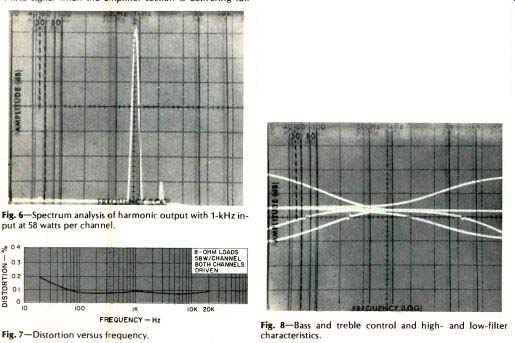
Fig. 7--Distortion versus frequency.
Fig. 8--Bass and treble control and high- and low-filter characteristics.
Fig. 9--Loudness control action.
Figure 6 is a 'scope photo of the spectrum analysis of a 1-kHz signal when the amplifier section is delivering full Fig. 6-Spectrum analysis of harmonic output with 1-kHz input at 58 watts per channel rated output (58 watts per channel at 8 ohms) and shows the presence of a minute amount of second-order harmonic content (2 kHz) with no evidence of higher order harmonics within the 70 dB range of the analyzer as it was set up for this display.
Frequency response for the phono preamp-equalizer section was within 0.8 dB of the RIAA curve from 30 Hz to 15 kHz, and input sensitivity was exactly 2.0 mV as claimed. A signal input level of 115 mV at 1 kHz was handled by the phono input circuits before 0.3% THD was observed. Overall frequency response through the high level inputs was flat within 1 dB from 8 Hz to 40 kHz, and the-3 dB roll-off point was reached at a frequency of 75 kHz. Hum and noise in phono was a very good-71 dB without using a weighting network (Technics claims only-70 dB with "A" weighting), while in high level operation, the S/N ratio was-87 dB-also unweighted.
Range of bass and treble tone controls is shown graphically in the 'scope photo of Fig. 8, with extra traces superimposed to compare the action of the low- and high-cut filters. Note that the filter action is moderate and slopes are at a rate of only 6 dB per octave, so that little is accomplished by these circuits that could not have been done by use of the bass and treble controls in less than their extreme cut positions.
Action of the loudness control circuitry is shown in the 'scope photo of Fig. 9 for different settings of the volume control and only bass compensation is afforded by this circuit at low listening levels (as opposed to some loudness circuits which accentuate both bass and treble frequencies when the volume control settings are reduced).
Listening and Use Tests
The amplifier section of the SA-5550 performed nicely for us during our extended listening tests and delivered enough power to drive two sets of low-efficiency speaker systems to good listening levels. Under normal listening conditions, heat sinks remained comfortably cool even after extended "on" time, and the amplifier seemed stable and well protected even when driven to clipping for short periods. We appreciated the click-stop action of the tone controls when enable us to repeat favored settings of these controls exactly. In addition to being able to record onto two tape decks, the SA-5550 makes provision for recording from the tape 1 outputs to the tape 2 inputs, or, from deck "1" to deck "2." Monitoring of either tape deck's output is possible by choosing the right combination of front panel tape buttons, a feature which will no doubt find favor with recording enthusiasts.
If one were asked to judge between the amplifier and the tuner sections of this well-executed receiver, picking a clear-cut winner would be a difficult matter. The tuner section has good sensitivity in both mono and stereo, and the 50-dB quieting mark is reached with fairly low signal levels.
In addition, the distortion, ultimate quieting, and selectivity performance figures are all rather good for a receiver in this price class. The amplifier section delivers a good deal of power over a fairly wide band with quite reasonably low distortion, and it is one of the few units these days which is specifically rated for 4-Ohm operation. All in all, this receiver from Technics is an all-around winner, regardless of whether you live close to stations or in the deep fringes. With a suggested price tag of $479.95, judging the SA-5550 as a superior receiver isn't hard at all.
Leonard Feldman
==============
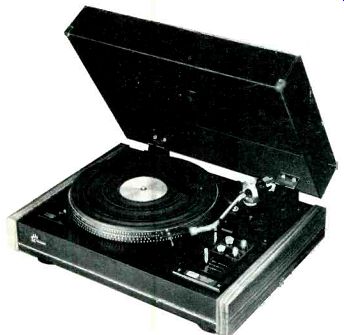
Sansui Model SR-717 Direct-Drive Turntable
MANUFACTURER'S SPECS
Speeds: 33 1/3 and 45 rpm. Fine Speed Adjust: ±4%. Wow and Flutter: 0.035% weighted rms. Signal-To-Noise Ratio: Better than 60 dB. Tonearm: Statically balanced, S-shaped tubular. Features: Oil-damped tonearm lifter, lateral balancer, direct-readout stylus-force dial, inside force cancellor. Dimensions: 20 in. W x 15 1/2 in. D x 7 1/2 in. H. Approximate Nationally Advertised Value: $350.00.
There's no doubt about it, these modern turntables bear little resemblance to the old models of just a few years ago! A prime example is the SR-717, Sansui's new top-of-the-line direct-drive unit par excellence. It is rather larger than most turntables, measuring 20 inches wide by 15.5 inches deep.
The top plate and in fact the whole unit is finished in a charcoal black with silver trim, making a nice contrast with the polished wooded endpieces. The 9.25-in. arm is an S-type, and it has a gimbal suspension using knife-edge supports in the vertical plane. The rotatable counterbalance is calibrated in pressures from 0 to 2.5 grams, and there is provision for an additional weight if the cartridge is heavier than 11 grams. On the left of the arm pivot is a shaft for a lateral balance weight, and a suspended weight with calibrated spindle is used for the anti-skating adjustment-what Sansui calls the "inside force cancellor."
The controls are simplicity itself: a press-button for 33 1/3, another for 45 rpm, each one having a small variable speed control next to it. There is a 3-position lever switch marked Off, On and Play, the last named position operating the arm lowering device. The strobe light is mounted at the front to the left, and the strobe speed markings (50 and 60 Hz) are on the turntable rim. The turntable is made of an aluminum alloy and turns the scales at just over 3 lbs. The motor is a 20 pole d.c. brushless servo type driven by an electronic supply unit that employs 20 transistors plus an IC. A voltage selector is underneath with the phono sockets at the rear, and the complete unit is mounted on four heavy-duty shock-absorber feet-a method of suspension I have always favored.
Measurements
As the cables supplied were low-capacity types, a CD-4 phono cartridge (Audio-technica AT-20) was used for the tests-or most of them. Setting up took a little longer than usual due to the more complicated anti-skating arrangement and the cartridge needed that extra arm weight for correct balancing. Then there was the lateral balancing to be done, but the whole process only took a few minutes. The first test was for wow and flutter, and the measured figure was very low indeed at 0.04% using the DIN 45-507 standard.
I expected rumble to be low too, and I was not disappointed as it measured better than-67 dB (ARLL), which is exceptionally good. The speed control gave a variation of +5 and-3% at 33 1/3 and ±4% at 45 rpm. As with most modern arms, the vertical and lateral friction were too low to measure accurately although no figures are quoted by Sansui. Tracking error was within 0.5 degrees per inch, a good figure for this type of arm. Accuracy of the stylus-force dial was well within 5%, and the anti-skating calibration was found to be very satisfactory. (It gives a choice of four positions: 0.5, 1, 1.5 and 2 grams.) As the motor is servo controlled from a stabilized power supply, speed accuracy is not determined by the line voltage or frequency. Once the speed control has been set, the speed remains rock steady and no further adjustment will be required.
Use Test
The SR-717 was on test over a period of several weeks-it was such an easy unit to use, I was reluctant to change it! After playing a number of CD-4 records, including ones made with the experimental RCA Quachalator, 1 changed the cartridge for a Shure V-15 Mk III to find the optimum tracking force. As expected, this came out at 11/4 grams and the anti skating device was also set at that force. As I have pointed out previously, CD-4 cartridges with a Shibata stylus need rather more force but the effective weight on the record is spread over a greater area. I ought to have mentioned earlier that the unit comes complete with a transparent, hinged plastic lid which adds the finishing touch to a very handsome piece of equipment. As we have seen, it is a top performer too-certainly one of the best half dozen units now available at any price. It's not particularly cheap but then products of this caliber rarely are....
George W. Tillett
------------
++++++++++
--------------
(Audio magazine, 1976)
Also see:
Record Cleaners Revisited/B.V. Pisha
= = = =