Three Car Radios Tested
by LEONARD FELDMAN
EXACTLY ONE YEAR ago we examined five car radios produced by as many manufacturers and intended for add-on installation in an automobile after the car leaves the factory. Prices of the units tested ranged from a low of around $170.00 to a high of over $800.00 and all of the units measured had provisions for either cassette or 8-track cartridge playback. Results were disappointing if one were to compare the performance of any of these units with that from even the least costly, low-powered, high-fidelity AM/FM stereo receiver intended for home use. In fact, considering their fairly low power output capabilities, their high distortion measurements, and their relatively poor sensitivities and 50-dB quieting points, we were rather surprised at the fairly pleasant kind of sound these car units delivered when hooked up to a pair of speakers typically used in automobile installations.
Recently we were contacted by Pioneer of America (one of whose models had been tested for that report last year), who told us that they had developed and were going to market a "true" high-fidelity car stereo FM radio with cassette playing facilities. Rather than test that new model by itself, we decided that it might be a good idea to have another look at a few more of the current crop of car add-on radio/tape units. So, this current test report includes not only the Pioneer KP-500 unit, but a new unit from Motorola as well as a current model from Panasonic.
All three units tested operate from 12 to 15 volt power sources, with ground or chassis returned to the negative terminal of the car battery. All of the units employ 75-ohm unbalanced antenna inputs and use coaxial connectors of the type which normally feed car antennas to built-in factory supplied radios. The Pioneer KP-500 has only FM reception, while both the Panasonic and Motorola model offer AM reception as well. All three units can play back prerecorded cassettes. The Pioneer unit is intended for under-the-dash mounting, while the other two units are intended for in dash installation. The Motorola unit employs a clever cassette insertion arrangement, which has also appeared elsewhere, in that the entire dial scale, pointer and all, simply flips up and inward as a cassette is inserted (with its long dimension running from front to back). This not only makes the unit extremely compact (7 in. wide by 7 in. deep by 1-7/8 in. high) but helps discourage theft, since one cannot tell by looking at the unit that it does have provision for cassette tape playing, thus making it less desirable. Both the Panasonic and the Pioneer units have separate cassette doors, but in each case the cassette is inserted with its short dimension running from left to right to conserve panel space.
----------------
BRAND AND MODEL
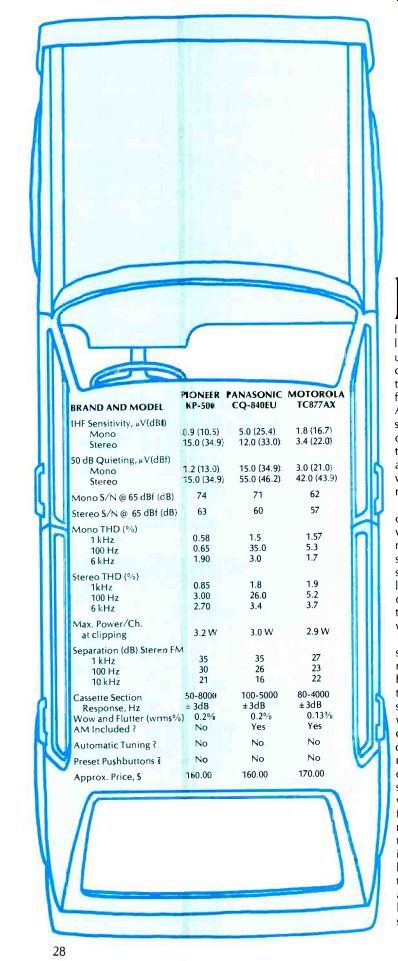
IHF Sensitivity, 44V(dB0 Mono Stereo 50 dB Quieting, µV(dBf)
Mono Stereo Mono S/N @ 65 dBf (dB)
Stereo S/N @ 65 dBf (dB) Mono THD (%) 1 kHz 100 Hz 6kHz Stereo THD (%) 1kHz 100 Hz 6kHz Max. Power/Ch.
at clipping Separation (dB) Stereo FM 1 kHz 100 Hz 10 kHz
PIONEER PANASONIC MOTOROLA KP-SOft CQ-840EU TC877AX
0.9 (10.5) 5.0 (25.4) 1.8 (16.7)
15.0 (34.9) 12.0 (33.0) 3.4 (22.0) 1.2 (13.0) 15.0 (34.9) 3.0 (21.0) 15.0 (34.9) 55.0 (46.2) 42.0 (43.9)
62 57 74 63 71 60
0.58 1.5
0.65 35.0 1.90 3.0
0.85 1.8 3.00 26.0 2.70 3.4 3.2 W 3.0 W 1.57 5.3 1.7 1.9 5.2 3.7 2.9 W 35 35 27 30 26 23 21 16 22
Cassette Section 50-8000 Response, Hz s 3dB Wow and Flutter (wrens%) 0.2% AM Included ? No iseeAutomatic Tuning ? Preset Pushbuttons Approx. Price, $ 100-5000 80-4000 f3dB ±3dB
0.2% 0.13% Yes Yes No No No No No No 160.00 160.00 170.00
--------------------------
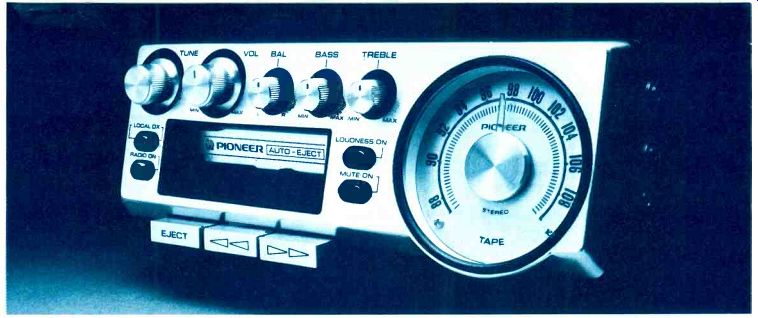
Pioneer of America, KP-500
The Pioneer unit was the only one of the three tested which is supplied with a really complete set of published specifications, and quite impressive they are too. Usable sensitivity is listed as 12.0 dBf (1 µV @ 75 ohms), and 50-dB quieting in mono is 14.3 dBf (1.4 µV @ 75 ohms). Selectivity is given as 74 dB, while a capture ratio of 1.8 dB is claimed. S/N ratio (presumably in mono) is given as 68 dB. Audio power output is listed at 3.8 watts per channel (with no qualifying values of THD or power band), and-surprise of surprises-the bass and treble controls offer 10 dB of boost or cut at 100 and 10,000 Hz (unlike the usual single control "treble cut" tone control systems offered on most car units). Wow and flutter for the cassette tape mechanism is listed at 0.3%. The KP-500 has a suggested retail price of $160.00. The front portion of the KP-500 slopes slightly upwards which provides improved visibility of controls and dial settings. At the right is a circularly calibrated FM frequency dial with a clock-type rotating pointer. Frequency calibration is at every 2 MHz and is almost, but not quite, linear. Along the upper edge of the panel, to the left of the circular dial, are tiny bass, treble, and balance controls and somewhat larger knobs for volume adjustment and station tuning. Below the tuning control are three tiny toggle switches, one of which introduces interstation muting, another providing two levels of FM sensitivity for Local or Distant reception, and the third for turning on the radio. Even with this Radio On switch in its off position, power is automatically turned on when a cassette is introduced into the nearby compartment. To the right of the cassette compartment door is another toggle switch which actuates a loudness control circuit. Below the cassette door are three rectangular transport controls, stop/eject, fast-forward, and rewind. No "play" button is needed since normal tape transport at 1-7/8 ips occurs when the cassette is fully inserted. The multi-conductor cable at the rear of the unit terminates with a socket, a plug connected to the positive supply lead (fused, with in-line fuseholder supplied), and speaker connecting leads, including ground returns. A recessed receptacle on the rear surface accepts the coaxial antenna connector referred to earlier.
FM Performance Measurements Quieting and distortion characteristics for the Pioneer KP 500 in both mono and stereo operation are plotted in the graphs of Fig. 1. IHF usable sensitivity in mono was 0.9 µV (10.5 dBf), as opposed to the 1.0 µV claimed. Best S/N ratio in mono was 74 dB, while 50 dB of quieting in mono was reached with a signal input of only 1.2 AN (13.0 dBf). Stereo sensitivity and 50-dB quieting were both governed by the stereo switching threshold which occurred at 15 AN (34.9 dBf), by which time S/N was already 52 dB, reaching a maximum of 63 dB for strong signals. THD in mono was 0.58%, increasing to 0.85% in stereo for a 1-kHz signal.
Figure 2 shows stereo separation capability, as well as distortion in mono and stereo, for different audio frequencies.
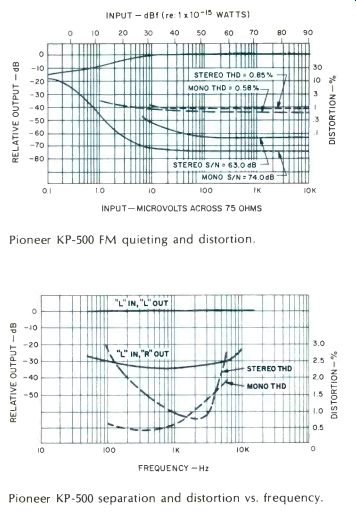
--- Pioneer KP-500 FM quieting and distortion. Pioneer KP-500 separation and distortion vs. frequency.
THD at the low frequencies was rather high, in stereo, reaching 3.0% at 100 Hz. Separation at 1 kHz was 35 dB, decreasing to 21 dB at 10 kHz. Audio response generally followed prescribed 75 microsecond de-emphasis at the mid and high frequencies, but is deliberately rolled off at the low end, probably to prevent distortion from the limited response of loudspeakers generally used in automobile installations.
Capture ratio measured just under 1.8 dB, while measured alternate channel selectivity was 70 dB-quite excellent for a unit of this type, even if a bit short of claims. Muting was overcome with a signal input of 8.4 µV (29.9 dBf). While dial calibration was off in the worst case by 1.5 MHz at 98 MHz, we understand that our sample was subjected to some severe environment and shock tests before being submitted to us and perhaps this degree of error in calibration may have resulted from these earlier tests. Certainly, the calibration could be easily adjusted and we do feel that in a car radio calibration is particularly important, since drivers cannot spend much time peering down at the dial while operating their vehicles.
Amplifier and Cassette Section Measurements All measurements were made with a supply voltage of 14.0 volts d.c., and 4-ohm resistive loads were used for all power measurements of this and the other receivers tested. For a 1.0% THD level at 1 kHz, the unit delivered 2.75 watts per channel (with both channels driven). At 10% THD, power delivered was 3.2 watts per channel, still somewhat short of the 3.8 watts claimed. Had a 3.2 ohm load been used (the nominal impedance of car speakers), perhaps the unit would have managed to "squeak through" at the claimed 3.8 watts per channel, albeit at 10% total harmonic distortion. Tone control action was as described, and it was nice to finally find a car unit that actually incorporates separate bass and treble controls that really work. Loudness control circuitry also worked as expected and seemed well calibrated in terms of the action of the master volume control.
Wow and flutter of the cassette mechanism measured
0.2% W rms. Using a test cassette tape, which we recorded for this purpose on our Nakamichi 1000 deck (known to have response out to 20,000 Hz) using low-noise high output tape, playback response of the KP-500 cassette player extended from 50 Hz to 8 kHz for the-3 dB rolloff points.
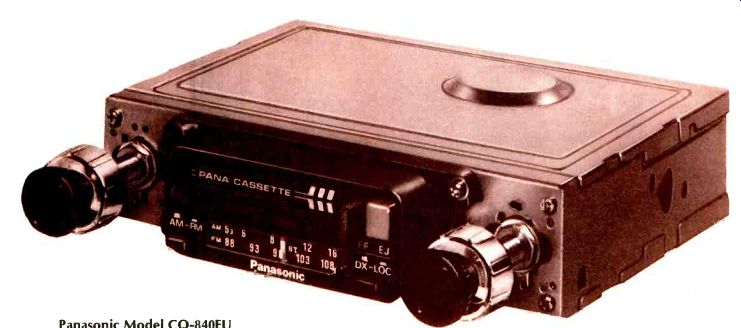
------ Panasonic Model CQ-840EU The Panasonic unit tested also retails for just under
$160.00 and lists a power output capability of the amplifier section of 3.5 watts per channel (at 400 Hz, for 10% THD, into a 4-ohm load). Wow and flutter for the cassette section is given as less than 0.4% W rms and frequency response for the cassette section is claimed to be from 50 Hz to 10,000 Hz (with no "plus or minus dB tolerance given). The only meaningful FM performance specification listed by the manufacturer is stereo FM separation, at 25 dB. The unit is also extremely compact, measuring 7 in. by 7 in. by 1-23/32 in. high.
Since this unit is intended for in-dash mounting, major controls are arranged much like those found on factory-installed radios, that is, concentric volume on/off and tone control knobs are at the left, while the tuning control is at the right. There is no balance control provided. The cassette insertion slot is centered above the frequency dial, which contains only a few frequency notations, thus serving only as a guide to the frequency being tuned in. An FM stereo light is also included in the dial area. Slide switches at either side of the dial area select AM or FM operation and DX (distant) or LOC (local) sensitivity. Eject and Fast Forward pushbuttons are located to the right of the cassette door. A short length of coaxial cable emanates from the rear of the unit for connection of the car antenna's cable and plug. Separate speaker cables and power wire (with built-in fuse) plug into appropriately labeled sockets on the rear of the chassis.
FM Performance Measurements
Figure 3 plots quieting and distortion characteristics of the Panasonic CQ840EU for mono and stereo reception. IHF sensitivity measured 5.0 µV (25.4 dBf for 75-ohm input), while in stereo, sensitivity was 15 µV (34.9 dBf). Ultimate S/N in stereo was 60 dB, 71 dB for mono. THD measured 1.5% in mono and 1.8% in stereo for a 1-kHz audio signal at 100% modulation. The 50-dB quieting points for mono and stereo were 18 AN (36.5 dBf) and 60 AN (47.0 dBf), respectively. Stereo threshold (switching) occurs at a signal input of 3µV (21 dBf). Limiting is poor in comparison to home units, as evidenced by the rather high signal strength required before audio output levels off at its highest value. Separation and distortion as a function of frequency are plotted in Fig. 4.
Best stereo FM separation measured 35 dB at 1 kHz, decreasing to 16 dB at 10 kHz.
Useful response of the radio portion of this unit does not extend much below 200 Hz, by which frequency distortion is already above 4.0%. The rising distortion is, however, compensated for by the fast roll-off in response built into the set.
At 200 Hz, response is already down some 9 dB below the 1-kHz reference point. With the tone control fully clockwise, high end response rolls off rapidly too and is down some 11 dB at 10 kHz compared to the required de-emphasis characteristic called for in FM. With the tone control in its counterclockwise position, response at 10 kHz is down 32 dB at 10 kHz relative to mid-frequency response, 21 dB down at 5 kHz.
Cassette Section Performance
Wow and flutter of the cassette section of the Panasonic CQ-840EU measured 0.2% W rms, exactly equaling the readings obtained with the Pioneer unit. Playback frequency response extended from 100 Hz to 5000 Hz with reference to the-3 dB roll-off points.
Amplifier Section At 1.0 watt output per channel of a 1 kHz signal, THD of the Panasonic unit (using 4-ohm loads) measured just under 2.0%. The 10% THD point was reached when 3.08 watts per channel were delivered to the resistive loads. With a 200-Hz input signal, the 10% THD point was reached at a power output of 2.5 watts, indicating a limitation at the low end of the audio spectrum.
----------- Panasonic CQ-840EU FM quieting and distortion.
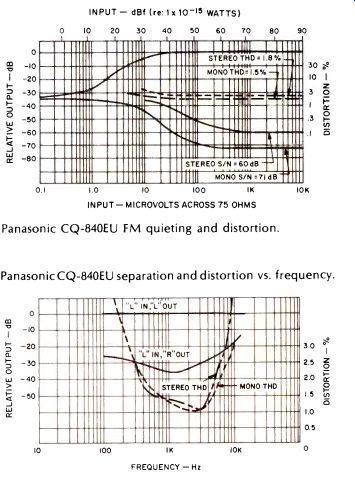
Panasonic CQ-840EU separation and distortion vs. frequency.
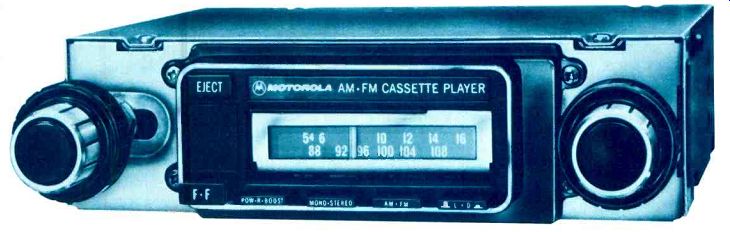
Motorola Model TC877AX The third automobile radio/cassette unit tested was a Motorola Model TC877AX which is offered for sale at an average retail price of $170.00. This unit is almost identical in size to the Panasonic unit and, like it, is intended for in-dash mounting. The control layout includes dual concentric knobs at left and right, with volume and tone controls forming one pair, and tuning knob plus balance control constituting the second pair of rotary controls. Long threaded shafts associated with these control pairs make for easy installation of the unit, and the distance between these control pairs can be varied by loosening hex nuts which retain the controls in place and sliding the entire control from left to right in wide slots provided.
As we noted earlier, the dial area pivots out of the way to accept a standard tape cassette inserted with long dimension oriented from front to back. A cassette Eject button is located above and to the left of the dial/cassette opening, and below it are three illuminated indicators which spell out Stereo, AM or FM and Tape, depending upon type of programming selected or tuned to. A fast-forward button (which must be held in to work) is located below these indicators. Along the bottom of the exposed section of the panel are four thin push buttons; one is a local/distance switch, the second selects AM or FM reception, the third selects mono or stereo, and the fourth is labeled Power Boost, about which we shall have more to say presently. Emanating from the rear of the chassis are a short length of cable with the standard coaxial connector and sets of color-coded wires terminated in polarized speaker plugs for connection to the pair of speakers used. A separate black wire, with built-in line fuseholder and fuse, connects to the positive voltage supply of the automobile.
While supplied with well-written installation and operating instructions and the necessary brackets and hardware for easy mounting, there were no performance specifications supplied with the receiver. A full schematic diagram is included in the owner's manual though, and we were somewhat surprised to note that AM and FM circuitry are completely independent in this little unit. Three tuned circuits are used in the r.f. section of both the FM and AM tuners (tuning is accomplished inductively rather than by means of variable capacitors-typical practice in automotive radios). What is Power Boost? Flipping Motorola's Power Boost switch raises the sound level by changing the voltage divider action of the volume ...
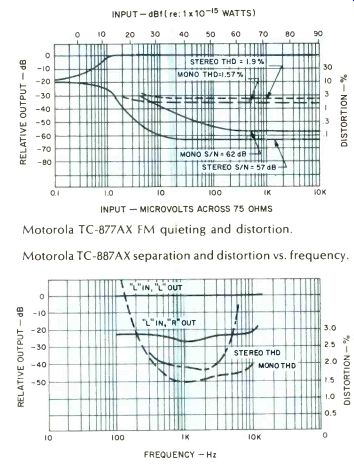
Motorola TC-877AX FM quieting and distortion. Motorola TC-887AX separation and distortion vs. frequency.
...control circuitry and also gives a different frequency response characteristic. In other words, when the switch is depressed, gain is increased by a finite amount so that program material sounds louder with a different frequency response.
There is no increase in total power output capability regardless of which of the switch positions is selected-just a change of gain! The point of this, says Motorola, is to quickly change the unit's output to a higher level with a response tailored to mask ambient noise, which is, of course, much higher on the road than in the home. An interesting approach to the problem of road noise but we would rather have had a higher powered amp section.
Circuitry is otherwise quite conventional with bi-polar transistors used even in the r.f. amplifier of the FM section, quadrature detection of FM, and a phase-lock-loop multiplex decoder section incorporated. Two-stage tape preamplifiers are used for the cassette playback section. Selection of AM or FM is effected by simply applying supply voltage to the appropriate circuits. Power output stages are push-pull and use PNP-NPN complementary pairs, with 1000 µF capacitive coupling to speakers.
FM Performance Measurements
Quieting and distortion characteristics of the Motorola TC877AX unit are plotted in Fig. 5. IHF sensitivity in mono measured 1.8 µV (16.5 dBf), while in stereo the sensitivity was 3.4 µV (22.0 dBf). To reach 50 dB of quieting, 2.9 µV (20.7 dBf) of signal was required in mono, 42 µV (43.9 dBf) for stereo. Signal-to-noise ratio in mono reached 62 dB with strong signal inputs and 57 dB in stereo. Mono THD was 1.57% in mono and 1.9% in stereo for a 1-kHz modulating signal.
Stereo threshold was the lowest of all three, measuring 1.0 µV. This might prove to be a disadvantage (at these low signal levels, stereo reception is all but impossibly noisy) were it not for the stereo/mono switch provided on the front panel which allows the user to switch back to quieter mono reception when weak-signal stereo reception is too noisy.
As shown in Fig. 6, stereo separation at 1 kHz measured 27 dB for the Motorola unit and remained relatively good out to 10 kHz, at which frequency it measured 22 dB. The use of that phase-lock-loop IC circuit (Motorola's own) no doubt is helpful here. Distortion at low audio frequencies was up (5.2% at 100 Hz), though frequency response is not rolled off quite as rapidly in this unit as in the Panasonic. Response was down some 5.5 dB at 50 Hz and was accurate to within 3 dB up to 15 kHz at the high end (with tone control in the maximum clockwise position, of course). We measured a selectivity of 65 dB and a capture ratio of 2.5 dB for this receiver. Dial calibration was quite accurate though again, only a few numbers (without precise points or marks) are inscribed for AM or FM station selection.
Cassette Tape Section
The Motorola unit had the best wow-and-flutter measurements of all three units tested, 0.13% W rms, though its playback response extended only from 80 Hz to 4 kHz ±3 dB. Amplifier Section Measurements The amplifier section of the Motorola unit delivered 2.9 watts per channel at 10% total harmonic distortion using a 1 kHz input signal. Distortion decreased to 2.0% at 2.0 watts output but remained higher than 1.0% down to power output levels of 1.0 watt.
Conclusions The table summarizes the important measurements made for the three units tested. Clearly, Pioneer's claim that they have succeeded in producing a "true hi-fi" car radio/cassette player comes close to being fulfilled in terms of the unit's FM reception capability and cassette performance. The Motorola unit runs a not-too-close second in FM performance but is clearly worse insofar as cassette playback response is concerned, though it did have excellent wow and-flutter numbers for the transport system. As the table clearly shows, power output was quite similar for all three units, within a couple of tenths of a watt. This raises an interesting point. According to the Federal Trade Commission rule on power disclosure for home entertainment amplifiers, all of these units should have had to disclose power output in the now-approved and complete fashion required by the FTC for all amplifiers delivering more than 2.0 watts per channel. Is the loop-hole in the word "home entertainment?" If so, that loop-hole needs plugging we think. As it stands, all three amplifiers are rated at around 3 watts, yet there were fairly substantial differences in the power band which would have had to be published had these products been subject to the FTC rule.
In listening tests (performed in our lab, and not in a moving vehicle), the Pioneer KP-500 also won hands down and was noticeably more sensitive (receiving a greater number of stations than the other two when hooked up to a simple indoor dipole antenna with a suitable matching transformer for unbalanced 75-ohm connection). In the test report we did for five car radios last year I concluded with the following statement: "Maybe I'm letting my audio snobbery show by suggesting that I'd like to put a small d.c.-to-a.c. converter in my car trunk to power a small home-type hi-fi receiver for serious listening on the highway. Since that's difficult and pretty expensive, I will admit that FM stereo listening can be fairly pleasant using one of these medium-fi auto units." It appears time to modify that statement somewhat, if only insofar as the Pioneer entry is concerned. While still a long way from meeting the performance of the amplifier sections of even the most moderately priced home stereo receivers, the FM section has made a great step forward and is the equal of some home-bound hi-fi components. Its cassette reproduction, while not equal to that of home stereo cassette decks (and not equipped with record or Dolby playback facilities) does provide response that is far better than you can get from many AM transmissions and not very much worse than that obtained from some FM broadcasts. Since FM on the road is, at best, a hit and miss proposition, having cassette facilities on these relatively low-cost units is a worthwhile addition, particularly if you are in the habit of recording and preserving your favorite selections on home cassette decks. Such recorded cassettes can be tucked in your pocket next time you travel and popped into such units for added listening pleasure in your car.
===============
Car Speaker Placement
Tomlinson Holman
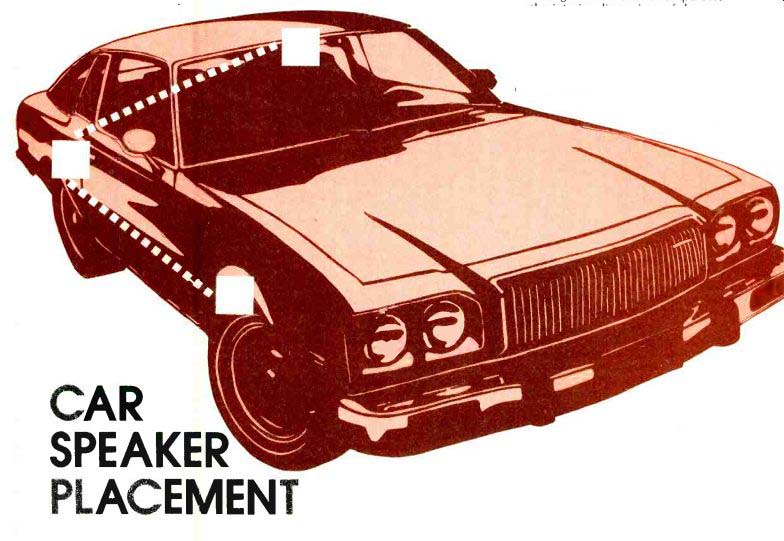
THE INTERACTION between loudspeakers and listening environments has been studied for home listening rooms and auditoria for many years. Recently, there has been increased interest in high quality reproduction in automobiles.
Since loudspeakers can be expected to operate differently in the small, sealed space inside automobiles, we set out to measure some effects of these interactions. As a reference, a wide-range speaker system small enough for use in a car, the Advent Model 400 loudspeaker, was measured via pink noise and a real-time analyzer in various listening room locations, averaging three microphone positions for each, to arrive at an averaged composite curve. This curve, depicting the integrated frequency response of the loudspeaker operating into the type of environment for which it was designed, was used as our reference. Then the same speaker was placed in various positions in an Audi Fox and a cluster of measurement microphones were located to simulate the driver's listening position. The curves taken in the car were then compared to the room response composite curve, and the difference between each of them and the room curve was plotted.
Figure 1 shows the difference between auto and listening room responses which results from placements on the left and right sides of the rear deck with the speakers facing forward. Figure 2 was derived by removing the drivers from their enclosures and installing them, along with the LCR frequency tailoring network which sets the octave-to-octave musical balance of the system, in the bottom front portion of the front doors. In this case the door serves as a baffle. Figure 3 gives a comparison of the overall average response that we measured in this car with the mean response in rooms. The difference is considerable and most pronounced between 100 to 500 Hz and 1600 to 8000 Hz.
Differences between the various placements are seen in these figures.
In general, the high frequencies seem to hold up better in the door placement. The low end response between 160 and 800 Hz is complex and highly sensitive to position. At frequencies beyond 4 kHz, an effect was noted in the graphs and audibly confirmed-in this car the headrests have a shadowing effect which reduces the very high frequency response for rear deck placement and front seat listening. All in all, it appears that the door placement is best for this car.
We can guess at some reasons for the effects seen. The speaker drivers mounted in a car operate into a rather bizarre group of coupled cavities and boundary surfaces which affect the frequency dependence of the radiation resistance in odd ways, and so the power response is altered. Between 160 and 800 Hz, speaker placement is critical. In addition, the wavelengths involved are comparable to the interior dimensions of the car; standing wave problems occur at higher frequencies than in rooms due to the small size of the space. The listener does not usually have an unobstructed on-axis path to the speaker, and with less than perfectly dispersive drivers, aberrations in the high end response and in localization cues for stereo effect are likely.
At the very lowest frequencies an interesting effect appeared (not shown in the graphs); when the windows and doors are closed, the listener is essentially inside an acoustic suspension loudspeaker system and the frequency response does not roll off at the predicted rate below resonance but, instead, remains flat to subsonic frequencies. This comes about from being inside a sealed box with dimensions much smaller than a wavelength were the rules for sound propagation in free space do not apply.
Next, the noise spectrum of the Audi was measured at 55 mph on a good highway. We found that this car produces the most noise in the 100 and 125 Hz one-third octave bands, with rapid fall-off both below and above these bands. Interestingly, this peak coincided with the region of maximum positive interaction for the speakers. This can prove to be a helpful interaction since loudspeaker output should be boosted in this range to avoid masking by car and road noise.
In the high frequency band, too, the boost which the car environment produces is in the right direction since an elevation of high frequencies can produce both better intelligibility on voice and improved definition on music.
Notes
1. The placement of drivers in the rear deck lid facing upwards was avoided for a number of reasons. First, one would expect some rather violent frequency response anomalies from the interaction of the space trapped between the rear window and deck, and the rest of the car-similar to a badly matched horn. Also, such placements result in more extreme temperature excursions and sunlight which may result in premature wear.
2. A distinct disadvantage to rear placements showed up on a long overnight trip. The driver, who needs the stimulation of the radio to prevent drowsiness, is the furthest from the sound source, while the rear seat passengers are blasted by the levels needed by the driver.
3. The Audi used had cloth interior seats; we made no measurements on sedans with vinyl interiors. We did measure the response for one location in a Buick Sport Wagon with vinyl interior-results had the same general direction and shape as in the Audi. Advent Corp., Cambridge, Mass.
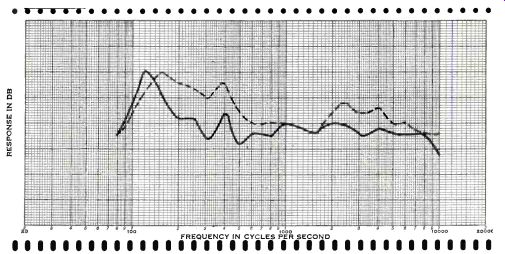
Fig. 1--Difference between car and room response for left rear (dashed) and
right rear (solid) placements (5 dB per large division).
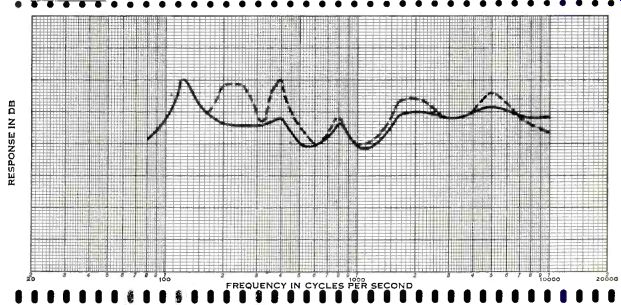
Fig. 2--Difference between car and room response for left and right (dashed
and solid) front door placements (5 dB per major division).
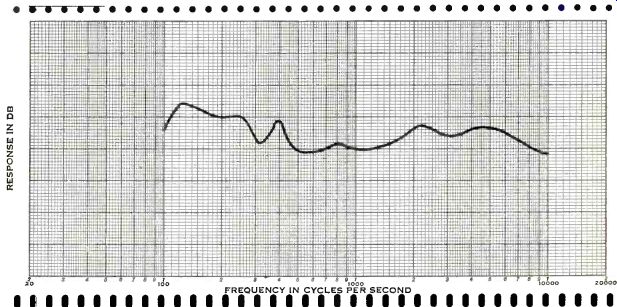
Fig. 3--Difference between mean car response for the four positions and the
room response (5 dB per major division).
ADVERTISEMENT:
BREAK THE SOUND BARRIER. The ADS-2002/Nakamichi 250 music system opens up a new era: genuine high fidelity from a miniature system for your automobile and your home.
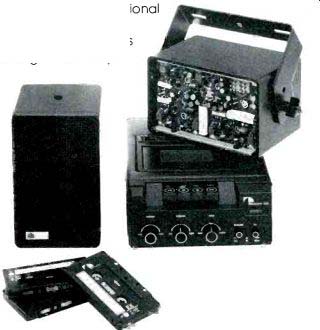
For the first time ever, you now can enjoy the same high quality music reproduction that you have come to expect from the finest component stereos in your automobile, boat, and motor home. ADS and Nakamichi Research, both famous for their superb home and professional audio equipment, have jointly developed a unique stereo system to bring you your own 55 mph concert hall. But, you can also remove the entire set in seconds and convert it to AC-operation: then take it to your summer cottage, dormitory, office, or wherever you like.
This miniature music system is so small, it easily fits in your briefcase; it consists of two high performance 2-way loudspeakers, six built-in, ultra modern power amplifiers and a tiny studio quality cassette player equipped with Dolby circuits and all controls for the system. For home use there is an optional AC-power pack. Drive to your nearest ADS dealer and ask him about the 55 mph Concert Hall. You will hear a dream come true.
01S2002 with NAKAMICHI 250 (Right ADS2002 shown without mounting bracket. Left ADS2002 shown with back panel removed).
ADS, ANALOG & DIGITAL SYSTEMS, INC. 64 INDUSTRIAL WAY WILMINGTON, MA. 01887, U.S.A.-(61 7) 658-5100.
Distributed in CANADA by A. Allen Pringle, Ltd., 30 Scarsdale Road, Don Mills, Ontario BY ADS 1976.
(Audio magazine, 1976)
Also see:
Equipment Profiles: E88 "Eclipse" Model 2240 Electronic Crossover/Leonard Feldman; Garrard Model 86SB Turntable/George W. Tillett
Audio in General (Departments): Audioclinic/Joseph Giovanelli; Tape Guide/Herman Burstein; What's New In Audio ; Audio ETC/Edward Tatnall Canby ; Behind The Scenes/Bert Whyte
Energy-Time Test/Richard C. Heyser
= = = =