EDWARD TATNALL CANBY
RADIO REVELATIONS
Somehow in my audio-bio segments I have not yet told several FM stories, including the first time I heard hi fi via FM, referred to in April. I write too much, like the rest of our tribe, so I pulled that story out of the column before the Editor even had a chance to see it. Now I'll tell it, along with another one, maybe my favorite.
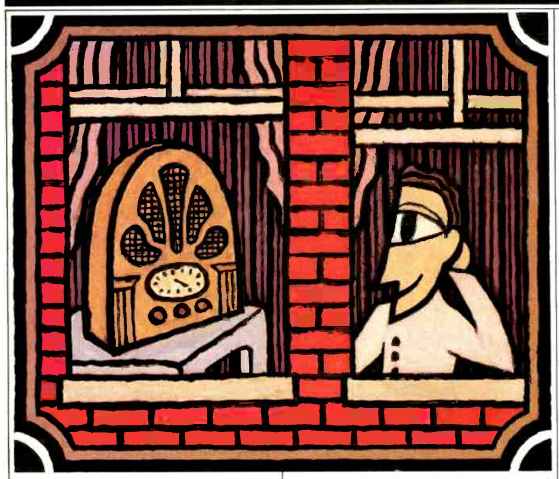
As I've said, I heard FM sound considerably before my stint at an FM station. Time flies-I had to go through a long calculation by calendar, remembering residences, jobs, world events, before I could fix a date. I came up with the autumn of 1941. That's a long way back--could I be wrong? No--though I didn't write down the date at the time.
It wasn't yet Pearl Harbor by a few months. Life went on outwardly on a peacetime basis, but do not think it was really that way. Since Munich, 1938, the axe had been poised to fall on us too, one way or another.
So in the autumn of 1941 I moved into a sort of emergency communal apartment in New York's Greenwich Village. It was a lovely little 18th-century brick house with four tiny floors, two rooms on each, the whole of which we rented for $100 a month. Nothing wrong with prices in those days. I shared a front room--the front room--on the second floor with my cousin, also in need of housing. We ate communally in the small basement dining room and had a Father Divine "angel" to cook us one glorious meal a day.
She answered our phone with a loud "Peace!" instead of hello. My friends were baffled.
On the first floor (a half-flight up, in the New York manner) was the living room, a combined front and back parlor with large open doors between. I soon found a big console radio, a floor model, set up in one corner for our use.
The very first time I heard that thing I realized it was quite peculiar. It didn't seem to make any of the familiar radio sounds-that muddy hiss of dirty white noise, the occasional burst of static, the faint but incessant interference from other stations in the background.
And when the sound came on, it had none of the standard muffled texture--thick, mushy bass and no highs. The voices didn't sound like radio voices, which never had a trace of sibilant midrange. (Those effects would have attracted no attention, either mine or anyone else's. It was just normal radio.) But when the evening news came on this radio, things were weird. A man just began to talk, quietly, like one more person in the room. He was alive, right there. You didn't even have to turn him up. You could get everything he said even at low volume.
Even more peculiar-this is faithful to my memory of the time-the radio didn't seem to be turned on. It was dead. There was just this voice. When you turned the machine on during a moment of broadcast silence (there was plenty on experimental FM!), nothing happened. No sound. Was the wall plug loose? Did the on/off switch work? (I was soon trying the thing out when nobody was around.) You flipped the on/off back and forth, doubtfully. There would be nothing. Dead silence. You thwacked the cabinet, to see if that would make it start. No use. But the red "On" light was lit. How could it be? Then suddenly this voice would start talking right beside you. You jumped.
Ever so casually, he read you the news or announced the next feature in a low tone, right at your elbow. Out of a dead radio? It couldn't be. That was the impact of 1941 FM the first time you ever heard it, as other oldsters will agree.
This was the very earliest FM broadcasting, remember, regularly on the air though still experimental; it was low band, mono, with a highly potent signal coming out of that original Armstrong station a few miles from the city. Everything in this FM was proto-commercial, and every detail, as I've noted in the past, was tailored and supervised by Major Armstrong himself, including the receiving equipment, which had to meet his standards whatever the brand. He was the licenser. The result was the purest mono signal, by far, that was available to the public, utterly unlike the usual reproduced sound.
Though I've said all this before, I have to emphasize that the fi we take for granted today was already there --99% of it, at least--nearly a half-century ago.
Here was a fine example of how I fell into audio. I had simply stumbled onto FM, all unknowing. But that wasn't all.
The big FM radio in the living room, it turned out, belonged to a character named Waddy, a member of the household. I soon discovered why we had that radio when so few yet existed.
Waddy worked at the station! That was, again, W2XMN in Alpine, N.J., with its high, skeletal transmitting tower on the top of the cliffs across the Hudson River from upper New York City. I do not know just what Waddy did there but the station had only a few employees and things were informal. I suppose he was in daily communication with Major Armstrong in person, the very seat and source of FM, not to mention much else in radio history.
Bullseye! Without lifting a finger of intent, I was a step away from the center of FM development, with a state-of-the-art FM receiver at my beck.
I already owned a good many 78 rpm records and was reviewing more, until the war stopped the supply of Oriental shellac. Waddy, discovering this, began to borrow them from me for the station. W2XMN had no record library; it was strictly experimental, just to keep a powerful FM signal on the air.
But they had to use something in the way of listenable sound, and records were fine-as they still are.
So each morning Waddy would set off for work with an armful of my albums, and in the evening there they were, played back on FM. A cosy arrangement and surely the very first classical FM in the New York area! There was no program guide; we made up the "program" in the morning and it was aired the same evening.
Of course, I was not then hearing any hi-fi FM music. The only full-range sound we got was from the voices, speaking "live" from the station. The musical source, when and if, was the 78 disc in all its lo-fi glory, beautifully broadcast with excellent equipment but still no better than it was in itself. So Armstrong's FM music was not exactly hi-fi, though mostly it sounded better than on our home machines.
Not until two years later, when I moved into the FM station where I worked and broadcast throughout the rest of the war years, did I hear wide range hi-fi music. By then, 1943, we had a real studio, if modest, with a grand piano in it for live broadcasts.
There were also those remarkable rental ETs (electrical transcriptions) which I've described before: Big, 16-inch, semi-floppy vinyl discs played at 33 rpm, a half-dozen years before the LP and in many ways its professional prototype. Under the rental plan you could exchange the ETs you had for different ones. They came from several sources in both vertical and lateral formats.
(Some 15 years later the two were combined in one groove for the stereo LP.) We could play either type, as well as 78-rpm records.
They were real, wide-range recordings on quiet surfaces, those discs, and of course they had me fascinated.
Alas, most of them were the dreariest sort of nothing-music, what we now call "beautiful music" but even less worthy.
(Sorry, folks, but them's my feelings. The continuity from then to now on FM is all too evident.) Even so, I went through dozens, just to savor their splendid, shiny new sound and the unbelievably quiet surfaces. To my joy, I discovered that, as if by accident, there were a few classical items of excellent musical quality-and lo! My first real musical high fidelity. I ate it up.
In no time I had those 16-inch classical items on the air on my own weekly program (with the dismal title Mr. Canby Presents ...). These might rate as the very earliest classical hi-fi broadcasts on FM. But I couldn't go far. The small number of items didn't get me anywhere, and I continued to use the many 78 records we owned, FM or no.
Later on, London's early 78 ffrr shellacs were a great help.
Indeed, we were briefly involved in London's beginnings, out of Decca in England, both in the discs and in the enormous home ffrr reproducer that the company was then promoting. We were desperately trying for commercial viability and London/Decca was one of our high hopes (along with the "Dickering pickerup" and the very different Zenith Cobra, unfortunately not hi-fi). So our management decided to put on a massive press party and demo for London's ffrr machine, right in our upstairs studio, the one with the grand piano. Our quarters had been converted from a two-story duplex penthouse apartment, and that studio (the ex-living room) even had a big fireplace.

We had put a small talk-back speaker in the fireplace, handily stowed behind the logs and what-not. Convenient and out of the way. Through that little speaker the control-room engineer could talk to the studio during rehearsals or (not on the air) when something went wrong during a broadcast. If a mike went dead and the announcer continued talking, all unknowing, out squawked a raucous voice from the fireplace--"Use the other mike, for cripe's sake!"--and the day was saved. It was no more than a cheapie, four-inch radio speaker but it sufficed.
It played music cues to me when I broadcast, before my mike was opened up, and so on.
So-in came that enormous radio phonograph with everything-- London or Decca--on it, up the freight elevator and then laboriously up the studio stairs. No elevator there. Then the question: Where to put it? The piano was very much in the way. Well, of course, said the Boss, put it in front of the fireplace. We aren't burning any wood. And that is where it went. This, you must understand, was the Biggest Boss, the owner of the station, whose baby this London thing was. He wouldn't know we had a communications speaker in there and nobody was about to tell him. His word was law. So the fireplace disappeared behind the behemoth, which looked just fine taking up around half the wall.
This was our Biggest Boss indeed, a high-level merchandiser in several department stores of note and a general doer of Good Works that brought him plenty of notice. He was no radio man, just the big-shot owner. We didn't really think he cared a hoot for hi-fi, though he made much fuss about it in public.
All in all, he was not a popular Boss.
The great day arrived, along with press and dignitaries. There were speeches by London people and a longer speech by Biggest Boss, who had a way of taking over. Here was the most revolutionary High-Fidelity Reproducer ever built, and here was FM, the miracle of radio, et cetera, on and on.
(As a matter of fact it was a good machine.) At last, with a dynamic wave of the hand, or similar, he motioned for the actual demo to begin. And it did.
He beamed. Wonderful! Didn't I tell you? Following his lead, everyone else acted mightily impressed. Decca/London looked merely a bit confused but said nothing. We on the staff looked at each other-and said not a thing. I knew something was wrong, but I pretended not to notice. If the Boss liked it, so did I. Do you know where every bit of sound for that momentous demo was coming from? Out of that little speaker in the fireplace, behind the big machine, believe it or not. I don't know how it happened. Somebody was either stupid or devilishly clever, making one of those mistakes-on-purpose, and I think I know who. For 40 years I have chortled at the thought. Some people just need to have their bubbles pricked-like, perhaps, the Biggest Boss? I think London knew, but they were ever so gentlemanly. Not a word.
Poker faces. The Boss never knew the difference, but we did. A hi-fi milestone, you'll admit.
= = = =
Also see:
Audio Research SP-11 preamp (Sept. 1986)