by C. G. McPROUD
STEREO HEADPHONES as we know them today apparently made their appearance in 1959, and while there was only one manufacturer that year, now there are many. John Koss introduced the idea of "Stereophones" and has made a successful business of phones ever since.
Earphones are not new, of course.
They have been used by radio "hams" for at least fifty years, and before that they were used for any listening that was necessary. They were necessary then because the signals were low in level, and there were no amplifiers to make them audible over loudspeaker--seven if we had loudspeakers. And the first loudspeakers were simply a single phone coupled to a horn. This arrangement gave way in the 20's to the first dynamic horn driver, introduced by Magnavox and still coupled to a horn. Even though the cone loudspeaker had been invented in about 1877, it did not become popular enough--or good enough--to enjoy general use until late in the 20's.
The first earphone was similar to the telephone receiver, from which it derived, purely as a means to provide a smaller device which could be worn on a band over the head instead of being held in the hand as one did the old telephone receiver. It consisted of a magnet, a coil of wire, and a diaphragm. The minute currents through the coil varied the attraction of its core to the iron diaphragm, resulting in movement of the diaphragm which moved the air in contact with it to create sound waves. The field created by the coil alone would attract the diaphragm on each half cycle of the signal, so the magnet was necessary to provide a "bias" to the diaphragm. Then the diaphragm would be attracted more on one half cycle and less on the next half cycle, rather than equally on both half cycles. Without the magnet, the reproduced signal would be twice the frequency of the applied current; with it, the sound would be equivalent to the signal current.
Somewhat improved phones were made with an armature inside a coil and a small linkage between one end of the armature and the center of a diaphragm.
This was the principle of the original " Baldwin" phones, which were somewhat more sensitive than the earlier types, and which could have better quality. Another type was the ribbon phone of RCA manufacture. This was one of the first really high quality headphones.
It consisted of a thin ribbon imbedded into a diaphragm in such a way as to be held between the poles of the coil, together with the permanent magnet.
These phones were called "High Fidelity Headphones," and carried the designation MI-3453 by RCA. Dynamic headphones made their appearance in the 30's, and one excellent type was provided by Western Electric.
They were used by mixers for location recording in the early days of sound movies. Later types consisted of tiny hearing-aid devices which were worn with molded plastic earpieces which effectively eliminated air leakage and provided excellent low-frequency response.
"Stereophones"
With the advent of stereophonic recording, the first listening was always done with phones-hence the name "binaural" became a part of the vocabulary of any knowledgeable audiophile.
In fact, it took some doing to eliminate the word from our lexicon, and we still haven't succeeded in eliminating "monaural" which is often used when monophonic is meant.
John Koss introduced his "Stereophones" during the 50's, employing a 3 1/2-in. dynamic speaker in each of the two earpieces. They created quite a sensation-so much so that many other manufacturers began to get into the market with their products so that today there must be upward of a hundred separate models available. Koss alone lists nine models, ranging in price from $150 for the ESP-9 Studio Monitor down to a lowest price of $19.95, which is simply an improved model of his first Stereophones. Our September issue listed 35 separate models, and two more are listed in the November issue. And for the Product Preview issue, we limited each manufacturer so that not every model could be listed. Furthermore, not every manufacturer was included in the listings.
Because of the many makes and models, we planned to cover the subject as thoroughly as possible in this issue, giving more details of the models selected by the manufacturer, providing response curves and comparing sensitivities and the sound isolation effect of many of the popular headphones on the market.
As a starter, we requested samples from a number of manufacturers, and soon we had an office full of headphones--fifteen in all. And still not every manufacturer was included, and certainly not every model they produce.
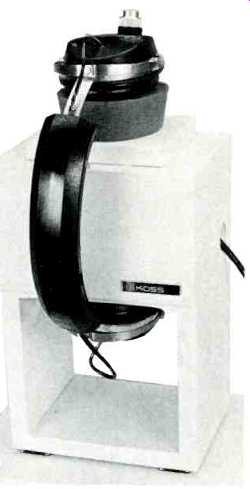
Fig. 1--Koss artificial ear. Dark portion is molded rubber and provides
the requisite 6 cm' cavity.
Performance Measurements
The measurement of headphone performance is relatively complicated. The phones must be coupled to a microphone by means of an "artificial ear" of specific characteristics-and here there is a considerable difference of opinion. There are U.S. standards, International Electrotechnical Commission standards, and the British National Physical Laboratory standards-and they do not all coincide. The basic artificial ear coupler consists of a 6-cu. cm. volume between the phone and the microphone diaphragm, while a 2.5 cu. cm. volume is used for hearing-aid measurements. Various types are available commercially, and at relatively high costs, so we borrowed the one used by Koss, together with a Bruel and Kjaer 1/2-in. condenser microphone, its cathode follower and power supply. These we used as standard, since they were used by Koss in measurements on their ESP-9 Studio Monitor Stereophones, which are in the category of highest quality. Then to make sure that we could continue headphone measurements after we returned the artificial ear and the B & K microphone to Koss, we built our own artificial ear, using an AKG C-451E condenser microphone. Our model consists of a 5 1/2 maple body, 6 1/2 in. long with a 3/4-in. hole through the center for the microphone. The 6-cu. cm. volume was retained as in the Koss model. The C 451E microphone is a 3/4-in. condenser, complete with an FET "follower" and a bi-polar transistor as an amplifier driving an output transformer. In addition, another transistor serves as an oscillator which generates a high-voltage signal which is rectified to supply 60 volts as a polarizing potential for the condenser cartridge. The FET and the two transistors are fed by simplexing a direct current through the input transformer of the following amplifier-as used for recording, for example-and the output transformer of the microphone. Any voltage from 7 ½ to 52 can be used with suitable current limiting resistors. With this microphone, only two wires and the shield are required, and when used in the usual fashion with a transformer at the input of a recording amplifier, it is possible to interchange microphones so that condensers or dynamics can be used as the need dictates. A simple modification makes it possible to use this microphone for measurements without an input transformer, and this model is priced within the range of most users' budgets. The calibration shows it to be flat to 15,000 Hz, and reasonably flat to over 20,000. For a sound source, we used a CBS STR-100 record, which has a swept signal from 40 to 20,000 Hz for both right and left channels. The left sweep only was used, and the output of the ADC 25 cartridge was fed to a preamplifier equalized to produce a signal flat within ±1 dB over the range. This was then fed to the tuner input of a Dynaco SCA 80, with the speaker output terminated in 8 ohms, and the phones were plugged into the front-panel jack, which had the usual 100 ohms in series with each lead for the phones. The signal was adjusted for 4 volts across the 8 ohms--a 2-watt signal.
The Koss ESP-6 phones require a different connection. The 4-wire lead from the E-9 Energizer is connected direct to the speaker terminals of the amplifier, and the speakers are connected to the Energizer. The phones are plugged into the socket on the Energizer, which in turn is plugged into an a.c. outlet. This provides both signal and polarizing potential for the electrostatic phones. The polarizing voltage can be provided by the rectified a.c. line voltage or by the signal itself which is stepped up in voltage and rectified by a voltage tripler to provide for self-energization. The two methods are selectable by a switch on the front panel of the Energizer. In addition, another switch turns the speakers on or off as desired.
Using the ESP-9's connected properly, we first ran several curves with the Bruel and Kjaer microphone and the Koss artificial ear, recording the output on the prototype instrument shown in Fig. 2.
After satisfying ourselves that these measurements were consistent, we next made the same runs with our own version of the artificial ear using the AKG C-451E microphone with an omnidirectional capsule. Thus we had a comparison between a standard measuring device and our own version. Then we proceeded to make curves on all the other headphones we had accumulated.
Our next measurement was to determine the sensitivity of the various phones. We fed a 1000-Hz signal into the SCA-80 and adjusted the level to an output of 3 volts, which was held constant for the measurement of all the headphones in our collection. Having a known level for the ESP-9's, we could readily compare the sensitivities of all the phones.
Next we placed a loudspeaker near the artificial ear and played a 400-Hz square wave through it, setting the level to get a readable signal from the microphone in the artificial ear. Then we placed each pair of phones consecutively on the ear, settled it for a minimum signal output, and measured the difference.
This "isolation" figure is listed for each of the models tested, and represents the reduction of external noise when the phones are on the head. It may or may not be important, depending on the use to which you plan to put the phones.
If you are recording in a location where you can hear the natural sound directly, you will want good isolation so that all you really hear is that picked up by the microphone. If it is for listening in your home so you do not disturb others, the isolation is not so important.
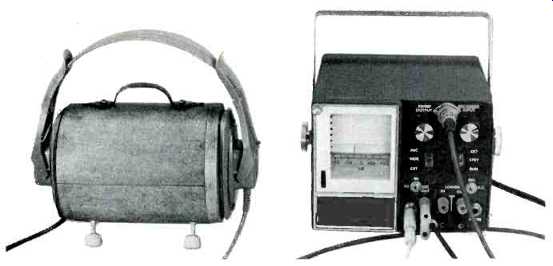
Fig. 2--Artificial ear made for our tests. It consists of a maple block
with a 3/4-in. hole through the center to accommodate the AKG C-451E condenser
microphone used for the measurements.
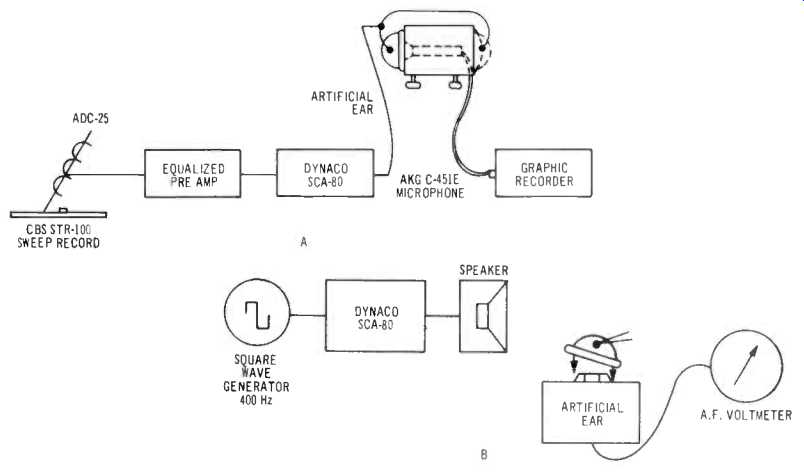
Fig. 3--(A) Setup of equipment for making response curves on the headphones.
(B) Setup of equipment for making isolation tests.
A Word About Right and Left
By and large, most of the headphones described in these columns have some form of indication as to which is intended for the left ear and which is for the right. But we found that there is not much consistency in the way the plugs are wired to the phones. The custom of wiring the jacks in receivers seems to be that the right channel feeds to the tip and the left channel feeds the ring, with the sleeve being common to both channels. About half of the phones tested were connected in accordance with this "standard," and the others were connected with the tip to the left phone and the ring to the right. Not that it makes much difference, except that if you are accustomed to hearing the violins on the left in real life, you may be surprised to be hearing them on the right when you plug the phones into your receiver or amplifier. With removable plugs, you could change the connections at the plug; with permanent molded plugs integral with the cord, you couldn't--you would need to make the change at the phone jack on the receiver or amplifier-or put the phones on "backward." When listening to loudspeakers, both ears hear the two channels-but with headphones, the channels are isolated.
With the usual recording methods, the sound is unnatural-although many people prefer it! In order to restore correct "balance," crosstalk of appropriate phase and amplitude must be introduced between channels. One circuit which does this is the Bauer crossfeed arrangement, which is reproduced below ( see AUDIO November, 1962).
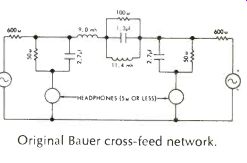
------ 4 Original Bauer cross-feed network.
AKG K-60
Gray plastic shells; d.c. resistance, 550 ohms per phone; for 600-ohm circuits, although usable with typical receiver headphone jacks. Removable silver-colored vinyl pads 33íx43í in., foam filled.
Double flat steel headband, plastic covered. Right and left phones identified by colored dots on band-yellow for left, red for right. Gray plastic cord, split to phones, 7 ft. long, detachable plug. Sensitivity: 95 dB SPL; isolation 19 dB. Weight, 11 oz. Price $39.50.
Beyer DT-48s
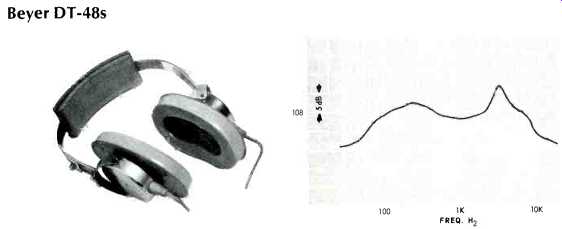
Aluminum shells, marked L and R; d.c. resistance, 5 ohms per phone. Foam filled vinyl pads 3x4.5-in. Adjustable steel hand with plastic top, two vinyl-covered foam pads. Cord 10 ft. long, split to each phone, with yellow and red bands to indicate left and right. Metal-shell plug, detachable. Furnished with leather-like vinyl zippered case. Sensitivity: 106 dB SPL; isolation 21 dB. Weight, 16 oz. Price: $98.00. Available with 50-ohm impedance for use with Nagra and Stellavox recorders as Model DT-48N, $98.00.
Bogen EP-10
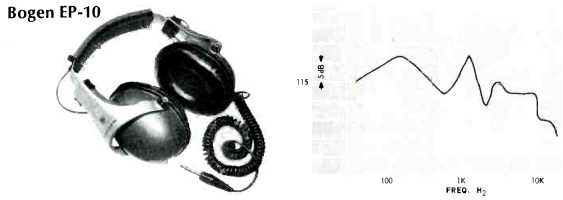
Olive plastic shells; d.c. resistance, 8 ohms per phone. Removable leather-like black vinyl pads, foam filled, 3.75x4.75 in. Plastic headband, foam rubber head pad. Coiled black cord to left phone, extends to 6 ft., permanent molded plug. Sensitivity, 115 dB SPL; isolation, 6 dB. Weight, 20 oz. Price: $29.95.
Clark/100A
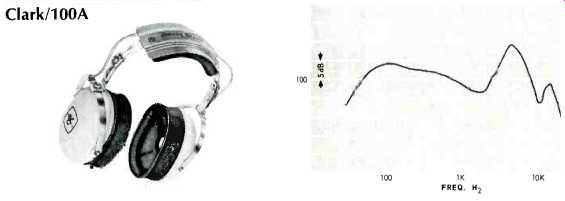
Gray plastic shells; d.c. resistance, 20 ohms each phone. (Also available in 300 and 600 ohms.) Removable molded foam pads 34x4 in., adjustable fiat steel band with molded foam pad. Black coiled cord extends to 10 ft., permanent molded plug. Sensitivity, 98 dB SPL, isolation 10 dB. Weight, 16 oz. Price $50.00.
Fisher HP-100
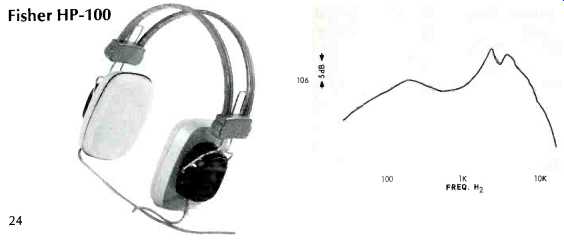
Light gray plastic shells with molded frame for flat foam pads over ears; d.c. resistance, 50 ohms each phone. Plastic covered wire headband. Gray cord split to each phone, 8 ft. long, with permanent molded plug. Red plastic indicator on right phone, yellow on left. Sensitivity, 104 dB SPL; isolation, 2 dB. Weight, 15 oz. Price $39.95.
Jensen HS-2
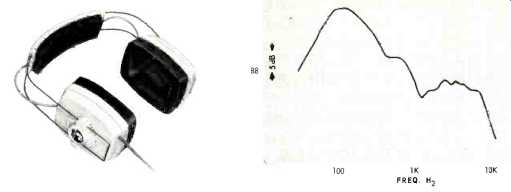
White plastic shells; d.c. resistance 4 ohms per phone. Pads of 7/8-in. foam, 3.25x 4.25 in., circumaural, dark gray in color. Adjustable two-wire headband, plastic top and foam head pad. Cord to left phone, 8 ft. long, and fitted with permanent plug. No identification as to which phone is intended for which ear. Sensitivity, 104 dB SPL; isolation, 2 dB. Weight, 15 oz. Price $39.95.
Koss PRO-4AA, Koss ESP 9
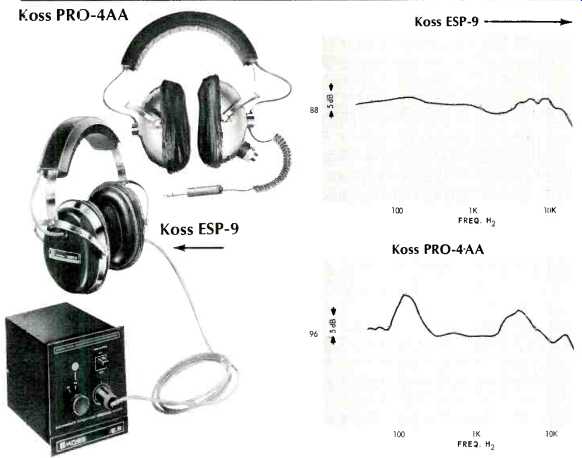
Only electrostatic phones in group. Black plastic shell, with removable vinyl liquid-filled pads 3.25x4.25. Single wide steel band, adjustable, with plastic cover and foam head pad. Cord connected to left phone, 6 ft. long, and fitted with 5-prong plug which mates with socket on E-9 Energizer, which plugs into a.c. socket, and connected to speaker terminals by 4-wire cable with spade tips. Switch on energizer permits selection of a.c. or signal-powered polarizing circuit, and a second switch turns on speakers which are connected to terminal strip on rear of Energizer. Sensitivity, 88 dB SPL; isolation, 11 dB. Weight, 19 oz. exclusive of Energizer. Price, $150.00, including Energizer.
----
Tan plastic shells; d.c. resistance, 8 ohms per phone. Removable liquid-filled pads 3.25x4.25. Wide steel band, adjustable, with plastic cover, foam head pad. Coiled 4-conductor cord, extendable to 10 ft., removable plug. Sensitivity, 96 dB SPL; isolation 10 dB. Weight, 19 oz. Price, $60.00.
Talking about temptation, the attractive girl above--also wearing Koss phones--is
one of the Bunnies aboard Hugh Hefner's private airplane . . .
----
Lafayette F-990
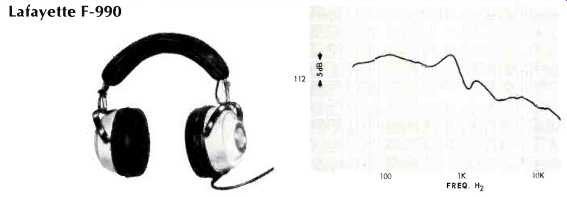
White plastic shells, 8 ohms d.c. resistance per phone. Round foam-filled vinyl pads, brown adjustable plastic band, foam filled vinyl head pad. Cord attached to one phone, 7 ft. in length, and fitted with removable plug. Sensitivity, 112 dB SPL; isolation, 9 dB. Weight, 20 oz. Price, $29.95.
----
Pioneer SE-50
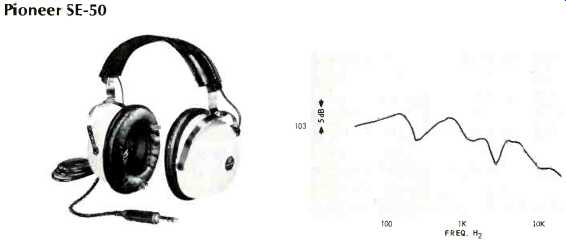
Plastic shells, white vinyl covered; d.c. resistance, 8 ohms per phone. Each phone fitted with level control for total signal and a second control for highs. Phones consist of 3-in. cone low-frequency unit and horn-type high-frequency unit, with capacitor dividing network. Leather covered adjustable steel band, leather foam filled head pad. Leather foam-filled pads 4x432 in., removable. Coiled black cord extends to 16 ft., fitted with permanent plug. Furnished in attractive black vinyl covered case with red and white lining. Sensitivity, 103 dB SPL; isolation, 15 dB. Weight, 20 oz. Price, $49.95.
Sennheiser HD-414
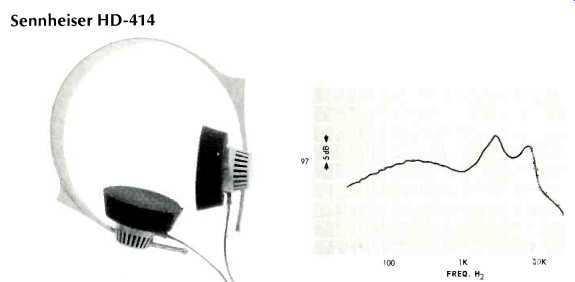
Gray plastic shells, 2000 ohms d.c. resistance per phone. "Open-Aire" ear pads of fine foam, 23 inches in diameter, 3 in. thick. Gray plastic band with no head pads, unnecessary because of light weight. Cord 15 ft. long, split to the two phones. Left phone identified by yellow plastic band on cord, right by red band. Cord furnished with removable black plug, and plastic "reel" furnished to wind cord on. Sensitivity, 97 dB SPL; isolation, 2 dB. High impedance permits direct use with preamp output and with tape recorder monitor jacks designed for high-Z phones. Weight 5 oz. Price, $29.95.
Sharpe 7
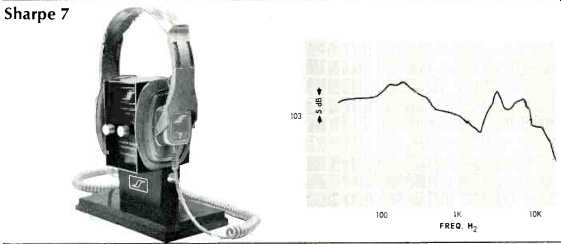
Green plastic shells, d.c. resistance 16 ohms per phone. Removable plastic pads 3.25x5 in., liquid-filled. Green plastic adjustable band with plastic head pad. Green coiled cord extendable to 15 ft., fitted with permanent plug. Sensitivity, 103 dB SPL; isolation, 8 dB. Weight, 18 oz. Price, $19.95.
Sony DRA-6A
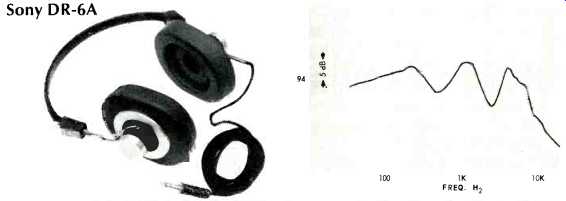
Plastic and aluminum shells, d.c. resistance 8 ohms per phone. Removable ,foam-filled vinyl pads 3.5x4.25 in. Adjustable single steel band plastic covered. Cloth covered 7-ft. cable, removable plug. Sensitivity, 94 dB SPL; isolation, 12 dB. Weight, 133í oz. Price, $27.50.
Superex PRO-4-B-V
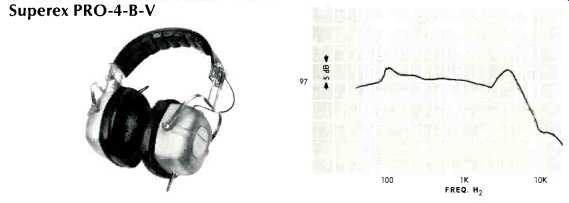
Dynamic cone woofer, ceramic tweeter; d.c. resistance, 8 ohms per phone. Available with impedances of 60, 2000, and 15,000 ohms. Dual steel band, adjustable, plastic covered, with vinyl head pad. Green plastic shells. Removable foam-filled vinyl pads 3.5x4 in. Black 4 wire coiled cord extendable to 15 ft., detachable plastic plug. Sensitivity, 111 dB SPL; isolation, 20 dB. Weight, 23 oz. Price, $59.95.
Telex Studio 1, Telex Serenata
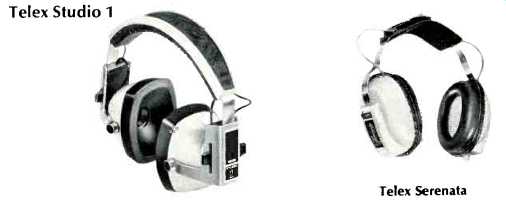
These models were not available in time to include their performance characteristics, but they will be included in a future issue. Ivory plastic shells; surgical silicone compound ear pads. Adjustable steel band, plastic cover, with head pad. Slide-type level controls on each phone, together with tone control for each. Coiled cord, 25 ft. long, with molded permanent plug. Weight, 24 oz. Price, $99.95. Studio 2 without controls), $84.95.
- - - - -
(adapted from Audio magazine, Dec. 1970)
Also see:
VM Model TF-10 Deluxe Component Stereo Receiver (Dec. 1970)
= = = =