BY DAVID LANDER
On the last day of April, the Supreme Court of the United States handed down a ruling that caused sighs of relief to emanate from pressrooms and editorial offices around the nation. The opinion upheld an appellate court decision that exonerated Consumers Union (the nonprofit group which publishes Consumer Re ports magazine) after a lower court had ruled they had libeled Bose Corporation.
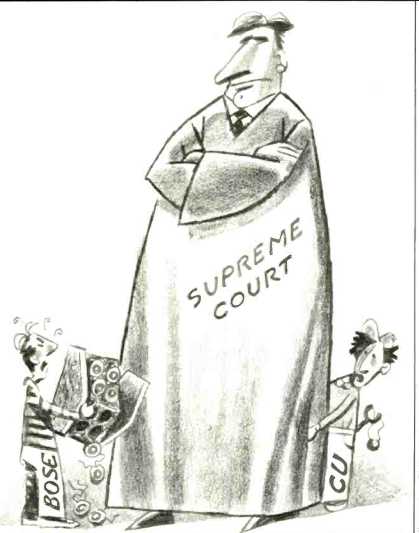
The decision put an end to a bitter 14-year-old battle between CU and the Bose Corporation, now almost certainly America's most successful high-fidelity manufacturer. Bose, objecting to derogatory comments about its Model 901 loudspeaker that appeared in Consumer Reports, sued the organization and won the initial firefight, becoming the first manufacturer ever to beat CU in the courtroom. When an appeals court reversed the decision, Bose appealed to the U.S. Supreme Court which, to the surprise of many following the case, agreed to hear it.
The press was not only shocked, but appalled and frightened. A court case involving a critical report on a high fidelity loudspeaker system seemed of little importance, and many legal experts suspected that one or more conservative Justices saw Bose v. CU as an opportunity to restrict appellate re view in libel cases, a protection that dates back two decades and has proven highly important to defendants in such suits.
It was therefore not surprising when the press rallied to CU's defense. A friend-of-the-court brief submitted to the Supreme Court in CU's behalf carried the names of eight major communications companies (including CBS, NBC, the New York Times Co., News week and Dow Jones, publishers of the Wall Street Journal) and argued that a decision against Consumers Union would imperil the press by imposing "standards of verbal accuracy that are as impossible to articulate as they are to meet." An editorial in the Washing ton Post called the case "preposterous," and New York Times columnist Anthony Lewis fumed over "facts that were outrageous in their very triviality.-
"After all," he wrote, "here was a magazine that had been embroiled in litigation for 13 years over what finally amounted to a three-word phrase." Because Bose's charges were, in fact, distilled to a case that ultimately hung on three little words, and because the ramifications were potentially so large, it may have been easier for the press to ignore the speaker maker's side of the issue and indulge its penchant for probing elsewhere. As an example of a media establishment biased in its own favor, Charles Hieken, attorney for Bose Corporation, points a finger at Timesman Lewis, "a special student law school classmate of mine [who] saw me at lunch in the Supreme Court before the oral argument and . . . did not even contact me before writing his . . . column." There is, in fact, much more to Bose v. CU than has met the media's eye.
And had the case not been so threatening to the press, that panning orb might have reflected at least a close-up or two of the aloof testing organization in Mount Vernon, N.Y. and the brilliant scientist/businessman who devoted years and untold tens of thousands of dollars to kicking the pedestal out from under it.
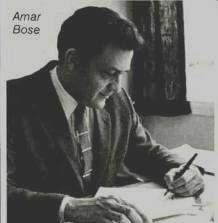
Amar Bose-founder, chairman, technical director and majority stock holder of Bose Corporation-presides over his audio empire from an office in a modern factory building perched on a Framingham, Mass. hilltop known as The Mountain. While loudspeaker de signers run the gamut from the self taught garage variety to graduate engineers with sterling credentials, Bose, with an earned doctorate from MIT and the status of full professor at that esteemed institution, epitomizes the latter group. His 901 loudspeaker system, a recent introduction at the time Consumer Reports chose to review it in May 1970, was the product of count less hours of research dating back nearly 15 years. In an attempt to emu late what one hears in a concert hall, which Bose contends is mainly sonic energy reflected off room surfaces, the 901 aims eight of its nine component loudspeakers at the wall behind the unit. Dr. Bose calls the resulting phenomenon "direct/reflected" sound.
CU used the editorial hook of its "relatively new design" to include the 901 in a speaker review that, for the most part, focused on models in the area of $160 to $300 a pair. Two 901s and the equalizer that completes the system then sold for $476 ($30 higher on the West Coast), considerably more. The magazine made a number of negative comments about the 901. After lauding its sound as "spacious," "reverberant," and "dramatic," the report went on as follows:
"But after listening to a number of recordings, it became apparent that the panelists could pinpoint the location of various instruments much more easily with a standard speaker system than with the Bose system. Worse, individual instruments heard through the Bose system seemed to grow to gigantic proportions and tended to wander about the room. For instance, a violin appeared to be 10 feet wide and a piano stretched from wall to wall." "As for sound quality," the author of the unsigned piece, a CU engineer named Larry Seligson, stated, "if the Bose 901 had been rated with the main group of tested speakers, it would have fallen between the high and medium-accuracy groups." Moreover, the 901 was said to require "a rather gigantic amount of power"; "50 watts per channel for the deepest bass response" was recommended. Summarized the writer, "We think the Bose system is so unusual that a prospective buyer must listen to it and judge it for himself. We would suggest delaying so big an investment until you were sure the system would please you after the novelty value had worn off." The review caused Bose to bristle.
For one thing, he notes, the power claim was far from correct, and the 901 was actually more efficient than any speaker tested for the article. As for the instruments tending to wander "about the room," this was called nothing less than scientifically impossible.
Early one June morning, shortly after the evaluation appeared in print, Bose and Frank Ferguson (then president of Bose Corporation) drove to Mount Vernon, N.Y. for a meeting at CU head quarters. For Bose, the get-together was a long-awaited one. He had first become interested in CU's testing procedures more than a decade earlier, when Consumer Reports gave a
$27.50 add-on electrostatic tweeter from Radio Shack a better rating than one designed by Arthur Janszen, a pioneer in electrostatics, that cost several times that amount. Bose felt Radio Shack's product was vastly inferior, yet its sales are said to have soared following the review's publication.
It may have been the teacher in him-possibly the evangelist-but even before he had a speaker to sell, Amar Bose was inviting CU personnel to hear him speak at meetings and seminars. All attempts at contact prior to his request for this post-publication powwow had been met with silence, however, and according to Frank Ferguson, Bose had thought he'd use the opportunity to expose what he believed was Seligson's "shoddy science" to concerned superiors. In stead, the pair found, the Mount Vernon group had something other than rating products on their minds-namely, the circulation of Consumer Reports.
"It was s0000 staggering it was be yond anything we had ever anticipated," a wide-eyed Amar Bose recalls.
"The attitude was beyond belief." Dr. Bose remembers Monte Florman, then associate technical director, asking, " 'What do you think people read our magazine for?' I said, after a pause,
'Product information.' Sandbach [Walker Sandbach, then the group's executive director], who was to my left, pounded on the table and said, 'No, Dr. Bose, you're wrong. People read our magazine for entertainment.' " The speaker maker goes on to recall that Colston Warne, then board chair man of CU and an Amherst professor of economics, confirmed this, citing a survey and commenting that people "love to read about vermin hair in canned soup." Sandbach, he alleges, added that, if the "sarcasm and spice" were removed from the magazine it would be more factual but circulation would drop to less than a quarter of its figure. To make matters worse, the CU officials refused to repeat the demonstration of the 901s that allegedly resulted in wandering instruments. (Florman later testified he made this decision because Bose's demeanor at the meeting gave it a "rancorous quality"; Bose claims he came in "quite courteously," and Ferguson supports this.) Nor would CU produce the recordings used for the test-crucial, since a speaker's imaging is invariably affected by program material. Had it not been for this meeting, Bose reflects, he probably would not have hauled out the heavy guns and opened fire.
The battle that followed was long and bloody. When the case finally came up for trial before a U.S. district judge in 1980, it went on for 19 days.
Of the original charges leveled, Judge Anthony Julian upheld only one, that of product disparagement, a form of libel.
His decision hinged on the three-word phrase that described the instruments as wandering "about the room." Julian rejected Bose's contention that Seligson's motivation in demeaning the 901 was his hope for commercializing a loudspeaker system based on a patent he and Robert S. Lanier, a former CU writer, had been granted not long before the review appeared.
To support his case, Bose cited an agreement that Lanier and Seligson struck with a certain Bertram Menden, who gave them $2,000 in exchange for their promise to develop a working model (which, it turned out, they were never able to do).
In fact, Menden was a private detective in the employ of Bose Corporation.
According to Dr. Bose, he was hired after the review appeared, to deter mine whether the Arnold L. Seligson whose name appears on the patent along with Lanier's was in fact the Larry Seligson of CU and, if so, who stood to gain if the patent was commercialized. Masquerading as the representative of an anonymous West Coast manufacturer interested in entering the audio business, Menden initially contacted Lanier, although who first raised the issue of money is a disputed point.
As for instruments wandering "about the room" rather than along the wall between the speakers, a normal effect in stereo, Seligson stuck to his position that what he heard was what he de scribed. But Judge Julian reasoned that, given the engineer's grasp of the English language, he must have known that what he wrote "did not accurately describe the effects that he had heard." Therefore, Julian held, Bose Corporation had sustained its burden under law, which stipulates in such cases that the plaintiff must offer "clear and convincing" proof, not only that a false statement had been made, but that it had been made with malice, legally defined in this context to mean with the knowledge that it was false or with reckless disregard of its truth or falsity. After a separate trial to consider the issue of damages, Bose was awarded a total of more than $210,000.
Then, after an appellate court turned Judge Julian's decision on its ear, the case went as high as it possibly could, to the Supreme Court of the United States.
In an attempt to get the appellate court's decision reversed, attorney Hieken argued for Bose that the court had overstepped its bounds, that Julian's finding of malice was a fact and the higher court was bound by law to accept "findings of fact" made by the trial court unless they were "clearly erroneous." Moreover, Hieken maintained, the appellate court relied on the testimony of CU's Monte Florman, which the district judge had decided was "wholly untrustworthy and ... not credible."
-------------------
Editing, Testing, and Libel
As you will see from David Lander's accompanying story, the Bose versus Consumers Union case is very complicated. Yet, there are still aspects and issues which, I feel, have not been brought out adequately. I am not much given to the writing of editorials, as I generally feel they are a sign of egotism, but I am so strongly interested a bystander that I hope I will be pardoned a small amount of personal journalism in turning over and explaining some further parts of this puzzle. Too, you should be interested because the case strongly affects what Audio and other magazines can say in product reviews.
First of all, as David explains. Bose v. CU was a libel suit, about the re view of the Bose Model 901 speaker, but for the life of me, I cannot-and this country's body of law to the contrary-see how an object can be libeled. People, not things, are libeled.
Bose v. CU seems to me to be a case of product discrimination, not of product disparagement, and it is that act of discrimination, in print, for which CU was sued. To an editor whose business is essentially the same, it is a frightening thing to see such a case brought at all, let alone get all the way to the Supreme Court.
It is also somewhat ironically deflating to suddenly find that a certain amount of inaccurate language is acceptable in "robust First Amendment debate." This does not seem, to me, to be a First Amendment case either, since the First Amendment has to do with Congress making no laws abridging freedom of the press. Such censor ship may be reserved to the States by the 10th Amendment. But, specifically, this is not a case where Congress has forbidden someone, e.g., members of a religious or political group, the right to publish. Indeed, the Congress was not involved. Certainly, both Bose and CU could say things in print, though Bose would have to publish in places other than Consumer Reports, which does not take advertising. It is simply not, on the face of it, a First Amendment case.
Speaking of advertising, let me lay one more romantic myth to rest. Acceptance of advertising by a magazine does not prevent that magazine from publishing the truth. Further, non-acceptance of advertising does not help a magazine publish the truth.
As might be obvious to long-time readers of hi-fi publications, the various magazines, both little and large, have quite different techniques and standards relative to dealing with re views and with manufacturers. Some let the manufacturers see what's to be printed and encourage a spicy reply; this method has always seemed to me to produce more tantrums than truth. Other magazines say relatively little about the products. Some makers don't care whether they see the reviews prior to publication because they see such things as a product of their public-relations effort. Other firms care strongly for exactly the same reason.
The question really isn't whether an editor shows a manufacturer a review prior to publication, but what the editor is prepared to do in the wake of the maker's response. Getting facts right, like price and color of face plate, justify showing some of the re view; getting things like circuit details right is not an easy exercise. At this stage of publication, a maker's tactful help can produce a review that is better for all four parties-reader, publication, reviewer, and maker.
While an editor must, obviously, stand fast before a fire-breathing manufacturer intent on securing assistance in the marketplace for a mediocre product, this same editor must similarly be wary of a reviewer who's simply gotten up on the wrong side of the bed that day. Most desirable are reviewers who test and write for a living; using some firm's chief engineer usually produces accurate numbers along with an unacceptably high potential for conflict of interest.
In attempting to tie up the loose ends of this story. David and I went to The Mountain and talked with Dr. Bose. He wasn't particularly interested in the inanimate libel question, but he did recall for us, rather vividly, the trepidation he felt about the effect of the review on his company. More extreme examples of this we term the "Don't kick my baby" syndrome. The power of the press is great, and CU's is greater, by far, than Audio's. The only general admonition I've ever made to our reviewers, beyond being right about measurement data, is that they be gentlemanly and fair, for we are not in the business of putting companies out of business or of making a product successful. While we very often find that we know aspects of a piece of gear as well as the maker, it is never our position that we know the whole better; to say otherwise would be hubris.
The loudspeaker is probably the most difficult portion of the audio chain to test, witness the rigor of Mr. Clark's review of the Acoustical Physics speaker in this issue. Despite the fact that Bose v. CU was decided on a First Amendment argument, testing methods lay at the center of the controversy. As David points out, Dr. Bose has some strong ideas about testing and sound, though when I asked him to discuss how a magazine ought to test, he replied that he preferred to keep his proprietary methods secret than to give away too much to his competitors. There were similar holes, to my mind, in CU's explanation of how they tested speakers, even after reading their "How We Test . ." mail-out brochure. This is fair enough, though probably as frustrating to the reader as it was to me, but it is to be emphasized that basic research on how people hear is still going on. Hearing and speaker testing are such difficult and diverse fields that it seems un likely that one could be familiar with all the literature and all the techniques. For the present, then, I think that we who test ought to do so with greater accuracy than we believe the ear-brain can muster. And for those of us who write about the testing, I commend a little charity.
-Eugene Pitts, Editor
-------------------------
On the other hand, Michael N. Pollet, an attorney for CU, maintained that the appellate court judges were well within their right when they refused to accept Judge Julian's finding of malice and held that CU was merely "guilty of using imprecise language." In effect, maintained Pollet, the appellate court in this case did no more than what the Supreme Court mandated in the land mark 1964 case, New York Times v. Sullivan, which "heightened" appellate courts' right of review in libel suits.
Had the Supreme Court reversed the appellate decision in the Bose case, Pollet felt the result might have proven "a tutorial to unsympathetic trial judges or juries as to how to immunize anti-press decisions and make them almost impervious to reversal. Quite often these issues of freedom of the press in a libel context come up in very highly charged, emotionalized circum stances," he elaborated, "and there is concern that there is anti-press feeling and that unsympathetic judges and juries who do not understand these constitutional issues involved will hold against the press for wrong reasons and that those wrong reasons cannot then be fairly looked at by appellate courts." It is undeniable that the powers of appellate review threatened by this case were significant in more than an academic sense. Libel defendants now lose more than 80% of all such cases tried, and about 80% of the ad verse decisions later examined by appellate courts are reversed or modified at that level.
Yet Amar Bose maintains that trimming of First Amendment liberties is "just the opposite" of what he wanted.
"The issue with CU itself is not their freedom to print something," the MIT professor asserts. "They're doing nothing more, as I see it, than writing a report on their so-called research. And we're asking that they do that research accurately." Bose has been known to make that same request-some would call it demand-of publishers other than Consumers Union. In 1974, a magazine called Physician's Life Style ran a test report slamming the 901, and attorney Hieken responded with a 10-page letter charging them with making "false and disparaging statements about Bose and its loudspeaker systems." The letter contrasted the review in question with complimentary statements made by a number of other magazines and ended with a list of demands that included a retraction on the cover of "the earliest possible" fu ture issue. Hieken and his client settled for the publication of a Bose Corporation-prepared article stating their point of view.
At least two overseas publishers have been summoned to court on similar occasions. In 1976, an English periodical called Hi-Fi Choice, which appears irregularly, was set to publish a collection of speaker reviews by audio writer Angus McKenzie. Though the events remain somewhat blurred by time, someone from Bose or its wholly owned U.K. subsidiary apparently saw a prepublication copy and resented he review given the 901. McKenzie, contacted by phone at his London home recently, confirmed that a temporary injunction was granted against Aquarius Press, which then published Hi-Fi Choice, while the publisher pre pared his case. Aquarius did so in a matter of days, says McKenzie, and he suit was thrown out of court.
Still in litigation is a Dutch case between Bose's Netherlands subsidiary and that nation's Consumers Union not connected with CU here). That organization was sued over an article published in 1978, which gave the Bose 301 loudspeaker a low rating.
While Bose denies personally knowing of the English incident until recently and comments that the action was taken by a U.K. management team since departed, he admits that the Dutch litigation was instituted with his knowledge, albeit by overseas managers.
Still, he defends the right of reviewers to state opinions, however negative, under their bylines. Like the CU piece, neither the one in Physician's Life Style nor the Dutch magazine, Consumentengids, is signed. According to Hieken, testing for the former was said to be the work of an unidentified "non commercial professional." The Dutch article, according to a translation sup plied by Bose Corporation, refers to a "panel" that consisted of "approximately" eight men whom it calls "professional sound-recording specialists, sound technicians, and other experts." Dr. Bose claims the same tests resulted in much different conclusions in an English article (the tests were conducted jointly by consumer groups from Holland, England and Belgium) and that the Dutch group would not reveal its testing methods.
------- Bose Model 901 Series V Loudspeakers
Though some may view Dr. Bose as overly aggressive in guarding the reputation of his company's products, there is no question that his long-running combat with CU began in pursuit of a victory more substantial than one which, in attorney Pollet's words to the Supreme court, hinged on "the alleged slip of a single preposition." And even the appeals court which sanitized that so-called slip made a point of saying they "would refrain from describing CU's loudspeaker article as exemplifying the very highest order of responsible journalism." Why, for example, does the piece repeatedly refer to listening "panels" and "panelists" when at least one such body consisted solely of Seligson and his assistant? Charles Hieken, in response to critics who consider his client's argument with CU trivial, argues that the publisher wields sufficient power to damage, even destroy, corporations. "None of the people who are making those comments experienced the apprehension Bose Corporation experienced when that article first came out." he declares.
"It was a small company."
(Adapted from: Audio magazine, Dec. 1984)
Also see:
Home Studios--Do It The Pro Way (Part I) (Sept. 1983)
Studio In The Home (or: home in a studio) (Apr. 1973)
Build A Microphone Preamp (Feb. 1979)
Have DAT ... will Travel (Sept. 1991)
= = = =