 .
.
Audio Research Corporation--HIGH-DEFINITION MUSIC REPRODUCTION EQUIPMENT
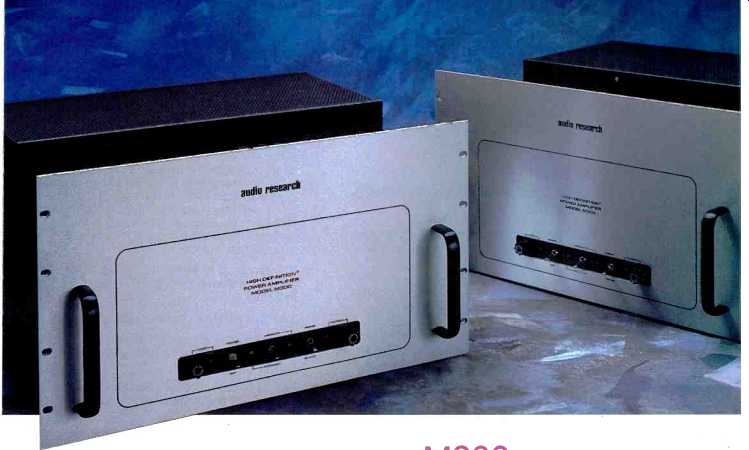
An unusual hybrid design with greater output efficiency from patented Audio Research circuitry.
M300 HYBRID MONAURAL POWER AMPLIFIER
Recently, Audio Research Corporation developed and patented (pending) new circuitry allowing hybrid utilization of Field Effect Transistors (FETs) with vacuum tubes in ways which can bring out the best in both devices. This circuitry is used in the relatively new, but already widely-acclaimed SP11 Preamplifier. Drawing from this technology, Audio Research has designed a new hybrid power amplifier, designated the M300 a monaural unit rated at 300 watts.
M300
HYBRID MONAURAL POWER AMPLIFIER
Most hybrid power amplifier designs use small signal-input vacuum tubes, then rely on FETs for the output stage. Audio Research has chosen instead to eliminate these low-level input tubes--tubes which can be prone to problems with hum, noise, microphonics, drift and, of course, require periodic replacement.
The new FET "front end" is combined with Audio Research's long-famous, patented cross-coupled circuit to provide a design offering exemplary stability, reliability (low maintenance), and superior performance.
These design advances have been coupled with yet another Audio Research patent: an output stage utilizing vacuum tubes, and partially cathode-coupled (as all previous Audio Research vacuum tube amplifiers have been), but with the screen (or accelerating) grids operating with a signal voltage precisely in phase with the cathode voltage. True "pentode" operation and efficiency is thereby achieved; however, all the advantages of partial cathode coupling are maintained.
Advantages include: Efficiency up to 60% and above. (Class "A" designs achieve 25% to 50%, typically 30% to 35%.) Inherently better cross-coupling.
Output transformer with lower "turns" and "impedance" ratios, resulting in greater bandwidth.
Partial cancellation of saturation effects of the "DC" in the output transformer's core.
Switching transients essentially eliminated, rendering the question of class of operation ("A," "AB," etc.) irrelevant. The virtues of Class "A" operation without the usual drawbacks.
Bias adjustment is essentially non-critical.
Output tubes need not be matched, although slightly better performance will result if they are.
Lower internal impedance improves handling of complex speaker loads.
To audition the M300 Monaural Power Amplifiers, visit your authorized Audio Research dealer. Black front panels available at additional cost. Call or write for literature on the complete line of Audio Research products.
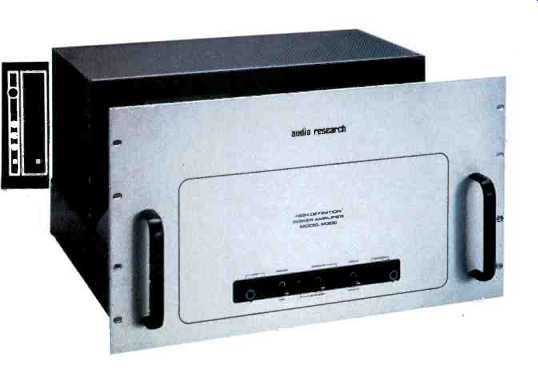

Operational Features
Front-panel replaceable line and screen voltage fuses, with LED indicators.
Two integral, low-noise fans for cooler operation, longer tube life. Front-panel switch allows "Hi" and "Lo" speeds.
"Standby" switch for lower power consumption and less heat during warm-up periods or telephone interruptions.
Automatic muting circuit provides silent shutdown upon power shut-off or interruption. No "thump" from speakers.
Gold-plated input connectors connect "ground" before "hot".
1, 2, 4, and 8-ohm output taps.
Front and rear handles for easier handling.
M300: Preliminary Specifications
(Power line stabilized at 120V.) POWER OUTPUT: 300 watts minimum continuous at 8 ohms from 16Hz to 25kHz with less than 0.5% total harmonic distortion (typically below .005% at 1 watt). Approximate actual power available at "clipping": 330W watts (1kHz). (Note that actual power output is dependent upon both line voltage and "condition," ie: if power line has high distortion, maximum power will be affected adversely, although from a listening standpoint this is not very critical.) POWER BANDWIDTH: (-3dB Points) 10Hz to 60kHz.
INPUT SENSITIVITY: 1.5V RMS for rated output.
INPUT IMPEDANCE: 60K ohms, nominal.
OUTPUT REGULATION: Approximately 0.3dB, 8 ohm load to open circuit (Damping factor approximately 30)
NEGATIVE FEEDBACK: 20dB.
SLEW RATE: 25 volts/microsecond.
RISE TIME: 3 microseconds.
HUM & NOISE: Less than 2mV RMS 90dB below rated output (broad bandwidth unweighted, inputs shorted).
POWER SUPPLY ENERGY STORAGE: Approximately 350 joules.
POWER REQUIREMENTS: 105-125VAC 60Hz (210-250VAC 50Hz)
900 watts at rated output. 450 watts at "idle" 130 watts at "standby".
DIMENSIONS: 19" (48 cm) W (standard rack panel) x 10.5 " (27 cm) H x 16" (41 cm) D (front panel back). Handles extend 1 5/8" (4.1 cm) forward of the front panel. Output connectors extend 1" behind rear panel.
WEIGHT: 110 lbs. (50 kg) Net; 126 lbs.
(57 kg) Shipping.
TUBES REQUIRED: 8 x 6550 Power Output (Matched pairs will yield marginally better performance.).
---------
SP9
STEREO PREAMPLIFIER
The SP9 Hybrid Stereo Preamplifier represents a further evolution of the innovative electronic design first embodied in the widely acclaimed Audio Research SP11 Stereo Preamplifier. The SP9 is not a "stripped-down" version of the SP11, but rather represents an adaptation of some of the SP11's patented hybrid technology to a simpler, more economical single-chassis format.
Using just two 6DJ8 vacuum tubes (one in the phono section and one in the high-level stage) in intermediary gain stages, the SP9 expresses the musicality and natural "rightness' vacuum-tube preamplifiers have been noted for, yet it does so with the quickness and dynamic vigor of the best solid-state designs.
STEREO PREAMPLIFIER
Because its two vacuum tubes are used so conservatively, the SP9 will undoubtedly prove to be one of the most reliable and low maintenance Audio Research preamps ever up to 10,000 hours of service life are possible before replacement of these tubes might be necessary. And, replacement tubes are not required to be select, low-noise (and expensive) types. Audio Research brand vacuum tubes obtained from your authorized dealer will provide the best performance and reliability.
Although the SP9 contains an on-board power supply (as opposed to the SP11's isolated supply), it is a highly advanced, tightly regulated design employing a shielded toroidal power transformer to minimize any potential problems of mechanical noise or hum. Location of this transformer in relation to special low-hum input circuitry has been optimized within the SP9 chassis layout to virtually eliminate transformer-related noise. (Note that while outboard power supplies have become a popular design trend among high-end audio manufacturers, simply isolating the power supply from the main chassis has little benefit if the basic design of the supply itself is second-rate. In such cases, outboard isolation may be little more than a cosmetic cure for more serious deficiencies.) While the SP9 is designed to provide superb playback from phono records, its high-level circuits have also been optimized for other popular input sources, including compact discs.
In this respect, the SP9 is virtually overload proof, insuring maximum enjoyment of today's most dynamic program material. And, with two tape monitor loops, the SP9 offers the tape dubbing flexibility so many listeners want but seldom find in an audiophile-grade preamplifier.
Of course, all controls and switches used in the SP9 have been carefully specified and selected to insure minimal sonic degradation as have the other active and passive components used in the construction of the SP9. While the SP9 is more affordable than some other Audio Research preamplifiers, its more modest price was not achieved at the sacrifice of component quality. Careful, elegant design, structural simplicity and efficient manufacturing techniques have all contributed to a standard of physical integrity and musical accuracy never before achieved in this price class.
To audition the SP9 Stereo Preamplifier, visit your authorized Audio Research dealer. Black front panel available at additional cost. Call or write for literature on the complete line of Audio Research products.
Operational Features
Automatic muting circuit for warmup, powerline voltage drop or interruption; plus manual (switchable) muting of main preamplifier outputs.
Full tape functions: two inputs, two outputs, plus two-position tape monitor switching.
Gold-plated input/output jacks selected for sonic purity.
These connect “ground" before "hot," disconnect "hot" before "ground" for protection of other components.
Shielded, toroidal power transformer for minimal mechanical noise and "hum." Phono section impedance internally adjustable for precise matching to moving-coil or moving-magnet phono cartridges.
Tube complement: two 6DJ8 vacuum tubes (one in phono stage, one in line stage). Low noise (78dB below 1V RMS input phono, more than 100dB below 1V RMS input high-level) plus substantial overall gain (66dB) makes the SP9 usable with a wide range of popular moving-coil phono cartridges.
SP9 -- Specifications
FREQUENCY RESPONSE:
High level section: ± .5dB, 5Hz to 50kHz/ 3dB points below 1Hz and above 200kHz.
Phono: ± .3dB of RIAA, 30Hz to 40kHz
DISTORTION: Less than .01% at 2V RMS output. (typically less than .005% in midband)
GAIN: Phono input to tape output: 46dB High level inputs to tape output: 0dB Phono input to main output: 66dB High level inputs to main output: 20dB
INPUT IMPEDANCE: 50K ohms Line Inputs; 47K Phono (Phono provisions for any value below 47K ohms or added input capacitance for matching certain magnetic cartridges.)
OUTPUT IMPEDANCE: 500 ohms main output, 850 ohms recorder output.
Recommended load 60K ohms and 100pF. (20K ohms minimum and 1000pF maximum)
MAXIMUM INPUTS: Phono, 200mV at 1kHz (1000mV RMS, 10kHZ). High level inputs essentially overload-proof.
RATED OUTPUTS: 2V RMS 5Hz to 50kHz, all outputs; 60K ohm load (main output capability is 50V RMS output at 1/2% THD at 1kHz into a 100K ohm load with 5V RMS high level input)
POWER SUPPLIES: Electronically-regulated low and high voltage supplies and electronic decoupling. Shielded toroid transformer.
Line regulation better than .01% NOISE: High Level: (1) 70uV RMS maximum residual unweighted wideband noise at main output with gain control minimum (98dB below 5V RMS output) (2) More than 100dB below 1V RMS input (less than 7uV equivalent input noise)
Phono: 0.12uV equivalent input noise, IHF weighted, shorted input (78dB below 1 mV input)
TUBE COMPLEMENT: 2 6DJ8/ECC88 dual triodes (Hybrid FET/Tube audio circuit, solid-state power supply)
POWER REQUIREMENTS: 100-135VAC 60Hz (200-270VAC 50/60Hz), 50 Watts
DIMENSIONS: 19" (48 cm) W x 5 1/4" (13.4 cm) H (standard rack panel) x 101/4" (26cm) D. Handles extend 1 5/8" (4.1) cm forward of front panel. Rear chassis fittings extend 5/8" (2.3 cm)
WEIGHT: 13 lbs. (5.9 kg) Net; 22 lbs.
(10 kg) Shipping
MIT

NEUTRALITY CLARITY PRECISE FOCUS
Exclusively In Audio Cable From MIT
In less than a decade, high-performance cable has emerged as a critical component in any quality audio system. Since the early-1980s, MIT has been the acknowledged leader in superior audio cable. This audible superiority results directly from leading-edge computer design capability, rigorous testing and a unique understanding of the physics of cable performance.
MIT cable delivers neutrality, clarity and precise focus because it is designed to virtually eliminate "phase noise". Phase noise includes all forms of frequency and phase instability, and is an inevitable by-product of audio cable that is not phase correct. In fact, all other audio cables suffer significantly from phase noise. Only MIT cable is designed to be truly time aligned, phase coherent and thus, noise free. The result: MIT cable does not alter the sound as do other audio cables.
In a dramatic comparison of MIT's superiority, MIT ran head-to-head tests of one-meter lengths of MIT MI-330 vs. solid-core straight wire, employing a sequence of music tone bursts. Despite past regard for straight wire, and some observers actually recommending its direct application in audio cable, comparable lengths of straight wire simply cannot compete with MIT cable on crucial phase noise performance.
These test graphs, which illustrate only one of a series of music tone bursts, provide visual proof of MI-330's overwhelming phase noise superiority. From the instant each music tone is retriggered, MI-330's defined transmission is obvious. Equally important is what occurs before each succeeding music tone is retriggered-a time segment which is supposed to be absolutely quiet (note exploded view of the pre-trigger time segment). MI-330 is essentially quiet before each music tone is retriggered, as audio cable must be for sonic accuracy. The length of straight wire, like other cables which are not phase correct, is noisy when it should be quiet. It is victimized by phase noise-stored energy residue which is being released at the wrong time! By comparison, MI-330's quiet passages and clearly defined step waveform mean that the music starts and stops when it is supposed to, yielding a more holographic sound stage, inter-transient silence and minimal distortion.
MIT now offers unequalled neutrality, clarity and precise focus in two cable families: MIT and PC-SQUARED. MIT is the finest audio cable money can buy, and includes the top-rated MI-330 interconnects and MH-750 Music Hose speaker cable, MH-650 junior Hose and the remarkable limited edition MI-330 Shotgun and MH-750 Shotgun cable series. PC-SQUARED provides exceptional performance, approaching MIT, but at a reduced cost in PC-2 interconnects and PC-18 speaker cable.
Minimal phase noise is but one significant advantage of all MIT products. For more information on MIT and PC-SQUARED product lines, and a more technical discussion of phase noise, please write for data to: Transparent Audio Marketing, P.O. Box 117, Route 202, Hollis, ME. 04042.
A=10 mV dA=62 mV T=0 ps dT=34.132 ns I
Signal Triggered
Solid-core straight wire (1m length): Measuring significant phase noisy before and after each music tone A=-8 mV dA=18 mV T=0 ps dT=46.746 ns
Signal Triggered
MIT MI-330 (1m length): Phase coherent and noise free before and after each music tone
ADCOM GFT-555 FM Stereo/AM Tuner
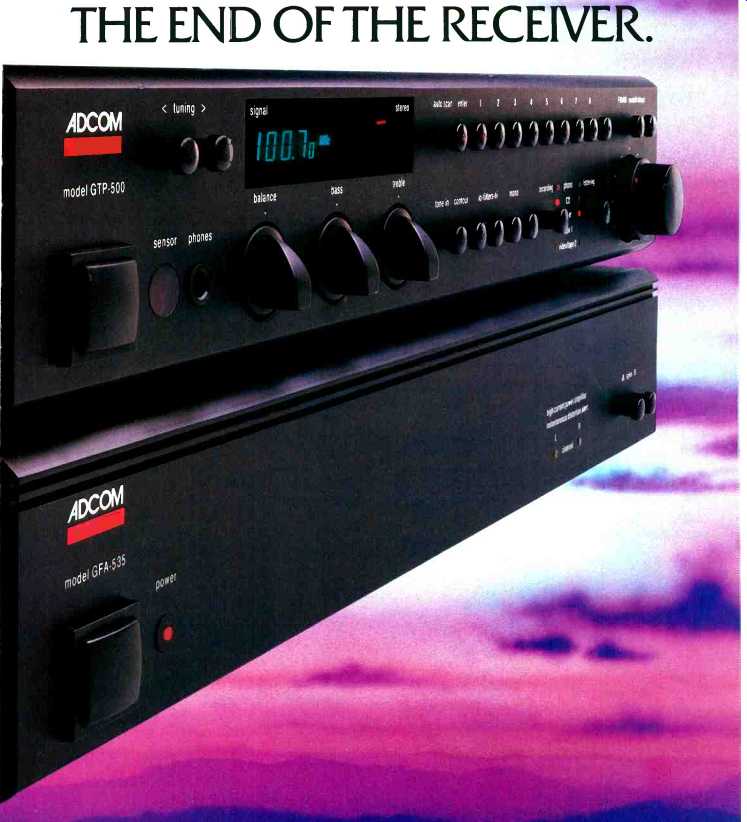
Now...from the people who brought you the GFA-555 high-current, high-power amplifier and the remarkable GFP-555 preamplifier...an affordable tuner for the real world of FM broadcast conditions.
Unlike all other components, a tuner's performance depends to a great extent on where it happens to be installed-that is, with respect to the nearest FM stations.
If you live in a close-in suburban area where a station's signal strength is reasonable and where there are few tall buildings, almost any tuner may do an adequate job. But in a major metropolitan area with tall buildings and many strong stations crowding the FM dial, your tuner mist contend with such problems as multipath distortion and front-end overload. And it should have the ability to separate stations contending for limited dial space.
In rural areas where stations are distant and weak, and where signals sometimes arrive at an adjacent or same broadcast frequency from different directions, a tuner requires high sensitivity for adequate signal boost and good capture ratios and selectivity to keep stations from interfering with each other.
High performance and affordability.
The ability to cope well with conditions in both metropolitan and fringe areas requires sophisticated, expensive circuitry.
Unless the ultimate selling price is no object, some compromise in design is usually necessary. The Adcom tuner is a clear exception to this rule. Through the use of recently developed component parts and innovative circuitry, Adcom has produced an excellent and eminently affordable tuner.
In order to create a perfect balance of sensitivity, selectivity, and low distortion--performance characteristics which can be appreciated every time you tune across the dial--we selected four specially designed, low-distortion IF filters with critically-defined bandpass capabilities.
For excellent signal-to-noise ratios and superb sensitivity throughout the FM band, there is a two-stage dual MOSFET RF input amplifier.
For outstanding stereo separation and frequency response, the stereo multiplex decoding circuits operate at 456 kHz instead of the more conventional 76 kHz.
To assure that the selected station will be heard without drift or error, the quartz referenced digital synthesis tuning system is designed for a tuning accuracy of 0.00025%.
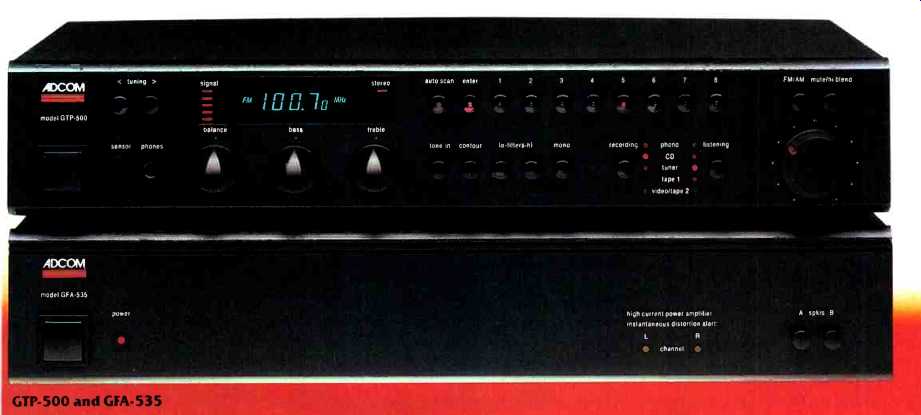
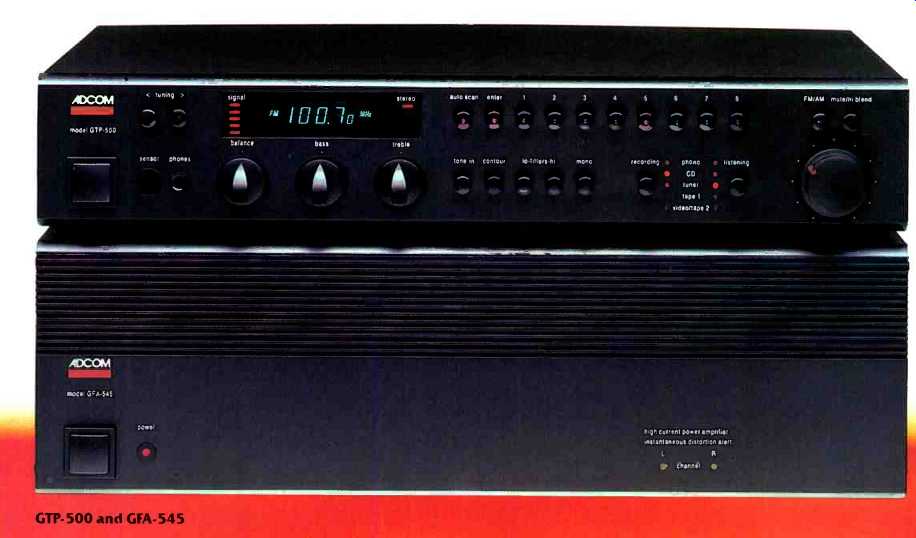
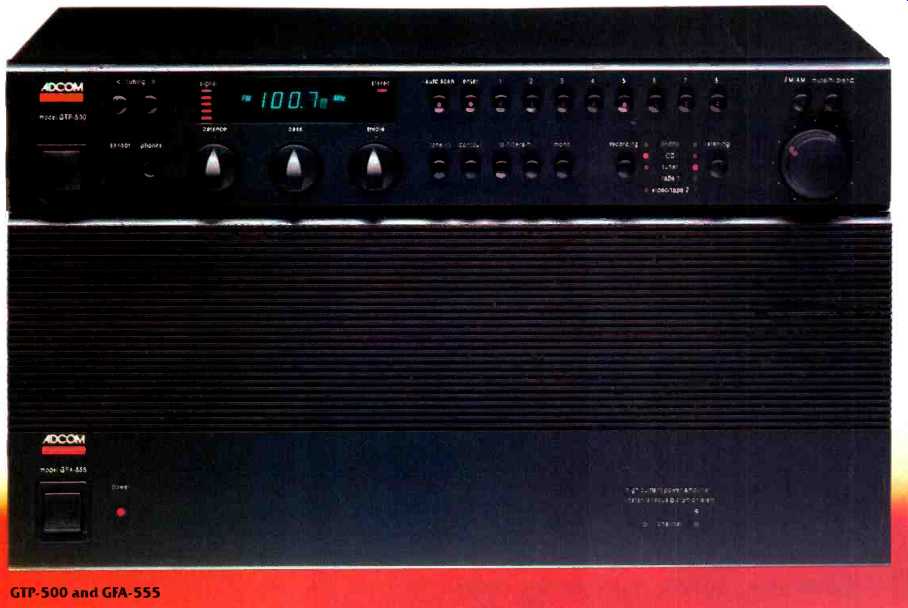

The primary objective: musicality.
But tuning ease and accuracy under adverse reception conditions were only part of the design considerations. Even though the technical aspects of tuner design are certainly important, we consider optimum musical quality most important of all. We never forget that all high fidelity components are primarily a means to musical enjoyment.
Our main design objective-to optimize sonic performance-is reflected only partially by the measured specifications.
For example, the frequency-generating circuitry associated with digital synthesis tuning tends to raise the background noise and distortion level of a tuner. To avoid this problem, we adopted computer shielding techniques--including ribbon wire--to prevent the synthesized digital pulses from leaking into the high-gain front end of the tuner.
Many operating and convenience features: In our concern for providing you with the best possible stereo reception, we haven't lost sight of ease and convenience.
You can program up to sixteen stations into memory--eight each, FM and AM--for instant retrieval at the touch of a button.
And the large, clear fluorescent frequency display can be read from across the room.
(A built-in lithium battery preserves station memory during lengthy power outages.) A five-stage LED signal-strength display enables you to orient your antenna for optimum reception. If the signal from a favorite station is just too weak to be entirely noise-free, the switchable "high blend" circuit reduces high frequency noise to preserve listenability.
And under extreme conditions where noise-free stereo signals can't be received at all, you have a stereo/mono switch for a practical compromise.
Finally, as you can see at a glance, we've also taken care to present all this simply and attractively. And like most of our components, you have a choice of either all black, or a white or silver front panel. Please write for literature and reviews of other fine Adcom products. We will reply promptly.
SPECIFICATIONS:
FM Section: IHF sensitivity, mono: 9.5 dBf (1 6 uV)
Signal strength for 50 dB quieting: Mono: 12.5 dBf Stereo: 36.5 dBf
Capture ratio: 1.5 dB
AM suppression: 70
dB Alternate channel selectivity: 80dB
Separation at 1kHz: 52 dB
Total harmonic distortion-stereo:
1 kHz: 0.05%
6 kHz: 0.09%
Intermodulation distortion (SMPTE 4:1 ratio):
0.08% up to 100% modulation
Maximum signal-to-noise ratio:
Mono: 85 dB
Stereo: 75 dB
Frequency response: 30 Hz-15 kHz
Antenna impedance: 75 or 300 ohms
Line voltage: 120V/60Hz (available in 220V/50Hz on special order)
Dimensions: (432mm x 83mmx 330mm D)
Weight: 14 lbs. (6.4 kg)
Optional accessory: Model RM-3 rack mount adapters.
Available on special order with white front panel with white buttons, or silver panel with black buttons.
"Thanks to Nitty Gritty, every music lover can get the best sound from his records" (and compact discs, too)
So says James Jarvis of the SENSIBLE SOUND. And Bert Whyte of AUDIO, Tony Cordesman of STEREOPHILE, Julian Hirsch of STEREO REVIEW, Enid Lumley of INTERNATIONAL AUDIO REVIEW, Michel Prin of SON HI FI, Al Fasoldt of FANFARE, and Jack Philpot of AUDIO AMATEUR all agree: there is no other record or compact disc cleaning system that is equal to those made by Nitty Gritty Record Care Products of California.
Why do these independent audio critics feel so strongly? Because cleaning systems made by Nitty Gritty get records and compact discs 100% clean. Free of dust, grease and static electricity. Microscopically clean. Perfectly clean.
Have you ever listened to a clean record?
Records that have been cleaned by a Nitty Gritty sound more like live music.
They have extended high frequency response, improved imaging, more acoustical space, and less noise.
There is no secret. The effectiveness of the Nitty Gritty record cleaning system is due to its superior design. The record cleaning system employs a powerful vacuum and a pure cleaning fluid. The Nitty Gritty cleaning fluid dissolves dust, and grease, neutralizes static charge, and then is suctioned immediately off, leaving a purified record. Perfectly prepared for play.
"Any record in one's collection, old or new, audiophile or not, will benefit greatly with a (Nitty Gritty) cleaning." Jarvis says, "I believe that anyone considering upgrading his system in any way should first obtain one of these record cleaning machines. Only then will he be aware of what he might be missing in the music, or of what his current system is really capable of in terms of music reproduction." Digital gets a wash, too.
The Nitty Gritty compact disc cleaning system is also regarded as state-of-the-art. The CD-1 is the first motorized CD cleaner. It uses bi-directional rotation to safely and surely clean a compact disc.
Bert Whyte said, "Nitty Gritty has come up Enter No. 74 on Reader Service Card with a CD cleaning machine that is unquestionably the easiest to use as well as the most efficient and effective method of ensuring pristine CD playing surfaces." The CD-1 also protects the CD with a clear coat that resists scratches. Perfectly protected from the elements.
And now, Nitty Gritty has accomplished yet another first: the first motorized cleaner for the 12 inch video laser disc.
The DD3 (not shown) is designed to operate like the CD-1, but on a grander scale.
It also has the ability to clean the other two sizes (10 inch and CD) of the digital discs. Perfectly clean.
Brochures, full reprints of test reports, and a list of dealers are available to you.
Send your name and address for an immediate packet of ear-opening information.
Nitty Gritty Record Care Products 4650 Arrow Highway Unit F4, Info Dept.
Montclair, California 91763 (714) 625-5525
Magneplanar Loudspeakers

IMAGE SIZE--Instruments projected from small boxes sitting on the floor sound like they are coming out of boxes on the floor. This problem can be partially corrected by placing the box speakers on tall speaker stands. However, the sound still seems to be coming out of a box, because that's precisely what it is doing. The patented Magneplanar principle eliminates these problems by a fundamentally different approach to sound propagation. The Magneplanar projects sound from top to bottom, giving the sound height as well as stereo width and depth. In the concert hall, instruments project in all directions. Instead of projecting sound out of a box, Magneplanars project in all directions, which closely duplicates the original performance. With your eyes closed the Magneplanar will allow you to "see" the original performance suspended in space. The full height, width and depth of the concert hall can be heard.
LOADING--Theoretically, loudspeakers should use massless drivers suspended in space with no box, magnet structure, or framework around the drivers. Most conventional box speakers are far from this ideal. The mass of the driver is high and the rear wave is contained within the box or magnet structure. While the frequency response can be smoothed out in a box speaker, the character of the sound is inevitably affected. The music sounds like it is coming out of a box-constricted and unnatural. The Magneplanar diaphragm comes closer to the ideal driver. The mass is low and the diaphragm is not contained. The sound is permitted to radiate freely into space. With the box removed, Magneplanars sound more like you are there.
UNIFORM DRIVE--The power from the amplifier causes the conventional cone speaker to react as if it had received a sharp blow at the voice coil. Since the outer portions of the cone cannot respond instantly, the cone will flex. The resulting cone breakup gives music a "fuzzy," "blurred" quality. The Magneplanar eliminates cone breakup by driving the Magneplanar diaphragm over its entire area. The force from the amplifier is distributed over the entire diaphragm so that it all moves at the same time. Cone or diaphragm breakup is dramatically reduced and the integrity of the music signal is preserved.
MASS-The effect of mass on a loudspeaker can be illustrated by the comparison of a balloon and a beach ball. In the case of the balloon a nominal force such as a puff of air will cause the balloon to accelerate quickly. When the force ceases, the balloon decelerates quickly. The same force will move the beach ball, but the ball is slower to start and slower to stop. High mass is one of the main causes of sonic degradation in a conventional box speaker.
Expecting a heavy cone woofer to move 1000 cycles per second in perfect synchronization with the electrical signal is expecting the impossible. The music is "blurred." The details and texture of the music is lost-the bass is "boomy" or "muddy"; mids and highs sound "nasal" or "raspy." The Magneplanar has less mass than the conventional box speaker; consequently the Magneplanar diaphragm is more in step with the electrical signal. The detail and texture of the music is maintained.
Magnepan's corporate and manufacturing facilities are located in White Bear Lake, Minnesota, a small community north of the twin cities of St. Paul and Minneapolis. Having rapidly outgrown the original facilities, Magnepan's current plant is over 50,000 square feet, in addition to the corporate and engineering offices.
When production was first started in 1971 the entire speaker was virtually handmade. Today, after more than 130,000 sold, the speakers are made with the same care and attention; but the devices used in the fabrication are much more modern and efficient, affording greater consistency and cost effectiveness.
For example, a computerized frame router allowed the older composite wood and metal frames, which incorporated 25 pieces, to be replaced by more rigid, one-piece, high density fiberboard frames.
Magnepan will continue to explore and add any new manufacturing techniques which will improve the construction quality and consistency of their products, which have always enjoyed an excellent reputation for the care with which they were made.
A Tradition of Innovation and Advanced Technology
Complement Your Decor Magneplanars provide unique styling not available in box speakers. With optional trim and fabrics, Magneplanar screens can blend or contrast with the surrounding decor, thus forming a backdrop same manner as curtains or drapes. With Magneplanars you have the ability to add a pair of speakers to your living area without adding the visual "weight" of box speakers. Magneplanars are easily moved for vacuuming or repositioning to other listening areas.
Magneplanar Models
SMGa--Incorporates most of the unique qualities of the large expensive models, at an affordable price.
This smallest and most popular model is for the serious music lover on a budget and works best in smaller listening rooms. The SMGa can be placed against the wall when you are listening to background music or pulled out 2 or 3 feet to appreciate their full potential. The SMGa is our most efficient model and can be driven with smaller receivers and amplifiers or can be part of a serious audiophile system, utilizing the best of equipment.
The music lover on a budget can now own a music system that will bring him or her much closer to the excitement of a live performance. Available in three trims (oak, brass, or chrome), and three fabric colors (off-white, black, or brown). MG-1c and MG-IIc-These models are of similar design, both representing excellent value. The MG-IIc is one foot taller than the MG-Ic, providing better vertical dispersion and extension of the frequency extremes. Both models appeal to a wide range of listening tastes. For the classical music enthusiast, the critical midrange of the MG-IIc is often the speaker of choice. Having been introduced in their original versions many years ago, these speakers have benefited from years of gradual refinements.
They highlight Magnepan's belief that there should be no change for the sake of change. Improvements over earlier versions include a reduction in diaphragm mass, refinements in magnetic structure, improved crossover design, more rigid panel construction, inclusion of bi-amplification option, and improved diaphragm mass distribution.
Both models are worthy of the finest ancillary equipment and source material, and are remarkable in their respective price ranges.
Magnepan's Design Policy
To seek the most elegant, cost-effective solutions to design problems.
To design speakers that we at Magnepan, as serious audiophiles, would want to use in our personal music systems.
To maintain aesthetically pleasing designs which blend well into the home.
To make model changes based on major performance improvements rather than "making changes for the sake of change" To design products that will perform reliably for many years.
MG-2.5/R and MG-IIIa-The MG-2.5/R and MG-IIIa utilize Magnepan's patented line-source ribbon in conjunction with the latest generation planar magnetic bass.
The line-source ribbon is a transformerless design which eliminates dynamic compression and distortion associated with 2-3 inch long ribbons of the past. The ribbon is bipolar, with near-perfect polar response of 180 degrees off the front and rear at 20,000 Hz. This results in superb image stability, regardless of the listener's position. At 2.5 microns, the Magneplanar ribbon is lower in mass than any previous ribbon, and provides high frequency extension beyond 50.000 Hz. Full, deep bass into the 30 Hz range is insured by the latest planar-magnetic drivers developed by Magnepan.
To approach musical perfection in a loudspeaker, all drivers must be of similar overall characteristics--the MG-2.5/R and MG-IIIa achieve this by employing: line-source, bipolar, transformerless, and low-mass driver technologies in both the new ribbon mid/ tweeter and the time-tested, planar-magnetic bass.
As a three-way system, the MG-IIIa surpasses the MG-2.5/R in lower mid-range clarity. The MG-IIIa has a larger bass diaphragm than the MG-2.5/R, which gives deeper extension and more impact in larger rooms. In addition, the MG-IIIa has the added feature of bi-amplification. Both models are of similar design and the choice of serious audiophiles.
Two Unique Technologies
Planar-Magnetic Driver
- Low Mass .0005 inch diaphragm
- Bi-Polar Design-No cabinet to color sound
- Direct Coupled-No transformer is necessary.
Subtle detailing is maintained with no dynamic compression
- Mirror-Imaged for stable stereo image
- Linear Power Response--No compression of dynamic range
- Superb Power Response
High Power handling
Flat Impedance for ideal amplifier loading
- Accurate Phase response
Line-Source Ribbon Driver
- Lowest Mass ribbon tweeter on the market
- Direct Coupled-No transformer is necessary. Subtle detailing is maintained with no dynamic compression
- Bi-Polar Design does not close off the ribbon, which allows the rear wave to radiate freely
- Nearly Perfect 360° horizontal dispersion at 20 kHz
- Superb Power Response
- Line Radiator Design allows excellent phasing with Magneplanar's line source midrange
-Flat Impedance due to "straight wire" design
- Wideband Operation (1-50 kHz)
U.S. PAT. NOS. 4,319,096 & 3,674,946
MAGNEPAN 1645 Ninth Street, White Bear Lake, MN 55110
Revox B226: Digital at the Vanishing Point

Connect a new Revox B226 CD player to a very high quality home audio system. Load it with a superbly recorded disc. Sit back, press "play" on the IR remote control ... and something peculiar happens.
The B226 virtually disappears.
What you hear is pure music. Nothing added, nothing taken away. No harshness, no grittiness, no coloration, no shrinking, no softening, no etching. Nothing except all the depth, dynamics, and subtle nuances of a live musical performance.
This "vanishing act" does not come easily. For example, the B226 transport chassis is made from solid die-cast aluminum alloy to provide long-term stability.
The entire mechanism is suspended on damped isolation mounts to minimize potential problems from vibration or resonance.
Also, the B226 incorporates the newest generation of European developed LSI chips for D-A conversion, interpolation, error correction, and digital filtering. Resolution is full 16-bit, with quadruple oversampling and dual D-A converters for precise phase linearity. New adaptive error correction selects the best error correction strategy (from 60 possibilities) to greatly improve performance on dirty or damaged discs.
In the crucial analog output stages, Revox uses strictly professional grade components. B226 circuit boards meet the same performance and reliability standards as boards made for our Studer professional mastering recorders. Little wonder, since both come from the same plant in the Black Forest of West Germany.
Essentially, then, the B226 delivers a purity and transparency of sound that challenges "custom conversion" units. But without sacrificing convenience and flexibility.
With Revox you still get full programmability of virtually every imaginable function, plus digital outputs for audio and CD-I/CD-ROM, fixed and adjustable audio outputs with ample voltage for directly driving power amps, and the convenience of infrared remote control with multi-room capability.
For a convincing demonstration, visit your nearest authorized Revox dealer. Slip your favorite CD into a B226, sit back, and listen to digital audio at the vanishing point.
STUDER-REVOX 1425 Elm Hill Pike, Nashville, TN 37210
615-254-5651
Shure

Do you know how important a cartridge and stylus are?
True high fidelity sound reproduction begins with the phono cartridge. It is the only point at which the recording is linked to the rest of your stereo system. Your system could have the most sophisticated turntable, receiver, and speakers but reproduce poor quality sound if the cartridge is not functioning correctly and accurately.
A top quality Shure cartridge or stylus also reduces record wear. With regular replacement, it can extend the life of your collection.
What goes on inside a cartridge?
The diagram on the left illustrates the basic structure of a Shure moving magnet cartridge.
(1) Sound actually starts when the diamond stylus tip (needle) rides in the record groove.
The motion of this tip moves a (2) magnet. The magnet and tip are connected by the (3) stylus shank. Inside the cartridge body, (4) magnetic conductors surround the magnet. (5) A coil of pure copper wire wraps around one leg of each conductor. As the magnet moves, it distributes the magnetic field among these magnetic conductors. Energy flows through the center of the copper coil and produces the electrical signal.
This signal corresponds to the original motion of the tip and is electrically transmitted to the other components of your stereo system by terminal pins (6) bonded to the ends of the coils.
What shouldn't go on inside a cartridge? The internal components of many cartridges are held in place with glue. Over time, they can loosen and movement can cause resonances that color or blur the signal and lessen the stereo effect. To eliminate this problem, all Shure cartridges feature (7) DURA-BODY ENCAPSULATE construction (see diagram to left). This unique encapsulation technique holds all components tightly in place. It ensures performance uniformity and cartridge longevity, eliminating the possibility of short or open circuits in the electrical components that could render the cartridge inoperative.
Stylus tips-which one is right for you? The shape of the diamond tip is the single most differentiating factor among styli. Certain shapes work better with one type of high fidelity equipment and for different musical preferences than others.
The Spherical or "conical" Tip has a simple, rounded tip.
It was particularly well-suited to early LP recordings and pre-stereo records, although it is compatible with modern stereo recordings.
The Elliptical Tip works better with the newer, more lightweight tonearms. It is elongated, like an oval, and fits the record groove undulations better than the spherical tip, especially at higher frequency ranges.
The Hyperelliptical (HE) Tip is an improvement over the spherical and elliptical designs. The area of the tip that actually touches the record groove wall is longer and narrower to allow it to faithfully reproduce the highest frequency ranges with less distortion.
The Micro-Ridge Tip represents the ultimate in low-distortion sound reproduction due to its flawless tracing ability. The smaller contact radius dimension of the Micro-Ridge reduces distortion to an absolute minimum. It is today's state-of-the-art design.
Which tip provides the least amount of distortion? Distortion resulting from the tip shape is due to the inability of the tip to trace high frequency and complex signals. Spherical tips introduce the greatest amount of this type of distortion.
The exclusive Shure 9.9% Micro Ridge Tip reduces these effects to a minimum.
How long does a stylus tip last? Stylus life varies by tip shape.* The patented Shure Micro Ridge Tip is designed to provide as much as 1500 hours of playing time before requiring replacement. This is twice as much as ordinary elliptical designs.
'Many other factors affect stylus life (tracking force. condition of your record collection, variations in stylus diameter and quality. etc.) so a prediction of usable stylus life is always an estimate.
Spherical
1.6% 1 cl 6 mil
Spherical E 2nd harmonic distortion average both channels 3.7 kHz, 31 cm/sec peak 74% recorded velocity H I M distortion, average both channels 1 kHz/1.5 kHz, 15 cm/sec peak recorded velocity
4.6 % 2.9% öe0.4%
.2 x .7md 2 x 1.5 mil 15 = 33 Mil Elliptical Hyperelliptical Micro-Ridge Useful Stylus Life Elliptical Hours playing time Audible distortion Hyper-elliptical Micro-Ridge 1500
How can a stylus be protected from damage?
Shure's patented Side-Guard Stylus Protection System protects your stylus from damage by guiding it into a protected area in the stylus grip when it is accidentally bumped against a record or the edge of the turntable platter.
Side Guard
The finest achievement in sound reproduction.
The V15 Type V-MR.
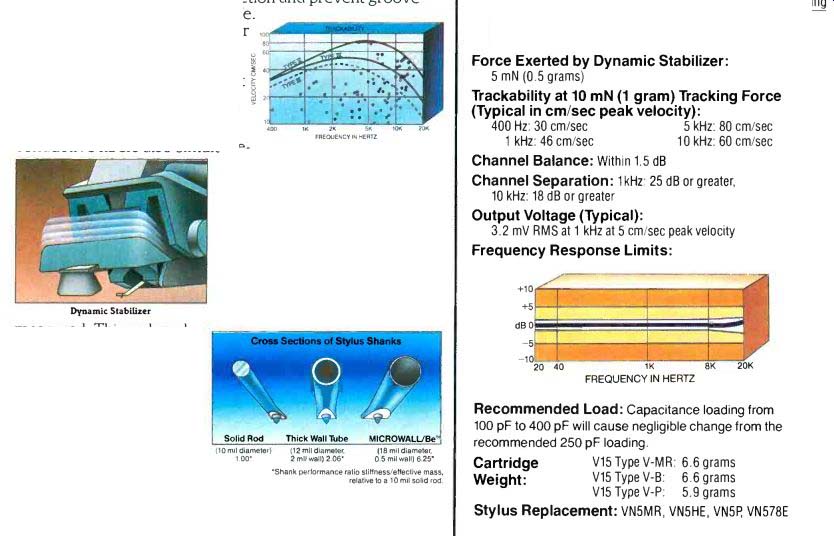
Shure's V15-Type V-MR features the revolutionary Micro Ridge Stylus Tip for unsurpassed tracing, particularly in the essential high frequency range. It provides an incredible 60cm/sec.; enough to handle the hottest signals of today's superdiscs. The patented MR Tip is also MASAR"-polished to further reduce record wall friction and prevent groove wall damage to extend record life.
A patented Dynamic Stabilizer functions like a miniature shock absorber to compensate for record warps which might result in groove skipping, cartridge , bottoming and signal wow. The stabilizer's 10,000 electrically conductive fibers also simultaneously discharge static electricity from the record surface and sweep microscopic dust from record grooves.
The Beryllium MICROWALL/Be 1 t Stylus Shank delivers incredibly accurate, high-frequency trackability with the lowest effective stylus mass of any shank yet measured. This reduced mass results in a truer, more refined sound with significantly less record and stylus wear. You'll also hear crisper highs and more forceful bass with a rich audio depth you've never heard before.




SPECIFICATIONS
For the sophisticated listener.
The M111HE and M110HE
Relax and enjoy your favorite music at its best. The M111HE and M110HE offer you brilliant clarity in sound for outstanding listening enjoyment. They include design technology and performance that are superior to comparably priced cartridges from other manufacturers.
These cartridges accurately reproduce even the most difficult music passages. Their critically accurate tracking is the result of Shure's uniquely constructed heat-treated telescoped stylus shank and exclusive precision crafted Hyperelliptical Diamond Tip.
The M1111-IE also has Shure's exclusive Dynamic Stabilizer shock absorber. Both models contain a built-in Side-Guard Stylus Protection System to protect your stylus from accidental damage. The M110HE also features a slide-on stylus guard.
These cartridges can be used with the standard 1/2" mount tone arm or most P-mount tone arm systems.
Accessories include a stylus cleaning brush plus a screwdriver and mounting hardware.
Whether you choose the M111HE or M110HE, you'll find either is a modest price to pay for big sound.
'Note: The M111HE is not recommended for use in nonadjustable P-mount tonearms. For these tonearms we recommend the M110HE.
Outstanding cartridges for the basic system.
The M105E and M104E
The M105E and M104E capture and recreate sound with an elliptical shaped diamond stylus tip and an aluminum alloy shank to faithfully reproduce your favorite music.
The M105E features a Destaticizer brush to clean dust from record grooves and remove static electricity from the record surface. Plus built-in Side-Guard Stylus Protection.
SPECIFICATIONS:
Stylus Tip: .2 x .7
Elliptical Tracking Force at the Stylus Tip: Optimum: 12.5 mN (1.25 grams)
Maximum: 15.0 mN (1.5 grams)
Force Exerted by Destaticizer (M105E): 5 mN (0.5 grams)
Trackability at 12.5 mN (1.25 grams) Tracking Force (Typical in cm/sec peak velocity): M105E. 400 Hz: 25 cm/sec 1 kHz: 35 cm/sec 10 kHz: 23 cm/sec M104E: 400 Hz: 24 cm/sec Frequency Response: Essentially flat 20-20,000 Hz Channel Balance: Within 2.0 dB Channel Separation: 1 kHz: 25 dB typical Output Voltage (Typical): M105E: 4.7 mV RMS at 1 kHz at 5 cm/sec. peak velocity M104E: 5.0 mV RMS at 1 kHz at 5 cm/sec. peak velocity Net Weight (with mounting adapter, screw and nut): M105E: 7.8 grams; also P-mount compatible M104E: 7.3 grams: also P-mount compatible Stylus Replacement: N105E, N104E
The M99E and M92E
The M99E and M92E offer excellent sound performance within their price range. Why gamble on other budget priced cartridges when Shure quality is still within your grasp? The elliptical shaped stylus tip teamed with an aluminum alloy stylus shank traces the groove of your records for a difference you can hear.
Both cartridges feature a slide-on stylus guard and fit on P-mount tone arm systems or on 1/2' mount tone arms when you use the adapter provided.
Accessories include all the necessary mounting hardware.
SPECIFICATIONS
Stylus Tip: .4 x .7 elliptical
Tracking Force at the Stylus Tip: Optimum: 12.5 mN (1.25 grams)
Maximum: 15.0 mN (1.5 grams)
Trackability at 12.5 mN (1.25 grams)
Tracking Force (Typical in cm/sec peak velocity): 400 Hz: 24 cm/sec
Frequency Response: M99E: 20-20,000 Hz
M92E: 20-18,000 Hz
Channel Balance: Within 2.0 dB
Channel Separation: 1 kHz: 20 dB typical
Output Voltage (Typical): 5.0 mV RMS at 1 kHz at 5 cm/sec. peak velocity
Net Weight (with mounting adapter, screw and nut): 7.3 grams; also P-mount compatible
Stylus Replacement: N99E, N92E
--------------
Genuine Shure replacement styli.
Laboratory tests prove it: a genuine Shure replacement stylus brings your cartridge right back up to original specifications. No fly-by-night imitation can be trusted to do this. And
no substitute offers Shure one-year warranty on craftsmanship and materials. Insist on the real thing-because a cheap imitation could be the most expensive "bargain" you'll ever buy.
Protect valuable records by replacing your Shure cartridge or stylus at least once a year.
Even a precision-crafted diamond stylus will eventually become worn and degrade your hi-fi system's sound quality. This may actually ruin precious records in just a single play! Have your stylus checked at least once a year by your Shure dealer and. if worn, replace it with a genuine Shure stylus. It's the least expensive insurance for your valuable record collection.
Anyone can replace a Shure stylus... it's as easy as A, B, C: A. Grasp the stylus B. Gently withdraw the C. Push the new grip between stylus assembly from stylus into thumb and cartridge, position in the forefinger, cartridge until the stylus grip touches the cartridge body.
Magnat Speaker Technology vs. The Rest Of The World.
While most companies have been content using decades-old technology, Magnat of West Germany has consistently developed radical new designs in their pursuit of the perfect loudspeaker.
Over the past 14 years, Magnat® of West Germany has been involved in more loudspeaker innovations than any other company. Some have resulted in incremental improvements in sonic accuracy.
Others have proven to be major breakthroughs in loudspeaker technology. A brief history....
1974 Magnat designs woofer voice coils using exclusive rectangular-shaped computer wound wire. These "Ribbon Wire" coils provide greatly improved transient response and much lower distortion.
1976 Magnat introduces the world's first speaker system with all drivers incorporating Ribbon Wire technology.
1979 Magnat develops and patents a revolutionary omnidirectional plasma high-frequency driver. This massless tweeter produces sound by modulating a small, controlled cloud of ionized air. MaGnat 1982 Magnat plasma speakers win Europe's two most coveted audio awards, Germany's "Hi Fi Preiz" and France's "Decibel D'Honneur 1983 Magnat develops a tweeter whose patented soft-metal dome is far more rigid than those made with soft plastic or textiles, but doesn't suffer from the resonance peaks associated with domes made of other metals.
1984 Magnat creates and patents Magnasphere omni-directional drivers. These ball-shaped, baffle free transducers radiate sound in all directions, just like musical instruments. Magnasphere speakers redefine world standards for dispersion, accuracy and lifelike stereo imaging.
1985 Magnasphere speakers become the first products in history to win three "Decibel D'Honneurs' the prestigious French audio award.
Of course these new technologies are only a means to an end. The real point is that Magnat's research results in speakers that sound audibly better, with less distortion and a more natural, open sound, than what you're accustomed to hearing from conventional designs.
Magnat and Magnasphere speakers are priced from $300 to $3,000 per pair" If you'd like to know more about Europe's most honored loudspeakers, send us the coupon for a brochure and a dealer referral.
*suggested retail prices.
Distributed in Canada by Evolution Technology, Inc., Toronto. In Canada: 1-416-335-4422
Magnat Germany's Number One Brand Of High-Performance Speakers
Box 808 Marblehead, MA 01945
Kyocera
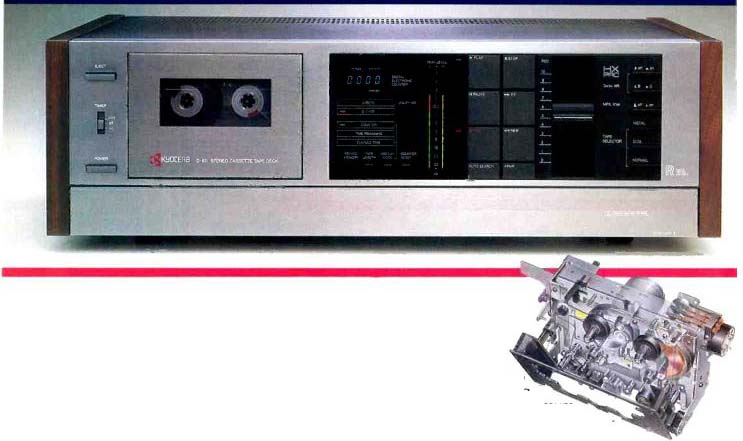
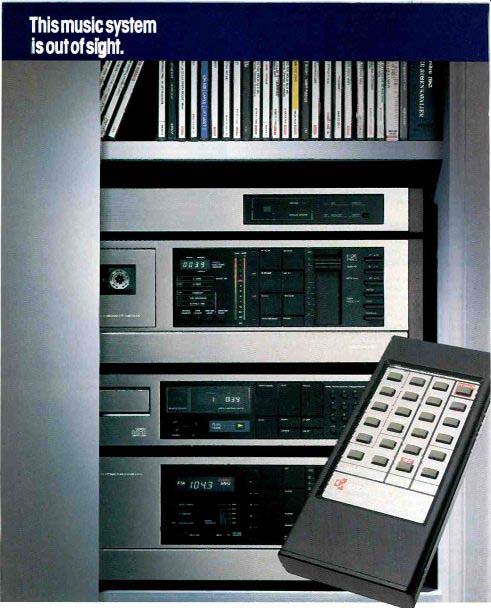
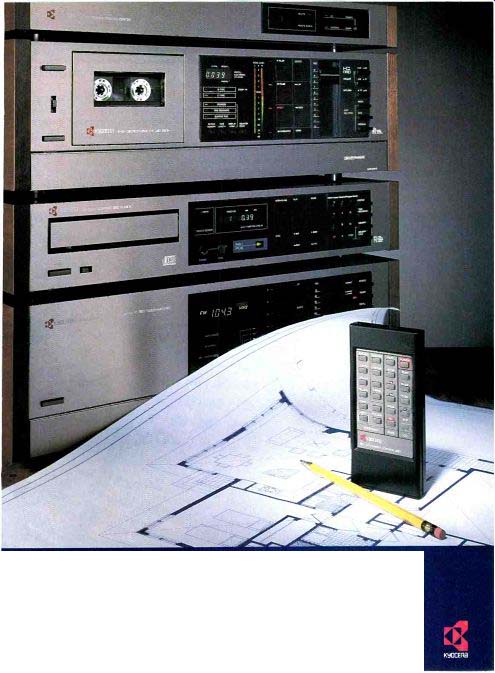
How to carry a 100-Watt MOS FET Receiver, a Dolby HX Pro Cassette Deck, and an anti-resonant Compact Disc Player around the house.
Kyocera puts one high-end audio system in many rooms.
The finer your audio system, the more you should enjoy it. So why confine your listening pleasure to just one room? Imagine having beautiful music throughout your house. In the bedroom as you get dressed. In the family room as you relax. In the Riving room as you entertain. Now imagine all this music coming from a single audio system of consummate fidelity.
Not long ago, this kind of flexibility was just a dream. It would have taken several separate hi-fi systems to accomplish this feat-with tremendous expense and duplication of components. But the tiny remote sensor of Kyocera's new Full System Remote Control network has changed all that For the cost of separate systems of marginal quality, you can assemble a single Kyocera system of audiophile quality--and enjoy that system in several rooms.
If you want to make your audio system the centerpiece of your living room, you'll be happy to know that Kyocera components are as beautiful as any on the market. But if you'd rather tuck your Kyocera components discreetly away, you can still enjoy them-and operate them via wireless remote control,
CD PLAYERS: Kyocera presents the features they'll be copying next.

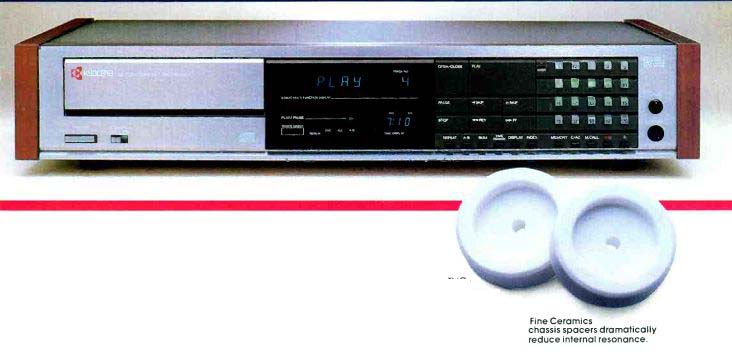
In May of 1983, Kyocera introduced a CD player with true 16-bit digital filters. Today, the competition's calling this circuit "the latest thing.' Years ago we had four-times oversampling. This year every high-end player worth mentioning has a similar design. In September, 1984 Kyocera raised some eyebrows with the world's first Fine Ceramics anti-resonant CD chassis.
Now the stores are full of flimsy imitations.
How did all these innovations happen to come from Kyocera, and not some household name? Perhaps because Kyocera's knowledge of digital circuitry comes from years of building computers for some of the best-known names in electronics. Perhaps because Kyocera is a world leader in Fine Ceramics, the technology used to house circuitry in aerospace, computers and other advanced systems. Or perhaps because some top-rated CD players from other brands were actually built by Kyocera.
Now Kyocera has four world-beating Compact Disc Players. Each boasts technology so advanced, it's a preview of what the competition will be selling in 1989. After all, history does repeat itself.
SOLVING THE PROBLEM OF RESONANCE
Because the CD's track of pits is microscopically narrow, vibration can cause mistracking and its consequent data errors. In fact, controlled tests performed for Kyocera by an independent research laboratory confirm that a non-resonant Fine Ceramics chassis incurred significantly fewer data errors than a conventional chassis of similar design.
That's why three of these new CD players feature Fine Ceramics spacers strategically located in the chassis. They isolate the laser transport and printed circuit boards from external vibration. In addition, dual zirconia-ceramic guide shafts, developed by the Kyocera Gamou Works, assure smoother travel of the laser transport for superior tracking stability.
THE KYOCERA DA-310CX. Compatible with the Kyocera Full System Remote Control network Zirconia-ceramic laser guide shafts for smoother laser travel, longer life 16-bit double oversampling digital filters for maximum noise suppression 3rd-order bessel-derived analog filters for minimum phase shift Rigid metal chassis construction Floating laser subchassis Three beam laser tracking for superior tracking stability Gold-plated output jacks Skip forward and Back Two-way repeat (disc and track) 16-selection programmability "Dedicated" wireless remote control supplied Multi-function fluorescent display Headphone output with volume control Wood side panels.
THE KYOCERA DA-410CX.
ALL THE FEATURES OF THE DA-310CX, PLUS: Anti-resonant construction with Fine Ceramics chassis spacers for fewer data errors, lower distortion DC analog amplifier with left/right phase compensation for improved stereo imaging Direct random track selection with 10-key pad Timer playback capability.
THE KYOCERA DA-510CX.
ALL THE FEATURES OF THE DA-410CX, PLUS: Digital filtering with four-times oversampling at 176.4 kHz to minimize aliasing noise Dual digital-to-analog converters eliminate interchannel phase delay Optically coupled digital signal routing to eliminate internal interference Direct digital output for connection to other digital components Digital Subcode Output port for disc information output Three way repeat: disc, track and phrase Direct random track selection with 20-key pad Intro Scan plays a ten-second sample of each track on the disc Background Music function plays songs on the disc in random sequence.
THE KYOCERA DA-710CX. ALL THE FEATURES OF THE DA-510CX, PLUS: Separate digital and analog power supplies minimize interference Dual monaural audio circuit maintains high separation 100% discrete components in the analog output stage for minimum distortion Low-noise LC-OFC wiring 99-track direct access.
--------Fine Ceramics chassis spacers dramatically reduce internal resonance.
CASSETTE DECKS: Two heads can be better than three.
For years, cassette deck manufacturers have touted the three-head feature. Again and again, we are told that three heads are the only way to achieve frequency response to 20 kHz. So many brands have devoted so much attention to this argument that it seems heretical to suggest there's a better way. In fact, doing three heads properly is an extremely expensive proposition. And doing it poorly is a sure way to sacrifice performance.
Proponents of three-head design like to gloss over the fact that any three-head deck with pretentions to high performance must come to grips with the problem of azimuth error.
Azimuth error occurs when the playback head gap does not line up precisely with the signals laid down by the record head gap. This kind of error can never occur on two-head decks, where the record and playback gaps are exactly the same. Less than one degree of azimuth error can cause significant loss of response above 15 kHz. And that's ironic, because extended highs were supposed to be the strength of the three-head design in the first place.
Some manufacturers try to reduce azimuth error by placing the record and playback heads close together-often squeezing them through the cassette's central window. Others try to conquer azimuth error through elaborate mechanics and electronics. To be fair, the more elaborate systems do work, but only at incredible cost to the consumer. And the simpler systems? If the response falls short of 20 kHz on Type II tape, then the azimuth error correction is not completely successful.
Kyocera has a fresh approach. We maintain that a properly designed two-head deck can give you exemplary frequency response. And our decks prove it. Instead of spending money on elaborate azimuth error correction, we consciously spent the money on reducing wow & flutter.
A TRANSPORT OF DELIGHT.
The most audible shortcoming of today's decks is wow & flutter.
That's why Kyocera concentrated on improving the transport. On the D-811, we used two capstans, isolated by a closed-loop belt, for minimum modulation noise. We gave the takeup capstan direct drive. We supplied a separate high-torque motor to drive the reel hubs. And we even used a third motor to insert the heads into the cassette gently and precisely. The result is sound without the veil of modulation noise, wow & flutter that plagues lesser cassette decks.
THE KYOCERA D-611.
Compatible with the Kyocera Full System Remote Control network Three-motor transport Direct drive FG servo motor turns the capstan without gears or pulleys-wow &flutter only 0.035% (WRMS) High torque motor drives reel hubs Third motor gently inserts heads into cassette Sendust-core record/ play head achieves response to 20 kHz with Type I and Type II tape, to 22 kHz with metal tape Dolby B and C noise reduction Switchable MPX filter Fine Bias control Timer recording and play Automatic Program Mute Recording adds four-second blanks between songs Auto Play and Repeat Memory Stop and Memory Play.
THE KYOCERA D-811.
ALL THE FEATURES OF THE D-611, PLUS: Dolby HX Pro Bias Compensation for extended recording range 400 Hz calibration tone for record balance Closed-loop dual-capstan tape drive minimizes modulation noise Wow & flutter reduced to only 0.02% (WRMS) Fluorescent readout of tape time in minutes and seconds LED peak level indicators with peak-hold.
RECEIVERS: We take them seriously.
If receivers have something of a bad reputation among serious audiophiles, there's a good reason. In Japan, where everybody owns component high fidelity, nobody owns one-piece receivers. In fact, North America may be the only place where receivers represent a majority of the market.
For most Japanese audio engineers, receivers are strictly for export. They're not serious components at all. So receivers are designed by the second-string engineers. This explains why even companies with decent separates tend to load their receivers up with meaningless knobs, buttons, and displays.
The irony here is that there's no reason why receivers must be second-class components. There's nothing to prevent a company from using the same common sense and judgment in receiver design as they exercise with separates. This is the guiding philosophy behind Kyocera receivers.
MOS-FETS IN THE DRIVER STAGE. A rarity in receivers, Metal-Oxide-Semiconductor Field Effect Transistors (MOS FETs) are used in the driver stages of all Kyocera receivers for their superior transient response and isolation characteristics.
PRE-OUT/MAIN-IN JACKS. While it is hard to find a receiver with preamp--output/main amp input jacks nowadays, all Kyocera receivers have them. So you can connect outboard signal processors, use higher-powered amps, or use your receiver as part of an elaborate multi-amp system. That's particularly important considering the multi-room capability of the Kyocera Full-System Remote Control network.
THE KYOCERA R-461.
50 Watts per channel (continuous RMS, both channels driven into 8 Ohms from 20 Hz to 20 kHz with no more than 0.02% THD Compatible with Kyocera Full System Remote Control network Manual/ electronic volume control Subsonic filter at 20 Hz with 12 dB/octave slope High filter Two tape monitors with dubbing Preamp Output/Main Amp Input jacks MOS FETs in the amplifier driver stage for better dynamic performance Low-feedback design for reduced transient intermodulation distortion Female banana jacks bypass speaker switching for straight-wire-with-gain circuit Quartz frequency synthesis tuning FM front end with MOS FETs and High-Q varicaps for minimum interference Ceramic IF filters for high selectivity, low distortion 6AM + 6 FM station presets.
THE KYOCERA R-661.
70 Watts per channel (continuous RMS, both channels driven into 8 Ohms from 20 Hz to 20 kHz with no more than 0.02% THD .ALL THE FEATURES OF THE R-461, PLUS: Toroidal transformer Oxygen-Free Copper (OFC) wiring for reduced noise Moving Magnet/Moving Coil phono input stage Parametric bass and treble controls with continuously variable turnover frequency for sensitive and precise tonal adjustment Wide/Narrow IF bandwidth switch adapts to your reception conditions High frequency FM comparator for reduced noise FM quadrature detector for low distortion Chopper type FM stereo demodulator for improved stereo separation High blend switch for better sound on weak FM stations 7 AM + 7 FM station presets.
THE KYOCERA R-861.
*100 Watts per channel (continuous RMS, both channels driven into 8 Ohms from 20 Hz to 20 kHz with no more than 0.02% THD .ALL THE FEATURES OF THE R-661, PLUS: Parametric bass, midrange, and treble controls Automated IF bandwidth switching (Wide/Narrow) adapts to your reception conditions Switchable de-emphasis for Dolby FM broadcasts.
Kyocera--Built right from the ground up.
Kyocera Electronics Inc., 100 Randolph Road CN 6700, Somerset, NJ 08873-1284, (201) 560-0060
ADCOM GFP-555 PREAMPLIFIER
A remarkable combination of exceptional performance, flexibility and value.
The traditional audiophile has typically had the choice of two opposing designs in preamplifiers. One offered flexibility, with the (assumed) sacrifice in musical accuracy. The other took the purist route, with no features beyond a volume control and on/off switch.
The Adcom GFP-555 preamplifier was designed to face this dilemma head-on, and resolves it in ways that will satisfy the most diehard of purists.
Outstanding performance--affordable price.
The GFP-555's musical performance is outstanding-by any measurement or listening criterion-and at the same time it offers a full array of meaningful controls and features.
What's more, the GFP-555 does it all at a surprisingly affordable price. Surprising, that is, only to those who aren't yet familiar with the Adcom approach to design and performance.
Musical performance, in particular.
Getting down to basics: Sound quality is paramount.
Gain path-simple and direct.
The GFP-555's gain path is simple and direct from input to output. The use of a minimum number of components-each of the highest quality-means low waveform distortion and less phase shift.
The gain stages employ the most innovative state-of-the-art linear amplifiers ever used in high fidelity components. These individually selected instrument-grade devices are in a class by themselves.
The speed of the gain stages is extraordinarily high-almost fifty times faster than the speed of CD or LP signals. And along with this speed, there's the lowest noise and lowest offset voltage currently available.
The almost nonexistent offset voltage eliminates the need for blocking capacitors used by others, and allows the GFP-555 to be direct coupled for exceedingly wide frequency response-from DC to beyond 400,000 Hz.
Noise is exceptionally low throughout all inputs. with a typical noise floor of four billionths of a volt-per-square-root-hertz-more than 115 dB below a 10mV input at 1kHz! The power transformer and associated power supply components are of very sophisticated design. Dispersion of radiated noise and hum fields is eliminated by the use of layers of mu-metal shielding on the power transformer.
In addition, the use of large filter capacitors permits excellent regulation of power supply, providing consistently high performance regardless of fluctuations in signal or AC line voltage.
Those concerned about preamps with tone control circuitry should be aware that although the GPF-555 has it, the "normal" position keeps this circuitry out of the signal path as thoroughly as if it weren't there at all.
When wanted, it can be switched in.
The high- and low-cut filters are passive.
Their gentle slope has very low phase shift, and prevents ringing and significant changes in sound quality.
The output impedance is 470 ohms, low enough to avoid high-frequency loss when long lengths of cable are used between the preamplifier and power amplifier.
CD and phono input jacks, and all output jacks, are gold plated for minimum signal loss.
And speaking of flexibility.
There are times you may want to listen to one input (phono, tuner, CD, tape, etc.) while taping from another. That's precisely what you can do with this preamplifier.
The headphone jack has its own amplifier, both to prevent loading of the preamp output circuit and to provide sufficient gain to drive virtually any headphone.
Two sets of output jacks are provided: one pair for amplifiers, such as Adcom's, which are direct-coupled; the other pair for amplifiers which require coupling capacitors.
For optimized performance of any magnetic phono cartridge, adjustable capacitance loading is provided.
There's an unusual number of inputs: five for high level inputs (tuner, CD, tape 1, tape 2, video/AUX); and one phono input that can be switched for low- or high-output moving-coil and moving-magnet cartridges.
Contour circuits for enhancing bass response at low listening levels have been around for some time, of course. Ours are considerably more sophisticated, more useful and more musically accurate over a wider range of listening conditions than any you are likely to have encountered.
Considering the opportunities offered the new breed of signal processors, you’ll welcome the separate processor loop that leaves both tape loops available for use.
Final word.
What all this adds up to with respect to music is very simple. There is less phase shift between channels, dead quiet background (essential for CDs), total transparency and clarity of detail. The music truly comes alive, with no sense of "electronic presence" in the reproductive chain.
Of course, we hope that this information reaches you at a time when you're interested in a new preamplifier, or should be-whether your first or an upgrade-and that what interests you above all is a demonstrably superior combination of sonic performance, flexibility and value.
-----------------------------
Headphone amplifier. A separate high quality audio amplifier section is provided for use with headphones.
On-chassis selector switching. By avoiding long signal traces and wires, this feature minimizes crosstalk by switching audio signals close to their input source.
Tightly-regulated power supply--Maintains outstanding performance and consistency, regardless of fluctuations in signal level or AC line voltage.
Volume control. This high quality precision potentiometer maintains ideal balance between channels throughout its rotation.
Glass epoxy circuit board, copper plated on both sides.
Direct on-chassis input / output jacks.
Bypass capacitors.
Custom-designed linear gain sages with unique semiconductor complement.
----------------------------------
SPECIFICATIONS.
Total harmonic distortion: 0.005% IM distortion: 0.005%
Signal-to-noise ratio: Phono (re 0.5 V output): >85 dB
Tuner, CD, tape (re 2 V output): >100 dB
Tone controls: Bass (40 Hz) . 9.5 dB Treble (15 kHz) .9.5 dB Contour (switchable): +6 dB at 50 Hz Frequency response: 1 Hz-100 kHz 0.1 dB High filter (switchable): 2.5 dB at 20 kHz (6 dB/octave)
Low filter (switchable): 5 dB at 20 Hz (6 dB/octave)
Input sensitivity for 0.5V output: Phono High MC/MM: 0.4 mV
Phono Low MC: 0.13 mV High: 40 mV Maximum output level: 10 volts Input impedance: High MC/MM: 47 k-ohms Low MC: 100 ohms
Output impedance: 470 ohms
Phono overload at 1 kHz High MC/MM: 140 mV
Phono input capacitance: Adjustable; 100 pF, 175 pF 275 pF
Line voltage: 120V/60 Hz (Available in 230V/50 Hz on special order)
Dimensions: 17" x 3 ¼” x 12 3/4" D (432mm x 83mm x 324mm D)
Weight: 14 lbs. (6.4 kg)
Optional accessory: Model RM-3, rack mount adapters.
Adcom products are available with white or silver front panels on special order.
Shown: GFP-555 preamplifier, GFT-555 AM/FM-stereo tuner and GFA-545 power amplifier with white front panels.
PIONEER ELITE SERIES--A NEW CLASS OF AUDIO AND VIDEO COMPONENTS
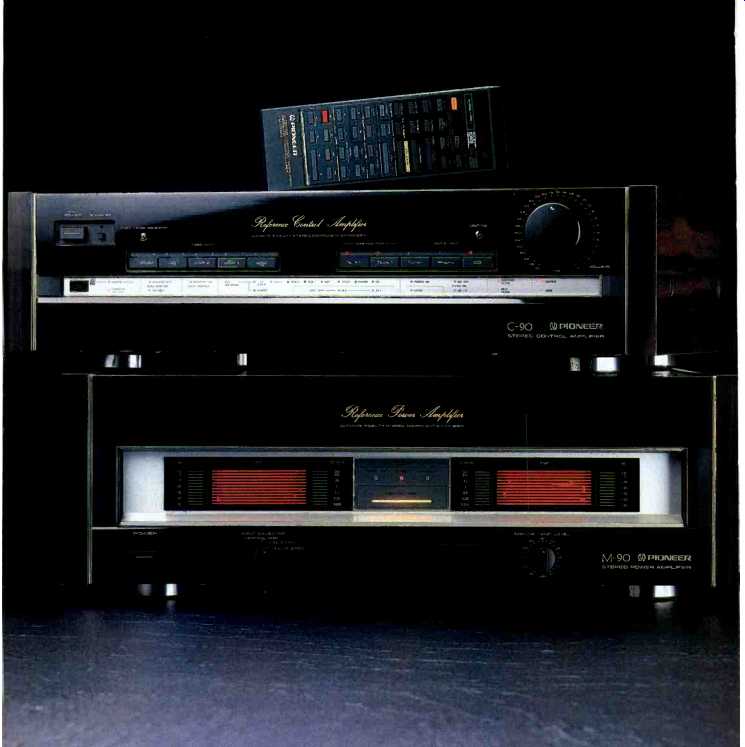
Reference Amplifiers
C-90 Reference Control Amplifier
We've given the C-90 a twin-mono amp construction which features separate power supplies and chassis layouts for the left and right channels. This elaborate construction shuts out mutual interference between channels, thus dramatically reducing intermodulation distortion. There's also an independent power supply that uses an exclusive transformer for video circuits, displays, relays, microcomputers and electronic switches.
We've also isolated the circuits in the C-90 from the external world because we know that a preamplifier is as susceptible to external disturbances and vibration as any other component. Preamps handle very delicate signals measured in microvolts and millivolts. When subjected to vibration, parts vibrate in sympathy, resulting in a type of distortion called "microphonics." Though subtle, this effect is discernable, especially with the tremendously wide dynamic range possible with digital programs. So we constructed feet from polycarbonate (for optimum shock absorbing response), anchored circuit boards to the chassis with rubber dampers, used flexible copper screws to cushion shocks, and employed a massive solid-aluminum volume control knob.
In order to retain higher purity and integrity, we shortened signal paths as much as possible through the use of relays, electronic switches and other means of electronic control wherever applicable.
This has resulted in a drastic reduction of signal loss and deterioration (noise, distortion, crosstalk, etc.). To boost the delicate signals from moving-coil cartridges, Pioneer's exclusive "hybrid" booster combines a quality transformer and an optimum-gain phono equalizer. With one-half the normal number of turns of coil, the transformer's thicker wire reduces DC resistance and stray wire capacitance for better high-frequency response. The reduced gain in the transformer is compensated for by an equalizer specially designed for low-noise performance. All this ensures that our "hybrid" booster provides a flat response from lows to highs and well-damped sound, making your "analog" records sound better than ever.
Pioneer's policy of using only quality parts is expressed throughout the amplifier, from circuit boards to wiring, from capacitors to semiconductors. Copper plating is used for the chassis and screws, for instance, to reduce subtle magnetic distortion.
In addition to high-quality sound, the C-90 also provides tremendous convenience: it connects, switches and controls six video components two play-only units (LD players, TV tuners, etc.), three record/playback VCRs, and one processor unit. Besides, it provides two monitor outputs, and a 5-pin RF converter output that accepts an optional RF modulator (JA-RF5) for connecting a conventional TV. Using the sharpness, detail and noise reduction controls, you can even enhance the video as you watch or dub.
And for added convenience, the C-90 comes with a remote control that lets you control volume and input selection, as well as handle other Pioneer audio/video equipment with the "SR" mark. Adding a touch of class to the amplifier is an aluminum front panel finished with a lacquer-like shine.
M-90 NON SWITCHING AMP'
Reference Power Amplifier The demand for a reliable and high-output power amplifier has never been greater now with the wide dynamic range made possible by the Compact Disc. The M-90 Reference Power Amplifier was designed especially for this digital age.
Speaker systems can have rated impedances of, say, 6 or 8 ohms, but when they play music with wide dynamic variations, the actual impedance can go much lower, especially at low frequencies. With dynamic digital sound, an amplifier must be equipped with a power supply that performs reliably even under the heaviest load. And that's why we've created the M-90: its power supply features two outsize transformers, large electrolytic capacitors (for a total capacitance of 48,000µF) and four bridged rectifier circuits with fast-recovery diodes.
And in the power amplifier, 16 high-power transistors (8 per channel) are used in an elaborate "four-in-parallel" configuration.
What this means is that the M-90 is ready to deliver a continuous average power output of 200 watts per channel, min., at 8 ohms from 20Hz to 20,000Hz with no more than 0.003% total harmonic distortion. What's even more amazing is its dynamic power: 300 watts at 8 ohms, 550 watts at 4 ohms and 800 watts at 2 ohms (with EIA dynamic test signal). We also have made signal paths as short as possible to ensure signal integrity. The volume control for CD input is located on the front panel, of course, but actual level adjustment is performed by a potentiometer located behind the input terminals and linked by a long shaft.
In addition to the input for a control amp, the M-90 has an input, with volume control, for direct connection of a Compact Disc player to allow you to enjoy purer-than-ever digital sound. Another line-level direct input is also provided that permits you to add other digital equipment in the future. The M-90 also has an output to allow you to return the signals to the preamp for equalization or recording on a tape deck.
We used our exclusive Non-Switching Circuit Type II for the power output stage, thus ending switching distortion. And we have elaborated on this design to reduce distortion further across a wide power output range. Thermal distortion is also drastically reduced by stabilizing the idling current supplied to power transistors from the moment power is turned on. Moreover, we've reduced non-linear distortion of power transistors to 1/30 that of our class-B amps.
To ensure quality sound, we used quality parts, such as gold-plated in/output jacks, OFC (Oxygen-Free Copper) wiring, and 70µm thick copper-plated circuit boards. To reduce magnetic distortion, the entire chassis is copper-plated, and so are screws used throughout.
Sophisticated craftsmanship is evident from the exterior: the power amp's aluminum panel front glows with a traditional lacquer-like luster. The front panel also contains large fluorescent power output indicators.
*Measured pursuant to the Federal Trade Commission's Trade Regulation Rule on Power Output Claims for Amplifiers.
REFERENCE DIGITAL AMPLIFIER AND TUNER
A-91D NON SWITCHING AMP
Reference Digital Non-Switching Integrated Amplifier
Here's an amazing amplifier that's ready for digital reproduction: the A-91D. It even comes with a digital circuit for Compact Discs.
With the A-91D, program signals go through the shortest direct path from circuit to circuit, to minimize chances of noise pickup and to maintain musical purity. We've made this possible by having actual switching and control occur near circuits or input terminals. A "LINE DIRECT" switch lets you further trim the signal route; it runs the input selector direct to the power amp, bypassing all intervening circuits (except volume control) physically as well as electrically. It lets you enjoy unusually clear and clean reproduction from any program source.
Subtle vibrations can cause subtle sound degradation by microscopically moving parts and devices. So we've shut them out using a non-resonating frame chassis, insulators and a heat sink, all with a honeycomb construction. They also add to the rigidity of the entire chassis. Using separate circuit blocks contributes to clarity by keeping interference to a minimum.
Our new Non-Switching Circuit Type III features excellent low impedance driving capability combined with low distortion. Our exclusive power-amp design offers more advantages. One, it puts an end to switching distortion to add clarity to the sound you hear. Two, it fully stabilizes idling current, so that distortion due to thermal fluctuation is reduced to zero. Three, distortion created by power transistors is reduced to 1/50th the original value. Four, load variations are suppressed, and dynamic response is improved when large currents are drawn at low impedances, thanks to separation of the voltage- and current-amplifying stages.
The A-91D is designed to drive low impedances of 6 or even 4 ohms with low distortion over a wide frequency range. Backing it up are two high-capacity power transformers. They are contained in finned die-cast iron cases, filled with a damping agent, which dissipate heat to prevent the increased resistance and impedance that high temperatures can cause. They are also solid and non-resonating, and magnetically shielded to prevent magnetic radiation from affecting delicate signals.
In the A-91D, we've extended the digital advantages by including independent digital conversion circuitry. There are two glitch-free D/A (Digital-to-Analog) converters (one for each channel), a digital filter which uses four times the normal sampling frequency (176.4kHz), and an analog low-pass filter built from quality discrete parts.
Use the A-91D with a CD player with digital output such as the Pioneer PD-M90X, and you'll get digital sound in its purest form.
There are six digital inputs and three digital outputs, of which two inputs and one output have optical interfaces to permit electrical isolation. An Optical Transfer Distortion Canceller is added to eliminate jitter for accurate optical transmission.
The A-91D delivers a continuous average power output of 120 watts* per channel, min., at 8 ohms, from 20Hz to 20,000Hz with no more than 0.003% total harmonic distortion.
*Measured pursuant to the Federal Trade Commission's Trade Regulation Rule on Power Output Claims for Amplifiers.
F-91
Reference Digital Synthesizer Tuner
We've pushed the level of FM sound quality to record highs with the addition of two Pioneer exclusives to the F-91.
The first is the ARTS (Active Real-Time Tracing System) included in the IF section of the tuner. With some tuners, especially expensive ones, you have the choice of using a narrow or wide IF bandwidth.
The first lets you avoid interference, but you have to settle for an increase in distortion. The second provides lower distortion and better sound, but interference may get in the way. Pioneer ARTS it's simply the best of both worlds: its IF filter actively follows the desired signal while rejecting interference. Now you can enjoy both the low distortion of a wide bandpass and the high selectivity of a narrow bandpass.
Sensitivity is improved, too.
The second Pioneer feature is the Digital Direct Decoder Type III. It takes the output from the ARTS IF circuitry and converts it into digital form before directly turning it into stereo analog signals. Thanks to digital operation, our DDD Type III is less prone to signal degradation.
Moreover, in the Type III, we've simplified the circuitry using a new PLL detector, which has reduced noise even further.
Improvements extend to other circuits of the tuner as well.
The front end, for instance, features an ID MOS FET to improve reception. Indeed, the front end is as highly sensitive and selective as an elaborate 4-ganged tuning capacitor.
The F-91, like our amps and CD players, is designed based on our anti-vibration concept to damp harmful resonance and vibration for improved sound. We've turned circuits into modules and filled them with epoxy resin. And we've added honeycomb ribs to the chassis and used large insulators to shut out external vibration.
Then, of course, there are a wealth of features designed to improve convenience. You can preset up to 24 FM and AM stations in any combination. Up to three different stations can be programmed so that, when controlled by an optional timer, they are tuned in sequence--a convenient way to make unattended recording.
More features for convenience are an auto tuning mode, selectable muting level, recording level calibrator, and a fluorescent display.
Pioneer ARTS (Active Real-Time Tracing System)
A conventional wideband filter permits low-distortion reception but suffers when undesirable signals interfere (Photo 1). An alternate narrowband filter may cut interference, but can add distortion because of the limited bandwidth (Photo 2). Photo 3 shows the response of the F-91 with ARTS. As you can see, it delivers a low-distortion signal even when there's interference. The Pioneer ARTS simply combines the low-distortion performance of a wide bandwidth and the high selectivity of a narrow bandwidth.
REFERENCE MULTI-PLAY COMPACT DISC PLAYER.
PD-M90X Six-disc multi-play convenience Class and convenience happily coexist in the PD-M90X, which combines classical elegance with computer-age features.
Our top-of-the-line multi-play CD player, the PD-M90X lets you enjoy beautiful, dynamic digital sound for hours and hours, uninterrupted. It accepts up to six CDs mounted inside a special magazine and plays the discs just the way you want them played. You can play each song on all six discs one by one, or jump to the song or disc you want instantly, using DISC NUMBER and TRACK NUMBER buttons provided both on the remote control and on the unit itself. For added convenience, you can also select up to 32 tracks from the six discs and program them for playback in any order! A single-disc loader is also standard for single-play convenience.
Remote control with "one-touch" program loading The PD-M90X comes provided with a full-function "SR" remote control.
It offers three extra conveniences: a numeric keypad, a multi-function LCD (Liquid Crystal Display) panel and the MPSS* (Magazine Program Selection System). The keypad gives you instant access to any track, a feature you'll also find useful when programming tracks. The LCD panel serves as a guide to programming, letting you preset tracks and the order away from the player while referring to labels of the discs.
The Magazine Program Selection System permits you to store up to 80 programmed "steps" (songs and pauses) from eight six-disc magazines. Using MPSS, you are saved from reprogramming tracks each time you mount a magazine: all you have to do is press the memory button for that specific magazine and the "transfer" button.
The programmed songs are then automatically "loaded" from the remote into the player. Now loading programmed tracks has become as simple as touching a button.
4-way repeat, random play, fluorescent panel and other conveniences
The PD-M90X offers four-way repeat, including a single track, a single disc, all six discs and programmed tracks. The random play feature lets you leave track selection up to the player touch the RANDOM PLAY button, and a built-in microcomputer randomly selects the songs for you from among the six loaded discs, without repeating tracks!** Or, press this key in the programmed play mode, and the computer randomly selects songs from among those programmed. Programmable pauses, 2-speed manual search, track search, and timer start function with options of normal and random play these are other conveniences of our multi-play CD player.
A multi-function 7-digit fluorescent display is provided to show you the operating status of the player. It shows the elapsed time and remaining time of a track in play, as well as the remaining time of an entire disc. In addition, the display shows the accumulated total time each time you program a track. A graphic indicator shows which disc is being played at any moment.
Anti-vibration concept--When it comes to hi-tech features for better digital sound, the PD-M90X has plenty. To damp vibration and resonance, which can cause muddy sound, we use a copper-plated honeycomb chassis; a Disc Stabilizer to firmly clamp the rotating disc; and large aluminum ringed insulators made of vibration-absorbing polycarbonate.
Oversampling digital filter An oversampling digital filter using twice the normal sampling frequency 88.2kHz ensures low noise and minimal phase distortion for extra clarity and razor-sharp sound definition.
Digital level control A digital level control lets you attenuate the playback level from the remote. Since it adjusts the signal while still in digital form, our digital volume control adds a minimum of noise and distortion.
Digital output
There is a digital output for connection to an outboard DAC (Digital-to Analog Converter) unit or an amplifier featuring a built-in DAC like the Pioneer A-91D, so that you'll enjoy better yet, purer yet digital sound.
MPSS is a trademark of Pioneer Electronic Corporation.
"'Some tracks may repeat when a disc contains more than 100 tracks.
Note: The PD-M90X comes with both a 6-disc magazine and a single-disc loader.
Additional magazines (JD-M100) are available as options.
Reference Quartz-PLL Direct-Drive Turntable
PL-90
Think of it as the most advanced form in turntable technology. The PL-90 is designed to let you enjoy the maximum dynamic range and low distortion that today's best analog recordings can deliver.
To get the best performance out of today's sophisticated phono cartridges, we've fashioned its straight tone arm out of light yet rigid alumina ceramics. Then we've fitted on it a Pioneer DRA (Dynamic Resonance Absorber), a combination of a viscous damper and weight, to eliminate resonance.
To ensure that your records are played with extremely low noise and wow and flutter, we use ad coreless direct-drive DC-servo motor controlled by a precise quartz-PLL servo system to provide cog-free and ripple-free smooth torque generation.
The motor is fitted with a Stable Hanging Rotor to improve stability. The platter is large (14-3/16 inches across), heavy (7 lbs. 4 oz.) and has a high moment of inertia (655 kilograms per square centimeter), to smooth out rotation.
The important tone arm and motor are fully insulated from external influences through a Double Insulation System that shuts out vibration in both horizontal and vertical planes. The cabinet is made of high-density material to suppress resonance.
Ease of use is enhanced with the addition of automatic arm lift-up at the end of record play.
Digital Standard Speaker System
DSS-E10/DSS-E6
Here's a pair of speaker systems specifically designed to serve as standards for accurate digital reproduction. A number of Pioneer exclusive designs has contributed to the making of our reference speaker systems.
One is the LDMC (Linear-Drive Magnetic Circuit) in the woofer.
It creates a uniform magnetic field over a wide range within the voice coil gap. As a result, the voice coil is driven by the same uniform force, whether it is being pushed far outward to create very loud sounds, or is hardly moving to produce the faintest notes. The LDMC makes the sound you hear refreshingly transparent, powerful and exceptionally lifelike.
Our woofers also feature the EBD ( Electronic Bass Drive). This design uses two voice coils wound on the bobbin, one on top of the other. Driven by two frequency-divided voice coils, the woofer produces double the amount of usable bass sound, extending the low frequency response substantially.
Our DRS (Dynamic Response Suspension) improves the linearity of the damper and surround of the woofer, so that the driver responds accurately to a wide range of inputs from the loudest to softest sounds.
This adds to a wider dynamic range.
The diaphragm of the woofer is made of Pioneer's PG or Polymer Graphite* that's light and firm. It combines low distortion, smooth response and low coloration. The midranges are made of hard boron to improve sensitivity and assure natural response. Tweeters are lightweight and responsive beryllium ribbons combining better transient response and low distortion.
*Polymer Graphite is a trademark of Pioneer Electronic Corporation.
- --- - - ----------------
Reference LD Player
LD-S1
The best in picture and sound
Here's the finest LD player available to consumers anywhere in the world. Designed and engineered specifically for the videophile with an ear for excellent sound. Take a look at some of the LD-S1's standout specifications: 420-line horizontal resolution, 48dB video signal-to-noise ratio, 105dB audio signal-to-noise ratio and 97dB audio dynamic range.
Full-floating drive system
Subjected to vibration, the pickup of an LD player can cause jitter, patchy colors and streaks in solid colors. And vibrating PC boards can muddy the sound. So we've isolated the motor disc drive from the rest of the chassis, to reduce the amount of vibration passed from the motor to other parts of the player. The result is a drastic reduction of jitter and streaks. Specifically: Our new Dynamic Pressure Bearing has lessened the load applied to the metal bearing. As the shaft starts to rotate, liquid silicone collects under the shaft, cushioning it and supporting it to prevent direct contact with the bearing. Transmission of motor vibration is lessened and friction reduced for smoother motor rotation.
Our magnetic disc clamper uses a powerful magnet to hold the disc. The moment a disc is in place, the clamper arm is removed from the clamper, thus ending the transmission of the motor vibration to other parts of the player.
AccuFocus System
The tracking beams reflected from the disc are added by the quadrant photodetector inside the pickup assembly. But there is a slight phase difference between the outputs from leading and trailing beams. In the LD-S1, however, the outputs from the leading beam are delayed so that they can be added to those from the trailing beam in time. This reduces distortion and improves frequency response, especially the highs, of the RF output. Both audio and video benefit.
4X oversampling digital filter and twin D/A converters
We've incorporated a digital filter using a sampling frequency 4 times higher than that used in conventional filters. Working with an analog low-pass filter, it reduces phase delay as well as distortion. To eliminate phase difference between channels, we use two independent glitch free D/A (Digital-to-Analog) converters. LDs with digital sound have never sounded better.
Digital memory
Eight-bit digital memory brings you versatile and clean special effects the LD-S1 is the first player ever to be equipped with this innovative feature. You can freeze and store a picture in memory for viewing anytime. You can enjoy still and multi-speed play even from CLV (Extended-Play) discs, not to mention CAV (Standard-Play) discs. You'll also enjoy "strobe motion" and still with sound, two exciting new additions. Pictures are exceptionally stable and free of noise. Scanned pictures are also free of noise bars.
Elaborate power supply and quality parts
The LD-S1's power supply is elaborate, using two transformers, one for servo and digital circuits, and another for audio and video circuits. And to shut out interference between audio and video circuits, each has a separate power supply (independent coil windings on the transformer) and is laid out so that it is separated from the other. Quality parts are used for improved sound and picture, including a 1mm-thick OFC (Oxygen-Free Copper) ground bus plate, gold-plated terminals, copper plated chassis, and OFC AC power cable.
Superb operating conveniences The LD-S1 is equipped with a number of features to make operations superbly easy. Any part of a disc can be accessed in one-half the normal time of conventional players. A large fluorescent panel serves as your guide to operation. A new addition is the "Last Memory" feature: press the "LAST MEMORY" button before shutting off the power, and at the next viewing play resumes with a scene a few seconds back from where you left off. The front panel has all the controls you need for operation. And the remote control is ergonomically designed for ease of use.
Available functions include Still/Step, Dual-Speed Scan, Frame/ Time Search, Chapter Search, 9-Step Multi-Speed Play, 4-Mode Repeat, Chapter-Skip Search and Chapter Program. Other features include onscreen display, picture tone control, two video outputs, I/O port for computer interface, gold-plated headphone output, and an SR terminal.
ADCOM
THE END OF THE RECEIVER.
ADCOM model GTP-500
THE DAWN OF A NEW ERA.
The Adcom' GTP 500 Tuner/Preamplifier.
A new level of sonic quality and convenience that obsoletes the receiver.
Adcom is well known as a manufacturer of quality separate components-tuners, preamplifiers and amplifiers-all highly regarded for their exceptional performance and their rational prices.
Demonstrably superior quality along with flexibility and affordability is what we now offer in a significantly new type of component. The GTP-500 combines an exceptional tuner and preamplifier on a single chassis, conceived and designed for use with a wide choice of separate power amplifiers.
Avoiding the receiver's inherent problems.
Receivers are not equipped with the heavy-duty, high current, high voltage power supplies available in the best separate power amplifiers. First of all, there just isn't enough space. More importantly, there are technical limitations. In a receiver, such supplies would generate unacceptable levels of heat and hum. And the high signal levels found in the power output stages create a source of noise, crosstalk and preamplifier instability.
Obviously, heat and noise-generating elements shouldn't be operating in close proximity to tuner and preamplifier circuits. However, this is exactly where such elements-scaled down, to be sure-are found in receivers.
That's why the over-all performance of receivers (and integrated amplifiers, for that matter) is seriously compromised for the seeming advantage of all-in one convenience.
Our new tuner/preamplifier totally eliminates all such compromises, and avoids any degradation in tuner and preamplifier performance typically introduced by the presence of incompatible power amplifier components.
Simply stated, we've kept the low-current, low voltage elements totally isolated from the high-current, high-voltage elements-as they should be, and may always be from now on in quality components.
60 to 600 watts per channel! At the same time, we've achieved something else that you can appreciate even without a technical background.
You can now have all the low-distortion power you are ever likely to need or want-from a conservative 60 watts per channel to an awesome 600 watts per channel, continuous, at any time you need it, not just for milliseconds! All with a matching high-performance tuner/preamplifier to control and apply the power.
THE ADCOM TUNER/PREAMPLIFIER AND 60 WATTS PER CHANNEL.
There's a lot more to the GTP-500 tuner/ preamplifier than meets the eye.
The tuner section is quartz-referenced and digitally synthesized, with a tuning accuracy of 0.000025 percent. Since tuner accuracy translates into lower distortion, our superb rating is audibly significant.
If you're in an urban area troubled by excessively strong stereo--FM signals and multi path distortion or in a rural area where distance is a problem--you'll appreciate how well this tuner brings alive the musical aspects of the received signal.
The specially-designed IF stage offers distortion free listening from high-quality broadcasts. And sensitivity and selectivity are optimized for a balance of performance characteristics that can be appreciated every time you listen to a radio signal.
When especially difficult reception conditions cause excessive noise, a switchable high-blend circuit can be used.
Sixteen stations-eight each, FM] and AM-can be programmed for instant retrieval at the touch of a button. Once a station is tuned in, it's locked in. No drift. No error. And a touch of another button scans up or down from any point.
We've added even more remote-control convenience and flexibility than you've been enjoying with your VCRs and TV sets.
An integral part of this new system component is a full-function wireless remote control that lets you command the GTP-500.
Every bit of this high level of performance is yours to control from the comfort of your favorite chair, and -- with optional extension remote sensor-from other rooms in your home, as well as patio and pool.
Remote control from any chair, any room.
---- RCS00
Most useful functions of the GTP-500 can be operated by remote control:
Power on/off
Selection of pre-programmed
FM and AM stations
FM scan
Volume level
Source selection
Remote sensors, wired to the system, can be installed in other rooms, and activated in the same manner. Thus, the superb performance of your Adcom system can be enjoyed whenever and wherever you like at minimal additional cost.
THE ADCOM TUNER/PREAMPLIFIER AND 100 WATTS PER CHANNEL.
The preamplifier section.
The preamplifier section provides optimum signal-to-noise ratios at both the phono and high-level inputs. That's very important for playing compact discs and the new wide-range HiFi video systems, as well as your treasured LPs.
The phono and high-level amplifiers (which are at the heart of the preamplifier) use custom-designed linear gain stages that provide low distortion, low noise and high speed.
High accuracy in the RIAA phono equalization circuit assures superb performance from any high output moving-coil or moving-magnet cartridge.
The separate recording selector allows listening to one source while recording from another.
Tone controls and contouring circuits can be switched in when needed, and are more useful and musically accurate than any you're likely to have encountered.
As for convenience...
Those lights you see on various buttons and controls all have a useful function. They indicate the program source you've selected-phono, tape, CD, tuner, etc.--either manually or with the wireless remote control. The motorized level control also has an LED that rotates with it and can be observed from across the room. Note: Unlike electronic remote control circuits, this one is infinitely adjustable and distortion-free.
As for power...
You've already noted the most obvious advantage of having the tuner and amplifier on one chassis and power amplifier on another: the virtually unlimited choice of output power.
If at this time, 60 watts per channel meets your needs, that's what you can have with the matching GFA-535 power stage. If you need more power-because of your new CD library, or less efficient speakers in a larger room-you might want our 100watt/channel GFA-545 or our 200-watt/channel GFA-555.
THE ADCOM TUNER/PREAMPLIFIER AND 200 WATTS PER CHANNEL.
And if you should ever need extraordinarily high power, that's also available, even at a later date. Just add a second GFA-555, with each amplifier bridged to its mono mode. You'll then have 600 watts per channel.
The quality of power.
Here is where we've made our strongest impact on music lovers who demand the best sonic performance regardless of price.
All our power amplifiers are based on the same sophisticated circuitry as our flagship GFA-555, which received a rare tribute from Stereophile magazine (Volume 8, no. 4). A pertinent quote:
"It is so clearly superior to past amplifiers in the low-to-mid-priced range-not to mention most amplifiers two to three times its price-that I can unhesitatingly recommend it for even the most demanding high end system”.*
It's now decision-making time.
If you've been thinking about just another receiver.
or something really extravagant, you now have a significantly new and different choice. For the first time, you can have a superb level of sound quality together with convenience and flexibility. And all at a remarkably affordable price.
Anything less will be another compromise.
"A reprint of the complete report is yours for the asking. It also includes the approximate retail prices-up to $6.000!-of all the amplifiers mentioned in the report.
Remote control of your GTP throughout your home!
XR-500
With one or more XR-500 remote sensors (optional) connected to the GTP-500 Tuner/Preamplifier, you can use the RC-500 wireless remote control to operate your Adcom system from as many rooms as you like.
Speaker selectors.
GFS-3
GFS-6
These heavy-duty speaker selectors can be used with amplifiers rated up to 200 watts/channel. The GFS-3 switches up to three speaker pairs; the GFS-6, up to six pairs. Each speaker selector contains special-circuitry to protect your amplifier from reduced impedance when multiple speakers are operating at the same time.
Components also available with white or silver front panels.
All components shown in this brochure (except the GFS-3) are available on special order with white or silver front panels.
The GTP-500 Tuner/Preamplifier and GFA-545 Power Amplifier are shown here with white front panels.
Rack Mount Adaptors.
Optional adaptors for 19" rack mount are available for all models except GFS-3.
SPECIFICATIONS: GTP-500
FM TUNER SECTION
IHF sensitivity, mono: 9.5 dBf Signal strength for 50dB quieting.
mono/stereo: 12.5:36.5 dBf
Capture ratio: 1 5 dB AM suppression: 65 dB
Alternate channel selectivity: 80 dB
Separation at 1kHz: 52 dB
THD/stereo: of 1kHz. 0.09%
Maximum signal-to-noise ratio, mono/stereo: 85,75 dB
Frequency response: 30Hz-15kHz
Antenna impedance: 75 or 300 ohms
PREAMPLIFIER SECTION
Total harmonic distortion: 0.01% IM distortion: 0.005% Frequency response: 20 Hz 20 kHz 0.1 dB Maximum output level: 8 volts Input sensitivity for .5V output: Phono:.4mV High level: 40 mV Signal-to-noise ratio: For .5V output: Phono: 82 dB For 2V output: High level:--.100 dB Tone controls: Bass (40 Hz) 9.0 dB Treble (15 kHz) 9.0 dB Output impedance: 470 ohms High filter:-2 dB at 20 kHz Low filter: 5.0 dB at 20 Hz Voltage: 117V/60 Hz (Available in 220V/50Hz on special order)
Dimensions: 17 x 3 1/4 x 12 3/4"
Weight: 15 lbs.
Optional accessory for GTP-500: RM-3 rack mount adaptor
11 Elkins Road, East Brunswick, NJ 08816 USA
Telephone: 201-390-1130
1986 ADCOM
a/d/s

In 1983, Dr. Godehard Guenther, President of a/d/s/, issued an injunction to our engineers and designers. "Guys," he said, "somebody's got to come up with a new loudspeaker standard.
Let's make sure it's us" Understand: he wasn't suggesting our existing loudspeakers weren't good. Rather, he was challenging us to address the shortcomings present even in the very best speakers, ours included.
Shortcomings made all the more apparent by the sonic demands of the compact disc.
What we sought to build were speakers that didn't sound like a set of drivers stuffed in a box.
Our goal was to create speakers characterized by a stable sound stage, pinpoint imaging and sound that seemed to emanate from free space.
It was a tall order. But the technology that has resulted-Unisön ... of one voice-is the kind other speaker makers will be emulating for years to come.
----At a/d/s/, we make our own drivers. Our high definition woofers feature new cones, magnets, baskets and voice coil assemblies-painstakingly crafted to eliminate coloration.
We finally had the tools to be as critical as we were inclined to be.
Our first task was to take a long, hard look at the limitations inherent in loudspeaker drivers. That required a powerful "microscope" And, fortunately, we had one--a high-resolution, super-fast computer from Hewlett-Packard, supported by a sophisticated mathematical program of our own devise.
Housed in a specially designed a/d/s/acoustics laboratory, the computer gave us the ability to generate and analyze driver performance data with an accuracy, thoroughness and detail never attainable before.
----------High technology enclosure materials enable us to make the new CM7 (left) and CM5 extremely compact without sacrificing interior volume. How compact? Consider that the CM5 measures a mere 9 5/8" x 5 3/4" x 6 1/8". In this veritable mountain of information, acoustic truths resided.
------The CM7's 4th-order, 24dB/octave crossover network. Complex, sophisticated and expensive to manufacture, it's a major reason why the speaker produces such a stable image.
If the drivers aren't flawless, no amount of camouflaging will hide the flaws.
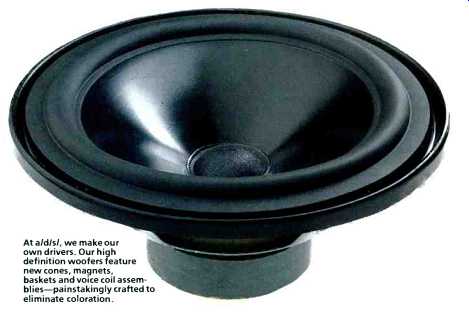
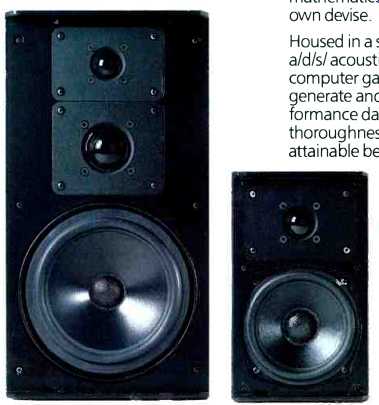
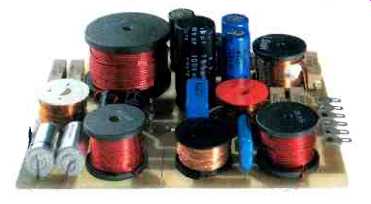
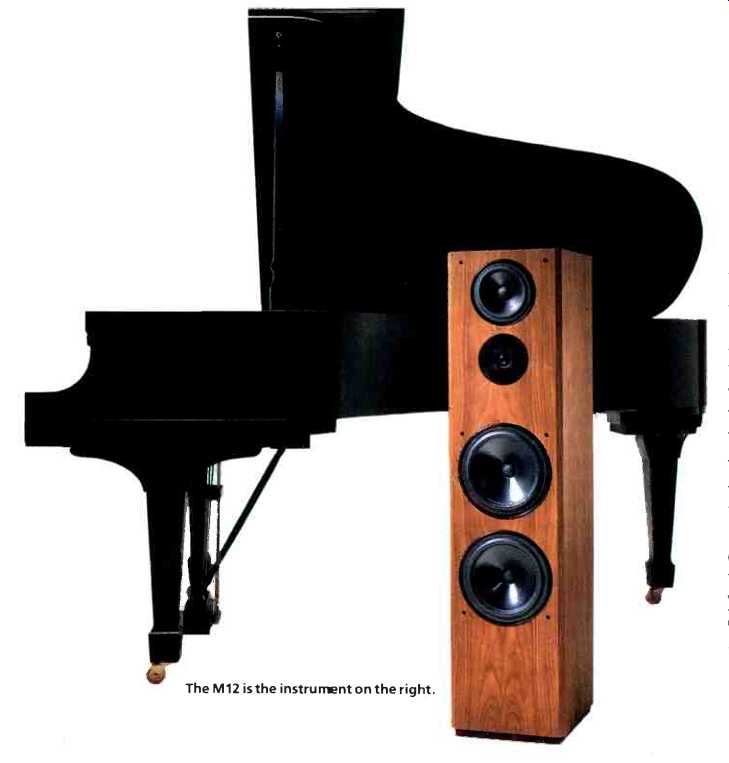

One fact was obvious: the traditional materials used to construct woofers, tweeters and midranges--polypropylene, metal, cellulose compounds--were simply inadequate. So we set about to discover new ones ideally suited at the molecular level to the jobs they're required to do.
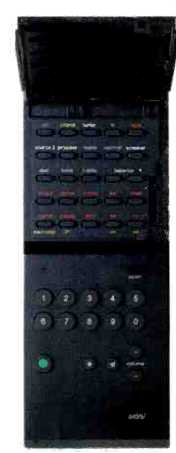
For the domes of our tweeters, we selected a proprietary copolymer that's exceedingly rigid, yet has superb internal damping and freedom from ringing. For the voice coil formers in our midranges, we adopted stainless steel. Strong and non-magnetic, it enabled us to produce a motor quick enough to resolve the finest detail, even at the highest volume level. And so our research went, until our drivers were as perfect as the laws of physics allow.
The crossover network.
You don't see it. You shouldn't hear it, either.
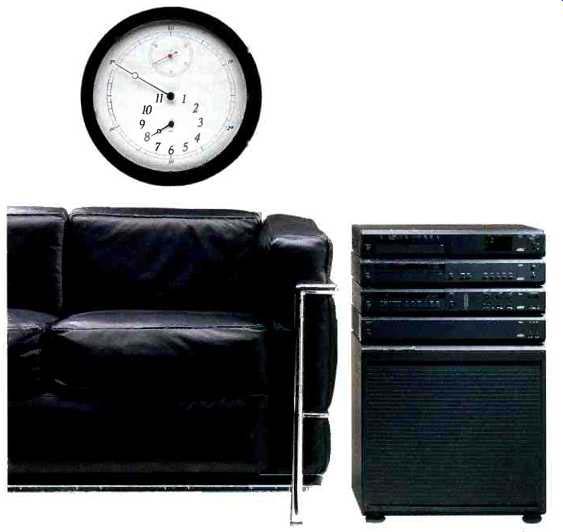
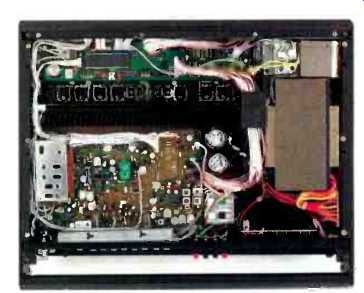

When most speaker makers design crossover networks, their primary concern is the interaction of the drivers. We were more ambitious. We sought crossovers that optimize the relationship between the drivers and their enclosure, even with the room in which the system is played.
And we had an advantage: the excellence of our drivers allowed us to use ideal crossover points.
Using these points, all the fundamental tones of the human voice can be reproduced by a single driver. With the computer, we evaluated countless prototypes of crossovers. A 4th-order network of the Linkwitz-Riley type proved the most appropriate. This type alone yields the response that satisfied our requirements for neutrality and realistic imaging. On a frequency response plot, the crossover points aren't even detectable.
How good it ultimately sounds depends on the box you put it in.
That's why we employed a polymer material filled with an extremely high mass compound to produce the rigid, aurally "invisible" enclosures of our Compact Monitor Series. You'll be amazed by the weight of these little beauties--they're heavy. You'll be floored by the sound.
---With its stainless steel coil former and copolymer cone, the Unisón midrange does something a cone midrange has never done before: span the fundamental range of the human voice-from 200 to 2,000 Hz.
---Our tweeters' domes are made of yet another proprietary copolymer, giving them the unique ability to provide smooth, detailed, high frequency response at even the highest levels.
To our ears, our new speakers--the M Series and compact CM Series-offer convincing proof that Unisón technology does indeed define a new era in speaker performance. All that remains is for you to take ears of your own to one of the dealers listed on the back page of this ad.
As you know, a/d/s/ began life as a speaker company. But it was only a matter of time before our interest in accurate musical reproduction led us to think seriously about the electronic portion of a sound system.
As you can plainly see, the R4's displays are extremely legible and easy-to-read from anywhere within a wide viewing angle.
The unit provides you with full information about its operating status, so you know what you're doing and not flying blind.
What we wondered was whether we could improve upon that which was available at the time.
The results appeared first in this country in 1983.
The R4 gives you true multi-room capabilities, while the RC1 provides the means to control the system no matter what room you're in.
Lean, spare and understated, the Atelier Series was an articulation of our belief that high-grade electronic components needn't look like laboratory instruments. Nor require an engineering degree to coax into operation. Nor surrender to the indignities of planned obsolescence.
That philosophy today finds its expression in the Atelier R4 and its perfectly matched family of components.
A new class of component, as a look under the hood will attest.
At first glance, the R4 may appear to be a receiver. And it's true that the unit functionally incorporates the classic elements of that category of product. But beyond the impressive amplifier, pre-amplifier and tuner sections, the R4 bears about as much resemblance to a receiver as a BMW 735 does to a motor scooter. A look inside will illustrate the point.
We draw your attention first to what you'd least expect to find in a high fidelity product-a computer. Specifically, a microprocessor designed by a/d/s/ to provide a level of functionality never available before. For example, you can program the R4 to automatically turn on any combination of sources within your Atelier system for listening and recording, whether you're at home or off on an extended vacation.
---The R4. Its slim, spare design gives little hint of the technological sophistication and sonic power that reside inside.
When you are at home, you'll appreciate the fact that the R4 can give you access to any source from any room in your house--all by remote control. And when we say control, we mean control.
With the RC1, you can control the nuances of every remote-ready Atelier component in your system--the compact disk player, the cassette deck, the tuner, even Atelier components which have yet to leave the drawing-boards at a/d/s/.
If you're a computer buff, you'll be pleased to know you have the option of controlling Atelier functions by connecting your pc to the RS-232 port in the R4.
With the RC1 remote control unit, you can control every important function of every remote-ready Atelier component. You can do it standing up, sitting down or lying on your back. It issues more than 200 different commands.
Pertinent to the subject of control is the large scale integrated chip that's embedded within the R4's control circuit. This chip makes it possible for you to control volume, bass and treble settings in precise, digital increments-channel to channel, and with none of the variation in levels that are typical of "twirl-knob" systems.
The sonic purity is uncommon because the design is uncommon.
The R4's preamp signal paths are unusually noise free. That's because all circuits have been painstakingly protected from stray radiation by ample amounts of shielding-one of just many steps we've taken to preserve the extremely low distortion of the amplification stages.
As audio purists, we also feel compelled to tell you that the R4's microprocessor exists entirely outside the path of the audio signal. In other words, it keeps to itself, which is as it should be.
The FM portion of the R4 is as impressive as everything else about the unit. Fine-tuning is done in small, digital increments, which results in superb signal acquisition-the best possible, in fact-and eliminates distortion and "fuzzy" reception. Working down the signal chain, we come to the IF amps. Their bandwidth has been carefully designed to yield exceptional selectivity.
Finally, stereo decoding is, in a word, impeccable. The result: optimum stereo separation.
As for the prodigious amount of power the R4 produces for its size, that was accomplished thanks to our use of a proprietary rail-switching technology that automatically and instantaneously increases power for high-energy music transients-well beyond its rated 75 watts per channel.
A glimpse inside reveals how carefully thought-out the R4 is. No space is wasted.
Electronic circuitry, heat sinks, transformers, etc., are all contained within a box that stands only 2 3/4" high.
When you need more power, we have more amplifier. Our PA4 amp provides 150 watts per channel, and nearly double that amount when bridged. Whether you use one or two PA4's in tandem with the R4, operation remains completely automatic.
Moreover, you don't surrender any of your remote control capabilities-a fact that nicely differentiates Atelier from its competitors: One final point deserves to be repeated. When we entered the electronics arena in 1983, our stated goal was to produce superb audio equipment that never became outdated. The R4 is the product of that vision, and it won't.
The Atelier system of electronic components. From top to bottom, the R4, the CD4 compact disk player, the C4 cassette deck and the PA4 power amp. That's even an Atelier storage module they're sitting on.
SUMO---THE NEW BALANCE.
SUMO PRODUCTS GROUP

21300 Superior St., Chatsworth, CA 91311
818/407-2427
ATHENA. The preamplifier is in many ways the most telling component in the audio chain. All too often technical absolutism results in sound quality that is sterile, unappealing, or aggressive. Yet bad lab performance almost always indicates poor sonic integrity. With Athena, Sumo demonstrates a new balance. A preamplifier that is both a stunning performer in the areas of quickness, linearity, and freedom from overload. Yet a warm, faithful, and exciting reproducer of music.
Athena represents the culmination of a major effort at Sumo. As such, it sets new standards for dynamic headroom and freedom from overload. Utilizing high voltage power supply rails, passively linearized circuitry, and a high current toroidal transformer, Athena can faithfully reproduce music at levels far in excess of the peak output of signal sources. As a result, compact discs display dynamic range without high end pain. And complex passages come through intact and unstrained.
Sonic purity in Athena is enhanced both by careful component selection and the exclusive use of pure Class A circuitry Low noise 1% metal film resistors and metalized polypropylene capacitors are used throughout.
Components are mounted on a military grade glass epoxy printed circuit board. And all external connections are made via gold plated input and output jacks. Further, a bypass function allows the user to totally remove the high level section of the preamp from the signal path.
When selected, this provides both direct line-drive for high level sources (such as a CD player), as well as direct phono out.
At various times and for various products, we hear the words powerful, impactful, detailed, delicate, accurate, transparent, smooth, natural and a variety of other flattering adjectives. But one word is repeated more frequently than all the rest, and it is that for which we have strived above all. Musical. Athena is above all gloriously musical.
As with all Sumo products, Athena is designed and manufactured in the United States. Among those select dealers stocking our products are:
AUDIO EXCHANGE
28 West 8th St.
New York, NY 10011
212/982-7191
--------------
THE BALANCE OF POWER.
ANDROMEDA. The need for power is undeniable.
But raw power is not a measure of a great amplifier. At Sumo, we recognized the need but approached the problem in new ways. Andromeda, for example, is a differential amplifier employing a unique full wave balanced bridge output circuit. This provides impressive statistics as well as awesome performance. The power is 200 watts RMS per channel into 8 ohms at less than 0.05% THD. There is no current limiting. As a consequence Andromeda is capable of delivering 80 amp peaks at 1 ohm instantaneously.
Music has definition and detail. Sonic texture is smooth and transparent. Bass is tight, mid-range natural, and highs clean. Instrumental timbre is accurate through the top two octaves. Soundstage is wide, instrument placement consistent. The reviews are consistent too.
Your Sumo dealer will show them to you.
POLARIS. The promise of delicate tube-like performance is part of the allure of MOSFET amplifiers.
But the promise remained largely unfulfilled, until now, because of transconductance error. In Polaris, Sumo employs proprietary active bias output circuitry to correct the problem. Dedicated servo circuitry also reduces crossover notch distortion to levels found in the very best Class A amplifiers. And the elimination of protection circuitry ensures the purest possible reproduction of music.
The power is 100 watts RMS per channel into 8 ohms at 0.05% THD, there is no current limiting. Polaris is a conservatively rated amplifier capable of driving 4 ohm, even 2 ohm, loads comfortably.
Audiophile analog pressings reveal new nuances of sound. Compact Digital discs display dynamic range without high end pain. Loudspeakers are driven to new highs. Subwoofers to new lows. There is finesse for the subtlest shading and power for the most explosive rock-and-roll.
Sumo products are manufactured in the USA. Among the select group of dealers stocking them are:
AUDIO PLUS
6214 So. Dixie Hwy.
Miami, FL 33143
305/662-4971
PREFERRED SOUND
309 Water St.
Charlottesville, VA 22901
804/296-5696
------------
A QUESTION OF BALANCE.
SAMSON. Reproduction of music's bottom-most frequencies is often a moving experience. It can also be the difference between passively listening to music and emotional involvement. But the reproduction of sub 50 Hz fundamentals is a difficult proposition. And as a result most speakers are more shadow than substance at these frequencies.
Sumo's Samson is a groundbreaking product. It is a subwoofer whose development reflects a genuine understanding of the question. It is built around a 15 inch woofer and a massive 181/2 pound magnet assembly. As a result it has the mechanical driving force to be both hair trigger quick and flat to 25 Hz. It also has unparalleled amplifier power. Built in is a dedicated ONE THOUSAND WATT PWM switching amplifier, a revolutionary design that sets new standards for headroom, linearity, efficiency, and speed.
Music, as a result, is reproduced with a new authority.
Electrostatic panels add thunder to their air. And emotion is communicated with an immediacy that is surpassed only by the live experience.
DELILAH. The question becomes one of blend. Of integrating a subwoofer smoothly and unobtrusively into a range of acoustic environments. And of doing so in combination with any number of audio components. To this end Sumo introduces Delilah, a 2-way electronic crossover, and a natural complement to Samson.
Delilah is an expression of both sonic purity and extreme flexibility. It offers a summed mono, as well as stereo bass outputs. It has bridging circuits at each low frequency terminal. And it allows the selection of any of five crossover frequencies.
The result is deep bass without disorientation. More system headroom. Less strain. And the opportunity for emotional involvement in the musical experience.
Sumo products are manufactured in the USA. Among the select group of dealers stocking them are:
JEMSTONE AUDIO
325 Grove St.
East Lansing, MI 48823. 517/332-1230
ATLANTIC STEREO
636 Route 18 E. Brunswick, NJ 08816
201/390-0780
(Audio magazine, Oct. 1987)
Also see: Audio (misc ADs compilation, Jan. 1986)
= = = =